Basilica di San Lorenzo Maggiore: Ancient Mosaics and Roman Columns
The Basilica di San Lorenzo Maggiore is one of the earliest Christian churches in Milan, dating to the late 4th–early 5th century CE. Fronted by 16 ancient Roman columns and housing 4th-century mosaics in the Cappella di Sant'Aquilino, it sits at the heart of the Ticinese neighborhood, a short walk from the Navigli canals.
Quick Facts
- Location
- Corso di Porta Ticinese 35–37, Ticinese, Milan
- Getting There
- Tram line 3 (stop Ticinese Molino delle Armi) and tram 14 stop nearby; short walk from the Duomo and Navigli area
- Time Needed
- 45–90 minutes (longer if you visit the Cappella di Sant'Aquilino)
- Cost
- Basilica free; paid access for the Cappella di Sant'Aquilino (verify exact fee on site)
- Best for
- Early Christian architecture, Roman history, mosaic art, quiet mornings
- Official website
- www.sanlorenzomaggiore.com
Why This Basilica Deserves More Than a Passing Look
The Basilica di San Lorenzo Maggiore does not announce itself the way the Duomo does. There is no ticket line stretching around the block, no velvet ropes, no timed entry. What you get instead is one of the most historically layered religious sites in all of northern Italy, standing quietly on Corso di Porta Ticinese while the city moves around it.
Built between approximately the late 4th and early 5th century CE, this is widely considered one of the earliest Christian churches in Milan. That puts it in the same era as the first great wave of church construction under the Roman emperor Theodosius. The dedication to Saint Lawrence (San Lorenzo) is documented from 590 CE under Lombard rule. When you consider that the building has been here, in some continuous form, for over 1,600 years, the experience of standing inside it changes considerably.
San Lorenzo is not an isolated monument either. It anchors the southern edge of a walking route through the Ticinese neighborhood that connects Roman ruins, medieval churches, and canal-side streets within a few hundred meters of one another. For anyone serious about Milan's architectural history, this is a starting point, not a footnote.
💡 Local tip
The basilica operates split hours: typically 8:00–12:30 and 15:00–18:30 on weekdays, and 9:00–13:00 and 15:00–19:00 on weekends. Arriving just after the afternoon reopening (around 15:30) typically means fewer visitors and calmer light inside. Verify hours locally or by phone (+39 02 89404129) before visiting, as liturgical schedules can affect access.
The Columns Outside: 16 Romans Before You Even Enter
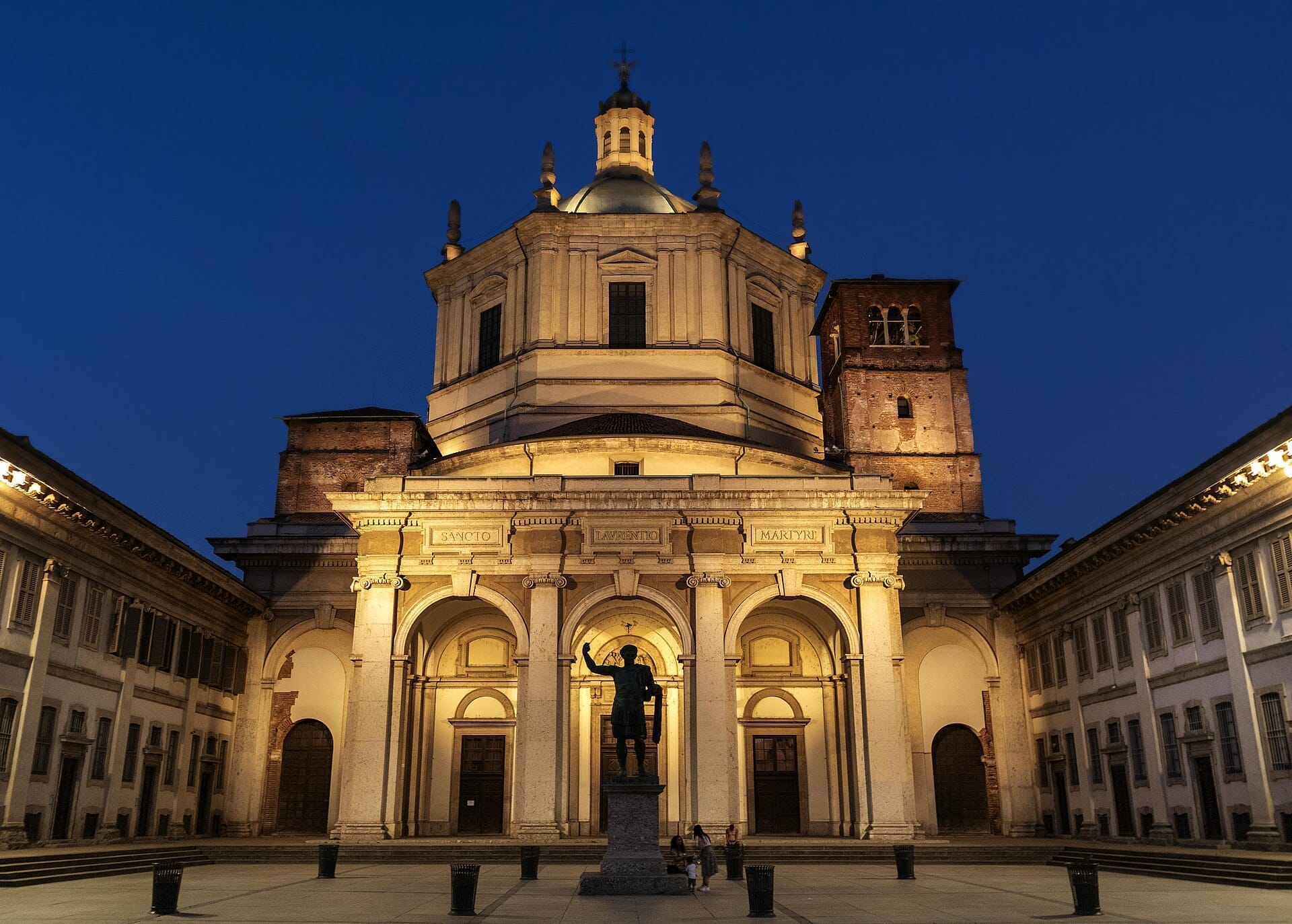
Before you reach the entrance, you pass through what is arguably the most atmospheric open-air space in Milan: the forecourt lined by the Colonne di San Lorenzo, 16 Roman columns with Corinthian capitals, standing in a rough arc that pre-dates the basilica itself. These columns were salvaged from a nearby Roman structure, possibly baths or a public building from the 3rd century CE, and repositioned here when the church was constructed.
In the late afternoon, the columns cast long shadows across the paving stones and the square fills with people sitting on the steps, students from the nearby university, locals cutting through from the Naviglio Grande, tourists pausing to photograph them. The columns themselves are worn smooth in places, the stone warm-toned against the facade behind. At night, they are lit from below and the effect is genuinely striking.
The bronze statue of Emperor Constantine in front of the columns is a modern addition (a copy of the original in Rome), placed here because of Constantine's historical connection to early Christian Milan. It does not date from antiquity, but the pairing with the ancient columns creates a scene that feels more cohesive than accidental.
ℹ️ Good to know
The columns are always accessible (they are in an open public square), so even if you visit when the basilica is closed, the forecourt and the Colonne di San Lorenzo are worth seeing at any hour.
Tickets & tours
Hand-picked options from our booking partner. Prices are indicative; availability and final rates are confirmed when you complete your booking.
Duomo Cathedral private tour with a local guide
From 105 €Instant confirmationFree cancellationSforza Castle entry and self-guided tour
From 15 €Instant confirmationFree cancellationSkip-the-line Duomo tour in Milan
From 40 €Instant confirmationFree cancellationNavigli Canals of Milan private walking tour with a local guide
From 40 €Instant confirmationFree cancellation
Inside the Basilica: Architecture Across Sixteen Centuries
The interior is a central-plan church, which means it reads as a wide, roughly octagonal space rather than the long nave-and-transept layout common in later Gothic or Baroque churches. This reflects its late-antique origins: the quatrefoil plan, with four semicircular apses radiating from a central dome, was a sophisticated Roman design concept adapted for Christian use.
The dome you see today is not the original. The great dome collapsed in 1573 and was rebuilt by architect Martino Bassi, giving the interior its current Renaissance character. The façade dates even later, to 1894, which explains why it looks comparatively plain and formal against the ancient surroundings. This layering of eras, late Roman plan, Renaissance dome, 19th-century facade, is either fascinating or slightly disorienting depending on your tolerance for architectural patchwork.
The basilica reused stones from a nearby Roman amphitheatre as foundational material. If you visit the underground area accessible through the Cappella di Sant'Aquilino, you can actually see some of these original amphitheatre stones. If you visit the underground area accessible through the Cappella di Sant'Aquilino, you can actually see some of these original amphitheatre stones. The church is, in a literal sense, built from the bones of the Roman city.
Morning light enters through the upper windows and illuminates the central space in a way that feels very different from the afternoon, when the interior settles into a cooler, dimmer tone. If you are interested in the architecture for its own sake, morning visits offer better visibility of the structural details. If you simply want a moment of quiet, afternoons work better as foot traffic is lower after the post-lunch reopening.
The Cappella di Sant'Aquilino: Milan's Oldest Mosaics
The most extraordinary thing inside San Lorenzo is not immediately obvious. Through a doorway off the right side of the main space, a small fee gives you access to the Cappella di Sant'Aquilino, a separate 4th-century chapel that is contemporary with the basilica itself and contains some of the oldest surviving mosaics in Milan.
The mosaic fragments that remain, primarily in the apse, depict Christ with apostles in a style that belongs unmistakably to late antiquity: flat, frontal figures, bold outlines, gold-ground tesserae. The preservation is imperfect, sections are missing or restored, but what survives is remarkably rare. These mosaics predate most of what you will find in more famous Italian mosaic destinations outside of Ravenna and Rome.
The chapel also provides access to the underground level, where architectural fragments including those amphitheatre stones are visible. The space is narrow and involves uneven stairs. It is not suitable for visitors with significant mobility limitations, and it can feel cramped when more than a handful of people are inside at once. Go early, or go late in the afternoon.
⚠️ What to skip
The Cappella di Sant'Aquilino has its own hours, which may differ from the main basilica. The underground section involves stairs and irregular surfaces. Visitors with mobility limitations should contact the basilica directly before planning to visit this area.
The Surrounding Area: What Else Is Within Walking Distance
The location of San Lorenzo is one of its genuine advantages. The Colonne di San Lorenzo forecourt opens directly onto Corso di Porta Ticinese, one of the most characterful streets in the city, lined with independent shops, bars, and occasional market stalls. From here, the Navigli canal area is an easy walk south.
Going north along Corso di Porta Ticinese takes you toward the Basilica di Sant'Eustorgio, another early Christian church with its own historically significant chapel, and eventually to the medieval Porta Ticinese gates. The entire route is walkable in under 20 minutes and represents one of the densest concentrations of pre-medieval heritage in Milan.
The Parco delle Basiliche, a long green strip running between San Lorenzo and Sant'Eustorgio, offers a decent place to sit between visits, though it is more a functional urban park than a destination in its own right. The area around Piazza Vetra, directly behind San Lorenzo, is quieter than the main street side and has a slightly different, more residential character.
Practical Walkthrough: What to Expect on Arrival
There is no formal entrance queue. You walk across the piazza, past or through the columns, and into the church through the main door. The interior is free of charge. Staff are present but this is an active place of worship, so the atmosphere is quieter than a typical museum: no recorded audio tours playing, no organized crowd flow.
Dress code applies as in any Italian church: shoulders and knees should be covered. The interior is cool even in summer, which is a relief in July and August when Corso di Porta Ticinese gets oppressively hot. Carry a light layer if you tend to feel the cold.
Photography inside is generally permitted for personal use, but without flash, and with attention to worshippers. The mosaics in the Cappella di Sant'Aquilino are best photographed with a slightly boosted ISO rather than flash, as the space is small and flash washes out the gold tesserae entirely. A wide-angle lens or a phone with a good low-light mode works well for the main octagonal space.
If you are planning a full day in this part of Milan, consider pairing San Lorenzo with the broader circuit of Milanese churches, several of which are within walking distance and free to enter. The concentration of early Christian heritage in Ticinese is unmatched anywhere else in the city.
Insider Tips
- The Cappella di Sant'Aquilino is the single most important reason to visit, but many visitors walk past the entrance door without realizing it exists. It is set into the right-hand wall of the main basilica and marked by a modest sign. Ask at the entrance if you cannot find it.
- The forecourt columns are much more photogenic at golden hour than in the middle of the day. If you arrive around 17:00–18:00 in spring or summer, the low sun hits the Corinthian capitals directly and the contrast against the stone is excellent.
- San Lorenzo sits at the edge of one of Milan's more social outdoor evening spots. By 18:00 on weekday evenings, the steps around the columns fill with locals. If you want the columns to yourself for photographs, arrive before 9:00 in the morning.
- The underground level beneath the Cappella di Sant'Aquilino contains visible fragments of the Roman amphitheatre that was dismantled to build this church. Most visitors do not know this section exists. It is small and worth the few minutes it takes.
- If the basilica is closed when you arrive (it operates split hours with a midday break), the walk around the exterior perimeter including the apse views from Piazza Vetra takes about 15 minutes and reveals details of the building's original form that are not visible from the front.
Who Is Basilica di San Lorenzo Maggiore For?
- Travelers interested in Roman and early Christian history who want context beyond the medieval and Renaissance
- Architecture enthusiasts tracking Milan's building history from antiquity through the 16th century
- Visitors looking for significant heritage sites that are free to enter and not overwhelmed by crowds
- Photographers seeking atmospheric evening shots with ancient columns and street life
- Anyone building an itinerary around the Ticinese neighborhood and the Navigli canals
Nearby Attractions
Other things to see while in Ticinese & Sant'Ambrogio:
- Basilica di Sant'Ambrogio
Founded by Saint Ambrose himself in 379 AD and rebuilt in the 11th century as a masterpiece of Lombard Romanesque architecture, the Basilica di Sant'Ambrogio is the spiritual and historical anchor of Milan. Entry to the church is free, and the complex rewards slow, attentive visitors far more than a quick stop.
- Basilica di Sant'Eustorgio
The Basilica di Sant'Eustorgio is one of Milan's most historically layered sacred sites, combining a paleochristian necropolis, a Renaissance chapel of rare refinement, and a 12th-century Romanesque nave into a single compact complex. Located on Piazza Sant'Eustorgio in the Ticinese quarter, it rewards visitors who look past the plain brick facade to discover what lies beneath and behind it.
- Cenacolo Vinciano (The Last Supper)
Leonardo da Vinci's Last Supper survives on the refectory wall of Santa Maria delle Grazie, a 460 x 880 cm tempera mural painted between 1495 and 1498. Visits are strictly limited to 15 minutes per group of 40, and tickets require advance reservation. This guide covers everything you need to know before you go.
- Chiesa di San Maurizio al Monastero Maggiore
Built in 1503 on Corso Magenta, the Chiesa di San Maurizio al Monastero Maggiore holds more than 4,000 square metres of Renaissance frescoes across its painted interior walls. Entry is free, crowds are modest, and the experience rewards slow attention.