Colonne di San Lorenzo: Milan's Roman Columns and the Square That Never Sleeps
Standing in front of the Basilica di San Lorenzo Maggiore along Corso di Porta Ticinese, the Colonne di San Lorenzo are sixteen marble Corinthian columns dating to the 2nd century AD. Free to visit at any hour, this outdoor monument is one of Milan's most surprising encounters: ancient Rome in the middle of a lively neighborhood square.
Quick Facts
- Location
- Corso di Porta Ticinese, in front of Basilica di San Lorenzo Maggiore, Ticinese, Milan
- Getting There
- Tram 3 and 15, Bus 94 (stops near the columns); 15-minute walk from Duomo via Via Torino
- Time Needed
- 20–40 minutes for the columns; longer if you combine with the basilica or continue to Navigli
- Cost
- Free. No tickets, no barriers, open public space at all hours
- Best for
- History lovers, evening strollers, architecture enthusiasts, photography
- Official website
- www.sanlorenzomaggiore.com
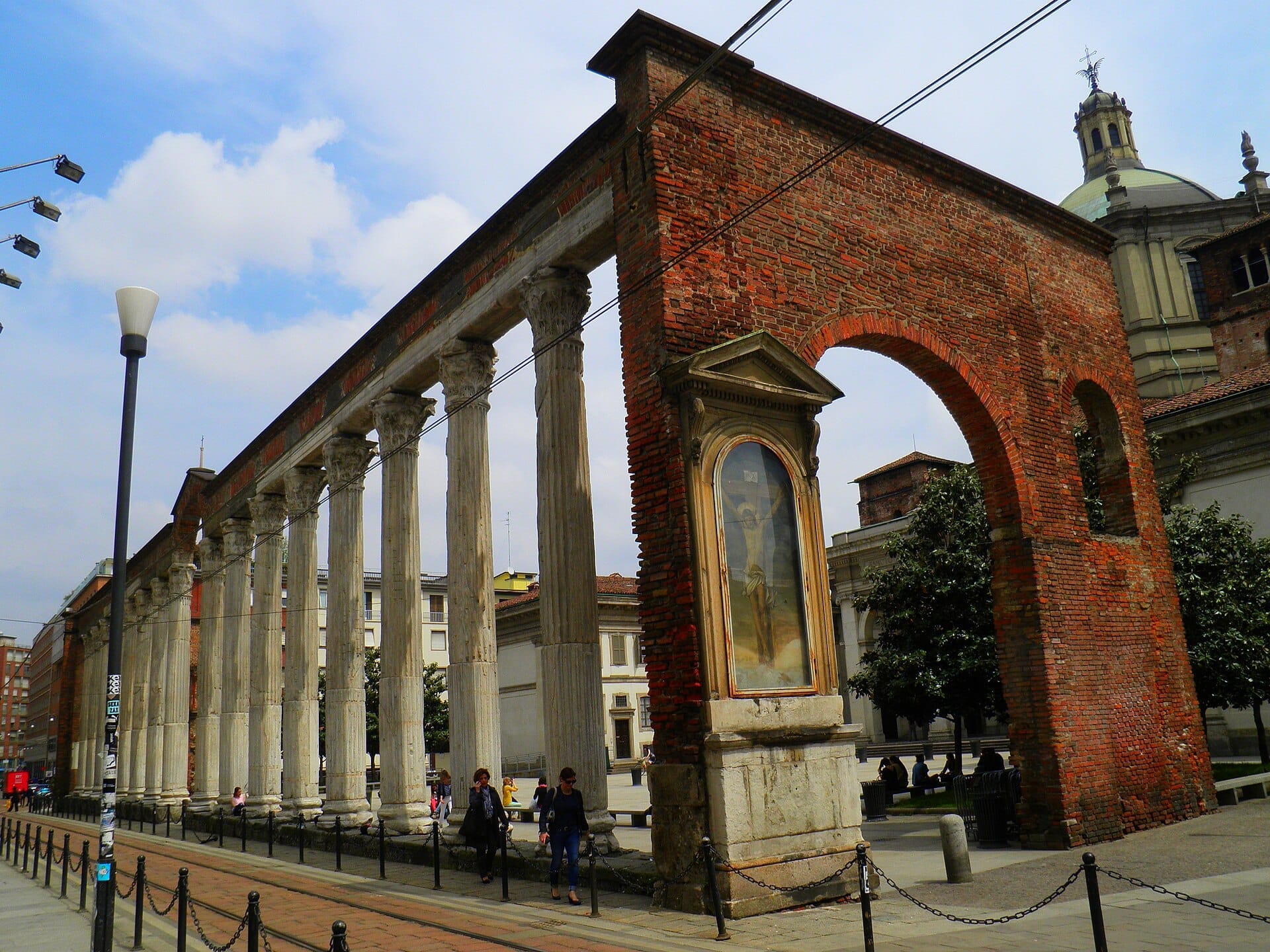
What You're Looking At: Sixteen Columns from Ancient Rome
The Colonne di San Lorenzo are the oldest Roman monument still standing in Milan, and they stop people mid-stride every time. Sixteen Corinthian columns, each rising around 8 metres, cut from pale marble and crowned with capitals that still carry their original carved detail. They stand in a loose semicircle on a raised platform in front of the Basilica di San Lorenzo Maggiore, connected by a section of entablature and a later medieval arch fitted with a cross. The overall effect is somewhere between ruin and architectural statement: clearly ancient, clearly deliberate.
The columns themselves almost certainly predate the basilica. They were likely quarried and carved in the late Roman period, probably in the 2nd–3rd century AD, as part of a monumental Roman building. The leading theory places them as elements of a large thermal bath complex or temple, though the original structure no longer exists above ground. When the Basilica di San Lorenzo Maggiore was constructed in late antiquity, the columns were reused in front of the church as a monumental forecourt. This kind of deliberate reuse of Roman material was common in late antiquity, but sixteen columns assembled into a coherent colonnade at this scale is unusual outside Rome itself.
ℹ️ Good to know
The bronze statue standing in the square is Emperor Constantine, placed here in 1937. It is a copy of the original from the Lateran complex in Rome. Constantine's association with San Lorenzo is historically significant: he issued the Edict of Milan in 313 AD, granting religious tolerance across the Roman Empire.
The Square Through the Day: Morning Calm to Late-Night Gathering
Arrive before 9am and the piazza is almost entirely yours. The marble columns catch early light cleanly, with long shadows crossing the pavement and almost no foot traffic between you and the stone. The surrounding cafés are just opening; a few locals cut through on their way to work. This is the best time for photographs: soft light, no crowds, and the pale marble of the columns against the red-brick facade of the basilica behind them creates a genuinely striking image. The air at this hour carries the faint smell of espresso from nearby bars and occasionally the yeasty warmth of a panetteria opening its doors.
By mid-morning the square fills with a steady mix of tourists reading about the columns and residents sitting on the steps of the platform. Corso di Porta Ticinese is a serious shopping and pedestrian street, and foot traffic builds quickly on weekdays. The columns do not feel overwhelmed by this, partly because the open space around them is generous, but in the 10am to 1pm window expect to share the space and work around other visitors for any wide-angle photography.
The evening is when this square transforms. From around 6pm onwards, and especially from spring through to early autumn, young Milanese treat the steps and surrounding pavement as an outdoor living room. Bottles of wine from nearby shops appear, music plays from phone speakers, conversations happen in Italian and several other languages. The columns, lit from below after dark, take on a theatrical quality: white marble columns glowing against the night sky, a 2nd-century AD structure serving as backdrop for a contemporary urban scene. It is one of the more unusual juxtapositions Milan offers, and it is completely free.
💡 Local tip
If you visit in the evening, the narrow streets of the Ticinese neighborhood behind the basilica are lined with aperitivo bars. The colonnade is a natural starting point for an evening that continues into the Navigli canal district, roughly 10 minutes on foot to the south.
Tickets & tours
Hand-picked options from our booking partner. Prices are indicative; availability and final rates are confirmed when you complete your booking.
Duomo Cathedral private tour with a local guide
From 105 €Instant confirmationFree cancellationSforza Castle entry and self-guided tour
From 15 €Instant confirmationFree cancellationSkip-the-line Duomo tour in Milan
From 40 €Instant confirmationFree cancellationNavigli Canals of Milan private walking tour with a local guide
From 40 €Instant confirmationFree cancellation
Architecture and Historical Context
Milan was the Roman city of Mediolanum, a significant administrative center and at one point the de facto capital of the Western Roman Empire. The Colonne di San Lorenzo are one of the most legible traces of that city's scale and ambition. The columns themselves are cut from marble, likely quarried in northern Italy, which was a standard material for high-status Roman construction in the region. The Corinthian capitals remain intact on most of the columns, which is noteworthy given their age and the number of times they have been moved, adapted, and built around.
The basilica they front, the Basilica di San Lorenzo Maggiore, is itself one of the oldest Christian churches in Milan, built in the late 4th century AD and significantly modified in the centuries that followed. The connection between the colonnade and the basilica is architectural as much as historical: the columns form a propylon, a formal entrance forecourt, that gives the church a processional approach. The medieval brick additions, including the arch and cross visible in the center of the colonnade, represent a later medieval reworking that layered Christian symbolism onto the Roman structure.
For a broader picture of how Milan's Roman and early Christian layers connect, the Milan architecture guide covers the city's architectural timeline from antiquity to the present day.
Getting There and Moving Through the Area
The columns are at the northern end of Corso di Porta Ticinese, which runs roughly south from the city center toward the Navigli canal district. The most direct walking route from Piazza Duomo follows Via Torino south and feeds naturally into Corso di Porta Ticinese; the walk takes about 15 minutes and passes through a genuine neighborhood street rather than a tourist corridor, with independent clothing shops, bookstores, and bars on both sides.
By public transport, tram 3 and tram 15 both stop near the columns on Corso di Porta Ticinese, and tram 2 serves the same corridor. There is no metro station directly adjacent, but the location is easily walkable from the Duomo area. The columns also sit at a natural midpoint for anyone walking between the Duomo district and the Navigli canal district, making them a logical stop rather than a detour.
The square itself is on street level and paved throughout, but the paving in some sections is uneven historic stone. Wheelchair users can access the open area around the columns without difficulty, though the raised platform directly at the base of the columns involves a step. There are no barriers, signs, or ticket infrastructure of any kind: this is simply a public urban space.
Photography: What Works and What Doesn't
The columns face roughly east, which means morning light falls on the front face directly and late afternoon light hits them at an angle from the side, emphasizing the texture of the Musso marble. Midday light in summer flattens the columns and creates hard shadows in the capitals. For architecture photography, early morning or the hour before sunset are strongly preferable. After dark, the artificial uplighting creates sharp contrast between the pale marble and the black sky, which works well for telephoto compression shots but makes wide-angle frames look more dramatic than accurate.
The bronze Constantine statue in the foreground complicates wide shots but provides a useful compositional anchor for medium-format frames that want to emphasize the Roman layering: empire, Christianity, and modern city all in one frame. From the opposite side of Corso di Porta Ticinese, a slightly elevated position near the tram stop gives a full-width view of all sixteen columns with the basilica dome visible above.
⚠️ What to skip
Weekend evenings in warm weather can be very crowded. The square becomes a social gathering point from around 7pm onwards. If you want a calm, unobstructed visit, aim for a weekday morning. The site is free and permanent, so there is never pressure to visit at any particular time.
What Else Is Nearby
Directly behind the colonnade, the Basilica di San Lorenzo Maggiore is worth entering: its octagonal interior from late antiquity, the 5th-century Cappella di Sant'Aquilino with original mosaics, and the scale of the original building make it one of Milan's most important early Christian sites. The Basilica di Sant'Eustorgio is a short walk further south along Corso di Porta Ticinese, with the Cappella Portinari considered one of the finest examples of early Renaissance art in Lombardy.
A few minutes north along the same road stands the medieval Porta Ticinese, a surviving city gate that gives the street its name. And for those continuing south, the Naviglio Grande canal is about a 10-minute walk, with its canal-side bars, restaurants, and the Darsena basin nearby. This corridor from the Duomo through the columns to the Navigli is one of the most rewarding walking routes in Milan for connecting historic and contemporary layers of the city.
If you are planning a broader itinerary, the Milan churches guide covers the full range of significant religious buildings across the city, many of which are in the same Ticinese and Sant'Ambrogio neighborhoods.
Setting Expectations
The Colonne di San Lorenzo are not a self-contained attraction in the way that a museum or a ticketed monument is. There is no interpretive signage to speak of, no guided tour infrastructure, and the surrounding square is a functioning public space rather than a curated visitor experience. If you come expecting a quiet archaeological site with explanatory panels, you will find something different.
What the columns actually offer is something rarer: a remarkably ancient structure embedded in daily city life, unrestricted and completely free, with a social atmosphere that changes by hour and season. For travelers with any interest in Roman history, early Christian architecture, or simply in how cities carry their past, the columns are worth the walk. They take ten minutes to look at properly, or an hour if you sit and watch how the square operates. Either way, they cost nothing and require no planning.
Travelers who prefer clearly structured heritage sites with interpretive context, gift shops, and timed entry may find the experience underwhelming. The columns reward curiosity and independent knowledge more than passive sightseeing.
Insider Tips
- The steps at the base of the colonnade platform are where locals gather for aperitivo on warm evenings. If you want to join in, pick up a bottle of wine or a can of something cold from one of the small alimentari shops on Corso di Porta Ticinese before arriving.
- To enter the Cappella di Sant'Aquilino inside the Basilica di San Lorenzo Maggiore, there is usually an admission fee. The 4th-century mosaics inside are in remarkably good condition and directly relevant to understanding why the columns were placed here in the first place.
- Tram 3 runs along Corso di Porta Ticinese and gives a useful overhead view of the colonnade as you approach from the Duomo direction. If you take the tram rather than walking, you get a brief elevated perspective on the columns that is difficult to replicate on foot.
- The columns look their best in overcast light, which softens the shadows in the Corinthian capitals and reveals the texture of the Musso marble. Clear midday sun in summer can wash out the detail significantly.
- The Porta Ticinese medieval gate, a few minutes north of the columns, is almost always overlooked by visitors focused on reaching the colonnade. It is free to walk through and worth a pause for the scale of the 14th-century brick construction.
Who Is Colonne di San Lorenzo For?
- History and archaeology enthusiasts wanting to see Milan's Roman past in context
- Architects and design travelers interested in the reuse of ancient material across centuries
- Evening walkers and aperitivo seekers using the columns as a starting point for a Navigli night out
- Photographers working the early morning light before the city crowds arrive
- Anyone walking the Duomo-to-Navigli corridor who wants a natural and meaningful stopping point
Nearby Attractions
Other things to see while in Ticinese & Sant'Ambrogio:
- Basilica di San Lorenzo Maggiore
The Basilica di San Lorenzo Maggiore is one of the earliest Christian churches in Milan, dating to the late 4th–early 5th century CE. Fronted by 16 ancient Roman columns and housing 4th-century mosaics in the Cappella di Sant'Aquilino, it sits at the heart of the Ticinese neighborhood, a short walk from the Navigli canals.
- Basilica di Sant'Ambrogio
Founded by Saint Ambrose himself in 379 AD and rebuilt in the 11th century as a masterpiece of Lombard Romanesque architecture, the Basilica di Sant'Ambrogio is the spiritual and historical anchor of Milan. Entry to the church is free, and the complex rewards slow, attentive visitors far more than a quick stop.
- Basilica di Sant'Eustorgio
The Basilica di Sant'Eustorgio is one of Milan's most historically layered sacred sites, combining a paleochristian necropolis, a Renaissance chapel of rare refinement, and a 12th-century Romanesque nave into a single compact complex. Located on Piazza Sant'Eustorgio in the Ticinese quarter, it rewards visitors who look past the plain brick facade to discover what lies beneath and behind it.
- Cenacolo Vinciano (The Last Supper)
Leonardo da Vinci's Last Supper survives on the refectory wall of Santa Maria delle Grazie, a 460 x 880 cm tempera mural painted between 1495 and 1498. Visits are strictly limited to 15 minutes per group of 40, and tickets require advance reservation. This guide covers everything you need to know before you go.