Leonardo's Last Supper (Cenacolo Vinciano): The Complete Visitor Guide
Leonardo da Vinci's Last Supper survives on the refectory wall of Santa Maria delle Grazie, a 460 x 880 cm tempera mural painted between 1495 and 1498. Visits are strictly limited to 15 minutes per group of 40, and tickets require advance reservation. This guide covers everything you need to know before you go.
Quick Facts
- Location
- Piazza Santa Maria delle Grazie, 20123 Milan — refectory of the former Dominican convent
- Getting There
- Metro Conciliazione (M1 red line), then a short walk east along Corso Magenta
- Time Needed
- Allow 30–60 min total: 15 min inside the refectory plus queuing and security time
- Cost
- €15 standard; €2 reduced (EU citizens 18–25). Verify current prices at cenacolovinciano.org
- Best for
- Art history enthusiasts, Renaissance scholars, first-time Milan visitors, cultural travelers
- Official website
- cenacolovinciano.org/en
What You Are Actually Going to See
The Cenacolo Vinciano, better known internationally as Leonardo's Last Supper, is not a painting in the conventional sense. Leonardo chose to work in tempera on gesso, pitch, and mastic applied to a dry plastered wall rather than in traditional fresco, which would have required him to paint quickly onto wet plaster. That decision gave him extraordinary control over detail and tone. It also meant the work began deteriorating within decades of completion. What you see today, measuring 460 cm by 880 cm across the north wall of the former refectory of Santa Maria delle Grazie, is the product of that original genius, centuries of damage, and a meticulous restoration completed in 1999.
The scale surprises almost every visitor. Photographs compress it. Standing in the refectory, you realize the figures are slightly larger than life size, and that Leonardo constructed a perspective system where the painted ceiling beams appear to continue the actual ceiling above you, pulling the scene into the same spatial world as the room you occupy. Christ sits at the exact vanishing point. The composition is not a calm tableau: Leonardo captured the precise moment Christ announced that one of the apostles would betray him, and the twelve figures respond in four psychological groups of three, each reaction distinct and readable across the room.
⚠️ What to skip
Tickets sell out weeks, sometimes months, in advance. The booking system on the official site (cenacolovinciano.org via Vivaticket) releases additional slots weekly on Wednesdays at 12:00 p.m. If you arrive in Milan without a ticket, your realistic options are a tour operator that includes Last Supper access or a same-day cancellation — neither is guaranteed. Book before you travel.
The 15-Minute Visit: What Actually Happens
The controlled entry system exists to protect the work. The refectory is kept at a constant temperature and humidity, and every group passes through a series of antechambers where air is filtered before entering. You will wait in a glass-walled anteroom, then another, then the doors open and you have 15 minutes. The group maximum is 40 people. In practice, most slots have fewer visitors, but peak summer dates fill completely.
Inside, there is no audio guide playing through speakers and no commentary unless you have booked a guided visit. The room is quiet except for muffled footsteps and low voices. Rangers are present but unobtrusive. Photography without flash is permitted. The lighting is controlled and consistent: the mural is evenly illuminated, which helps you read detail across the full width. Spend the first few moments adjusting to the scale, then move your attention across the groups of apostles from left to right. The agitation in Thomas's raised finger, the anguish in Philip pressing his hands to his chest, Judas pulling back and clutching a small bag — these are clearest when you stand slightly to one side rather than dead center.
Large bags and umbrellas cannot be taken into the refectory. Lockers are available at the entrance. Plan to arrive five to ten minutes before your slot; late arrivals are not admitted.
Tickets & tours
Hand-picked options from our booking partner. Prices are indicative; availability and final rates are confirmed when you complete your booking.
Guided Tour of Leonardo da Vinci's Last Supper in Milan
From 75 €Instant confirmationFree cancellationMilan Last Supper Guided Tour with Skip the Line Tickets
From 85 €Instant confirmationFree cancellationLast Supper and Milan Cathedral semi-private tour
From 150 €Instant confirmationFree cancellationLeonardo da Vinci's Last Supper Guided Tour in Milan
From 0 €Instant confirmation
Historical and Artistic Context
Leonardo worked on the mural between approximately 1495 and 1498, commissioned by Ludovico Sforza, Duke of Milan, for the Dominican convent attached to Santa Maria delle Grazie. The church itself was already a prestigious Sforza project, and the refectory commission placed Leonardo's work at the literal center of monastic daily life: the monks ate their meals facing the mural, so the Last Supper functioned as a perpetual visual meditation on sacrifice and community.
The opposite wall of the refectory holds a large Crucifixion fresco by Giovanni Donato da Montorfano, dated 1495. It is easy to overlook in the presence of Leonardo's work, but it is worth a look: Ludovico Sforza and his family appear in the lower corners, painted by a different hand. The contrast between Montorfano's conventional fresco technique and Leonardo's experimental approach is visible even to a non-specialist.
The building survived World War II bombing only partially. Allied air raids in August 1943 destroyed much of the convent and left the refectory roofless for years, exposed to the elements. The mural survived because the wall it was painted on remained standing, and because protective sandbags had been stacked against it. For the full story of Milan's art under da Vinci's influence, the Milan Leonardo da Vinci guide covers the wider network of sites connected to his years in the city.
Getting There and Arrival
The museum sits on Piazza Santa Maria delle Grazie, off Corso Magenta, in the Ticinese / Sant'Ambrogio area. The museum sits on Piazza Santa Maria delle Grazie, off Corso Magenta, in the Sant'Ambrogio area. From Metro Conciliazione (served by the M1 red line), the walk takes around ten minutes, heading east along Corso Magenta. Several tram lines on Corso Magenta also stop close to the museum entrance. The street is flat, shaded in places, and passes through a quiet residential and institutional stretch of the city that feels noticeably different from the commercial center near the Duomo. Several tram lines on Corso Magenta also stop close to the museum entrance.
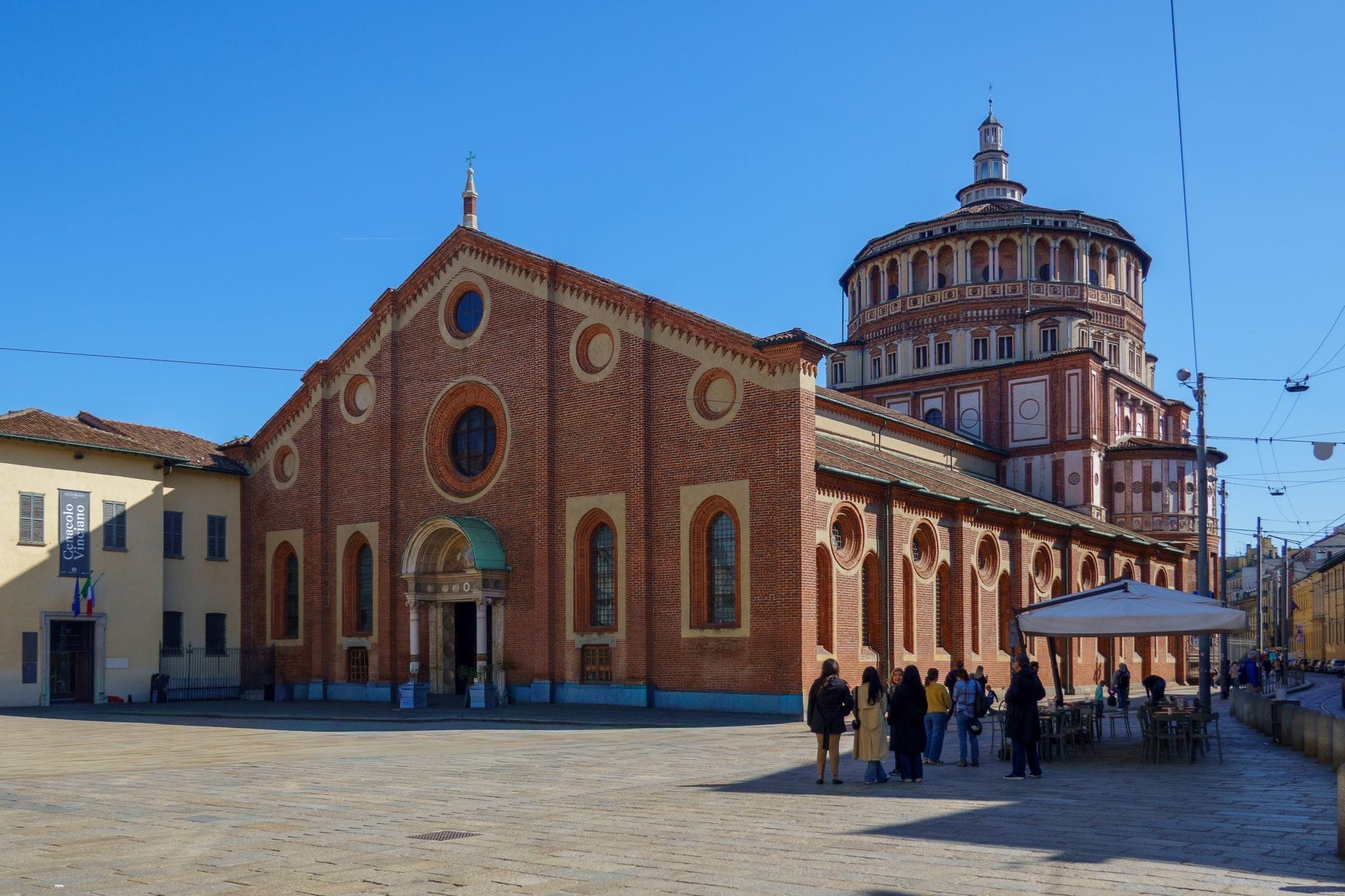
The museum entrance is through the convent complex, set slightly back from the main road. The church of Santa Maria delle Grazie stands immediately adjacent. If you have time before or after your slot, the church interior is free to enter and architecturally significant: the tribune added by Bramante for Ludovico Sforza in the 1490s is one of the finest examples of early Renaissance architecture in Milan.
💡 Local tip
Tram lines on Corso Magenta stop very close to Santa Maria delle Grazie, making them a convenient alternative to the metro if you are coming from the Duomo area or the Navigli.
How Experience Changes by Time of Day
The refectory is artificially lit and climate-controlled, so natural light conditions outside have no bearing on what you see inside. What does vary is the feel of the surrounding neighborhood and the logistics of arrival. Early morning visits, starting at 8:15 am, are the quietest in terms of foot traffic on Corso Magenta and at the entrance. The piazza in front of the church is peaceful at that hour, the stone cool, and the line at the entrance door short. Midday slots coincide with tour groups and school visits, which can make the anteroom louder and the wait more crowded, even though the 40-person limit keeps the refectory itself manageable.
Late afternoon slots, from around 5:00 pm onward, catch the surrounding streets in a warmer light. The neighborhood becomes more active with local foot traffic, and the church often has fewer visitors. If you plan to combine the Last Supper with the nearby Basilica di Sant'Ambrogio or a walk toward the Navigli canals, an afternoon slot allows a natural flow into the evening without backtracking.
Who This Visit Is and Is Not For
For anyone with a serious interest in Renaissance art, Italian history, or Leonardo specifically, this is one of the most consequential single works you can stand in front of anywhere in Italy. The 15-minute limit is genuinely enough time if you arrive knowing what you are looking at. Pair it with the Museo Nazionale della Scienza e della Tecnologia Leonardo da Vinci, a ten-minute walk away, for a full Leonardo-focused half-day.
Travelers who prefer spontaneous, walk-in experiences will find the booking requirement frustrating. The 15-minute slot is undeniably short, and if you have not read anything about the work beforehand, you may find yourself spending much of it simply orienting to the space. It is worth doing some preparation: even a brief read about the apostle groupings and Leonardo's perspective system will transform what you take away. Visitors who are not particularly interested in painting and are going mainly to say they have been there are likely to find the tightly controlled experience underwhelming compared with a larger, more freely explorable museum.
Families with young children should consider whether the 15-minute limit, the strict silence expected inside, and the lack of interactive elements suit their visit. Milan has excellent museums with broader family appeal, including the family-friendly options covered in our Milan with kids guide.
Accessibility
The museum provides access for visitors with disabilities, including dedicated booking options through the official site. The refectory is on the ground floor and accessible without stairs. If you have specific accessibility requirements, it is worth contacting the museum directly via the official website before booking to confirm current arrangements, as protocols can change.
Insider Tips
- Book your slot the moment you know your Milan travel dates. The Vivaticket system releases new slots at midnight, and popular weekend and summer dates can fill within hours. Three to four weeks in advance is the minimum; six to eight weeks is safer.
- The opposite wall of the refectory holds Giovanni Donato da Montorfano's 1495 Crucifixion fresco with portraits of the Sforza family. Most visitors ignore it entirely while fixating on Leonardo's wall, but it rewards a few moments of attention and makes the room feel complete.
- If tickets are sold out, look into tour operators that hold reserved allocations — they often carry a premium over the face value, but they are a legitimate route when direct tickets are unavailable.
- Arrive at least ten minutes before your entry slot. The airlock antechamber sequence takes time, and late arrivals are not admitted without exception. Missing your slot means losing your ticket.
- The church of Santa Maria delle Grazie next door is free to enter and contains Bramante's spectacular tribune, commissioned by Ludovico Sforza in the 1490s. Almost no one goes in. Spend ten minutes there before or after your slot.
Who Is Cenacolo Vinciano (The Last Supper) For?
- Art history and Renaissance enthusiasts who want to stand in front of one of the defining works of Western painting
- First-time Milan visitors building an itinerary around the city's major cultural landmarks
- Travelers following Leonardo da Vinci's years in Milan, combined with related sites along Corso Magenta
- Couples or small groups looking for a focused, high-impact cultural experience rather than a sprawling museum visit
- Photographers working in low light, as flash is prohibited and the controlled illumination rewards careful manual settings
Nearby Attractions
Other things to see while in Ticinese & Sant'Ambrogio:
- Basilica di San Lorenzo Maggiore
The Basilica di San Lorenzo Maggiore is one of the earliest Christian churches in Milan, dating to the late 4th–early 5th century CE. Fronted by 16 ancient Roman columns and housing 4th-century mosaics in the Cappella di Sant'Aquilino, it sits at the heart of the Ticinese neighborhood, a short walk from the Navigli canals.
- Basilica di Sant'Ambrogio
Founded by Saint Ambrose himself in 379 AD and rebuilt in the 11th century as a masterpiece of Lombard Romanesque architecture, the Basilica di Sant'Ambrogio is the spiritual and historical anchor of Milan. Entry to the church is free, and the complex rewards slow, attentive visitors far more than a quick stop.
- Basilica di Sant'Eustorgio
The Basilica di Sant'Eustorgio is one of Milan's most historically layered sacred sites, combining a paleochristian necropolis, a Renaissance chapel of rare refinement, and a 12th-century Romanesque nave into a single compact complex. Located on Piazza Sant'Eustorgio in the Ticinese quarter, it rewards visitors who look past the plain brick facade to discover what lies beneath and behind it.
- Chiesa di San Maurizio al Monastero Maggiore
Built in 1503 on Corso Magenta, the Chiesa di San Maurizio al Monastero Maggiore holds more than 4,000 square metres of Renaissance frescoes across its painted interior walls. Entry is free, crowds are modest, and the experience rewards slow attention.