Museo Nazionale della Scienza e della Tecnologia Leonardo da Vinci: Milan's Science Giant
Housed in a 16th-century Olivetan monastery in the Ticinese-Sant'Ambrogio quarter, the Museo Nazionale della Scienza e della Tecnologia Leonardo da Vinci is Italy's largest science and technology museum. Across roughly 50,000 square metres, it holds everything from Leonardo's mechanical drawings to a full-size submarine you can board — a serious half-day commitment that rewards curious visitors of almost any age.
Quick Facts
- Location
- Via San Vittore 21, 20123 Milan (Ticinese-Sant'Ambrogio)
- Getting There
- Metro M2 Sant'Ambrogio (5-min walk); trams 14 & 19 on Via Carducci; buses 58 & 94
- Time Needed
- 3–4 hours minimum; a full day for families
- Cost
- From approx. €10 for adults (verify current rates at museoscienza.org)
- Best for
- Families, science enthusiasts, Leonardo da Vinci fans, design & architecture lovers
- Official website
- www.museoscienza.org
What the Museum Actually Is
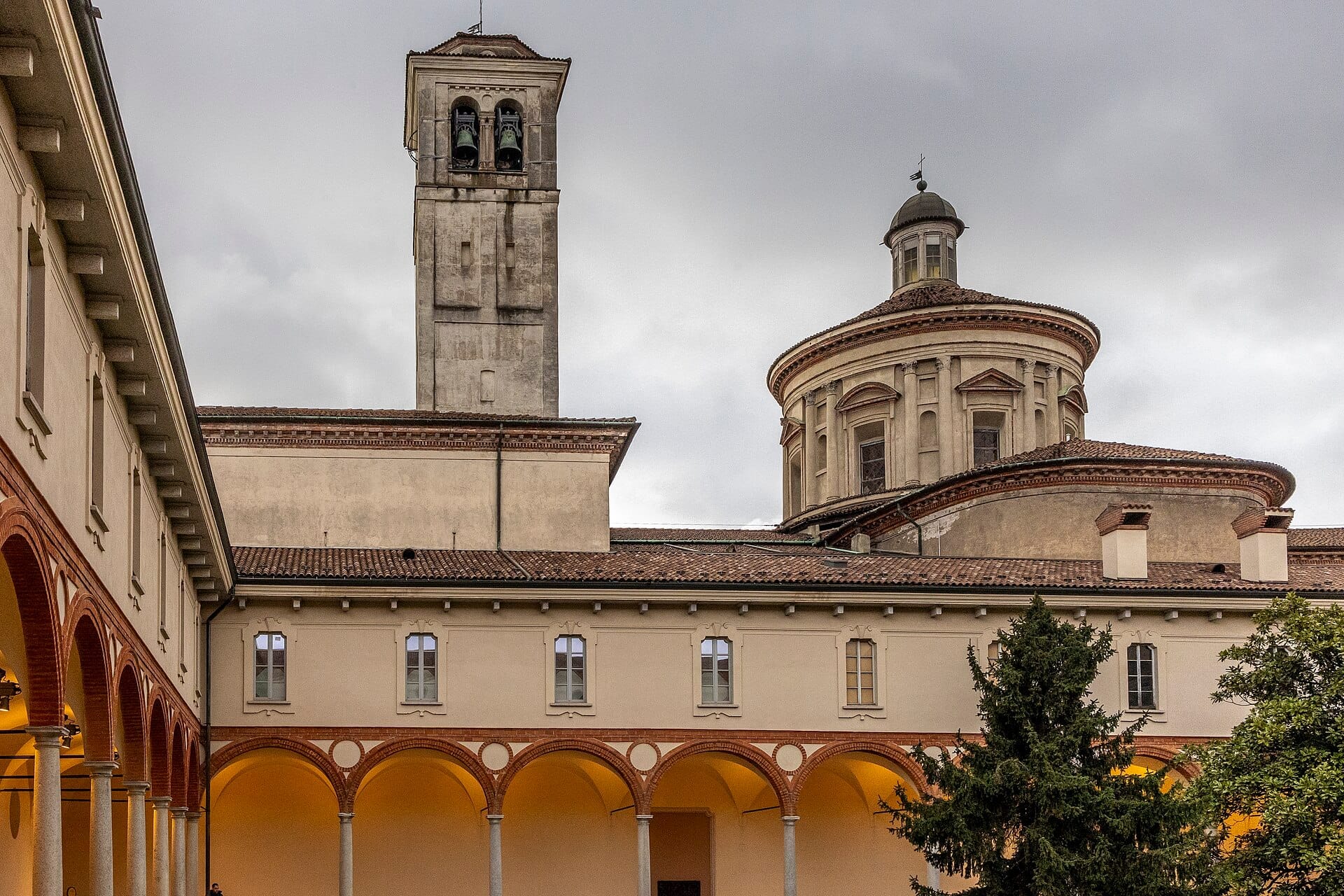
The Museo Nazionale della Scienza e della Tecnologia Leonardo da Vinci is Italy's largest science and technology museum, spread across about 50,000 square metres of a former 16th-century Olivetan monastery on Via San Vittore 21. Founded in 1953 and formally recognised by the Regione Lombardia in 2004, it is the kind of institution that takes several visits to fully absorb. The monastery's Renaissance cloisters, thick stone walls, and low vaulted ceilings provide an unexpectedly atmospheric setting for locomotive engines, aircraft fuselages, and rooms full of early computing machines.
There is a coherent curatorial vision here: the museum traces how scientific ideas move from drawing board to physical form across centuries and disciplines. The Leonardo gallery occupies a dedicated wing, but the collection extends far beyond one Renaissance genius into energy, materials, acoustics, naval history, space, and digital technology. The scale is imposing and occasionally overwhelming, which is worth knowing before you walk in.
💡 Local tip
Pick up the free floor map at the entrance. The museum is large enough that even return visitors miss entire sections without one. Priority rooms fill up mid-morning; the Leonardo gallery and the submarine tend to draw the longest queues by 11:00.
The Leonardo Wing: Drawing to Machine
The museum's most famous section is its gallery dedicated to Leonardo da Vinci, built around a collection of large-scale wooden models reconstructed from Leonardo's codices. These are not artworks on walls. They are three-dimensional attempts to interpret what Leonardo's sketches would have produced if built: a giant crossbow, a pivoting crane, an armoured vehicle, a helical aerial screw. The models are displayed at eye level with explanatory panels that quote directly from the codices and trace the gap between Leonardo's theoretical insight and 15th-century manufacturing capacity.
The intellectual experience here is more absorbing than purely aesthetic. You are asked to think about engineering logic, material constraints, and the limits of what one person could imagine before the tools existed to realise it. Panels alternate Italian and English text throughout, which is consistent across most of the museum. Visitors who have already explored Leonardo's life and legacy in Milan will find the gallery a natural complement to the church of Santa Maria delle Grazie, where his Last Supper is housed roughly 750 metres to the northwest.
For a fuller picture of Leonardo's presence in the city, the Leonardo da Vinci guide to Milan covers all major sites and explains how the museum fits into the broader itinerary.
Tickets & tours
Hand-picked options from our booking partner. Prices are indicative; availability and final rates are confirmed when you complete your booking.
Skip the line tickets to the National Museum of Science and Technology Leonardo da Vinci
From 10 €Instant confirmationFree cancellationMilan self-guided audio tour
From 8 €Instant confirmationGuided Tour of Leonardo da Vinci's Last Supper in Milan
From 75 €Instant confirmationFree cancellationLeonardo da Vinci's Last Supper Guided Tour in Milan
From 0 €Instant confirmation
Outdoor Pavilions: Trains, Ships, and a Submarine
Beyond the monastery walls, the museum extends into a series of outdoor and covered pavilions that house its most physically dramatic exhibits. The railway pavilion contains full-scale steam locomotives, freight wagons, and early diesel engines from the 19th and early 20th centuries. The aircraft pavilion holds propeller planes and early jet-era fuselages suspended overhead at angles that make the engineering feel visceral rather than archival. These spaces are popular with children precisely because the scale is hard to fake: you stand next to a locomotive and understand, in a way no photograph communicates, just how large these machines are.
The submarine Enrico Toti is the single most memorable exhibit. Launched in 1967 and decommissioned in 1999, it was disassembled and transported overland from La Spezia to Milan in 2005, a logistical operation that itself became part of the exhibition narrative. Guided tours take groups of visitors inside the pressure hull, through the control room, torpedo tubes, and crew quarters. The spaces are cramped, the air has a faintly metallic quality, and the guided commentary explains operational history without romanticising naval warfare. Booking the submarine tour in advance via the museum website is strongly recommended, as timed slots sell out on busy weekend mornings.
⚠️ What to skip
The submarine tour involves narrow hatches and confined spaces with low overhead clearance. It is not suitable for visitors with severe claustrophobia, and some sections are not step-free. Contact the museum at +39 02 48 555 1 if you have specific accessibility requirements before booking.
The Building Itself: A 16th-Century Monastery in Context
The Olivetan monastery of San Vittore al Corpo was founded in the 16th century and served successive religious and later military functions before being adapted for the museum. Its architectural character permeates the visit in ways that are easy to overlook when you are focused on exhibits. The main cloister, with its colonnaded walkways and central open courtyard, gives the morning visit a particular quality: early light crosses the stone pavement at a low angle, and the courtyard is quiet enough to hear your own footsteps. The contrast between monastic calm and industrial-era machinery is one of the museum's defining textures.
The neighbourhood, Ticinese-Sant'Ambrogio, provides useful context. Within a few minutes' walk you have the early Christian Basilica di Sant'Ambrogio, the Colonne di San Lorenzo, and easy access to the Navigli canal district. This part of Milan has a layered character that rewards walking rather than rushing between metro stops.
The Ticinese-Sant'Ambrogio neighbourhood guide outlines how to combine the museum with the area's other major historic and architectural sites in a single day.
Practical Walkthrough: Hours, Getting There, and What to Wear
The museum is open Tuesday through Friday from 10:00 to 18:00, and Saturday through Sunday from 10:00 to 19:00. It is closed on Mondays. Hours can vary on public holidays and during special exhibition periods; confirm on the official website at museoscienza.org before your visit. General admission starts from approximately €10 for adults, with varying rates for reduced categories, families, and add-on options including the submarine tour. Booking tickets in advance online is advisable on weekends and during school holidays, when entry queues form at the door.
From central Milan, the most direct route is Metro Line M2 (green line) to the Sant'Ambrogio stop, which leaves you a five-minute walk from the main entrance. Trams 14 and 19 run along Via Carducci and are useful if you are coming from the Navigli or Duomo areas. The museum has no dedicated parking facility and the streets nearby are typically busy with residential permit zones; arriving by public transport is the practical choice.
Wear comfortable shoes with grip. The outdoor pavilions involve uneven surfaces, and parts of the railway and aircraft sections require climbing short staircases or standing on elevated walkways. The indoor galleries maintain a steady temperature year-round, but the outdoor pavilions can be cold in winter and warm in summer, so layering is sensible. There is a café on site for mid-visit breaks.
ℹ️ Good to know
Photography is generally permitted throughout the permanent collection without flash. The submarine tour restricts photography in certain sections; the guide will clarify on the day.
Who Will Get the Most From This Museum
Families with children aged roughly six and above tend to respond strongly to the physical scale of the exhibits, particularly the trains, aircraft, and submarine. The museum is one of the few in Milan that holds children's attention for a full half-day without needing to simplify or condescend. Interactive stations are distributed through several galleries, though the hands-on elements are spread unevenly and some sections are more text-heavy.
Visitors primarily interested in fine art or fashion may find the museum less directly relevant to what draws them to Milan. It is a science and technology institution, not an art museum, and the curatorial language prioritises mechanical function over aesthetic experience. That said, the Leonardo gallery has genuine crossover appeal, and the building's architectural character adds something even for visitors who would not normally spend three hours thinking about steam engines.
If your main interest in Milan is its art collections, the guide to Milan's best museums maps out the full range of options across the city and helps you prioritise based on your interests.
Best Time to Visit
Tuesday through Thursday mornings are the quietest times. The museum draws school groups on weekday mornings, but tour groups tend to cluster around the Leonardo gallery and then disperse; arriving after 14:00 on a weekday lets you experience those sections without the queue. Weekend mornings, particularly on Saturdays, are consistently the busiest, with the submarine tours booking out by mid-morning.
Seasonally, the outdoor pavilions are most comfortable in spring and autumn. The railway and aircraft hangar spaces are not air-conditioned and can be stuffy in July and August, though the indoor galleries remain manageable. Milan's spring months of April and May bring pleasant temperatures, and the museum is a sensible choice for a rainy day at any time of year given that the majority of the exhibition space is indoors.
Insider Tips
- Book the Enrico Toti submarine tour online when you purchase your entry ticket. Slots are timed and limited, and weekend morning tours are often fully reserved by Friday. Showing up without a reservation means waiting or missing the tour entirely.
- The second cloister, further from the main entrance, is considerably less crowded than the Leonardo wing and houses some of the most interesting exhibits on materials science and early chemistry. Most visitors never reach it.
- The museum shop near the exit carries well-produced reproductions of Leonardo's codex pages and engineering drawings that are harder to find elsewhere in the city at a comparable quality. Worth a look even if you are not a regular souvenir buyer.
- If you are visiting with children under ten, the railway pavilion tends to produce the strongest reaction. Go there first while energy levels are high; the more text-heavy interior galleries work better later in the visit.
- The café closes before the museum does, typically around 16:00. If you are planning a long visit on a weekday, account for this when timing your break.
Who Is Museo Nazionale della Scienza e della Tecnologia Leonardo da Vinci For?
- Families with school-age children looking for a full half-day of genuinely engaging exhibits
- Leonardo da Vinci enthusiasts who want to see his mechanical ideas rendered in three dimensions
- Architecture and history visitors interested in Renaissance monastic buildings repurposed as public institutions
- Travellers combining the museum with a walk through the Ticinese-Sant'Ambrogio neighbourhood and its early Christian sites
- Rainy-day visits requiring several hours of indoor content without feeling rushed
Nearby Attractions
Other things to see while in Ticinese & Sant'Ambrogio:
- Basilica di San Lorenzo Maggiore
The Basilica di San Lorenzo Maggiore is one of the earliest Christian churches in Milan, dating to the late 4th–early 5th century CE. Fronted by 16 ancient Roman columns and housing 4th-century mosaics in the Cappella di Sant'Aquilino, it sits at the heart of the Ticinese neighborhood, a short walk from the Navigli canals.
- Basilica di Sant'Ambrogio
Founded by Saint Ambrose himself in 379 AD and rebuilt in the 11th century as a masterpiece of Lombard Romanesque architecture, the Basilica di Sant'Ambrogio is the spiritual and historical anchor of Milan. Entry to the church is free, and the complex rewards slow, attentive visitors far more than a quick stop.
- Basilica di Sant'Eustorgio
The Basilica di Sant'Eustorgio is one of Milan's most historically layered sacred sites, combining a paleochristian necropolis, a Renaissance chapel of rare refinement, and a 12th-century Romanesque nave into a single compact complex. Located on Piazza Sant'Eustorgio in the Ticinese quarter, it rewards visitors who look past the plain brick facade to discover what lies beneath and behind it.
- Cenacolo Vinciano (The Last Supper)
Leonardo da Vinci's Last Supper survives on the refectory wall of Santa Maria delle Grazie, a 460 x 880 cm tempera mural painted between 1495 and 1498. Visits are strictly limited to 15 minutes per group of 40, and tickets require advance reservation. This guide covers everything you need to know before you go.