Museo Civico Archeologico di Milano: Ancient Rome Beneath a Medieval Convent
Housed inside the former Monastero Maggiore on Corso Magenta, the Civico Museo Archeologico di Milano traces Milan's history from prehistoric times through the Roman Empire and beyond. At €5 entry, it is a civic museum combining genuine archaeological depth with an extraordinary architectural setting.
Quick Facts
- Location
- Corso Magenta 15, 20123 Milan (Ticinese / Sant'Ambrogio quarter)
- Getting There
- M1/M2 Cadorna or M1 Conciliazione; tram line 16 along Corso Magenta and tram line 19 stopping nearby
- Time Needed
- 1.5 to 2.5 hours for a thorough visit
- Cost
- Full €5 / Reduced €3 / Check current free-entry days and times on the official Musei Civici Milano website, as they are subject to change
- Best for
- Roman history enthusiasts, architecture lovers, travellers seeking an uncrowded cultural alternative
- Official website
- http://www.museoarcheologicomilano.it/
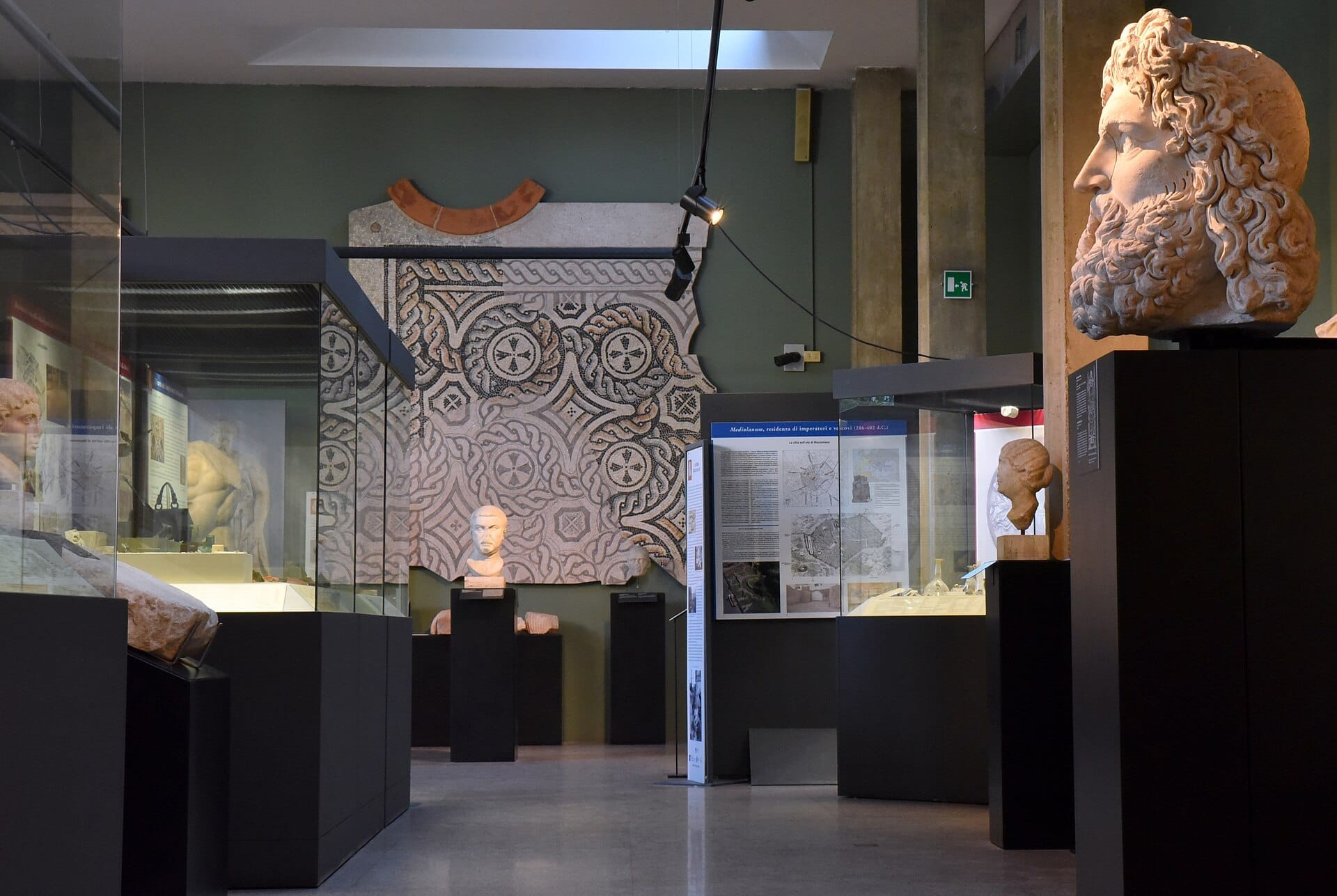
What the Museo Civico Archeologico di Milano Actually Is
The Civico Museo Archeologico di Milano is a civic archaeological museum inside one of the oldest monastic complexes in northern Italy. It occupies the former Monastero Maggiore di San Maurizio, a convent whose origins trace back to the 8th or 9th century AD, on a site where Roman walls and towers still stand with substantial original masonry preserved. The collection descends from two 19th-century institutions: the Museo Patrio Archeologico, founded in 1862, and the Gabinetto Numismatico di Brera, established in 1808, both of which were eventually merged and rehoused here.
The building itself is as compelling as anything inside the display cases. The cloister, the long corridors, the frescoed chapter rooms, and the Roman towers embedded into the convent walls create a layered experience you rarely find in purpose-built museums. You are reading a palimpsest: each century left something visible.
The museum sits on Corso Magenta, one of Milan's quieter central thoroughfares, a short walk from the Chiesa di San Maurizio al Monastero Maggiore, whose frescoes are considered Milan's most beautiful and are technically part of the same monastic complex. Visiting both on the same morning makes obvious sense.
💡 Local tip
The museum is closed on Mondays. It is also closed on 1 January, 1 May, and 25 December. Closing time is 17:30, with last admission one hour before; aim to arrive by around 16:00 for a relaxed visit.
The Collection: From Prehistoric Lombardy to Imperial Rome
The permanent exhibition moves chronologically, starting with prehistoric and proto-historic material from the Po Valley region, then accelerating through the Greek and Etruscan periods before settling into its most substantial section: Roman Milan, which the Romans called Mediolanum.
Mediolanum was not a provincial backwater. By the late 3rd century AD it had become the de facto capital of the Western Roman Empire, chosen by Emperor Maximian for its strategic position between the Alps and the Po plain. The museum makes this status tangible through a sequence of stone reliefs, architectural fragments, inscriptions, and everyday objects that would be at home in far more famous institutions. The Parabiago Plate, a large late-antique silver dish embossed with the triumph of Cybele and Attis, is the kind of object that stops you mid-stride. The detail in the silverwork and the cult iconography reward close inspection.
The numismatic collection deserves particular attention. It spans centuries of coinage and draws directly on the Gabinetto Numismatico heritage. Even visitors with limited interest in coins tend to slow down here because the accompanying labels contextualise the currency within political history: which emperor issued what, and why that matters to understanding the period.
There is also material from the Egyptian and Eastern Mediterranean worlds, giving the museum a broader Mediterranean scope than its name implies. The Egyptian section is modest but carefully curated.
Tickets & tours
Hand-picked options from our booking partner. Prices are indicative; availability and final rates are confirmed when you complete your booking.
Milan Museo Del Novecento entry ticket with audio guide
From 14 €Instant confirmationFree cancellationMilano highlights 2 hours private tour by vintage car
From 300 €Instant confirmationFree cancellationMilano highlights 3 hours private tour by vintage car
From 400 €Instant confirmationFree cancellationMilano highlights 30 minutes private tour by vintage car
From 80 €Instant confirmationFree cancellation
The Architecture: Roman Towers Inside a Medieval Convent
The building earns as much attention as the collection. The most dramatic structural element is a large circular Roman defensive tower dating to the late 3rd or early 4th century AD that rises inside the museum complex with much of its original brickwork intact. Standing beside it, you register the scale of Roman military engineering with a directness that photographs on a placard cannot replicate. A second polygonal tower is also preserved within the complex.
The Monastero Maggiore itself was the most important Benedictine convent in medieval Milan. Walking through its cloister in the morning, before tour groups arrive, the space has a particular stillness. The sound of Corso Magenta traffic fades quickly once you pass through the entrance. The stone underfoot is worn unevenly from centuries of use, and the arcade columns cast long shadows across the courtyard when the sun is at an angle.
This part of the Ticinese and Sant'Ambrogio neighbourhood concentrates more Roman and early Christian heritage per square kilometre than anywhere else in Milan. The Colonne di San Lorenzo, a row of 16 Roman columns from the 2nd century AD, stands just minutes away. The Basilica di Sant'Ambrogio, one of the oldest churches in Italy, is a ten-minute walk south.
How the Experience Changes by Time of Day
The museum opens at 10:00 from Tuesday through Sunday. Mid-morning on a weekday is reliably quiet: perhaps a school group in one wing, but the main galleries often hold fewer than a dozen visitors at a time. The cloister and Roman towers feel genuinely private at that hour, which matters when you are trying to absorb something as spatially complex as this building.
Early afternoon brings a small increase in visitor numbers, though this is not a museum that ever becomes congested in the way that the Duomo or the Last Supper do. By 15:00 on weekends you may share a gallery with more people, but it never reaches the point of crowds impeding movement or reading labels.
On free-entry days, which the city periodically designates (often certain Tuesdays or Sundays), expect noticeably more visitors than usual. Check the current schedule on the official Musei Civici Milano channels if you want to plan around these days.
ℹ️ Good to know
Free entry on the first Sunday of the month, when offered, cannot usually be booked online; arrive in person at the ticket office. The Abbonamento Musei Lombardia Valle d'Aosta card also grants free entry and is redeemable at the museum ticket office.
Getting There and Practical Logistics
The address is Corso Magenta 15, in the Ticinese / Sant'Ambrogio area of central Milan. The closest metro stations are Cadorna (M1 red line and M2 green line) and Conciliazione (M1 red line), both within about a ten-minute walk. Tram line 16 runs along Corso Magenta and tram line 19 stops nearby within a short walk of the entrance.
If you are approaching from the Duomo, the walk along Via Torino and then Via Meravigli takes roughly 15 minutes on foot and passes through a part of the historic centre that most visitors miss. It is a worthwhile route in its own right.
Accessibility note: all visitor groups requiring a dedicated guide, including those with special accessibility needs, must book in advance through Aster by emailing segreteria@spazioaster.it with the date, time, number of participants, and the rooms to be visited. Standard independent visitors do not need advance booking for general admission.
Ticket prices are €5 full and €3 reduced. Reduced pricing typically applies to specific age groups and student categories; check the official Musei Civici Milano website for the current eligibility criteria, as these are subject to revision.
Photography and What to Bring
Non-flash photography for personal use is generally permitted in the permanent collection. The Roman towers and the cloister courtyard offer the strongest architectural photography opportunities. Interior lighting in the display galleries is controlled and somewhat dim to protect the objects, so a camera that handles low light well will produce better results than a smartphone in those sections. The courtyard, on a clear morning, is bright enough for any device.
There is no cafe inside the museum, so plan accordingly. Corso Magenta has several bars within a two-minute walk for a coffee before or after. The museum does not have a dedicated coat check, but the entrance area accommodates bags and jackets without difficulty given the typically modest visitor numbers.
⚠️ What to skip
The museum building has uneven floors, worn stone steps, and areas without lift access due to its historic structure. Visitors with limited mobility should check specific room accessibility in advance before visiting.
Who This Museum Is Really For
The Civico Museo Archeologico di Milano is not trying to compete with Rome's Capitoline Museums or the Vatican collections. It is a mid-sized civic museum with a focused mandate: documenting the city that became one of the most important urban centres of the late Roman world. Within that mandate, it succeeds with real depth.
Visitors who come expecting interactive displays, multilingual audioguides, or the kind of visual spectacle associated with major international archaeological museums may find the presentation somewhat traditional. Labels are primarily in Italian, with some English. The interpretive apparatus is informative rather than immersive. This is a museum for people who read the panels, not for people looking for a theatrical experience.
For anyone following a serious interest in Roman northern Italy, or building an itinerary around Milan's ancient and medieval layers, this museum belongs on the list alongside the Basilica di San Lorenzo Maggiore and the early Christian heritage concentrated in this quarter. For a broader survey of Milan's history, the Milan architecture guide puts the Roman layers in longer urban context.
Travellers with very limited time and a primary focus on Renaissance art or contemporary design may find the museum less central to their priorities. At €5 and under two hours, however, the cost of entry in both money and time is low enough that the question is rarely whether to visit, but when.
Insider Tips
- Visit the Chiesa di San Maurizio al Monastero Maggiore immediately before or after: it shares the same monastic complex, admission is free, and its 16th-century frescoed interior is among the most beautiful spaces in Milan with a fraction of the usual crowds.
- The first and third Tuesdays of the month offer free entry from 14:00, but if you want the space largely to yourself, a paid Tuesday or Wednesday morning is significantly quieter than a free afternoon.
- Spend time in the Roman tower sections rather than moving through them quickly. The large late-Roman defensive tower within the complex is one of the most impressive military structures visible to the public in Milan, and most visitors walk past it in under two minutes.
- The numismatic collection rewards patience even for non-specialists: the labels connect coin series to specific political events in a way that clarifies late-Roman political history more efficiently than many textbooks.
- Combine the visit with a walk down to the Colonne di San Lorenzo and the Basilica di Sant'Ambrogio to trace the full Roman and early Christian heritage of this quarter in a single half-day itinerary.
Who Is Museo Civico Archeologico di Milano For?
- Roman history enthusiasts who want to understand why Milan mattered in the late Roman Empire
- Architecture lovers interested in the layered coexistence of Roman, medieval, and Renaissance structures in one building
- Travellers on a budget seeking serious cultural content at low cost
- Repeat visitors to Milan looking beyond the main circuit of Duomo, Last Supper, and Brera
- Academics, students, and researchers with a focus on northern Italian archaeology or numismatics
Nearby Attractions
Other things to see while in Ticinese & Sant'Ambrogio:
- Basilica di San Lorenzo Maggiore
The Basilica di San Lorenzo Maggiore is one of the earliest Christian churches in Milan, dating to the late 4th–early 5th century CE. Fronted by 16 ancient Roman columns and housing 4th-century mosaics in the Cappella di Sant'Aquilino, it sits at the heart of the Ticinese neighborhood, a short walk from the Navigli canals.
- Basilica di Sant'Ambrogio
Founded by Saint Ambrose himself in 379 AD and rebuilt in the 11th century as a masterpiece of Lombard Romanesque architecture, the Basilica di Sant'Ambrogio is the spiritual and historical anchor of Milan. Entry to the church is free, and the complex rewards slow, attentive visitors far more than a quick stop.
- Basilica di Sant'Eustorgio
The Basilica di Sant'Eustorgio is one of Milan's most historically layered sacred sites, combining a paleochristian necropolis, a Renaissance chapel of rare refinement, and a 12th-century Romanesque nave into a single compact complex. Located on Piazza Sant'Eustorgio in the Ticinese quarter, it rewards visitors who look past the plain brick facade to discover what lies beneath and behind it.
- Cenacolo Vinciano (The Last Supper)
Leonardo da Vinci's Last Supper survives on the refectory wall of Santa Maria delle Grazie, a 460 x 880 cm tempera mural painted between 1495 and 1498. Visits are strictly limited to 15 minutes per group of 40, and tickets require advance reservation. This guide covers everything you need to know before you go.