Duomo di Milano: The Complete Visitor's Guide to Milan Cathedral
The Duomo di Milano is one of the largest Gothic cathedrals in the world, nearly six centuries in the making and still the physical and symbolic heart of the city. This guide covers what to expect inside, how to reach the rooftops, when to visit, and the practical details that make the difference between a rushed stop and a memorable experience.
Quick Facts
- Location
- Piazza del Duomo, 20122 Milan (Duomo District)
- Getting There
- Duomo (Lines M1 red, M3 yellow) — exit directly onto the piazza
- Time Needed
- 2–4 hours for cathedral, rooftops, and museum; half a day if including the archaeological area
- Cost
- Cathedral entry for tourist visits requires a ticket (access for prayer is via separate, free entrances); rooftop and museum tickets are priced separately in EUR — verify current rates at duomomilano.it
- Best for
- Architecture lovers, history travelers, photography, first-time visitors to Milan
- Official website
- www.duomomilano.it
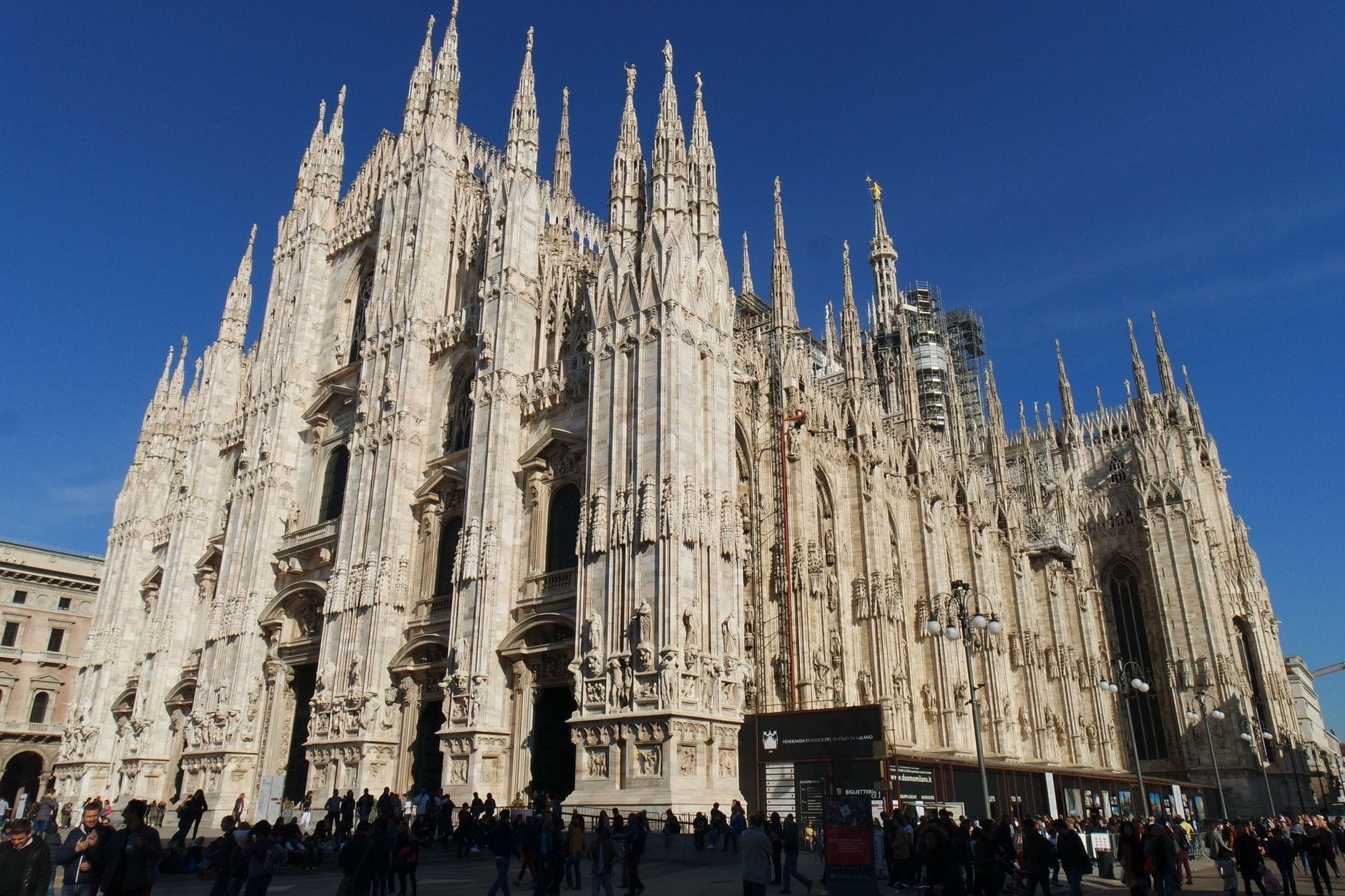
Why the Duomo Still Commands Attention
The Duomo di Milano — formally the Cattedrale Metropolitana della Natività della Beata Vergine Maria — is the largest church in Italy and one of the largest Gothic cathedrals in the world by floor area. Construction began in 1386 under Duke Gian Galeazzo Visconti, and the final details were not completed until 1965: a building process spanning 579 years and involving dozens of architects across radically different eras of design. The result is not a unified artistic statement but a layered, sometimes contradictory monument that reflects six centuries of ambition, interruption, and revision.
Its statistics alone are striking: 158.6 metres long, 92 metres wide, a maximum height of 108 metres, and a stated capacity of roughly 40,000 people. The roofline carries 135 spires and more than 3,400 statues, making it one of the most densely decorated exteriors of any building in Europe. The central spire, topped by the gilded copper Madonnina statue, was completed in 1774 and has been the symbol of Milan ever since — a skyline presence so established that local building regulations long restricted other structures from exceeding her height.
💡 Local tip
Book tickets online in advance at duomomilano.it. Walk-up queues at the box office can run 45–90 minutes on weekday mornings and much longer on weekends. Pre-booked tickets also let you choose a specific entry window for the rooftops.
Arriving at Piazza del Duomo: First Impressions
Emerging from the Duomo metro station onto the piazza is one of those disproportionately dramatic arrivals that Milan manages to pull off repeatedly. The cathedral fills the entire visual field: a white-marble facade in Late Gothic style, its forest of pinnacles catching the morning light in a way that makes the stone appear almost translucent. This effect is strongest in the hour after sunrise, when the east-facing facade catches direct light and the piazza is still mostly clear of crowds.
By mid-morning, the square is dense with visitors, pigeons, selfie sticks, and the occasional street vendor. The spatial experience of the piazza itself is significant: it was redesigned in the 19th century under Napoleon, who wanted a grand ceremonial approach to the cathedral, and its current dimensions are unusually generous for a historic European city center. To the northeast, the vaulted glass arcade of the Galleria Vittorio Emanuele II connects the square to Piazza della Scala.
The piazza functions as the geographic center of Milan and the symbolic center of northern Italy. Distance markers in the region are traditionally measured from this point. For a sense of what lies immediately around it, the Duomo District extends in every direction with a concentration of historic architecture, luxury retail, and cultural institutions that is unmatched elsewhere in the city.
Tickets & tours
Hand-picked options from our booking partner. Prices are indicative; availability and final rates are confirmed when you complete your booking.
Duomo Cathedral private tour with a local guide
From 105 €Instant confirmationFree cancellationSkip-the-line Duomo tour in Milan
From 40 €Instant confirmationFree cancellationSkip-the-line Milan's Duomo rooftop tour
From 42 €Instant confirmationFree cancellationDuomo of Milan guided tour
From 65 €Instant confirmationFree cancellation
Inside the Cathedral: What You Actually See
Stepping inside the Duomo is a shift in register that takes a moment to process. The interior is cool even in summer, lit predominantly by the 55 stained glass windows that run the length of both aisles — among the largest collections of stained glass in any single building in the world. The oldest date to the 15th century; some are more recent restorations. The light they produce is diffuse and slightly green-blue, giving the nave an almost submarine quality in the middle hours of the day.
The nave stretches 40 metres high, supported by 52 pillars — one for each week of the year, according to local tradition. The floor is predominantly white marble with decorative inlays, worn smooth near the main entrance from centuries of foot traffic. Along the aisles are side chapels, some with works by Lombard Renaissance painters, and various monuments to archbishops and Visconti rulers. The most visited single object inside is probably the nail said to be from the True Cross, displayed in a reliquary above the altar and lowered once a year on the Saturday closest to September 14th.
The atmosphere inside varies considerably by time. At 09:00, when the cathedral generally opens to visitors, you may find it nearly empty apart from worshippers at early Mass, and the silence against that scale of architecture is genuinely affecting. By 11:00 it is busy. By 14:00, tour groups dominate the nave in overlapping waves, and the ambient noise from dozens of audio guides makes quiet observation difficult. If the interior is the focus of your visit, arrive within the first 30 minutes of opening.
⚠️ What to skip
Dress code is enforced. Shoulders and knees must be covered to enter the cathedral. Scarves and wraps are available for purchase near the entrance, but bringing your own avoids both the cost and the queue at the desk.
The Rooftops: The Experience Most Worth Having
The rooftop terraces of the Duomo di Milano are, for many visitors, the single most rewarding part of the complex — and they are treated separately from the main cathedral ticket. You reach them either by stairs (slower, more tiring, but you move at your own pace) or by lift (faster, and the line for it is often shorter than expected). Once up, the experience is unlike anything else in the city. The rooftop is a stone landscape of spires, flying buttresses, gargoyles, and saints at close range — the same decorative programme that looks distant and abstract from the ground becomes intimate and specific at eye level. For more perspectives across the city skyline, see the best views in Milan guide, but the Duomo rooftop is the only one that puts you inside the architecture rather than above it.
On a clear day, the Alps are visible to the north — the arc from Monte Rosa through the Bernese peaks to the eastern Dolomites, depending on visibility. In late autumn and winter, when the Po Valley fog has lifted after rain, the view can extend around 100 kilometres. The Madonnina is reachable by stairs and stands near the highest accessible point: a gilded figure 4.16 metres tall that looks much smaller from the piazza roughly 108 metres below.
The rooftops are most photogenic in early morning and in the 90 minutes before sunset, when the light is warm and the shadows from the spires fall across each other at dramatic angles. Midday light flattens the marble. Wind at height can be significant in winter and spring — a layer on top is advisable even if the piazza below feels warm. The surface underfoot is uneven stone and includes narrow walkways between spires; flat, closed-toe shoes with grip are strongly recommended over sandals or heels.
The Duomo Museum and Archaeological Area
The Museo del Duomo, housed in spaces within the Palazzo Reale adjacent to the cathedral, traces the construction history of the building through original sculptures, stained glass, architectural models, and votive objects. It is frequently overlooked by visitors who spend their entire budget of time on the cathedral and rooftops, but it provides the context that transforms a beautiful building into a comprehensible one. Original Gothic statues removed during restoration are displayed here at human scale — the craftsmanship visible in ways impossible on the facade. The Duomo Museum deserves at least an hour if you have any interest in medieval craft or architectural history.
Below the cathedral, the Archaeological Area (Battistero di San Giovanni alle Fonti) reveals the remains of the 4th-century baptistery where Saint Ambrose is said to have baptised Augustine of Hippo in 387 CE. This is among the most significant early Christian archaeological sites in northern Italy. Access is included in some combined tickets; the space is small and dimly lit, with original mosaic floors visible behind protective barriers. It is particularly interesting but probably not a priority if your visit time is limited.
Historical and Cultural Context
The decision to build the Duomo in 1386 was a political act as much as a religious one. Gian Galeazzo Visconti was consolidating power over Milan and wanted a monument that would signal the city's importance to all of Europe. He invited architects and craftsmen from across the continent — French, German, and Flemish masters worked alongside Lombard builders — which explains the cathedral's distinctive mix of northern Gothic verticality and Italian decorative ornament. The marble used throughout, a pink-white Candoglia marble from a quarry near Lake Maggiore, was transported via a specially constructed canal system and has been sourced from the same quarry for ongoing restoration work for over 600 years. For broader context on Milan's architectural inheritance, the Milan architecture guide covers the major periods and buildings across the city.
Napoleon Bonaparte was crowned King of Italy in the Duomo in 1805, and the building has witnessed most of the major political events in Milan's modern history. During the Second World War, the structure sustained minor damage but the stained glass windows were removed and stored to protect them — a decision that preserved some of the most irreplaceable medieval glass in Europe.
The Duomo is also one of the most important pilgrimage sites in the Catholic Church and remains an active place of worship with daily Masses. This dual identity — working cathedral and mass-tourism landmark — creates occasional friction. During major liturgical events, tourist access may be restricted. The guide to Milan's churches provides a broader map of religious heritage in the city for those interested in the devotional dimension rather than the architectural one.
Practical Information for Your Visit
The cathedral complex is generally open daily from 09:00 to 19:00, though hours for specific areas (rooftops, museum, archaeological area) vary and may differ on religious holidays. All ticket prices are listed in euro and change periodically; the rooftop lift carries a higher charge than the stair option. Always check and book at duomomilano.it before you arrive, both for current pricing and to avoid the box office queue.
Getting there is straightforward: the Duomo metro station (Lines M1 red and M3 yellow) opens directly onto the piazza, making it one of the easiest major attractions in any European city to reach by public transport. Trams and buses also stop nearby. The Duomo Info Point, located at the right corner of the facade, is generally open daily from around 09:00 to 18:00 and can assist with accessibility queries, current restoration closures, and combined ticket options.
Accessibility across the complex is uneven. The cathedral floor is navigable by wheelchair, but the rooftops, which require either stairs or a lift, have specific access conditions that may change during ongoing restoration works. Visitors with reduced mobility should contact the Info Point or check the official site before purchasing rooftop tickets.
ℹ️ Good to know
Photography inside the cathedral is permitted for personal use without flash. Tripods are generally not allowed. On the rooftops, there are no such restrictions, and the elevated vantage point with foreground spire detail makes it among the best photography opportunities in the city.
Who Should Consider Skipping (or Adjusting Expectations)
The Duomo is not overhyped in the sense that the architecture delivers at scale. But visitors who are indifferent to Gothic cathedrals and primarily interested in Milan's design, food, or contemporary culture may find that the obligatory stop eats into time better spent elsewhere. The experience is also heavily dependent on crowd levels: on a summer Saturday at noon, the interior is loud, the rooftop queue is long, and the piazza is nearly impassable. Those with mobility limitations should plan carefully around the rooftop access constraints. And if you have already visited Chartres, Cologne, or Burgos, you will appreciate the Duomo more for its historical complexity than for any single architectural revelation.
Insider Tips
- The rooftop lift queue is typically shorter than the stairs queue in the mornings. In the afternoons this reverses: stairs move faster. If you book a late-morning rooftop slot, arrive 10 minutes early and head straight to the lift.
- The Madonnina viewpoint is the highest accessible rooftop level and requires additional stairs beyond the main terrace. Most visitors stop at the first walkway and miss the best elevated view. Push past the first open area and follow the signs upward.
- The north aisle of the cathedral interior receives the best stained glass light in the afternoon, when the low western sun backlights the windows on that side. The light quality between 15:00 and 17:00 on a clear afternoon is significantly different from the morning.
- The Duomo Museum in Palazzo Reale uses the same combined ticket for multiple areas. If you buy a cathedral-only ticket at the door and later decide you want the museum, you will pay a higher cumulative price than if you had purchased the combined pass upfront.
- Piazza del Duomo fills with visitors from mid-morning onwards, but the northern side of the cathedral, accessed via the lanes behind the building, is almost always quiet. The view of the apse and the roofline from the rear is architecturally striking and almost always unobstructed by crowds.
Who Is Duomo di Milano For?
- First-time visitors to Milan for whom the Duomo is unmissable as a cultural reference point
- Architecture enthusiasts interested in the evolution of Gothic design over multiple centuries
- Photographers seeking elevated urban perspectives with strong foreground interest
- Travelers with an interest in early Christian and medieval history
- Families with older children who can manage stairs and benefit from the rooftop sense of scale
Nearby Attractions
Other things to see while in Duomo District:
- Chiesa di San Bernardino alle Ossa
Tucked into Piazza Santo Stefano a short walk east of the Duomo, the Chiesa di San Bernardino alle Ossa is one of Milan's most arresting and least-crowded historic interiors. Its 17th-century ossuary chapel is lined floor to ceiling with human skulls and bones, crowned by a luminous baroque fresco. Entry is free.
- Museo del Duomo
The Museo del Duomo di Milano, housed inside Palazzo Reale on Piazza del Duomo, holds six centuries of sculpture, stained glass, and architectural models that the cathedral itself can no longer display. It is quieter than the church next door, considerably less crowded than the rooftop terraces, and far more revealing about how one of the world's most complex Gothic buildings actually came to be.
- Galleria Vittorio Emanuele II
Built between 1865 and 1877 and inaugurated in 1867, the Galleria Vittorio Emanuele II connects Piazza del Duomo to Piazza della Scala beneath a soaring 47-metre glass dome. Entry is free and the arcade never closes, making it one of the most accessible landmarks in northern Italy. Whether you stop for an espresso at a historic café or simply pass through on foot, the architecture alone rewards the detour.
- Gallerie d'Italia – Piazza Scala
Spread across three interconnected 19th-century palazzi steps from La Scala opera house, Gallerie d'Italia – Piazza Scala offers approximately 8,300 square metres of art ranging from Neoclassical painting to 20th-century Italian masters. The buildings themselves are as compelling as what hangs on their walls.