Galleria Vittorio Emanuele II: Inside Milan's Most Iconic Arcade
Built between 1865 and 1877 and inaugurated in 1867, the Galleria Vittorio Emanuele II connects Piazza del Duomo to Piazza della Scala beneath a soaring 47-metre glass dome. Entry is free and the arcade never closes, making it one of the most accessible landmarks in northern Italy. Whether you stop for an espresso at a historic café or simply pass through on foot, the architecture alone rewards the detour.
Quick Facts
- Location
- Piazza del Duomo, 20123 Milano — between the Cathedral and La Scala Opera House
- Getting There
- Duomo station (Metro Lines M1 and M3), 2-minute walk
- Time Needed
- 20–45 minutes to explore; longer if dining or shopping
- Cost
- Free to enter. Individual shops, cafés and restaurants charge their own prices.
- Best for
- Architecture lovers, first-time visitors to Milan, rainy-day walks, photography
- Official website
- www.comune.milano.it
What the Galleria Actually Is
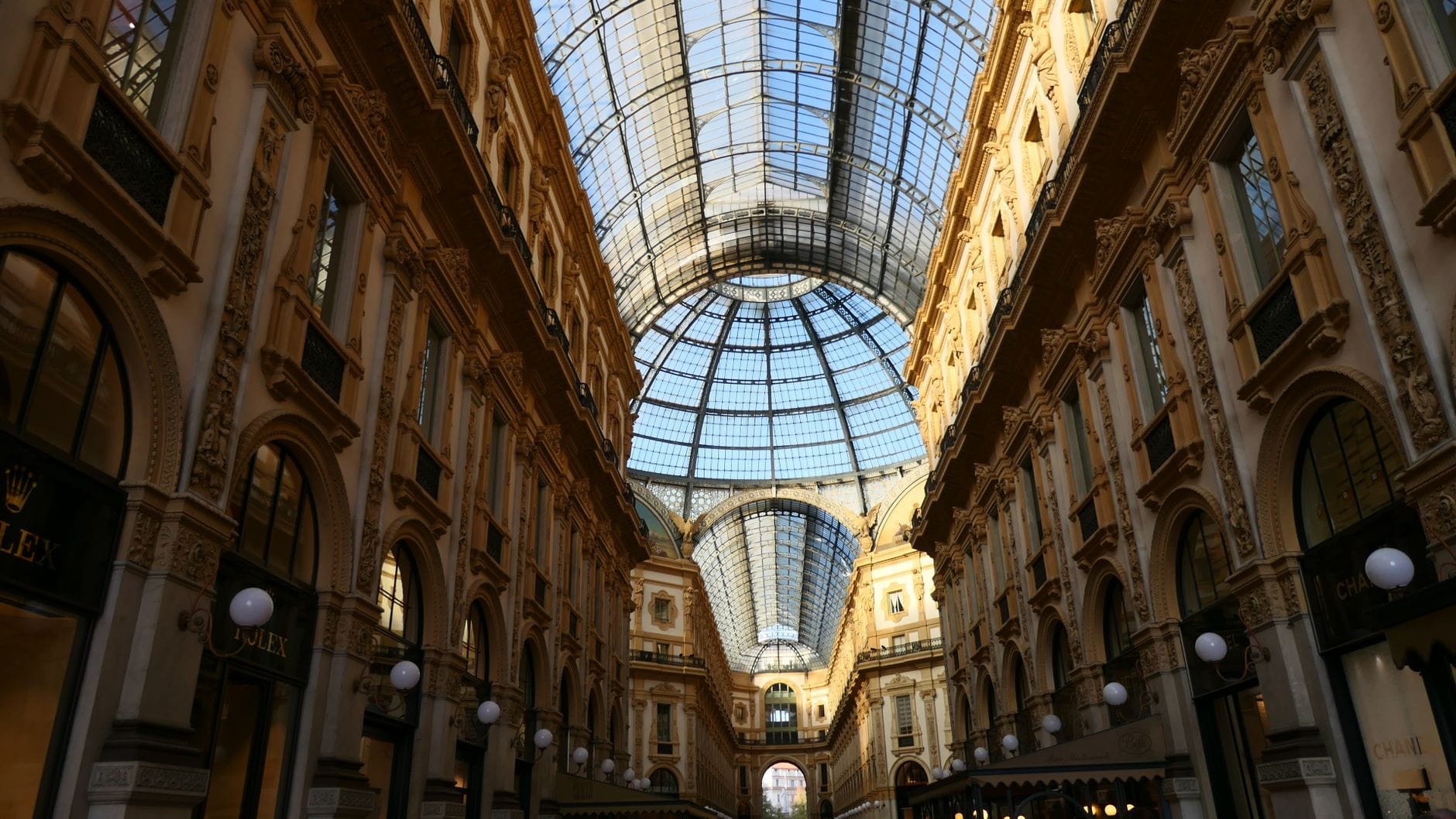
The Galleria Vittorio Emanuele II is a covered public arcade in the heart of Milan, designed by architect Giuseppe Mengoni and inaugurated on 15 September 1867. It takes the form of a Latin cross: the longer arm stretches 196 metres, the shorter 105.5 metres, and the two arms meet beneath a central octagonal dome roughly 47 metres high and 36 metres wide. The entire structure is framed in iron and sealed with glass vaults, making it a weatherproof pedestrian street rather than a traditional building. It is widely considered Italy's oldest active shopping arcade.
Physically, the Galleria links two of Milan's most significant squares: Piazza del Duomo to the south and Piazza della Scala, home to Teatro alla Scala, to the north. This position means it functions as a genuine urban passageway, not just a tourist destination. Locals walk through it every day on the way to work, which explains why the atmosphere shifts noticeably between commuter hours and tourist-heavy afternoons.
ℹ️ Good to know
The arcade passages are open 24 hours a day, seven days a week. There are no doors on the entrances, so there is no closing time for the gallery itself. Individual shops and restaurants keep their own business hours.
The Architecture Up Close
Mengoni's design belongs to the tradition of 19th-century iron-and-glass arcades that appeared across Europe after industrialisation made large glazed roofs structurally feasible, but the Galleria Vittorio Emanuele II is exceptional in scale and ornamental ambition. The barrel-vaulted glass ceiling runs the full length of both arms. At the crossing, the octagonal dome catches light from above and distributes it across the mosaic floor below, creating a room-like brightness even on overcast days.
The floor mosaics deserve attention at eye level. The most photographed is the Turin bull mosaic, positioned at the intersection of the two arms. By tradition, visitors spin on the bull's heel for good luck, a habit that has worn a visible depression into the stone over decades. The four large mosaics in the pendentives of the dome represent Europe, Asia, Africa and America, reflecting the confident cosmopolitanism of unified Italy in the 1860s.
The facades along both arms are four storeys of rendered plasterwork with arched windows and ornate detailing, painted in warm ochre tones. Looking up from street level, the interplay between the masonry walls and the transparent roof gives the interior a quality unlike any other covered space in the city. The foundation stone was laid on 7 March 1865; the monumental entrance arch on the Piazza del Duomo side was not completed until December 1877, more than a decade after construction began. Mengoni himself died in a fall from scaffolding near the entrance just days before the arch was finished.
💡 Local tip
Photography tip: The best angle for the dome is from directly beneath the central octagon, looking straight up. Early morning, before 9 am, gives you the cleanest shots with minimal heads in frame. The mosaic floor photographs well in any light but looks especially warm in the late afternoon when direct sun enters from the south.
Tickets & tours
Hand-picked options from our booking partner. Prices are indicative; availability and final rates are confirmed when you complete your booking.
Exclusive guided tour of Milan with La Scala, Duomo Square and the Galleria
From 50 €Instant confirmationFree cancellationDuomo Cathedral private tour with a local guide
From 105 €Instant confirmationFree cancellationSforza Castle entry and self-guided tour
From 15 €Instant confirmationFree cancellationSkip-the-line Duomo tour in Milan
From 40 €Instant confirmationFree cancellation
How the Experience Changes by Time of Day
The Galleria reads very differently depending on when you arrive. At 7 am on a weekday, it belongs to Milan rather than to tourists: office workers cut through with coffee in hand, shop staff unlock metal shutters, and the only sounds are footsteps echoing off the mosaic floor and the occasional delivery cart. The light at this hour is cool and diffuse, coming straight down through the glass vault, and there is a quiet that is almost impossible to find in the city centre later in the day.
By mid-morning the tour groups arrive, often just after visiting the Cathedral. From around 10 am to 6 pm, the Galleria is consistently full. The central octagon becomes a natural gathering point, and the floor mosaics attract steady queues of people performing the bull-heel spin ritual. This is not a reason to avoid coming, but it changes the texture of the experience from contemplative to energetic.
Evening is arguably the most pleasant time to linger. After 7 pm, the tour groups have dispersed, the shops begin to close, and the remaining crowd shifts toward people dining at the restaurants and café terraces. The dome is lit from within, the mosaic floor picks up warm light, and the space takes on a quality closer to a theatre lobby than a shopping street. If you are spending a full day in the area, consider returning after dinner simply to see it in this different register.
The Shops, Cafés and What They Actually Cost
The Galleria's tenants have changed considerably since the 19th century, but the commercial DNA remains consistent: luxury and heritage brands dominate. Prada, Louis Vuitton, Versace and Gucci all occupy flagship positions. Prada's presence here dates to 1913, which is frequently cited as one of the brand's founding retail locations. For anyone following Milan's fashion history, the arcade is a working chapter of that story.
For those without a luxury shopping budget, the Galleria still rewards a visit. Café Biffi and the Savini restaurant have operated here for generations and carry their own historical weight, though prices reflect the location. An espresso at one of the historic café counters costs noticeably more than at a neighbourhood bar. If cost is a consideration, the budget guide to Milan covers alternatives nearby.
The upper floors of some buildings within the arcade contain offices and private spaces not accessible to the public. The rooftop level has, at certain times, been used for ticketed experiences with views across the glass vault, though availability and pricing for such events should be verified directly with operators before planning a visit.
Fitting It Into Your Milan Itinerary
The Galleria sits at the geographic and symbolic centre of Milan's historic core. A logical walking sequence combines it with the Duomo di Milano immediately to the south and the Cathedral rooftop terraces for elevated views over the neighbourhood. From the north exit on Piazza della Scala, La Scala opera house is directly in front of you.
The broader Duomo district extends in every direction from here. Gallerie d'Italia on Piazza della Scala is a five-minute walk from the north exit and contains one of the most significant collections of 19th-century Italian painting in Lombardy. The combination of the Galleria, the Cathedral and Gallerie d'Italia makes a natural half-day loop without requiring transport.
Walking time through the arcade, end to end, is under five minutes at a steady pace. Most people take longer because the space invites pausing: to look up at the dome, to examine the floor mosaics, or simply to sit at a café table and watch the movement of the crowd. Budget at least 20 minutes if architecture is your primary interest; 45 minutes if you intend to shop or eat.
Accessibility, Weather and Practical Details
The main passageways are level, wide, and entirely covered, which makes the Galleria one of the most wheelchair-accessible spaces in central Milan. There are no steps within the arcade arms themselves. Individual shops and restaurant interiors may have their own access limitations; it is worth checking directly with specific venues if accessibility is a priority.
Because the arcade is covered, weather has almost no effect on the experience inside. Rain that makes Piazza del Duomo unpleasant has no impact here, which is one reason the Galleria tends to fill up during wet weather. Milan's winters can be cold and damp, but the glass roof retains enough warmth from the city that the interior feels mild even in January. In high summer, the glass vault can make the interior warm by midday; mornings are more comfortable.
⚠️ What to skip
Pickpocketing is reported in the Galleria and on Piazza del Duomo, as with any heavily crowded tourist area in a major European city. Keep bags zipped and worn in front in the central octagon area, particularly when crowds are dense.
Insider Tips
- The Savini restaurant has operated in the Galleria since 1867, the same year the arcade opened. You do not need to eat there to appreciate it — the interior is visible from the arcade and worth a glance through the glass.
- Prada's Galleria boutique at the south end of the west arm is one of the brand's oldest retail locations worldwide, dating to 1913. The shop itself is a piece of fashion history regardless of whether you intend to buy anything.
- To avoid the densest crowds at the central octagon, enter from the Piazza della Scala side rather than the Duomo side. Most tour groups enter from the Cathedral end, so working against the flow gives you the dome to yourself for a few minutes.
- The bull mosaic heel depression is genuine wear from decades of spinning, not a decorative feature. Stand on the heel and rotate three full turns for the traditional luck ritual — which, along with the floor mosaics in general, is one of those small details that separates a thorough visit from simply walking through.
- The Galleria looks its most dramatic in photographs taken just after sunset when the interior lighting is fully on but there is still some ambient blue in the sky visible through the dome. This window lasts only about 10 to 15 minutes.
Who Is Galleria Vittorio Emanuele II For?
- First-time visitors to Milan who want architectural context alongside the Cathedral visit
- Architecture and design enthusiasts interested in 19th-century iron-and-glass construction
- Travellers visiting on rainy days who want a landmark experience unaffected by weather
- Photographers looking for dramatic interior light and geometric compositions
- Luxury shoppers with interest in heritage flagship locations
Nearby Attractions
Other things to see while in Duomo District:
- Chiesa di San Bernardino alle Ossa
Tucked into Piazza Santo Stefano a short walk east of the Duomo, the Chiesa di San Bernardino alle Ossa is one of Milan's most arresting and least-crowded historic interiors. Its 17th-century ossuary chapel is lined floor to ceiling with human skulls and bones, crowned by a luminous baroque fresco. Entry is free.
- Duomo di Milano
The Duomo di Milano is one of the largest Gothic cathedrals in the world, nearly six centuries in the making and still the physical and symbolic heart of the city. This guide covers what to expect inside, how to reach the rooftops, when to visit, and the practical details that make the difference between a rushed stop and a memorable experience.
- Museo del Duomo
The Museo del Duomo di Milano, housed inside Palazzo Reale on Piazza del Duomo, holds six centuries of sculpture, stained glass, and architectural models that the cathedral itself can no longer display. It is quieter than the church next door, considerably less crowded than the rooftop terraces, and far more revealing about how one of the world's most complex Gothic buildings actually came to be.
- Gallerie d'Italia – Piazza Scala
Spread across three interconnected 19th-century palazzi steps from La Scala opera house, Gallerie d'Italia – Piazza Scala offers approximately 8,300 square metres of art ranging from Neoclassical painting to 20th-century Italian masters. The buildings themselves are as compelling as what hangs on their walls.