Milan Cathedral Rooftop Terraces: Walking Among 135 Gothic Spires Above the City
The rooftop terraces of Milan Cathedral place you at eye level with marble saints, grotesque gargoyles, and the gilded Madonnina on the main spire. At 45 metres above Piazza del Duomo, the Central Terrace offers one of the most architecturally dense viewpoints in Europe. This guide covers everything from ticket options to the best hour to visit.
Quick Facts
- Location
- Piazza del Duomo, 20122 Milan (Duomo District)
- Getting There
- Duomo station, Metro lines M1 and M3; also tram lines 2, 3, 12, 14, 16
- Time Needed
- 1 to 2 hours for the terraces alone; combine with Cathedral and Museum for a half-day
- Cost
- Combined ticket (Cathedral + Terrace by elevator + Museum): approx. €26 adults, around €14 ages 6–18, under 6 free. Stairs access costs less than elevator. Verify current prices at the official site before visiting.
- Best for
- Architecture lovers, photographers, first-time Milan visitors wanting an iconic view
- Official website
- www.duomomilano.it/en
What the Terraces Actually Are
The Terrazze del Duomo di Milano are the publicly accessible rooftop walkways that run across the top of Milan Cathedral, one of the largest Gothic churches in the world. Construction began in 1386 and continued across roughly five centuries, meaning almost every era of European craft tradition left its mark somewhere on this building. The terraces put you in the middle of that accumulation. You are not looking at the cathedral from a distance. You are walking on top of it, surrounded by it, close enough to read the expression on a marble face carved 600 years ago.
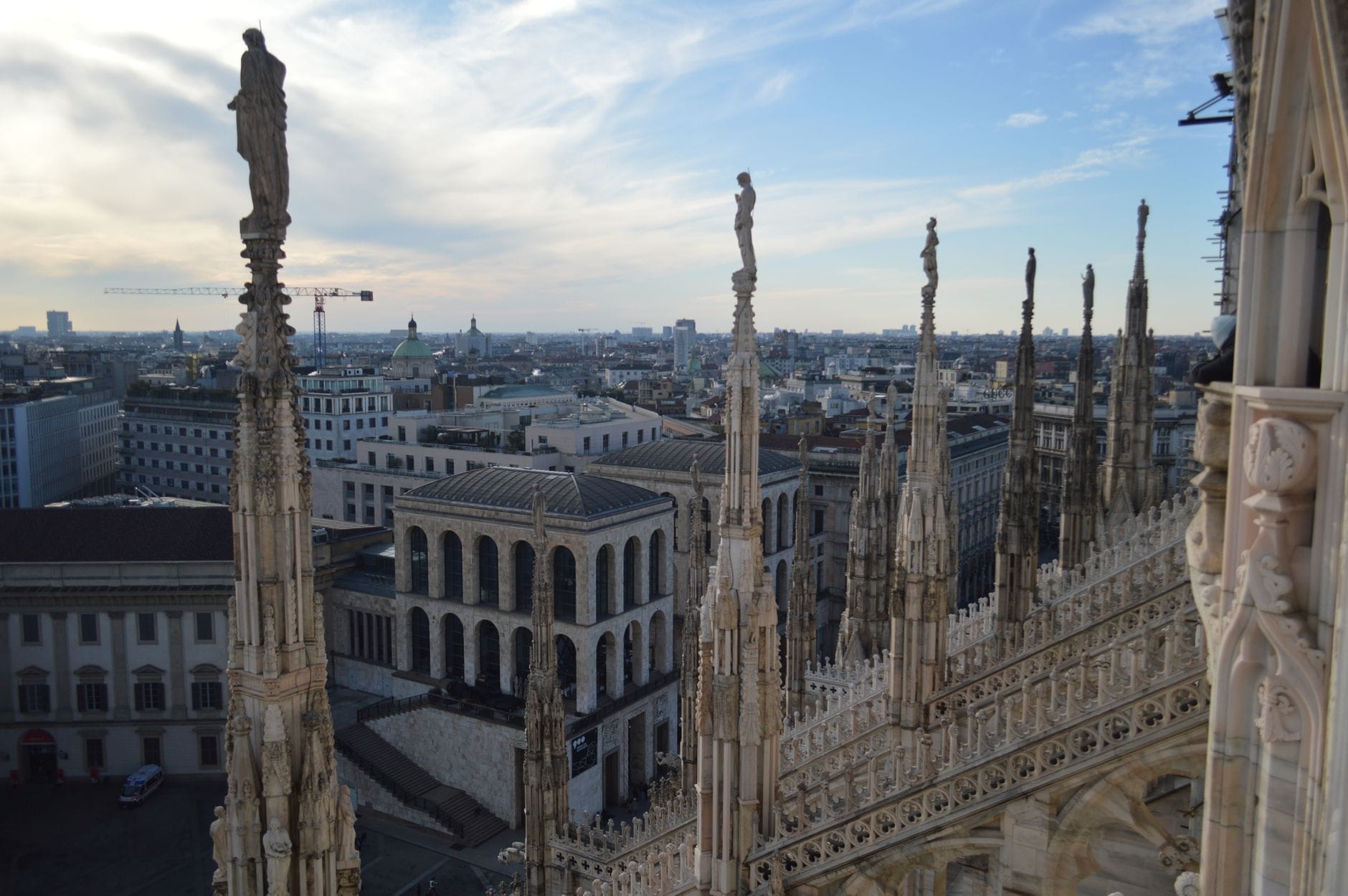
There are two main levels. The first terrace sits approximately 31 metres above ground and runs along the sides of the nave. A second, steeper climb brings you to the Central Terrace at around 45 metres, occupying a large area directly above the main nave interior. This upper level is the primary destination: it is where the density of Gothic ornament becomes almost overwhelming, and where the views over central Milan open in every direction.
💡 Local tip
Book tickets online in advance through the official Duomo website. The rooftop is extremely popular, especially on weekends, and queues for on-the-day tickets can be long. Purchasing ahead also lets you choose your entry time slot.
The Scale of What You Are Looking At
Numbers help here. The terraces host 135 spires, most standing around 17 metres tall. There are over 3,400 statues distributed across the exterior. The Main Spire was constructed between 1765 and 1770, and the gilded copper statue of the Virgin Mary known as the Madonnina was placed at its apex in 1774, standing about 4 metres tall. For two centuries, no building in Milan was permitted to rise above her. That rule no longer holds, but the Madonnina remains the most recognized silhouette in the city.
Walking the terraces, the sheer concentration of carved stone is disorienting in the best way. Each spire tapers to a pinnacle decorated with a single standing figure. The gargoyles, which function as drain spouts, lean out at odd angles over the piazza below. The white Candoglia marble the cathedral is built from has a texture closer to rough limestone than polished stone: pale grey-pink in flat light, almost luminous when the sun catches it at a low angle in the late afternoon. On warm days the stone radiates heat.
The cathedral's dimensions are equally striking. It is approximately 157 metres long and 92 metres wide, built to hold around 40,000 people. From the Central Terrace, you can look straight down the roofline and understand that scale physically in a way no floor plan communicates. For more on the architectural lineage of the building, see the Milan architecture guide.
Tickets & tours
Hand-picked options from our booking partner. Prices are indicative; availability and final rates are confirmed when you complete your booking.
Direct access to Milan Cathedral and Rooftop with guided tour
From 72 €Instant confirmationFree cancellationDirect access to Milan Duomo Cathedral and Rooftop Guided Tour
From 63 €Instant confirmationFree cancellationMilan Cathedral Rooftop skip-the-line tour
From 48 €Instant confirmationFree cancellationSmall-group Milan Duomo tour with rooftop terrace and skip-the-line
From 69 €Instant confirmationFree cancellation
How the Experience Changes by Time of Day
Arriving at opening, around 9:00, means cooler temperatures and significantly thinner crowds. The light at this hour is soft and directional, coming from the east, which casts long shadows between the spires and gives the marble a warmer tone than you get at midday. Photographers consistently prefer this window. The piazza below is quiet enough that you can hear the city waking up: distant tram bells, delivery vehicles, the first tourists gathering near the entrance below.
By 11:00 on any day with good weather, the terraces fill noticeably. Tour groups occupy the central walkways, and the elevator creates a steady stream of new arrivals. The noise level rises. Views are unchanged, but the sense of having the space to yourself is gone. Between roughly 13:00 and 14:00 there is sometimes a slight lull as group tours rotate out, though this is not guaranteed.
The last regular entry slot, typically around 18:00, offers the most dramatic light of the day if the sky is clear. The sun moves toward the northwest in summer and the terraces face west over the city centre, meaning the late afternoon hour catches the Madonnina and the western spires in direct golden light. This is also when the crowds have thinned again. The trade-off is that the terraces close around 19:00 on most days, so you have about an hour. If you use the elevator rather than the stairs, you will spend less time on the ascent and have more time on top.
⚠️ What to skip
On overcast or rainy days, the terraces are still open, but the experience changes considerably. Wet marble surfaces become slippery, and the views across Milan lose their depth. If your main goal is panoramic photography, check the forecast before committing to a specific day.
Stairs or Elevator: Which to Choose
There are two ways up: a staircase and an elevator. Both deliver you to the first terrace level. The stairs give you a gradual transition from street to roof, and the climb is not technically difficult for anyone in reasonable shape, though the steps are narrow and uneven in places. The elevator is faster and considerably less strenuous, and it costs more. For most visitors, the elevator makes sense simply because it saves energy for walking the terraces themselves.
However, getting from the first terrace level to the Central Terrace involves two steep stone stairways regardless of which option you chose for the initial ascent. There is no elevator between the two terrace levels. These connecting stairs are narrow and exposed, with open sides at certain points. Visitors with vertigo, reduced mobility, or difficulty with uneven stone surfaces should factor this in carefully. The first terrace level still offers views and access to the spires, so it is not without merit, but it is visually less complete than the Central Terrace above.
What to Photograph and Where to Stand
The most reproduced shot from the terraces frames the Madonnina on the main spire against the city skyline, with the modern towers of Porta Nuova visible in the distance. You get this best from the Central Terrace, looking northeast. In the foreground you have ranked spires descending in height, which provides depth. A standard zoom lens works well. Wide-angle lenses emphasize the spire forest but can make the cityscape feel distant.
For portraits against the marble statues, the side terraces at the first level are less crowded and give you more flexibility to compose without strangers walking through the frame. The statues at this level are close enough that you can fill a frame with just a single figure and a slice of the city below. Early morning or late afternoon gives you the best directional light for this.
On clear days in winter and early spring, the Alps are visible from the Central Terrace. This is not always mentioned in guidebook descriptions, which tend to focus on the city itself, but the combination of Gothic marble spires in the foreground and snow-covered peaks in the background is genuinely arresting.
💡 Local tip
Bring a wider strap for your camera or bag. The walkways are narrow and you will be adjusting constantly. A small daypack worn on the front is practical on busy days when the passages between spires are congested.
Practical Details and How to Get There
The terraces are open daily, generally from 9:00 to 19:00, with last admission around 18:00–18:10. In peak summer periods, Friday to Sunday rooftop hours may extend to 20:00 with last entry at 19:00. Hours can vary around public holidays and special events; check the official Duomo di Milano website before your visit. Tickets are sold as part of combined packages covering the Cathedral interior, the terraces, and the Duomo Museum in various configurations. The combination ticket including the Cathedral, terrace access by elevator, and the Museum is approximately €26 for adults and around €14 for visitors aged 6 to 18. Children under 6 enter free. Prices are subject to change, so confirm on the official site.
Getting to the Duomo is straightforward from anywhere in central Milan. The closest metro stop is Duomo station, served by both the red M1 line and the yellow M3 line. From the exit you are standing in Piazza del Duomo, looking directly at the cathedral facade. Tram lines 2, 3, 14, and 24 also stop nearby. If you are planning your wider itinerary around the historic centre, the Duomo district guide covers what else is worth your time in the immediate area.
Dress in comfortable shoes with grip. The marble and stone surfaces on the terraces are uneven and, in damp conditions, dangerously slippery. Flat-soled shoes or light hiking shoes are appropriate. In summer, there is no shade on the upper terraces; a hat and sunscreen are practical rather than optional. In winter the wind at elevation is noticeably colder than street level, so an extra layer is worth carrying.
The Duomo terraces are one component of a broader visit to the cathedral complex. The Duomo di Milano interior is a separate, equally worthwhile experience, and the Duomo Museum houses original statues, stained glass, and treasures removed from the exterior over the centuries. Most combined tickets allow you to sequence all three elements across a single day.
Who This Is Not For
If your primary motivation is a panoramic city view rather than the architectural experience itself, other vantage points in Milan may be more rewarding. The terraces sit at 45 metres, which is not high enough to give you a bird's-eye view of the street grid. What you get instead is a close, horizontal view across the city centre, with the spires occupying much of your visual field. That is the point, but it is different from the kind of sweeping urban panorama you might expect from the comparison.
Visitors who want height with a clearer cityscape view might also consider the Torre Branca in Parco Sempione, which offers a different perspective. For a full overview of where to find elevated views across the city, the best views in Milan guide compares the main options.
Visitors with a fear of heights may find parts of the terrace walkways uncomfortable. The passages between spires are open-sided, and the steep connecting stairs between the first and Central Terrace have minimal barriers. The cathedral is not overhyped as an architectural monument, but the terrace experience specifically requires some comfort with exposure at height. The elevator does not remove this element; it only changes how you arrive at the first level.
Insider Tips
- The 9:00 opening slot is consistently the least crowded time of day. If you want the terraces largely to yourself, be at the ticket desk or ticket machine before the doors open. Even a 30-minute head start over tour groups makes a visible difference.
- The first terrace level (31 metres) is less visited than the Central Terrace above, meaning you can spend time with the statues and gargoyles in relative quiet before making the steeper climb. If the crowd above is heavy, the first level is where the more detailed stone carving is anyway.
- In winter, particularly January and February, visibility to the Alps is highest and the terraces are at their least crowded. The marble is cold, and early morning temperatures at elevation can be well below street level, but the clarity of the light and the relative solitude make it a strong season for the visit.
- The Highline Galleria, a rooftop walkway above the adjacent Galleria Vittorio Emanuele II, is close enough to combine with the Duomo terraces on the same afternoon, giving you two very different elevated perspectives on the same piazza without much additional transit.
- If you are buying a combined ticket, check whether it includes the Duomo Museum. The museum houses original 15th-century statues that were removed from the exterior to preserve them, including pieces that predate anything currently visible on the terraces themselves. It adds 30 to 45 minutes and is worth the time.
Who Is Milan Cathedral Rooftop Terraces For?
- First-time visitors to Milan who want the defining city experience
- Architecture and Gothic art enthusiasts who want close contact with the stonework rather than distance from it
- Photographers working in early morning or late afternoon light
- Travelers pairing the terraces with the Cathedral interior and Duomo Museum for a half-day immersion
- Winter visitors who want the Alps visible on the horizon and the thinnest crowds of any season
Nearby Attractions
Other things to see while in Duomo District:
- Chiesa di San Bernardino alle Ossa
Tucked into Piazza Santo Stefano a short walk east of the Duomo, the Chiesa di San Bernardino alle Ossa is one of Milan's most arresting and least-crowded historic interiors. Its 17th-century ossuary chapel is lined floor to ceiling with human skulls and bones, crowned by a luminous baroque fresco. Entry is free.
- Duomo di Milano
The Duomo di Milano is one of the largest Gothic cathedrals in the world, nearly six centuries in the making and still the physical and symbolic heart of the city. This guide covers what to expect inside, how to reach the rooftops, when to visit, and the practical details that make the difference between a rushed stop and a memorable experience.
- Museo del Duomo
The Museo del Duomo di Milano, housed inside Palazzo Reale on Piazza del Duomo, holds six centuries of sculpture, stained glass, and architectural models that the cathedral itself can no longer display. It is quieter than the church next door, considerably less crowded than the rooftop terraces, and far more revealing about how one of the world's most complex Gothic buildings actually came to be.
- Galleria Vittorio Emanuele II
Built between 1865 and 1877 and inaugurated in 1867, the Galleria Vittorio Emanuele II connects Piazza del Duomo to Piazza della Scala beneath a soaring 47-metre glass dome. Entry is free and the arcade never closes, making it one of the most accessible landmarks in northern Italy. Whether you stop for an espresso at a historic café or simply pass through on foot, the architecture alone rewards the detour.