Torre Branca: Milan's Forgotten Viewpoint Tower Worth the Climb
Designed by Gio Ponti in 1933 and standing 108.6 metres above Parco Sempione, Torre Branca is one of Milan's most underrated panoramic viewpoints. The elevator ride takes just minutes, but the view stretches from the Duomo's spires to the Alps on a clear day.
Quick Facts
- Location
- Viale Alemagna (Parco Sempione), 20121 Milano
- Getting There
- Cairoli (M1) or Lanza (M2), then a short walk through Parco Sempione
- Time Needed
- 30–60 minutes including the park walk; the elevator visit itself is about 6–7 minutes
- Cost
- €9 per adult (7+ years), €6 for children 4–6, free for children up to 3; free on Wednesdays for school groups and pensioners
- Best for
- Skyline photography, architecture enthusiasts, evening views of Milan
- Official website
- www.fps-eventi.it/torre-branca
What Torre Branca Actually Is
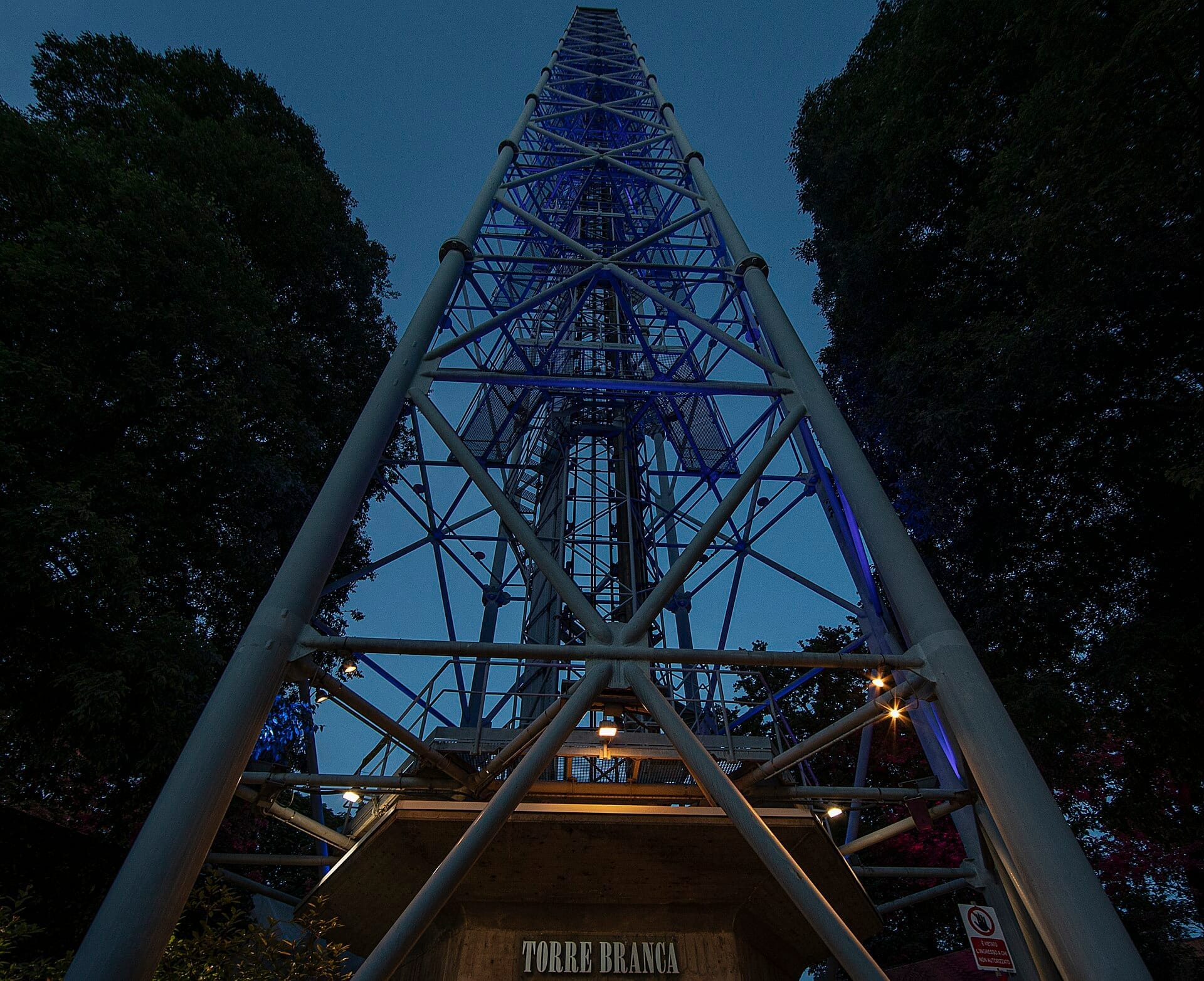
Torre Branca is a 108.6-metre steel observation tower rising from the centre of Parco Sempione, Milan's largest urban park. Designed by the architect Gio Ponti and built in 1933 for the 5th Triennale Exhibition, it was originally called Torre Littoria, a name that reflected the political climate of its era. The structure is an open lattice of iron, slender and almost skeletal against the Milan skyline, looking less like a civic monument and more like something borrowed from an early-twentieth-century world's fair.
After decades of use, the tower was decommissioned in 1972 when it became structurally unusable. It sat dormant for thirty years before Fratelli Branca, the Milan-based distillery known for its namesake amaro, funded a full restoration. In 2002 the tower reopened under its current name. That revival has kept it largely off the radar of tourists who gravitate toward the Duomo's rooftop terraces, which is part of its appeal.
⚠️ What to skip
Torre Branca closes in strong wind or bad weather, and the 2026 public season runs from 26 May to 30 September. Check the official website before visiting, especially if your Milan trip is short.
The View From the Top
Access is by elevator, which holds a maximum of five people per ride. The cabin ascends through the open iron lattice rather than an enclosed shaft, so the city unfolds around you as you rise. At the top, a glazed observation cabin offers 360-degree views. The canopy of Parco Sempione stretches directly below, the tree cover giving the city a density of green you would not expect this close to the centre.
To the southeast, the Castello Sforzesco sits close enough that you can read its battlements clearly. The Duomo's white marble forest of spires is visible further east, and on days with good visibility, the Alps form a sharp white line across the northern horizon. In spring and early autumn, before haze builds, the mountain backdrop is striking enough to anchor an entire photograph.
For comparison, the Duomo rooftop terraces put you among the Gothic spires but keep you at a lower elevation. Torre Branca sits higher and gives a flatter, more map-like perspective on the city grid, which suits skyline photography better than intimate architectural detail.
Tickets & tours
Hand-picked options from our booking partner. Prices are indicative; availability and final rates are confirmed when you complete your booking.
Torre Branca tickets
From 6 €Instant confirmationFree cancellationMilan Guided Tour of Branca Tower, Parco Sempione and Sforza Castle
From 40 €Instant confirmationFree cancellationDuomo Cathedral private tour with a local guide
From 105 €Instant confirmationFree cancellationSforza Castle entry and self-guided tour
From 15 €Instant confirmationFree cancellation
Best Time of Day to Visit
The tower opens in several specific time windows each day during the public season (for 2026, between 26 May and 30 September), with morning, afternoon, and evening sessions that noticeably change the experience.
The evening session, running from 20:30 to midnight, is the one that surprises visitors. As the city lights come on, the street grid of Milan resolves into a warm, amber mesh beneath you. The Castello is often lit dramatically from below, and the distant glow of Porta Nuova's towers to the northeast reads like a second skyline within the skyline. Queues are shorter in the evening sessions on weekdays, and the temperature at the top is more comfortable in summer than the midday heat.
💡 Local tip
The evening session on a Tuesday or Thursday tends to be the quietest based on typical visitor patterns. Weekend afternoon slots between 14:30 and 19:30 draw the largest crowds, particularly in June and July.
Gio Ponti and the Architecture of the Tower
Gio Ponti is one of the defining figures of twentieth-century Italian design, and Torre Branca is one of his earliest large-scale built works. Ponti went on to design the Pirelli Tower, Milan's first true skyscraper, completed in 1958, but in 1933 he was working in a different register: a temporary exhibition structure that needed to make a visual statement quickly and at height.
The tower's open lattice was a practical and aesthetic choice simultaneously. It reduces wind resistance (a genuine structural concern at this height), and it gives the structure a transparency that a solid tower would not have. From the park below, the tower reads almost as a drawing against the sky rather than a solid object. Visitors interested in Ponti's broader legacy in Milan can trace his influence through the city's postwar architecture, and a Milan architecture guide provides useful context for understanding that lineage.
Getting There and Practical Logistics
Torre Branca sits inside Parco Sempione, the 47-hectare park that stretches northwest from Castello Sforzesco. The most direct approach is from the Cairoli Castello stop on the M1 red line: exit toward the Castello, pass through the castle's central courtyard, and enter the park through the rear gate. The tower is visible from a distance, its steel frame rising above the tree line. The walk from the metro takes about ten minutes at a comfortable pace.
Cadorna FN station (M1 and M2 lines) is an alternative entry point for those approaching from the south side of the park. Tram lines also serve Largo Cairoli nearby. Cycling into the park is possible, and the flat terrain of the Po Valley city makes the approach easy from most central neighborhoods.
The elevator is the only means of ascent, which makes the tower accessible for most visitors who can manage the short outdoor walk from the park entrance. The platform at the top is enclosed and glazed. Visitors with severe vertigo should note that the elevator ride itself passes through the open structure, with the city visible on all sides during the ascent, which some find disorienting before they reach the cabin.
ℹ️ Good to know
The 2026 public season runs from 26 May to 30 September. The tower does not operate year-round. Outside this window, it is closed to visitors.
What to Combine It With
Torre Branca sits inside a park that rewards slow exploration before or after the tower visit. The Parco Sempione itself has an artificial lake, the neoclassical Arco della Pace at its northwest edge, and the Arena Civica, a 19th-century amphitheatre still used for events. Allowing an extra hour to walk the park adds real value to the trip without extra cost.
The Castello Sforzesco is effectively next door. Its museums house collections ranging from Egyptian antiquities to Michelangelo's final unfinished sculpture, the Rondanini Pietà. The Musei del Castello Sforzesco admission is separate, but pairing the two visits makes sense geographically. The Triennale Design Museum is also within the park grounds, directly adjacent to the tower's base, giving design-focused visitors a natural double.
Visitors thinking about multiple panoramic viewpoints across the city can compare this perspective with the best views in Milan to decide which combination suits their itinerary.
The Trade-Offs
Torre Branca is not a polished tourist experience. There is no multimedia exhibition, no café at the top, and no historical display in the base building. You take the elevator, you look at Milan from 108.6 metres, and you come back down. The entire experience takes under ten minutes once you are inside. At €9 that is reasonable for the quality of the view, but visitors expecting something more programmatic may feel underwhelmed.
The attraction works best for people who derive genuine satisfaction from seeing a city from above, for photographers wanting the Castello Sforzesco in their foreground, or for anyone who wants to understand Milan's spatial layout before spending days walking through it. It is also a legitimate piece of twentieth-century architectural heritage that deserves to be seen in context.
Visitors primarily interested in interiors, art, or cultural depth should weight their limited time elsewhere. Milan has museums and churches that reward a longer investment of attention. But if you are spending half a day in the Sempione area, fitting Torre Branca into that time costs very little and pays back a genuinely distinctive angle on the city.
Insider Tips
- Wednesday mornings offer free entry for pensioners and school groups, but this means the morning session (10:30–12:30) on Wednesdays can be busier with local visitors. If you qualify but want more space, consider the 20:30 evening slot instead, when crowds thin out regardless of the day.
- The tower faces northwest over the park, which means the afternoon sun in summer hits the observation cabin directly from the west, creating harsh glare through the glass. For clear photography, the morning session or the post-sunset evening session produce better results.
- Dress for wind even in summer. At 108.6 metres the temperature is noticeably cooler than ground level, and a breeze that feels mild in the park can be persistent at the top.
- The Triennale Design Museum is immediately next to the tower's base and shares the same cultural precinct. Its courtyard café is a practical place to wait if there is a short queue for the elevator, and it is free to enter the building's ground-floor spaces.
- Check the weather forecast for the day before visiting. The tower closes without notice in strong wind or poor weather, so call ahead or check the official website on the morning of your visit.
Who Is Torre Branca For?
- Photographers wanting the Castello Sforzesco and city grid in a single elevated frame
- Architecture enthusiasts tracking Gio Ponti's early career in Milan
- First-time visitors who want a spatial overview of the city before exploring on foot
- Evening walkers combining the park, the Arco della Pace, and a rooftop view in one outing
- Budget-conscious travelers looking for a high-quality view at a lower price than comparable options
Nearby Attractions
Other things to see while in Castello & Sempione:
- Acquario Civico di Milano
Opened in 1906 for Milan's International Expo, the Acquario Civico di Milano is one of the oldest aquariums in Europe, housed in a Liberty-style building inside Parco Sempione. At €8 entry, it offers a quiet, unhurried contrast to the city's blockbuster attractions.
- Arco della Pace
The Arco della Pace stands at the northwestern edge of the city, marking the historic entrance to Milan via Corso Sempione. Built over five decades, started under Napoleon and finished under Austrian rule, it tells the story of a city pulled between empires — and looks striking doing it. Entry is free, the surrounding square is open daily, and the arch connects directly to Parco Sempione.
- Castello Sforzesco
Castello Sforzesco is a major castle complex in Milan, housing nine civic museums within its Renaissance walls, including Michelangelo's unfinished Pietà Rondanini. The castle grounds are free to enter daily, making it one of Milan's most rewarding and accessible attractions.
- Musei del Castello Sforzesco
The Musei del Castello Sforzesco pack nine civic museum collections into one of northern Italy's most striking 15th-century fortresses. From Michelangelo's unfinished final sculpture to Egyptian mummies and Renaissance tapestries, this is Milan's most underrated museum complex — and one of its best-value cultural experiences.