Parco Sempione: Milan's Green Heart Behind the Castle
Parco Sempione is Milan's answer to a proper city park: 386,000 square metres of English-garden landscape tucked directly behind Castello Sforzesco, free to enter, and open late in the evening. From morning joggers to aperitivo crowds, it shows a different side of the city entirely.
Quick Facts
- Location
- Piazza Sempione, 20154 Milan (behind Castello Sforzesco)
- Getting There
- Cadorna (M1), Cairoli (M1), Lanza (M2); Trams 1, 2, 4, 12, 14, 19
- Time Needed
- 1–3 hours depending on pace and stops
- Cost
- Free entry
- Best for
- Afternoon walks, picnics, families, photography, evening strolls
What Parco Sempione Actually Is
Parco Sempione is the largest park in Milan's city centre: a sprawling 386,000-square-metre expanse of lawns, winding paths, artificial hills, and a small lake, laid out in the English-garden tradition between 1890 and 1893. It sits directly behind Castello Sforzesco, separated from the castle walls by just a few steps, and connects that medieval monument to the Arco della Pace at the park's northwestern edge. The entire perimeter is fenced and monitored, giving it a contained, safe character even in the evening.
The land has a long history before the park. It was first the Visconti ducal hunting ground, known as the 'Barcho,' then repurposed as a military parade ground called the Piazza d'armi before the municipality commissioned Emilio Alemagna to transform it into a public park. The English-garden style Alemagna chose was a deliberate contrast to the formal, symmetrical gardens common in Italian civic spaces: no straight axes, no clipped hedgerows, just naturalistic curves, sloping terrain, and water features that give the impression of countryside dropped into the middle of a metropolis.
💡 Local tip
The park opens at 06:30 daily. In summer (June–September) it stays open until about 23:30, making it one of the few large green spaces in any Italian city where you can sit outside well after dark without being moved on.
How the Park Changes Through the Day
Early mornings belong to runners and dog walkers. By 07:30 on a weekday, the main oval path around the interior is populated with a steady circuit of joggers, many of them office workers squeezing in a run before commuting. The light at this hour, filtering through the plane trees and oaks, has a particular quality that photographers who focus on urban greenery tend to seek out. The ground smells of damp grass and, near the lake, something faintly brackish.
Midday brings families and tourists, particularly in spring and autumn. The grassy slopes fill up with picnic blankets. Children gravitate to the open lawns near the central lake, where ducks and coots move between patches of reed. On hot summer days, shade becomes the primary commodity, and the tree canopy along the eastern edge, near the Triennale di Milano building, is where most people cluster. In July and August, the heat can be oppressive between noon and 16:00, and the park is at its least comfortable during those hours.
The most underrated window is late afternoon into early evening, roughly 17:00 to 20:00. The light softens, the temperature drops several degrees, and the park takes on a social character that is distinctly Milanese. Locals spread out on the grass with bottles of wine and charcuterie, students cluster near the Torre Branca, and the paths see a constant, unhurried flow of people simply walking. This is aperitivo hour diffused across open space, and it captures something genuine about how the city uses its parks.
⚠️ What to skip
Avoid the park on weekend afternoons in June and July when it reaches peak capacity. Paths near the main lake become crowded, café queues grow long, and finding a shaded spot on the grass requires patience. Weekday evenings are significantly more comfortable.
Tickets & tours
Hand-picked options from our booking partner. Prices are indicative; availability and final rates are confirmed when you complete your booking.
Milan Guided Tour of Branca Tower, Parco Sempione and Sforza Castle
From 40 €Instant confirmationFree cancellationDuomo Cathedral private tour with a local guide
From 105 €Instant confirmationFree cancellationSforza Castle entry and self-guided tour
From 15 €Instant confirmationFree cancellationSkip-the-line Duomo tour in Milan
From 40 €Instant confirmationFree cancellation
What to See Inside the Park
The Lake and Central Lawn
The artificial lake at the park's centre is modest in size but serves as its visual anchor. A small bridge spans one end, and the surrounding lawn is the flattest, most open part of the park, making it the default gathering spot. The water reflects the tree line and, on clear days, catches the upper profile of the Castello Sforzesco towers visible above the southern treeline. It is not a dramatic landscape feature, but it gives the park a focal point that open grassland alone would lack.
Torre Branca
The slender steel tower rising from the park's northwestern quadrant is the Torre Branca, designed by Gio Ponti and BBPR for the 1933 Triennale. It stands 108.6 metres tall and offers what is arguably the clearest aerial view of Parco Sempione itself, with the castle and the Arco della Pace visible in one frame. Opening hours are limited and seasonal, so confirm before planning a visit around it. The tower is not the reason most people come to the park, but if it happens to be open, the perspective from the top reframes the scale of the green space below.
Triennale di Milano
On the park's eastern edge sits the Triennale Design Museum, housed in Giovanni Muzio's 1933 Palazzo dell'Arte. The Triennale stages rotating design and contemporary art exhibitions and has a well-regarded café terrace that opens onto the park. Even visitors not entering the museum often use the terrace as a rest stop. The combination of good coffee, a shaded terrace, and a direct view across the park's lawns makes it worth factoring into your visit.
Arco della Pace and the Northern Exit
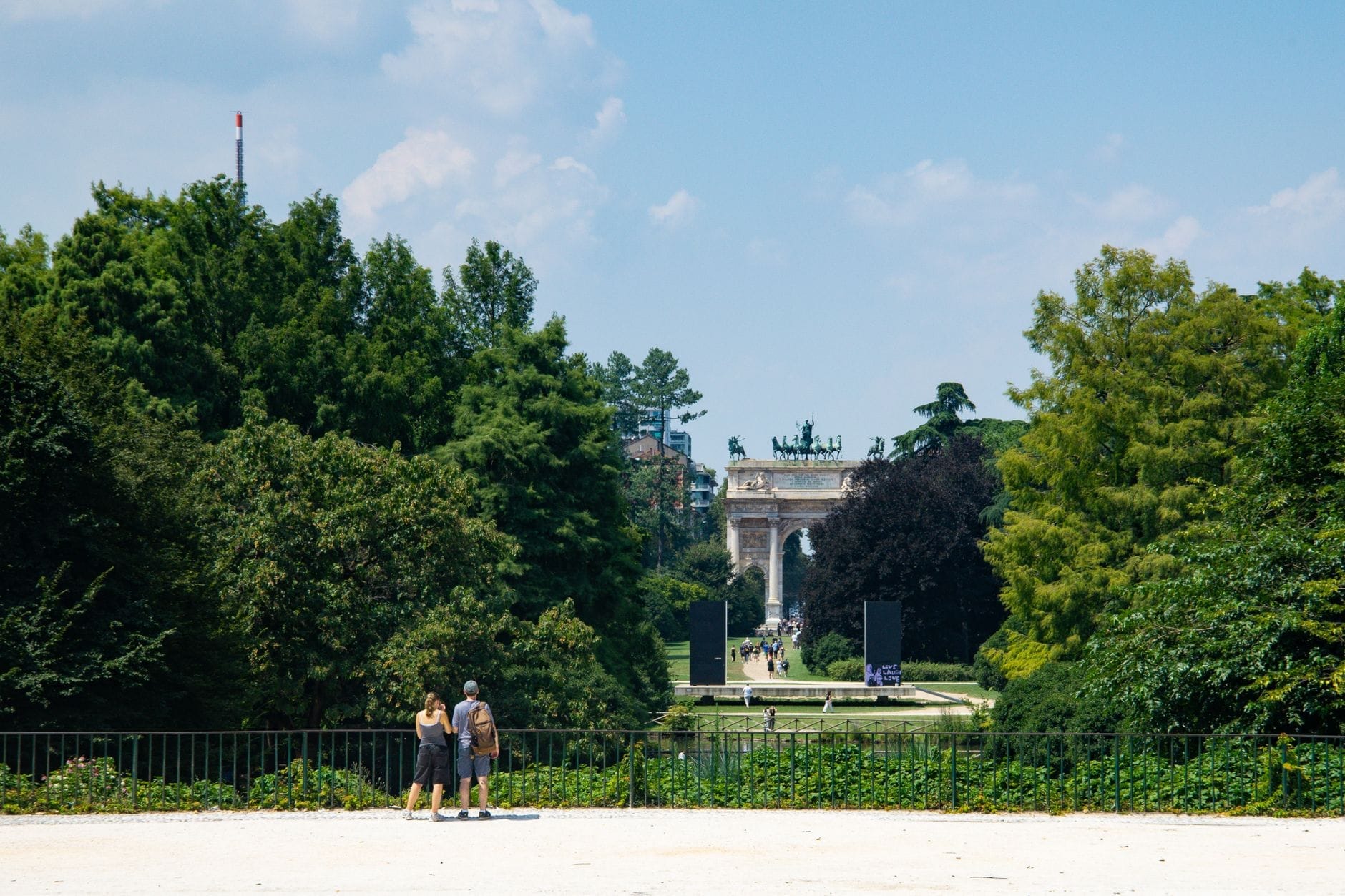
Walking northwest through the park leads to the Arco della Pace, the neoclassical triumphal arch completed in 1838 that marks the end of Corso Sempione. The arch is technically outside the park boundary but is the natural endpoint of the main northwest axis through the grounds. Seen from inside the park, framed by the avenue of trees leading to it, the arch reads as the park's formal terminus and provides one of the more photogenic long-distance shots available on this side of Milan.
Historical and Cultural Context
Parco Sempione's relationship with Castello Sforzesco is not incidental. The castle's outer walls form the park's southern boundary, and the two sites function as a single spatial experience for most visitors. The castle was the seat of the Sforza duchy from the fifteenth century; the land behind it shifted from aristocratic hunting ground to military use before finally becoming a public park under the newly unified Italian state. The decision to open it to the public in 1888, with planting completed by 1893, was part of a broader urban modernization effort as Milan grew into an industrial powerhouse.
The English-garden design was not merely aesthetic. At a moment when continental European parks were still largely formal and axial, choosing a naturalistic layout was a civic statement: this was a park for leisure and spontaneous use, not for ceremony. That original intention has held. Parco Sempione today is actively used by locals as a daily resource, not just a tourist backdrop, which distinguishes it from more manicured city-centre parks elsewhere in Italy.
For visitors particularly interested in Milan's architectural and design heritage, the park sits at the intersection of several important periods: the medieval castle, the nineteenth-century English garden, Gio Ponti's modernist tower, and Muzio's rationalist Triennale building. It is a compressed timeline of how Milan has shaped and reshaped its public spaces. This context is worth keeping in mind when reading the broader Milan architecture guide.
Practical Walkthrough: How to Approach a Visit
Most visitors enter from the southern gate adjacent to Castello Sforzesco, which places them immediately on the main central path. From here, the lake is visible within two or three minutes of walking. The main loop around the interior takes roughly 30 to 40 minutes at a relaxed pace. If you want to reach the Arco della Pace, add another 15 minutes in each direction on the northwestern path.
The park is fully fenced with several gated entrances. The southern entrance near the castle (accessible from Largo Cairoli or the castle courtyard) and the northwestern exit toward the Arco della Pace are the most used. There are public toilets inside the park, along with a café-bar in the central area and the Triennale terrace on the eastern side.
Getting there is straightforward. From the city centre, the Cadorna or Cairoli metro stops on M1 (red line) put you at the park's edge quickly. Lanza on M2 (green line) delivers you to the northern side. Multiple tram lines, including 1, 2, 4, 12, 14, and 19, stop nearby. If you are coming from the Brera neighborhood, the park is a short walk west.
ℹ️ Good to know
The park closes at different times depending on the season: around 21:00–22:00 from October through April, and as late as 23:00–23:30 in summer months. Gates are locked at closing, so watch the time if you are visiting in the evening.
Accessibility across the main paths is generally good: the primary routes are paved or compacted gravel, reasonably flat near the lake and central areas, though some of the artificial hillside paths involve gentle inclines. The park is not fully wheelchair-accessible throughout, but the central areas and main thoroughfares are manageable. Wear comfortable walking shoes; the grass areas can be uneven and damp after rain.
Photography Notes
Early morning light from the east hits the park's open lawn beautifully and the castle towers glow in the first hour after sunrise. The lake reflects well at this time of day when the surface is still. Late afternoon, particularly in autumn, brings warm directional light through the mature tree canopy that makes the interior paths look like a different city entirely.
For wide-angle shots that include the Arco della Pace, position yourself on the central path pointing northwest. For the castle, exit through the southern gate and shoot back from the Largo Cairoli side rather than from inside the park, where the trees obscure the full profile. The Triennale terrace is a useful elevated vantage point for shooting across the northern half of the park.
Who Should Manage Their Expectations
Parco Sempione is a working city park, not a manicured showpiece. It has worn patches of lawn, ordinary park benches, and a café that is functional rather than special. Visitors expecting the precision of, say, a formal Italian garden will find it unpolished. The same applies to anyone visiting purely to see a single famous feature: the park is best experienced as a whole rather than as a vehicle for a specific landmark.
In winter, the park is considerably less appealing. The trees lose their leaves, the grass turns muddy in wet weather, and the closure time drops to around 21:00–22:00. Milan winters are damp and often grey, and an empty park in those conditions requires a tolerance for bleak urban aesthetics. The castle and Triennale remain reasons to visit the area, but the park itself is a secondary draw in the colder months.
Insider Tips
- The Triennale café terrace is one of the better spots in central Milan for a coffee with a view. It faces directly onto the park's eastern lawn and stays busy but rarely overwhelmed. It is also a legitimate reason to sit for an hour without feeling pressured to buy museum tickets.
- If you are visiting Castello Sforzesco, walk through the castle's main courtyard and exit through the rear gate rather than doubling back. This drops you directly into the southern end of Parco Sempione and makes the two sites feel like one continuous experience rather than separate stops.
- The park's least-used entrance is from the northwest, near the Arco della Pace on Piazza Sempione. Approaching from this direction reverses the usual flow and gives you the long tree-lined approach toward the castle rather than away from it. The perspective is considerably more dramatic.
- Check whether Torre Branca is open before building your schedule around it. Hours are limited and can be irregular; the tower closes for private events and does not follow a predictable daily schedule. The park visit is complete without it, but the view from the top is genuinely worth the climb if timing allows.
- Flat areas near the lake fill up fast on sunny weekend afternoons. If you want grass space, aim for the slopes on the park's western side, which see less traffic and offer a slightly elevated view across the park toward the castle.
Who Is Parco Sempione For?
- Families with children looking for open space and fresh air in the city centre
- Architecture and design enthusiasts combining the park with Castello Sforzesco and the Triennale
- Photographers seeking natural light and urban landscape combinations
- Travelers wanting a free, low-effort afternoon away from Milan's main commercial streets
- Couples looking for a quiet evening walk with late opening hours in summer
Nearby Attractions
Other things to see while in Castello & Sempione:
- Acquario Civico di Milano
Opened in 1906 for Milan's International Expo, the Acquario Civico di Milano is one of the oldest aquariums in Europe, housed in a Liberty-style building inside Parco Sempione. At €8 entry, it offers a quiet, unhurried contrast to the city's blockbuster attractions.
- Arco della Pace
The Arco della Pace stands at the northwestern edge of the city, marking the historic entrance to Milan via Corso Sempione. Built over five decades, started under Napoleon and finished under Austrian rule, it tells the story of a city pulled between empires — and looks striking doing it. Entry is free, the surrounding square is open daily, and the arch connects directly to Parco Sempione.
- Castello Sforzesco
Castello Sforzesco is a major castle complex in Milan, housing nine civic museums within its Renaissance walls, including Michelangelo's unfinished Pietà Rondanini. The castle grounds are free to enter daily, making it one of Milan's most rewarding and accessible attractions.
- Musei del Castello Sforzesco
The Musei del Castello Sforzesco pack nine civic museum collections into one of northern Italy's most striking 15th-century fortresses. From Michelangelo's unfinished final sculpture to Egyptian mummies and Renaissance tapestries, this is Milan's most underrated museum complex — and one of its best-value cultural experiences.