Triennale Milano Design Museum: Where Italian Design Comes Into Focus
Housed in Giovanni Muzio's striking 1933 Palazzo dell'Arte beside Parco Sempione, Triennale Milano is a major Italian institution for design history and contemporary creative culture. General access is free, with ticketed exhibitions rotating through the year across architecture, fashion, industrial design, and the performing arts.
Quick Facts
- Location
- Viale Emilio Alemagna 6, 20121 Milano (Castello Sempione)
- Getting There
- Metro M1/M2 Cadorna – Triennale; Milano Cadorna rail station; Bus 61 stop Triennale; nearby BikeMi docking stations in Parco Sempione
- Time Needed
- 1.5 to 3 hours depending on current exhibitions
- Cost
- Free general access; ticketed exhibitions vary by event (online tickets generally discounted by €2 compared to onsite purchase)
- Best for
- Design and architecture enthusiasts, cultural travelers, students of Italian modernism
- Official website
- triennale.org/en
What Triennale Milano Actually Is
The Triennale Milano Design Museum is not a typical museum where you walk through permanent rooms of glassware and labeled placards. It is an active cultural institution, part permanent collection, part rotating exhibition program, part theater venue, part design bookshop and cafe. The building has been at the center of Italian design discourse since 1923, when the institution was founded in Monza as a triennial international exhibition of decorative arts and modern architecture, and the Triennale Design Museum, a dedicated permanent space within the building, opened formally in 2007.
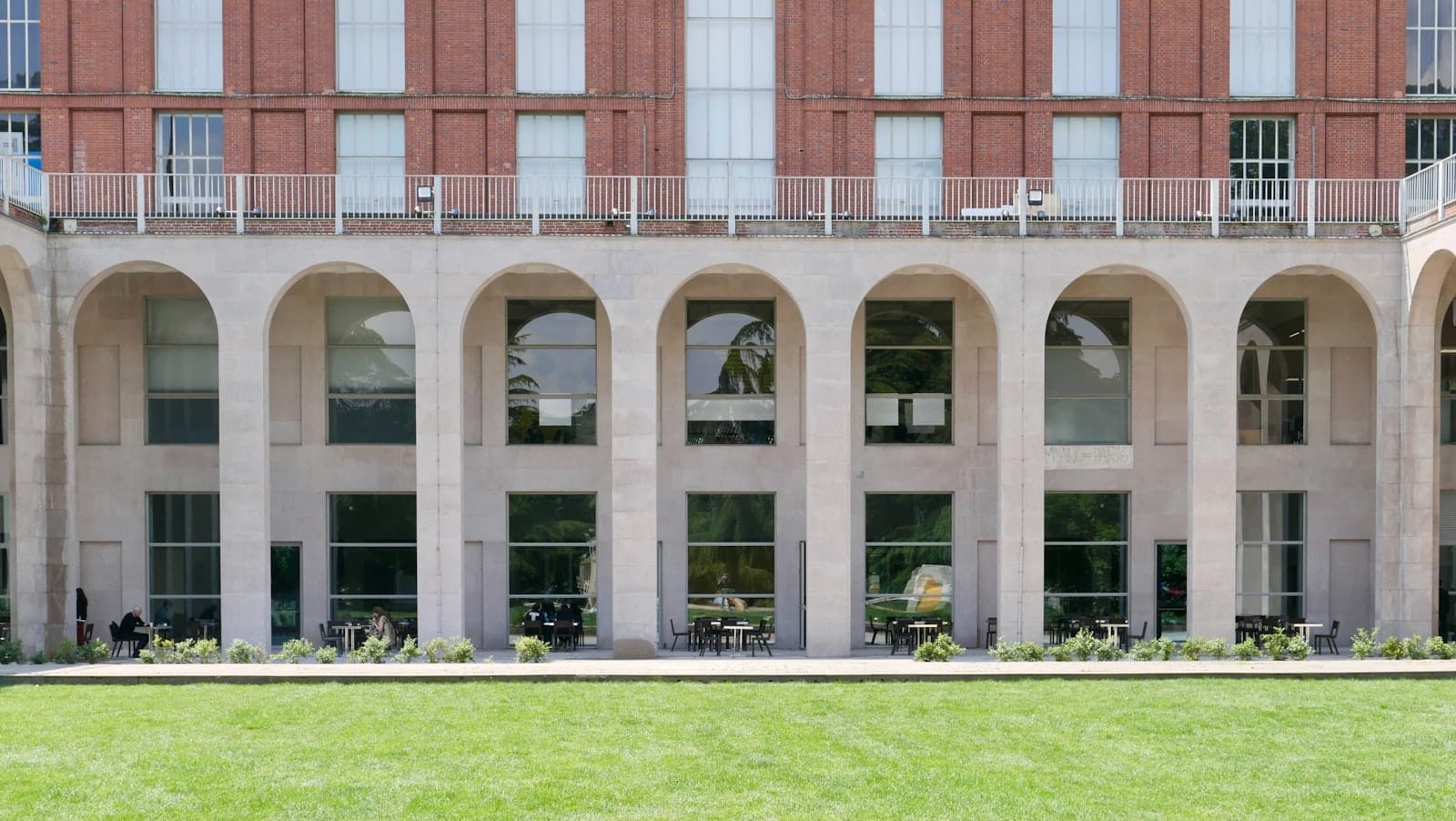
The museum occupies the Palazzo dell'Arte, a rationalist building completed in 1933 to designs by Milanese architect Giovanni Muzio, financed by the Bernocchi family. Muzio used a restrained but monumental classical-rationalist language: the long horizontal facade, the arched entrance loggia, and the generous interior volumes all signal a building designed for serious public purpose. It sits at the edge of Parco Sempione, Milan's largest central park, which means the approach on foot through the park is itself a reward.
ℹ️ Good to know
General access to the Triennale building, garden, and public spaces is free. Individual exhibitions, theater performances, and concerts require tickets, which vary by event. Buying online generally saves €2 per ticket compared to the on-site price.
The Building and the Approach
Approaching from Cadorna station, you walk west along Viale Emilio Alemagna, a tree-lined boulevard that separates the Parco Sempione greenery from the road. The Palazzo dell'Arte appears gradually, its cream-colored travertine-clad facade stretching wide and low against the sky. The main entrance faces the park rather than the street, which means first-time visitors sometimes circle briefly before finding the right door. The entrance loggia, with its deep arches and smooth stone floor, provides a transition zone between the noise of the avenue and the quieter interior.
Once inside, the ground floor is generously proportioned and mostly free to move through. The lobby connects to the cafe, the bookshop (one of the better design bookshops in Milan, with Italian-language monographs and international titles), and the main exhibition halls. Natural light from clerestory windows and large glazed openings keeps the space from feeling closed. The building itself rewards attention: the rationalist details, cornices, and ironwork are legible from a slow walk through the public areas even without buying an exhibition ticket.
Tickets & tours
Hand-picked options from our booking partner. Prices are indicative; availability and final rates are confirmed when you complete your booking.
Serravalle Designer Outlet shopping tour from Milan
From 22 €Instant confirmationFree cancellationDuomo Cathedral private tour with a local guide
From 105 €Instant confirmationFree cancellationSforza Castle entry and self-guided tour
From 15 €Instant confirmationFree cancellationSkip-the-line Duomo tour in Milan
From 40 €Instant confirmationFree cancellation
The Permanent Collection and Rotating Exhibitions
The permanent collection of the Triennale Design Museum traces the history of Italian design from the early twentieth century through the present. The objects range from industrial and product design to furniture, graphics, and fashion-adjacent material culture. The collection is presented thematically and chronologically in turns, with the display often reorganized to reflect the themes of whatever major temporary exhibition is running alongside it. This means the permanent collection never feels entirely static.
Rotating exhibitions cover the full range of design culture: architecture, urban planning, photography, product design, textile, digital media. The programming connects directly to Milan's status as a global design capital, particularly around Milan Design Week, when the Triennale typically anchors large-scale shows. During that period in April, the building and gardens become exceptionally active, with installations extending outdoors and evening programming drawing large crowds.
The theater and auditorium spaces are used for performances, film screenings, and lectures, which adds another dimension to the visit if you time it well. Check the official program calendar on the Triennale website before you arrive.
💡 Local tip
Always check triennale.org/en before visiting. The program changes frequently and some periods between major exhibitions offer limited ticketed content. Arriving without checking risks finding the exhibition halls closed or between shows.
How the Experience Changes by Time of Day
Mornings from opening at 10:30 am are the quietest period. The cafe is still warming up and most of the school groups and organized tours arrive later. If you are interested in spending time with the permanent collection or reading wall texts without competition for space, Tuesday through Thursday mornings are the best window.
By early afternoon, particularly on weekends, the ground floor and cafe fill noticeably. The garden terrace, which overlooks Parco Sempione from the back of the building, becomes popular as a lunch or coffee stop. The light in the main halls is flattering for photography from around 2:00 to 4:00 pm, when the sun angles through the upper windows without direct glare. The museum generally closes around 8:00 pm Tuesday through Sunday, which makes a late-afternoon visit followed by a walk through the park a natural way to end the day.
During special openings and vernissages tied to major exhibitions, the building stays open with an entirely different atmosphere: evening events draw a design-industry crowd and the energy shifts from contemplative to social. These events are usually listed on the official website and through Italian cultural event calendars.
Historical and Cultural Context
The Triennale institution was founded in 1923 in Monza as a triennial international exhibition of decorative arts and modern architecture. It relocated to Milan in 1933 when the Palazzo dell'Arte was completed. Over the following decades, the Triennale exhibitions became landmarks in twentieth-century design history, attracting participation from figures like Gio Ponti, BBPR, Achille and Pier Giacomo Castiglioni, and Ettore Sottsass at various points. The building witnessed some of the most significant debates in Italian modernism.
Today, the Triennale sits in a neighborhood that concentrates several of Milan's most significant cultural sites within walking distance: the Castello Sforzesco is less than ten minutes east, and the Parco Sempione directly adjoins the building. The Torre Branca observation tower, a 1933 steel structure by Gio Ponti, stands in the park immediately behind the Triennale and is visible from the garden terrace.
For anyone following Milan's broader design and architecture story, the Triennale works well as a complement to the Museo Nazionale della Scienza e della Tecnologia further south and to the architectural landmarks scattered across the city.
Practical Details: Getting There, Accessibility, and What to Bring
The most direct route is Metro lines M1 (red) or M2 (green) to Cadorna, which also serves the suburban Cadorna rail terminal for regional trains. From the station exit, the walk to the Palazzo dell'Arte takes about eight minutes along Viale Emilio Alemagna. Bus line 61 stops directly at the Triennale stop. If you are cycling, BikeMi docking stations in Parco Sempione are close to the entrance.
The building is presented as accessible to all visitors, with level access from the main entrance. Assistance dogs are permitted with appropriate disability documentation. Other animals are not allowed, including in the garden. For detailed information about lifts, hearing loops, or specific mobility services, contacting the museum directly via its official website is advisable before visiting.
There is no strict dress code. The interior is climate-controlled, so a light layer in summer is useful. The garden can be exposed in full sun, and the park walk from Cadorna can feel warm on hot July and August days. Bringing a water bottle makes the summer visit more comfortable. Photography is generally permitted in the permanent collection and public spaces; rules for temporary exhibitions vary, and signs at each entrance hall are usually clear.
⚠️ What to skip
The Triennale is closed on Mondays. Arriving on a Monday, even if the park around it is open, means finding the museum shut. Double-check opening hours on the official website before planning your visit, especially around Italian public holidays.
Who This Is For
The Triennale rewards visitors who arrive with some baseline interest in design, architecture, or Italian visual culture. The permanent collection is genuinely informative for anyone curious about how Italian design developed its international reputation across the twentieth century. The rotating exhibitions are often at a high curatorial level and regularly travel to major institutions internationally afterward.
Travelers with no particular interest in design who are hoping for a visually spectacular experience comparable to a major painting collection are likely to find it underwhelming, particularly if the current temporary exhibition happens to be conceptual or text-heavy. The building itself is architecturally interesting but does not compensate entirely if the programming does not connect with you. For families with young children, the space is navigable but not specifically oriented toward interactive or child-focused programming.
For design students, professionals, and anyone following Italian modernism or contemporary creative culture, this is one of the more reliable and consistently programmed institutions in Milan. The free base access also makes it easy to step in briefly, check the bookshop, have a coffee in the garden overlooking the park, and leave without feeling the visit needed to justify a ticket price.
Insider Tips
- The bookshop on the ground floor is worth visiting independently of any exhibition. It carries Italian-language design monographs, catalogs from past Triennale shows, and international titles that are harder to find elsewhere in Milan.
- The garden terrace at the rear of the building overlooks Parco Sempione and the Torre Branca. Even if you skip the exhibitions entirely, this is one of the more pleasant spots in the Castello Sempione neighborhood for a coffee break.
- If you are visiting during Milan Design Week in April, book exhibition tickets several weeks in advance. The Triennale is one of the focal points of the event and the main halls can reach capacity on peak days.
- Online ticket purchases generally save €2 per ticket compared to buying at the door. Given that some exhibitions carry meaningful ticket prices, the saving adds up for groups.
- Tuesday mornings are consistently the quietest time for the permanent collection. Weekday afternoons after 3:00 pm also tend to be calmer than weekend mornings, which attract organized groups and families.
Who Is Triennale Milano Design Museum For?
- Design and architecture enthusiasts wanting context for Italy's creative legacy
- Cultural travelers building a broader itinerary across Milan's museums and institutions
- Students and professionals in design, fashion, or architecture fields
- Visitors pairing the museum with a walk through Parco Sempione and a visit to Castello Sforzesco
- Anyone attending Milan Design Week who wants a serious institutional anchor to the week's events
Nearby Attractions
Other things to see while in Castello & Sempione:
- Acquario Civico di Milano
Opened in 1906 for Milan's International Expo, the Acquario Civico di Milano is one of the oldest aquariums in Europe, housed in a Liberty-style building inside Parco Sempione. At €8 entry, it offers a quiet, unhurried contrast to the city's blockbuster attractions.
- Arco della Pace
The Arco della Pace stands at the northwestern edge of the city, marking the historic entrance to Milan via Corso Sempione. Built over five decades, started under Napoleon and finished under Austrian rule, it tells the story of a city pulled between empires — and looks striking doing it. Entry is free, the surrounding square is open daily, and the arch connects directly to Parco Sempione.
- Castello Sforzesco
Castello Sforzesco is a major castle complex in Milan, housing nine civic museums within its Renaissance walls, including Michelangelo's unfinished Pietà Rondanini. The castle grounds are free to enter daily, making it one of Milan's most rewarding and accessible attractions.
- Musei del Castello Sforzesco
The Musei del Castello Sforzesco pack nine civic museum collections into one of northern Italy's most striking 15th-century fortresses. From Michelangelo's unfinished final sculpture to Egyptian mummies and Renaissance tapestries, this is Milan's most underrated museum complex — and one of its best-value cultural experiences.