Castello Sforzesco: Milan's Fortress, Art Treasury, and Urban Escape
Castello Sforzesco is a major castle complex in Milan, housing nine civic museums within its Renaissance walls, including Michelangelo's unfinished Pietà Rondanini. The castle grounds are free to enter daily, making it one of Milan's most rewarding and accessible attractions.
Quick Facts
- Location
- Piazza Castello, 3, 20121 Milano – Castello-Sempione district
- Getting There
- Metro M1 Cairoli Castello; M1/M2 Cadorna; M2 Lanza. Trams 1, 2, 4, 12, 14, 19.
- Time Needed
- 1 hour for the grounds; 3–4 hours to include the museums
- Cost
- Museums: approx. €10 adults, €5 reduced, free under 18. Grounds: free. Free entry first and third Tuesdays after 14:00 and first Sunday of the month.
- Best for
- History lovers, art enthusiasts, families, architecture fans, and anyone wanting a free open-air walk in central Milan
- Official website
- www.milanocastello.it
What Castello Sforzesco Actually Is
Castello Sforzesco is not simply a castle you admire from the outside. It is an entire walled compound in the heart of Milan, large enough to contain three courtyards, nine civic museums, a specialized library, and a constant flow of locals using it as a cut-through between the city centre and Parco Sempione. The scale of the place surprises most first-time visitors, who often expect a single building and instead find something closer to a small fortified town.
The origins go back to the mid-14th century, when the Visconti family began constructing a fortress on this site, then known as Castello di Porta Giovia, around 1358. After the Visconti line collapsed, Francesco Sforza took Milan and commissioned a major reconstruction from 1450 onward. The result was one of the most formidable Renaissance fortifications in northern Italy, taking on the characteristic square plan with round corner towers that still defines its silhouette today. Subsequent rulers, including Ludovico Sforza, employed Leonardo da Vinci to decorate interior rooms, traces of which survive.
The castle suffered considerable damage during World War II but underwent restoration work over the following decades, with significant phases completed as recently as 2005. Today it operates as a complex of civic museums managed by the city of Milan, sitting immediately northwest of the Duomo district and serving as the gateway to the green expanse of Parco Sempione beyond its northern walls.
💡 Local tip
The castle courtyards are open every day from 07:00 to 19:30 and are completely free. The castle courtyards are open every day from 07:00 to 19:30 and are completely free. You can walk through them without buying any museum ticket.
Arriving and First Impressions
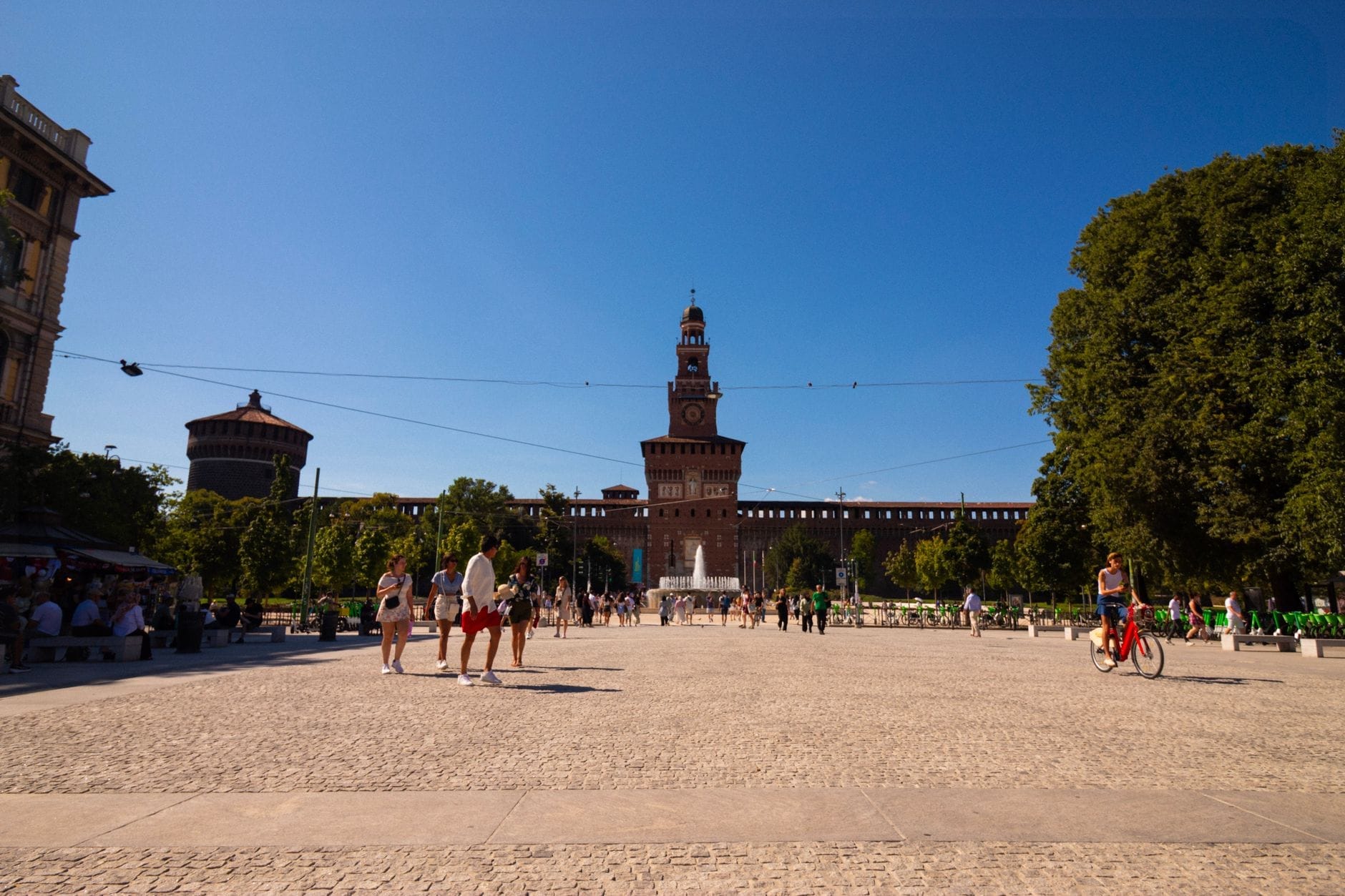
Approaching from the metro at Cairoli Castello, you surface onto a wide pedestrian piazza with the castle's central tower, the Torre del Filarete, directly ahead. The tower, rebuilt after a gunpowder explosion in 1521, stands prominently over the square and anchors the southern facade. The brickwork has the warm rust-red tone typical of Lombard Gothic architecture, and on a clear day the contrast against blue sky is sharp enough to stop foot traffic.
Walking under the central gateway, you enter the Piazza d'Armi, the largest of the three courtyards. This was historically the military drilling ground, and its sheer size becomes apparent: it is vast enough that sound loses itself before it reaches the far walls. On weekday mornings you will find dog walkers, students eating sandwiches on the grass, and the occasional guided school group. On weekend afternoons the atmosphere shifts, with weekend markets and occasional open-air events using the space. The transition between those two modes is one of the more interesting things to observe if you happen to visit on a Saturday morning.
Through a second arched passage lies the Corte Ducale, the former ducal residence courtyard. The architecture here is markedly more refined: loggias with carved stone detailing, terracotta ornament, and proportions that feel designed for ceremony rather than warfare. This is where the museum entrances are located, and where the quality of light, especially in the late afternoon, gives the facade a warmth that photographs poorly but rewards the naked eye.
Tickets & tours
Hand-picked options from our booking partner. Prices are indicative; availability and final rates are confirmed when you complete your booking.
Duomo Cathedral private tour with a local guide
From 105 €Instant confirmationFree cancellationSforza Castle entry and self-guided tour
From 15 €Instant confirmationFree cancellationSkip-the-line Duomo tour in Milan
From 40 €Instant confirmationFree cancellationNavigli Canals of Milan private walking tour with a local guide
From 40 €Instant confirmationFree cancellation
The Museums Inside: What Is Worth Your Time
Nine museums share the single combined ticket, which covers collections ranging from ancient Egyptian artifacts and medieval armor to Renaissance painting and applied decorative arts. Not every collection will interest every visitor, and trying to see everything in one afternoon leads to exhaustion before the most important works. A selective approach is more satisfying.
The single most significant work in the entire complex is Michelangelo's Pietà Rondanini, housed in the Museo d'Arte Antica. This is the sculpture Michelangelo was working on just days before his death in 1564. It is unfinished by design, or perhaps unfinished by circumstance: the two figures, Christ and the Virgin, have been partially reworked to the point where they almost dissolve into each other, stripped of classical solidity. Compared to the polished drama of the Pietà in Rome, the Rondanini is raw and strange. It occupies its own room, lit to emphasize texture rather than form, and most visitors spend longer in front of it than they anticipated. If you visit the Musei del Castello Sforzesco for one work, this is it.
The Pinacoteca del Castello Sforzesco holds a solid collection of Lombard and Venetian paintings, including works by Mantegna, Bellini, and Filippo Lippi. It does not compete in depth with the Pinacoteca di Brera, but for visitors who are not museum specialists, the quality-to-crowd ratio is notably better: you can stand in front of major Renaissance paintings without jostling for position. The Egyptian collection and the prehistoric section on the lower levels are extensive and professionally presented, though they require a specific interest to justify the time.
ℹ️ Good to know
Museums are open Tuesday to Sunday, approximately 10:00–17:30. They are closed on Mondays. Free entry applies on the first and third Tuesday after 14:00 and on the first Sunday of each month.
How the Experience Changes by Time of Day
Early morning, roughly 07:30 to 09:30, is the best time to experience the castle grounds without any manufactured atmosphere. The Piazza d'Armi is almost entirely local: joggers, commuters taking a shortcut, maintenance staff. The light is low and directional, catching the surface of the brick towers in ways that midday light flattens. If you are interested in architectural photography, this window before the tour groups arrive is the one to use.
By 11:00 on any weekend, the piazza fills rapidly. The approach from Piazza Castello becomes a continuous flow of visitors, and the Corte Ducale courtyard can feel uncomfortably crowded near the museum entrances. This does not make it unpleasant, but it changes the character significantly. The museums themselves, even at peak times, absorb crowds reasonably well due to the number of rooms spread across two floors.
Late afternoon, from around 16:00 until closing, is a second good window. The day-trippers and morning tour groups have thinned, the light in the Corte Ducale becomes golden, and the museums are quiet enough for a relaxed final hour. If you time your visit to exit the castle around 18:00 and continue north through the Foro Bonaparte and into Parco Sempione, the transition from Renaissance stonework to open parkland takes about three minutes on foot and feels like a genuine shift in register.
Getting There and Practical Logistics
The most direct metro access is Cairoli Castello on Line M1 (red), which deposits you on the south side of the castle forecourt. From here the main entrance tower is immediately visible and the walk takes under two minutes. Alternatively, Cadorna station (M1 and M2) and Lanza station (M2) are both within comfortable walking distance. Tram lines 1, 2, 4, 12, 14, and 19 stop nearby, and bus lines 18, 37, 50, 58, 61, and 94 serve the area. The castle is roughly a 20-minute walk from the Duomo along Via Dante, a partly pedestrianized street that is pleasant at most hours.
Parking is limited and the surrounding streets are heavily trafficked; arriving by public transport is strongly preferable. For broader context on navigating the city, the getting around Milan guide covers metro lines, trams, and tickets in detail.
For accessibility, the museums are distributed across two floors with the city confirming step-free access routes and lift availability. Visitors with specific mobility requirements should consult the official municipal museum pages before visiting, as access details can change during renovation phases. For accessibility, the museums are distributed across two floors with the city confirming step-free access routes and lift availability. Visitors with specific mobility requirements should consult the official municipal museum pages before visiting, as access details can change during renovation phases.
⚠️ What to skip
The castle grounds close at 19:30, but the museums close earlier, typically at 17:30. Arriving after 16:00 for the museums limits your time significantly. Check the official site for current hours and any holiday closures before your visit, as hours are subject to change.
What to Expect (and What Not To)
The castle is one of Milan's genuinely rewarding attractions, but it rewards preparation. Visitors who walk through the courtyards, spend an hour with the Pietà Rondanini, and continue into Parco Sempione will come away satisfied. Visitors who try to absorb all nine museums in a single afternoon often describe the experience as overwhelming and tiring, which reflects the scale rather than the quality.
The free access to the grounds means that even travelers on tight budgets can spend a meaningful morning here without spending anything. For context on how the castle fits into a broader stay, it sits logically within a three-day Milan itinerary alongside the Duomo and Brera, and the combination of castle, park, and a walk through the Brera neighbourhood makes for a full and well-varied day.
Travelers who prioritize polished, curated museum experiences with strong multilingual interpretation may find some of the castle's secondary collections underpresented compared to international standards. The core works, particularly the Pietà Rondanini and the Pinacoteca, are well presented, but signage quality across all nine collections is inconsistent. An audio guide or a pre-visit read on the key works will significantly improve the experience.
Those who find historical context more engaging with architectural framing might also enjoy pairing the castle visit with a broader look at Milan's built heritage, covered in the Milan architecture guide.
Insider Tips
- The Pietà Rondanini has its own dedicated room and is almost never as crowded as you would expect for a work of that significance. Visit mid-morning on a Tuesday or Wednesday for the best chance of having it nearly to yourself.
- The Biblioteca Trivulziana inside the castle holds one of Italy's most important collections of medieval manuscripts and rare books. Access is by appointment for researchers, but the reading room is occasionally included in open-day events — worth checking if you visit during Milan's cultural festival periods.
- The passage from the Corte Ducale northward through the Cortile della Ghirlanda and out into Parco Sempione is free and open during castle hours. It provides a direct pedestrian route from the city centre into the park that most day visitors miss entirely.
- On the first Sunday of the month, museum entry is free for everyone — and the crowds reflect that. If free entry is a priority, the first and third Tuesday after 14:00 is the less-known option and significantly quieter than Sunday.
- The Torre del Filarete, the main entrance tower, was rebuilt in the early 20th century by architect Luca Beltrami, who oversaw a major restoration of the entire castle from the 1890s onward. The 'medieval' appearance of much of what you see is, in part, a careful scholarly reconstruction rather than original 15th-century masonry — a distinction worth keeping in mind when framing the experience.
Who Is Castello Sforzesco For?
- Art lovers who want to see Michelangelo's final sculpture outside of Rome's tourist rush
- Families looking for a free, spacious outdoor space in central Milan with cultural depth nearby
- Architecture and history enthusiasts interested in Lombard Renaissance and Visconti-Sforza Milan
- Travelers combining a morning at the castle with an afternoon in Parco Sempione and the Brera district
- Budget travelers who want a substantive cultural experience without paying entrance fees for the grounds
Nearby Attractions
Other things to see while in Castello & Sempione:
- Acquario Civico di Milano
Opened in 1906 for Milan's International Expo, the Acquario Civico di Milano is one of the oldest aquariums in Europe, housed in a Liberty-style building inside Parco Sempione. At €8 entry, it offers a quiet, unhurried contrast to the city's blockbuster attractions.
- Arco della Pace
The Arco della Pace stands at the northwestern edge of the city, marking the historic entrance to Milan via Corso Sempione. Built over five decades, started under Napoleon and finished under Austrian rule, it tells the story of a city pulled between empires — and looks striking doing it. Entry is free, the surrounding square is open daily, and the arch connects directly to Parco Sempione.
- Musei del Castello Sforzesco
The Musei del Castello Sforzesco pack nine civic museum collections into one of northern Italy's most striking 15th-century fortresses. From Michelangelo's unfinished final sculpture to Egyptian mummies and Renaissance tapestries, this is Milan's most underrated museum complex — and one of its best-value cultural experiences.
- Parco Sempione
Parco Sempione is Milan's answer to a proper city park: 386,000 square metres of English-garden landscape tucked directly behind Castello Sforzesco, free to enter, and open late in the evening. From morning joggers to aperitivo crowds, it shows a different side of the city entirely.