Arco della Pace: Milan's Triumphal Arch and What Makes It Worth Your Time
The Arco della Pace stands at the northwestern edge of the city, marking the historic entrance to Milan via Corso Sempione. Built over five decades, started under Napoleon and finished under Austrian rule, it tells the story of a city pulled between empires — and looks striking doing it. Entry is free, the surrounding square is open daily, and the arch connects directly to Parco Sempione.
Quick Facts
- Location
- Piazza Sempione, 20154 Milan (Castello-Sempione area)
- Getting There
- M1 Cadorna or Cairoli; M2 Lanza; Trams 1, 10, 19 along Corso Sempione
- Time Needed
- 20–40 minutes to view the arch; longer if combining with Parco Sempione
- Cost
- Free — open-air public monument, no ticket required
- Best for
- Architecture lovers, history walkers, photographers, and anyone entering the city from the northwest
What You're Looking At: The Monument at a Glance
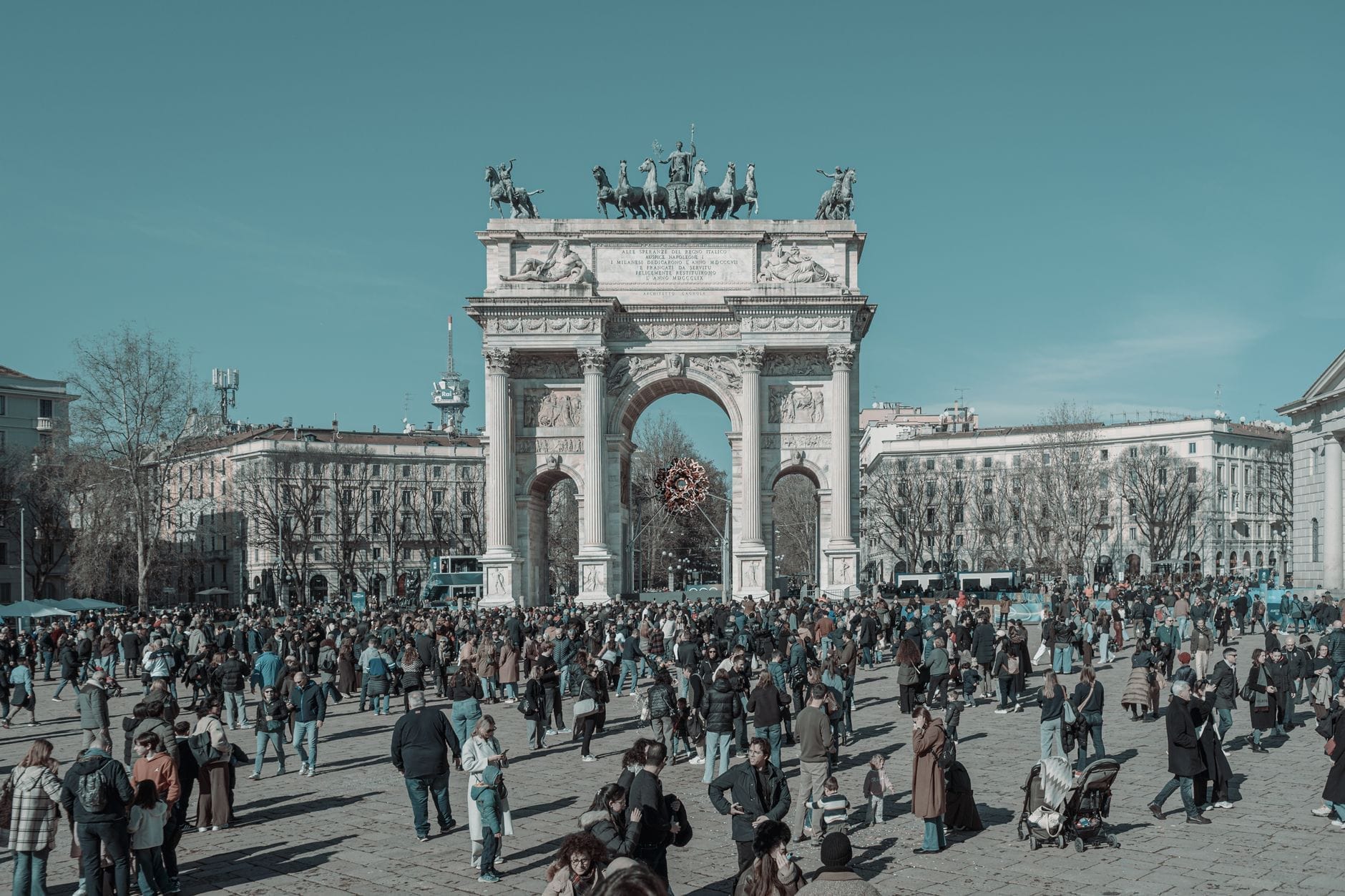
The Arco della Pace (Arch of Peace) rises 25 meters above Piazza Sempione at the far end of Corso Sempione, the broad tree-lined boulevard that cuts northwest from the city center. It is a triumphal arch in the classical Roman tradition, three arches wide, flanked by four Corinthian columns and finished in pale stone that catches light differently depending on the hour and season.
The structure measures approximately 25 meters high and 24 meters wide, with the central arch spanning 14.24 meters — wide enough to look genuinely monumental even in the context of a city full of large gestures. The granite core came from quarries at Baveno on Lake Maggiore, clad with marble from Crevola d'Ossola. On top sits a bronze chariot group depicting a six-horse quadriga, with allegorical figures flanking it on the outer corners.
ℹ️ Good to know
The monument and surrounding piazza are publicly accessible every day from approximately 6:30 a.m. to 9:00 p.m. There is no interior access for standard visitors — the experience is entirely exterior. Verify current access times before visiting, as they may change.
A History That Changed Direction Midway Through
Construction began around 1806–1807, commissioned to celebrate Napoleon Bonaparte's Italian campaigns and his entry into Milan. The architect Luigi Cagnola designed it as a monument to French imperial power, intended to anchor the new Corso Sempione — the road connecting Milan to the Simplon Pass and, symbolically, to Paris.
Napoleon fell before the arch was finished. By 1826, the project was reordered by Habsburg Emperor Francis I of Austria, who redirected its meaning entirely: instead of celebrating French conquest, it would commemorate the peace that followed the Congress of Vienna in 1815. The name changed accordingly. The arch was inaugurated in 1838 — more than three decades after its foundations were laid, under a different empire, with an entirely different political message carved into its friezes.
That layered history gives the Arco della Pace more to think about than most triumphal arches. The stone didn't change, but the story told by the inscriptions did. What was planned as a monument to conquest became one to peace — a rebrand that the city has been living with for nearly two centuries.
If you're tracing Milan's broader architectural evolution, the arch fits into a pattern of ambitious neoclassical projects from the Napoleonic and Restoration periods. The Milan architecture guide covers this context in detail, including how Cagnola's influence shaped other landmarks across the city.
Tickets & tours
Hand-picked options from our booking partner. Prices are indicative; availability and final rates are confirmed when you complete your booking.
Milan Guided Tour of Branca Tower, Parco Sempione and Sforza Castle
From 40 €Instant confirmationFree cancellationAudio guide for the Last Supper in Santa Maria delle Grazie
From 4 €Instant confirmationDuomo Cathedral private tour with a local guide
From 105 €Instant confirmationFree cancellationSforza Castle entry and self-guided tour
From 15 €Instant confirmationFree cancellation
Visiting: What the Experience Actually Looks Like
Approaching from Corso Sempione on foot, the arch appears at the end of a long straight boulevard framed by trees. The perspective is intentional — Cagnola designed the alignment so that the arch would function as a visual terminus, drawing the eye forward. From a distance it looks almost flat, like a stage flat. As you get closer, the relief carvings resolve into full figures, and the scale becomes increasingly impressive.
Piazza Sempione itself is a wide circular esplanade. Traffic circulates around the arch, so crossing to stand directly beneath it requires some attention, though the pavement is broad and crosswalks are marked. Once there, the view looking back down Corso Sempione is one of the better urban vistas in this part of the city — a reason in itself to make the walk.
The arch faces southeast, which means morning light hits the decorated face directly and photography is generally cleaner before midday. By late afternoon, the main face is in shadow and the light falls on the back, which is plainer. If you care about photographs, plan accordingly. Locals use the surrounding esplanade as a transit point, dog-walking circuit, and occasionally a backdrop for photography sessions — there is almost always someone there with a camera.
💡 Local tip
For the clearest photographs of the decorated face, visit between 9 a.m. and noon when the arch is front-lit. The bronze chariot on top catches direct sun on clear mornings and shows up well with a longer focal length from Corso Sempione.
Time of Day and Crowd Patterns
Early morning, before 8:30 a.m., the piazza is quiet. Joggers pass through Parco Sempione nearby, a few commuters cut across on foot or bicycle, and the arch itself is essentially unattended. This is the cleanest time to see it without tour groups or other visitors in the frame.
Mid-morning to early afternoon on weekends brings the steadiest flow of visitors, mostly walking out from Parco Sempione or coming up from the Castello direction. The arch is never crowded in the way that the Duomo is — there is simply too much open space around it for that. But on warm weekend afternoons in spring and autumn, the esplanade and nearby park fill with families, cyclists, and people sitting on benches, which creates a pleasant atmosphere if you are not solely focused on the monument.
Evenings are notably atmospheric. The arch is lit from below after dark, and the bronze chariot group reads clearly against the sky. The surrounding streets pick up foot traffic from people heading toward Corso Sempione's bars and restaurants, and there is a different quality to the space — less tourist-focused, more local.
The arch connects naturally to a broader walk through the area. Parco Sempione extends directly behind it to the south, and Castello Sforzesco is roughly 1.5 kilometers through the park — a walk that most visitors combine into a single afternoon.
Practical Details: Getting There and Getting Around
The arch is not directly served by a metro stop, but the options nearby are manageable. From M1 Cadorna or Cairoli, it is a 15–20 minute walk, partly through Parco Sempione. From M2 Lanza, the walk is slightly shorter via Via Legnano and Corso Sempione. Trams along Corso Sempione (lines 1, 2, 4, 12, 14, 19) stop near the piazza and are probably the most convenient option if you're coming from the center.
The surrounding piazza is entirely flat and accessible for wheelchairs and pushchairs. There is no entry point or staircase involved in seeing the monument. The park paths nearby are mostly paved or compacted, with some uneven sections on grass areas. Street parking exists along side streets, though this is central Milan and availability is limited during daytime hours.
💡 Local tip
If you combine the arch with a Parco Sempione visit, enter the park from the arch side and exit near the Castello. This one-directional route takes 45–60 minutes at a relaxed pace and passes the Torre Branca along the way.
Architectural Detail: What to Look at Closely
The four Corinthian columns are the most immediately recognizable element — tall, fluted, with elaborate capitals that cast sharp shadows in direct sun. Between and above the arches, the friezes carry relief carvings depicting battle scenes, allegorical figures, and historical events from the Napoleonic and Restoration periods. These are easy to miss if you stay at street level; stepping back a few meters improves the viewing angle considerably.
The six-horse chariot (sestiga) on top is a bronze composition depicting the goddess of Peace driving toward the city. At 25 meters height it requires some patience to read properly, and binoculars or a zoom lens reveal details that are invisible from ground level. The figures at the outer corners of the attic level represent the rivers Po, Ticino, Adda, and Verbano — the major waterways of Lombardy.
The Arco della Pace represents one of the more accomplished examples of neoclassical civic architecture in northern Italy. For travelers interested in this period and style, the guide to Milan's churches includes several contemporaneous buildings with comparable architectural ambition.
Who Should Skip This
Visitors with only a day or two in Milan and a list of interior highlights (the Last Supper, the Duomo, Pinacoteca di Brera) may find the arch a lower priority — it is an outdoor monument with no associated collection or interior experience, and the journey from central Milan adds time.
In wet or cold weather, the open esplanade offers no shelter and the stone reads flat under overcast skies. The arch is worth seeing, but it is not compelling enough to seek out in poor conditions when other covered attractions are available. In summer, midday visits are uncomfortable — the piazza is exposed and there is no shade directly around the arch itself.
Insider Tips
- Walk the full length of Corso Sempione toward the arch from the Cadorna end — the perspective from 400–500 meters back gives you the intended visual experience that Cagnola designed, which is lost if you approach from the park side.
- The back of the arch (northwest face, toward the suburbs) is plainer in decoration but interesting for its raw stone texture and for the contrast with the ornate southeast face. Few visitors walk around to see it.
- On clear evenings, the bronze chariot group is visible against the sky from as far away as the midpoint of Parco Sempione — worth checking from the Torre Branca terrace if you visit at dusk.
- Street food and café options are thin immediately around the piazza. Corso Sempione has several bars and cafés a few minutes' walk in either direction — plan your timing if you want coffee or a break nearby.
- The arch appears on the reverse of some older Italian lira coins from the 20th century — a small detail that locals and numismatists occasionally discuss, and one that reflects how embedded it is in Milanese civic identity.
Who Is Arco della Pace For?
- Architecture and history travelers who want to understand how Milan's urban fabric was shaped by successive ruling powers
- Photographers looking for a structured, photogenic landmark that is rarely overcrowded and works well in morning light
- Walkers combining a Parco Sempione loop with Castello Sforzesco — the arch anchors the northwest end of that natural route
- Visitors interested in Napoleonic-era and Restoration-period European monuments outside the usual tourist circuit
- Families with children who need open, flat space to move around while adults take in a historic site
Nearby Attractions
Other things to see while in Castello & Sempione:
- Acquario Civico di Milano
Opened in 1906 for Milan's International Expo, the Acquario Civico di Milano is one of the oldest aquariums in Europe, housed in a Liberty-style building inside Parco Sempione. At €8 entry, it offers a quiet, unhurried contrast to the city's blockbuster attractions.
- Castello Sforzesco
Castello Sforzesco is a major castle complex in Milan, housing nine civic museums within its Renaissance walls, including Michelangelo's unfinished Pietà Rondanini. The castle grounds are free to enter daily, making it one of Milan's most rewarding and accessible attractions.
- Musei del Castello Sforzesco
The Musei del Castello Sforzesco pack nine civic museum collections into one of northern Italy's most striking 15th-century fortresses. From Michelangelo's unfinished final sculpture to Egyptian mummies and Renaissance tapestries, this is Milan's most underrated museum complex — and one of its best-value cultural experiences.
- Parco Sempione
Parco Sempione is Milan's answer to a proper city park: 386,000 square metres of English-garden landscape tucked directly behind Castello Sforzesco, free to enter, and open late in the evening. From morning joggers to aperitivo crowds, it shows a different side of the city entirely.