Chiesa di San Bernardino alle Ossa: Milan's Extraordinary Ossuary Church
Tucked into Piazza Santo Stefano a short walk east of the Duomo, the Chiesa di San Bernardino alle Ossa is one of Milan's most arresting and least-crowded historic interiors. Its 17th-century ossuary chapel is lined floor to ceiling with human skulls and bones, crowned by a luminous baroque fresco. Entry is free.
Quick Facts
- Location
- Piazza Santo Stefano, Milan (Duomo District)
- Getting There
- Duomo (M1/M3) or San Babila (M1), both ~7 min walk
- Time Needed
- 30–50 minutes
- Cost
- Free admission
- Best for
- History, baroque art, unusual architecture, quiet reflection
- Official website
- www.sanbernardinoalleossa.it
What This Place Actually Is
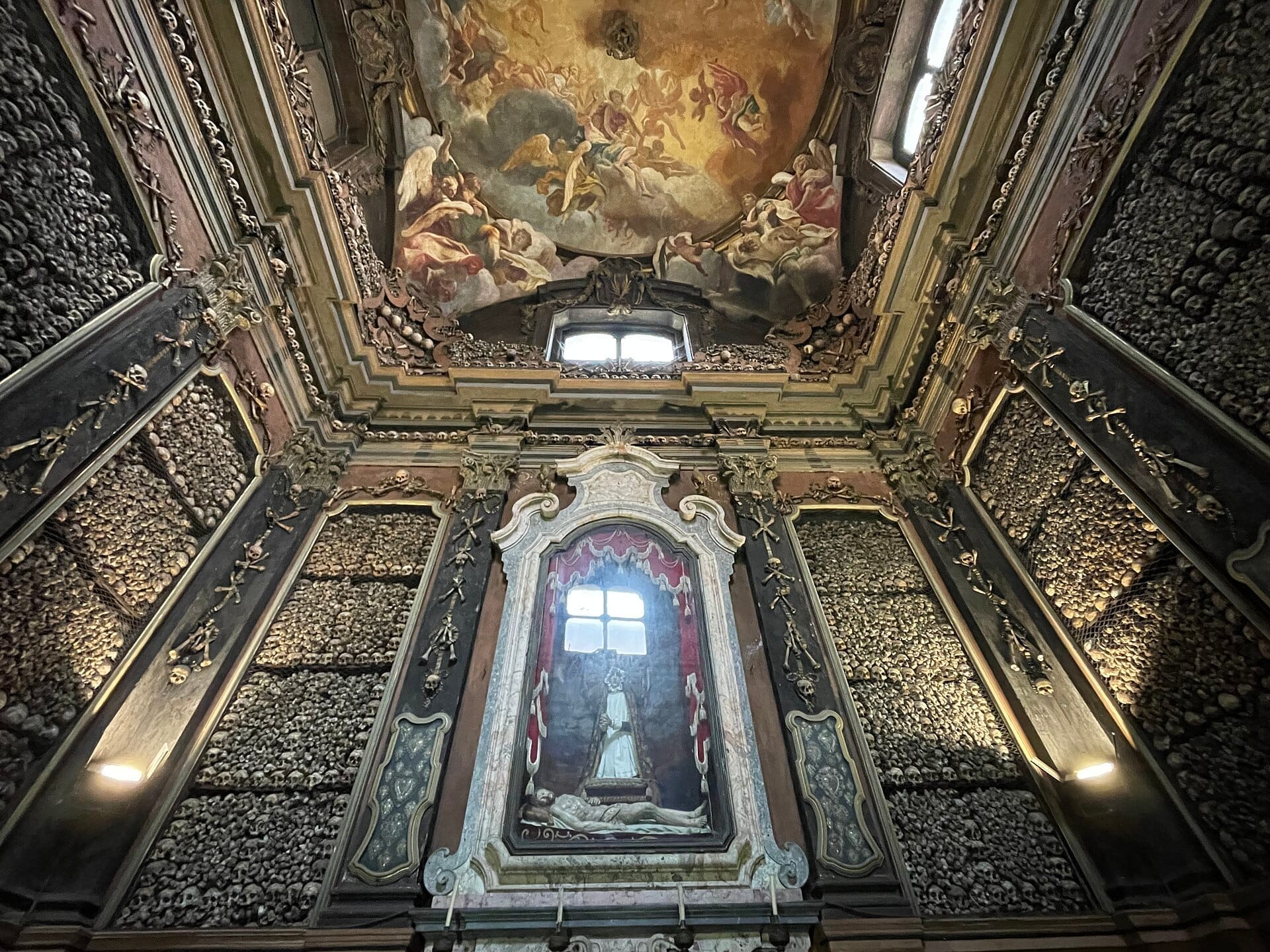
The Chiesa di San Bernardino alle Ossa is a Roman Catholic sanctuary on Piazza Santo Stefano, about seven minutes on foot east of the Duomo. Most visitors walk past without realising what is inside. The church itself is a composed baroque space, modest in scale. But connected to it is an ossuary chapel whose walls, niches, and ceiling decorations are constructed almost entirely from human bones and skulls.
This is not a gimmick. The bones were gathered over centuries from a medieval cemetery and from the overflow of a nearby hospital, and the chapel was rebuilt and consecrated in 1776 to designs by architect Carlo Giuseppe Merlo. The effect is deliberately devotional, not theatrical: the bones were arranged to honor the dead and remind the living of mortality, in keeping with a long Catholic tradition of ossuary art.
Visitors who have spent time in Milan's larger churches, such as Santa Maria delle Grazie or the Duomo di Milano, sometimes overlook San Bernardino alle Ossa entirely. That oversight is worth correcting. The church offers something genuinely different: a space that is simultaneously unsettling and serene.
ℹ️ Good to know
Opening hours: Monday–Friday 8:00–18:00, Saturday 9:30–18:00, Sunday 9:30–12:00 (ossuary closed on Sundays). Hours may vary on religious holidays. Verify directly with the sanctuary before visiting, especially on weekends or during liturgical periods.
The History Behind the Bones
The origins of the ossuary date to 1268–1269, when a small chapel was built adjacent to a cemetery near the hospital of San Barnaba in Brolo. As the cemetery filled and overflowed across generations, bones were transferred into the dedicated ossuary space. The church was later dedicated to San Bernardino da Siena in 1450, following the saint's canonization and the spread of his cult across northern Italy.
The structure suffered significant damage in 1642 when the bell tower of the neighbouring Santo Stefano Maggiore collapsed, destroying the ossuary. What stands today reflects the reconstruction that followed, eventually culminating in the baroque church and ossuary layout consecrated in 1776. Carlo Giuseppe Merlo's design integrated the ossuary directly into the church fabric, making the bones part of the architecture rather than a separate curiosity.
The vault above the ossuary chapel was decorated in 1695 by Sebastiano Ricci, one of the leading Venetian painters of the late baroque period. His fresco, known as "Trionfo di anime in un volo di angeli" (Triumph of Souls in a Flight of Angels), shows souls rising through a golden sky surrounded by angels. The contrast between the fresco's lightness overhead and the bones below is the defining visual experience of the space.
Tickets & tours
Hand-picked options from our booking partner. Prices are indicative; availability and final rates are confirmed when you complete your booking.
Escape Tour self-guided, interactive city challenge in Milan
From 30 €Instant confirmationEscape Tour self-guided, interactive city challenge in Milan
From 30 €Instant confirmationSerravalle Designer Outlet shopping tour from Milan
From 22 €Instant confirmationFree cancellationExclusive guided tour of Milan with La Scala, Duomo Square and the Galleria
From 50 €Instant confirmationFree cancellation
Walking Through the Space
You enter from Piazza Santo Stefano through a quiet forecourt. The main church is a single-nave baroque interior with side chapels, modest gilded decoration, and the kind of cool, slightly dim atmosphere common to Milan's smaller historic churches. On a weekday morning the nave is often empty, or occupied by a handful of people in private prayer.
The ossuary chapel is reached through a doorway to the right of the altar. The transition is abrupt. The walls are covered with tibias, femurs, and skulls arranged in geometric and decorative patterns, filling every available surface from waist height to ceiling. Some niches contain complete skull arrangements; others use long bones as structural borders around smaller skulls. The smell is of old stone and slightly damp plaster, with nothing clinical about it.
Looking up, Ricci's fresco opens the ceiling with pale sky and luminous figures. The bones recede from awareness for a moment as the eye adjusts to the paint. Then the two elements come back into focus together, and the theological argument the space is making becomes clear: the bodies below, the souls above.
💡 Local tip
Photography is generally possible inside the ossuary, but this is a working religious site. Keep voices low, silence your phone, and observe whether other visitors or the church caretaker indicate any restrictions.
Best Time to Visit and Crowd Patterns
San Bernardino alle Ossa attracts far fewer visitors than the major Duomo-area landmarks. On a typical Tuesday or Wednesday morning between 9:00 and 11:00, you may have the ossuary chapel entirely to yourself for several minutes at a stretch. This is the best window: the light through the chapel is soft, the church is quiet, and there is genuine space to stand and look without being moved along by a queue.
Weekend afternoons bring a moderate increase in visitors, including tour groups that combine San Bernardino with nearby Santo Stefano and the Duomo district. Even then, the chapel rarely feels congested, given its compact dimensions. If you are visiting as part of a broader walk through the historic centre, midweek mornings or late weekday afternoons offer the most contemplative atmosphere.
The church is open Monday through Saturday during the published hours, and on Sunday mornings from 9:30 to 12:00, while the ossuary itself is closed on Sundays. Confirm current hours with the sanctuary directly or via the official website before planning your visit, particularly around public holidays and major liturgical dates.
Getting There and Practical Logistics
The church sits on Piazza Santo Stefano, a small square that most visitors pass through only by intent. From the Duomo Metro stop (lines M1 and M3), the walk takes roughly seven minutes heading east through Via Larga. From San Babila Metro stop (line M1), the approach from the west takes a similar amount of time. The streets are paved and level for most of the route.
Accessibility within the church is not formally documented on the sanctuary's official website. The church is at street level and the entrance is flat from the piazza, but specific information on step-free access throughout the complex, including the ossuary chapel, is not publicly available. Visitors with reduced mobility should contact the sanctuary directly before visiting. For context on the broader neighbourhood, see the Duomo District overview.
There are no bag lockers or cloakrooms. The church is small, and large luggage would be awkward and disrespectful in this context. Leave bags at your accommodation if possible. Dress code follows standard church rules for Italy: shoulders and knees should be covered.
⚠️ What to skip
The ossuary is closed on Sundays, and the sanctuary has limited hours on Sunday mornings. A visit that is not planned around opening hours may result in a locked door on an otherwise unremarkable piazza. Always verify hours in advance.
The Fresco Up Close: Sebastiano Ricci
Sebastiano Ricci (1659–1734) was commissioned to paint the ossuary vault in 1695, and the fresco remains one of his most discussed works in Milan. Ricci was known for his loose, luminous technique and his ability to animate crowded celestial scenes without losing visual coherence. In the ossuary, working on a relatively small vault, he compressed a great deal of movement and light into a confined space.
The fresco is best seen from the centre of the ossuary floor, looking straight up. Take a moment to let your eyes adjust from the dim bone-lined walls to the brighter sky of the painted ceiling. For those interested in Milan's baroque and religious art more broadly, the guide to Milan's churches places San Bernardino alle Ossa in context alongside the city's other significant ecclesiastical interiors.
Who Will Get the Most Out of This Visit
This is not an attraction for everyone, and that candor matters here. The ossuary is deeply confronting. It is a room built from human remains, and no amount of baroque framing changes that fundamental fact. Visitors who are sensitive to death imagery, or who are travelling with young children, should consider whether the experience is appropriate for their group.
For those with an interest in baroque art, funerary culture, or the history of medicine and religious practice in early modern Italy, San Bernardino alle Ossa is exceptionally rewarding. It pairs well with a visit to the Cimitero Monumentale di Milano, Milan's 19th-century monumental cemetery, which approaches death and commemoration from a very different architectural tradition.
Travelers who find that major Milan landmarks are crowded and impersonal will appreciate San Bernardino alle Ossa for exactly the opposite reason: it is quiet, it is free, and it asks something of the visitor beyond passive looking.
Insider Tips
- Arrive within the first hour of opening on a weekday. The ossuary chapel is often empty, and the quality of the experience in silence is substantially different from arriving mid-afternoon with other visitors present.
- Stand in the centre of the ossuary floor and look directly upward at the Ricci fresco before examining the bone arrangements at eye level. The intended sequence, souls rising above earthly remains, reads more clearly from that position.
- The piazza outside, Piazza Santo Stefano, also contains the Chiesa di Santo Stefano Maggiore, whose bell tower collapse in 1642 was the event that necessitated rebuilding San Bernardino alle Ossa. The two churches form a historically linked pair worth considering together.
- The church is a working sanctuary and Mass is celebrated regularly. Check the schedule on the official website if you want to observe a service, or plan your visit outside liturgical hours if you prefer uninterrupted access to the ossuary.
- Bring a compact camera or use your phone, but be discreet. The dim interior requires a steady hand or good low-light performance. Flash photography would be disruptive and is unlikely to produce better results than available light.
Who Is Chiesa di San Bernardino alle Ossa For?
- Travelers interested in baroque art and religious iconography
- History enthusiasts focused on medieval and early modern Milan
- Visitors seeking a quiet, free alternative to the crowded Duomo district landmarks
- Those interested in funerary culture and the history of ossuary traditions in Europe
- Architecture-focused travelers exploring Milan's ecclesiastical heritage
Nearby Attractions
Other things to see while in Duomo District:
- Duomo di Milano
The Duomo di Milano is one of the largest Gothic cathedrals in the world, nearly six centuries in the making and still the physical and symbolic heart of the city. This guide covers what to expect inside, how to reach the rooftops, when to visit, and the practical details that make the difference between a rushed stop and a memorable experience.
- Museo del Duomo
The Museo del Duomo di Milano, housed inside Palazzo Reale on Piazza del Duomo, holds six centuries of sculpture, stained glass, and architectural models that the cathedral itself can no longer display. It is quieter than the church next door, considerably less crowded than the rooftop terraces, and far more revealing about how one of the world's most complex Gothic buildings actually came to be.
- Galleria Vittorio Emanuele II
Built between 1865 and 1877 and inaugurated in 1867, the Galleria Vittorio Emanuele II connects Piazza del Duomo to Piazza della Scala beneath a soaring 47-metre glass dome. Entry is free and the arcade never closes, making it one of the most accessible landmarks in northern Italy. Whether you stop for an espresso at a historic café or simply pass through on foot, the architecture alone rewards the detour.
- Gallerie d'Italia – Piazza Scala
Spread across three interconnected 19th-century palazzi steps from La Scala opera house, Gallerie d'Italia – Piazza Scala offers approximately 8,300 square metres of art ranging from Neoclassical painting to 20th-century Italian masters. The buildings themselves are as compelling as what hangs on their walls.