Teatro alla Scala: Milan's Opera House and What It's Actually Like to Visit
Teatro alla Scala is one of the world's most historically significant opera houses, located in the heart of Milan's Duomo district. Whether you're attending a full performance or exploring the theatre museum, understanding how the building works, who it's for, and how to plan your visit makes all the difference.
Quick Facts
- Location
- Piazza della Scala, 20121 Milano (Duomo district)
- Getting There
- Metro lines M1 (red) and M3 (yellow) to Duomo station (about a 5‑minute walk); tram lines 1 and 2 stop nearby
- Time Needed
- 45–60 min for the museum; 2.5–5 hrs for a full opera or ballet performance
- Cost
- Museum tickets vary; performance tickets priced by seat category and production — check official site for current prices
- Best for
- Opera and classical music lovers, architecture enthusiasts, serious culture seekers
- Official website
- www.teatroallascala.org/en/index.html
What Teatro alla Scala Actually Is
Teatro alla Scala is not merely a concert hall or a tourist attraction. It is the operating center of one of the world's most demanding and closely watched opera traditions, a place where careers are made or ended on a single opening night, and where audiences have been known to boo tenors with the same force they applaud them. The building stands on Piazza della Scala in central Milan, directly opposite Palazzo Marino, the city's town hall, and its neoclassical facade is restrained to the point of severity — nothing about the exterior prepares you for the red velvet and gilded tiers inside.
Commissioned by Empress Maria Theresa of Austria and designed by architect Giuseppe Piermarini, the theatre was built between 1776 and 1778 on the site of the former Church of Santa Maria della Scala, from which it takes its name. It opened in 1778 and has, with interruptions, been at the center of Italian and European operatic culture ever since. It is where Verdi's works were dissected and debated, where Maria Callas cemented her legend, and where Arturo Toscanini conducted the emotional reopening concert on 11 May 1946, after the building had been severely damaged by Allied air raids on the night of 15–16 August 1943.
ℹ️ Good to know
There are two distinct ways to experience La Scala: attending a live performance, or visiting the Museo Teatrale alla Scala (the theatre museum). These are separate experiences with separate ticketing. Most day visitors opt for the museum, which includes a view into the auditorium itself when rehearsals permit.
The Auditorium: What You See From Inside
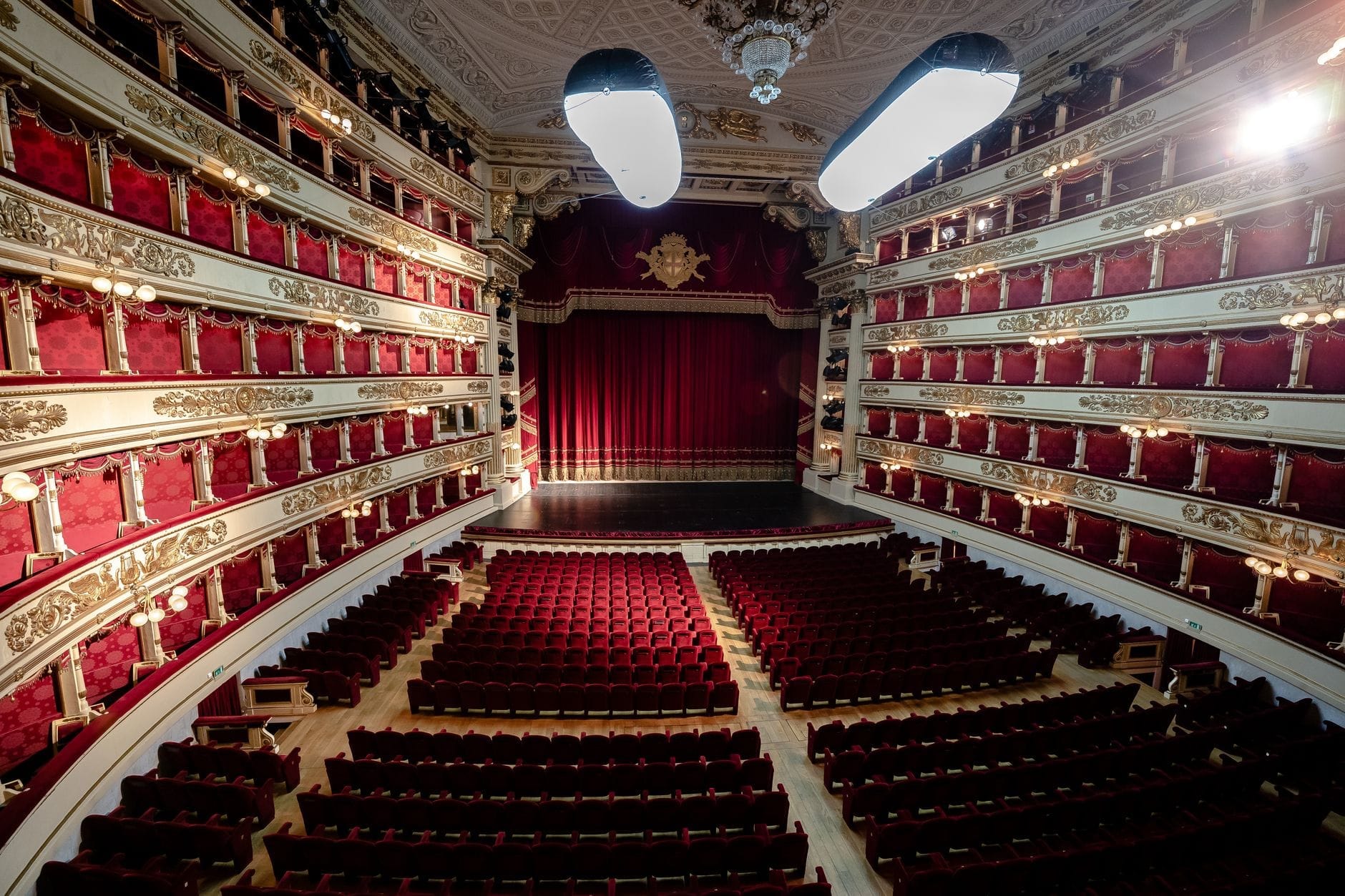
The interior of La Scala is one of those spaces that genuinely earns its reputation. The auditorium is arranged in the traditional Italian horseshoe shape, with six tiers of boxes rising steeply above the stalls. The color palette is deep red and gold, and the acoustics were designed so that sound carries with unusual precision to every corner of the house. The main chandelier, restored and modernized over the years, casts warm light across the house without competing with the stage.
Seating capacity is approximately 2,030 for performances, though this figure can shift slightly depending on staging configurations. The stalls (platea) offer the most direct sightlines to the stage, while the lower boxes provide the theatrical experience the house was designed around. Upper gallery seats (loggione) are the most affordable and are famously occupied by the loggionisti, a self-appointed jury of knowledgeable regulars whose approval or disapproval carries genuine weight in Italian opera culture.
If you visit through the museum, you may be able to look into the auditorium from an upper gallery position. Whether the house is empty or partially set for rehearsal, the scale of the space reads differently in person than in photographs — it is simultaneously more intimate and more imposing than expected. Bring your distance glasses if you plan to use the museum viewing position for any extended time.
Tickets & tours
Hand-picked options from our booking partner. Prices are indicative; availability and final rates are confirmed when you complete your booking.
Milan Leonardo da Vinci Exploration Game and Tour
From 12 €Instant confirmationFree cancellationThe Milan Pass
From 0 €Instant confirmationThe Milan Pass
From 0 €Instant confirmationThe Milan Pass
From 0 €Instant confirmation
The Theatre Museum (Museo Teatrale alla Scala)
The Museo Teatrale alla Scala is the most accessible entry point into La Scala for the average visitor. Located within the theatre building with its entrance on Largo Ghiringhelli 1, the museum holds an extensive collection of opera memorabilia: portraits and busts of composers and performers, costumes from historic productions, period instruments, set designs, librettos, and documentation tracing the theatre's history from its 18th-century origins through to the 2002–2004 restoration by architect Mario Botta, which added the fly tower and the oval tower visible from the side streets. The restoration preserved Piermarini's neoclassical interior while quietly modernizing the stage machinery and backstage infrastructure. For more on what sets La Scala apart architecturally from Milan's other major cultural buildings, see the Milan architecture guide.
The museum is organized across several rooms and moves roughly chronologically, though the display logic rewards slow browsing rather than a quick circuit. There is enough material to hold a serious opera enthusiast for well over an hour, but most casual visitors cover the highlights in 45 to 60 minutes. Note that gallery ticketholders enter via the Museum entrance on Largo Ghiringhelli, not the main theatre entrance on Piazza della Scala — this distinction matters practically, especially in the evening when performance crowds are moving through the building simultaneously.
💡 Local tip
Access to the auditorium viewing gallery from the museum depends on whether rehearsals or technical preparations are underway. There is no guarantee of auditorium access on any given day. If seeing the interior is your primary goal, contact the theatre in advance or build flexibility into your schedule.
Attending a Live Performance: The Practicalities
The main performance season runs from December through July, traditionally opening on 7 December, the feast day of Sant'Ambrogio (Saint Ambrose), Milan's patron saint. The opening night gala is one of the city's most prominent social events of the year, with tickets for premium positions sold far in advance and subject to significant demand. A separate concert and recital season runs alongside the main opera and ballet programme.
Tickets can be purchased online via the official La Scala website, through authorised agents, or at the box office located in Piazza della Scala (Largo Ghiringhelli 1). The box office is open Monday through Saturday, 12:00 to 18:00; on the first day of ticket sales for a given production, opening is moved forward to 10:00. Prices are published in the ticket price section of the official site and are denominated in euros; they vary significantly by production, seat category, and demand. For context on how La Scala fits into Milan's broader cultural scene, the best museums in Milan guide covers the city's major cultural institutions across different categories.
The expected dress code for evening performances leans formal, particularly for premieres and gala events. Business attire is widely accepted, but very casual dress draws notice in the boxes and stalls. Performances start punctually, and latecomers are typically held at the entrance until the first suitable pause, which in opera can mean waiting through an entire act. Arrive at least 30 minutes before curtain time, both to find your seat and to orient yourself to the building.
⚠️ What to skip
Photography and filming are strictly prohibited during performances. Flash photography is generally not permitted in the museum either. Bags larger than a small handbag may need to be checked at the cloakroom.
The Piazza della Scala and the Surrounding Area
La Scala sits at the edge of the Duomo district, within easy walking distance of two of Milan's most visited sites: the Galleria Vittorio Emanuele II, whose main northern exit opens almost directly toward the theatre, and the Duomo itself, a few minutes further south. The piazza in front of the theatre is anchored by a 19th-century statue of Leonardo da Vinci, a reminder that Milan and Leonardo's connection goes deeper than the Duomo. The square itself is modest in size and not a destination in its own right, but it functions as a useful orientation point in central Milan. For more on Leonardo's presence in the city, the Milan Leonardo da Vinci guide gives useful context.
Morning is a good time to photograph the theatre facade without crowd interference — by mid-afternoon the area around Galleria Vittorio Emanuele II becomes extremely congested, and the tourist pressure extends to the streets between the Galleria and La Scala. In the evening before a performance, the piazza takes on a different character: groups gather outside, formally dressed attendees arrive by taxi, and the building's exterior lighting gives the stone facade more warmth than it shows during the day.
Who Should (and Shouldn't) Visit
The theatre museum is worth visiting for anyone with a genuine interest in opera, classical music, or Italian cultural history. The collection is substantive, not just decorative, and the chance to look into the auditorium makes the visit feel connected to the living institution rather than a static archive. If you have no particular interest in opera or theatre history, the museum is unlikely to change your mind — the experience is largely object-based and relies on the visitor bringing some context with them.
Attending a performance is a different proposition entirely. If opera or ballet is something you actively seek out, La Scala offers a quality of production and a physical setting that is difficult to replicate. If you are considering attending purely because it feels like an important thing to do in Milan, consider carefully: a three-hour opera performed in Italian with no prior engagement with the repertoire is a long and demanding evening that not everyone enjoys. There is no shame in being clear about your own interests.
Families with young children will generally find the museum manageable in small doses, though it is not designed as an interactive children's space. For broader family-oriented suggestions in Milan, the Milan with kids guide covers more suitable options across the city.
Getting There and Practical Notes
The most straightforward approach is by metro: lines M1 (red) and M3 (yellow) both serve the Duomo station, from which La Scala is a five-minute walk north through the Galleria or along Via Manzoni. Tram lines also run along nearby streets. The surrounding area is flat and entirely walkable from most central hotels. For a fuller breakdown of getting around the city, the guide to getting around Milan covers all transit options in detail.
The box office address is Largo Ghiringhelli 1 (also the museum entrance), while the main theatre entrance for performance-goers is on Piazza della Scala. These two points are close together but on different sides of the building footprint — orientate yourself before arriving in the evening, especially if you are running close to curtain time. For accessibility arrangements beyond what is published online, the theatre's contact channels are the appropriate source; the official site lists specific contact information for visitor services.
Insider Tips
- The auditorium viewing gallery from the museum is not guaranteed on any given day. If seeing the interior is your main reason for visiting, check the theatre's schedule in advance and consider arriving early in the museum's opening hours, when access is more likely before rehearsal activity begins.
- For affordable access to a live performance, gallery seats (loggione) are the most economical and are culturally significant in their own right — the loggionisti in the upper tiers are knowledgeable and vocal, and being among them is an experience distinct from sitting in the boxes below.
- The 7 December opening night gala is a high-profile social event with tickets allocated far in advance. If attending the opening is important to you, begin monitoring the sales calendar months ahead — standard ticket release dates are published on the official site.
- The piazza outside La Scala is quietest on weekday mornings, when you can photograph the neoclassical facade without tour groups in the frame. The Galleria Vittorio Emanuele II entrance nearby becomes crowded by 10:30 most days.
- If you are combining a museum visit with broader sightseeing, note that the Museo Poldi Pezzoli — one of Milan's most underappreciated house museums — is less than a ten-minute walk north along Via Manzoni, making it a natural pairing for a cultural half-day in the area.
Who Is Teatro alla Scala For?
- Opera and classical music enthusiasts seeking a live performance in one of the world's defining venues
- Architecture and design travelers interested in Piermarini's neoclassical original and Mario Botta's 2002–2004 restoration
- Cultural history visitors who want to understand Milan's identity as an Italian and European cultural capital
- Photographers looking for a grand civic facade with minimal visual clutter, best captured on weekday mornings
- Travelers on a longer Milan stay who have already covered the Duomo and Brera and want to go deeper into the city's institutional cultural life
Nearby Attractions
Other things to see while in Duomo District:
- Chiesa di San Bernardino alle Ossa
Tucked into Piazza Santo Stefano a short walk east of the Duomo, the Chiesa di San Bernardino alle Ossa is one of Milan's most arresting and least-crowded historic interiors. Its 17th-century ossuary chapel is lined floor to ceiling with human skulls and bones, crowned by a luminous baroque fresco. Entry is free.
- Duomo di Milano
The Duomo di Milano is one of the largest Gothic cathedrals in the world, nearly six centuries in the making and still the physical and symbolic heart of the city. This guide covers what to expect inside, how to reach the rooftops, when to visit, and the practical details that make the difference between a rushed stop and a memorable experience.
- Museo del Duomo
The Museo del Duomo di Milano, housed inside Palazzo Reale on Piazza del Duomo, holds six centuries of sculpture, stained glass, and architectural models that the cathedral itself can no longer display. It is quieter than the church next door, considerably less crowded than the rooftop terraces, and far more revealing about how one of the world's most complex Gothic buildings actually came to be.
- Galleria Vittorio Emanuele II
Built between 1865 and 1877 and inaugurated in 1867, the Galleria Vittorio Emanuele II connects Piazza del Duomo to Piazza della Scala beneath a soaring 47-metre glass dome. Entry is free and the arcade never closes, making it one of the most accessible landmarks in northern Italy. Whether you stop for an espresso at a historic café or simply pass through on foot, the architecture alone rewards the detour.