Pirelli HangarBicocca: Milan's Industrial Cathedral of Contemporary Art
Housed in a converted locomotive factory in Milan's Bicocca district, Pirelli HangarBicocca is one of Europe's largest single-storey exhibition spaces. Entry is free, shows are ambitious, and the permanent installation by Anselm Kiefer alone justifies the trip across town.
Quick Facts
- Location
- Via Chiese 2, 20126 Milano — Bicocca district, northern Milan
- Getting There
- Metro Line 5 (Lilla), then bus 51 from Ponale or bus 87 from Sesto Marelli, followed by a short walk
- Time Needed
- 1.5 to 3 hours depending on current exhibitions
- Cost
- Free (verify on official site for special events)
- Best for
- Contemporary art lovers, architecture enthusiasts, off-the-tourist-trail explorers
- Official website
- pirellihangarbicocca.org/en
What Pirelli HangarBicocca Actually Is
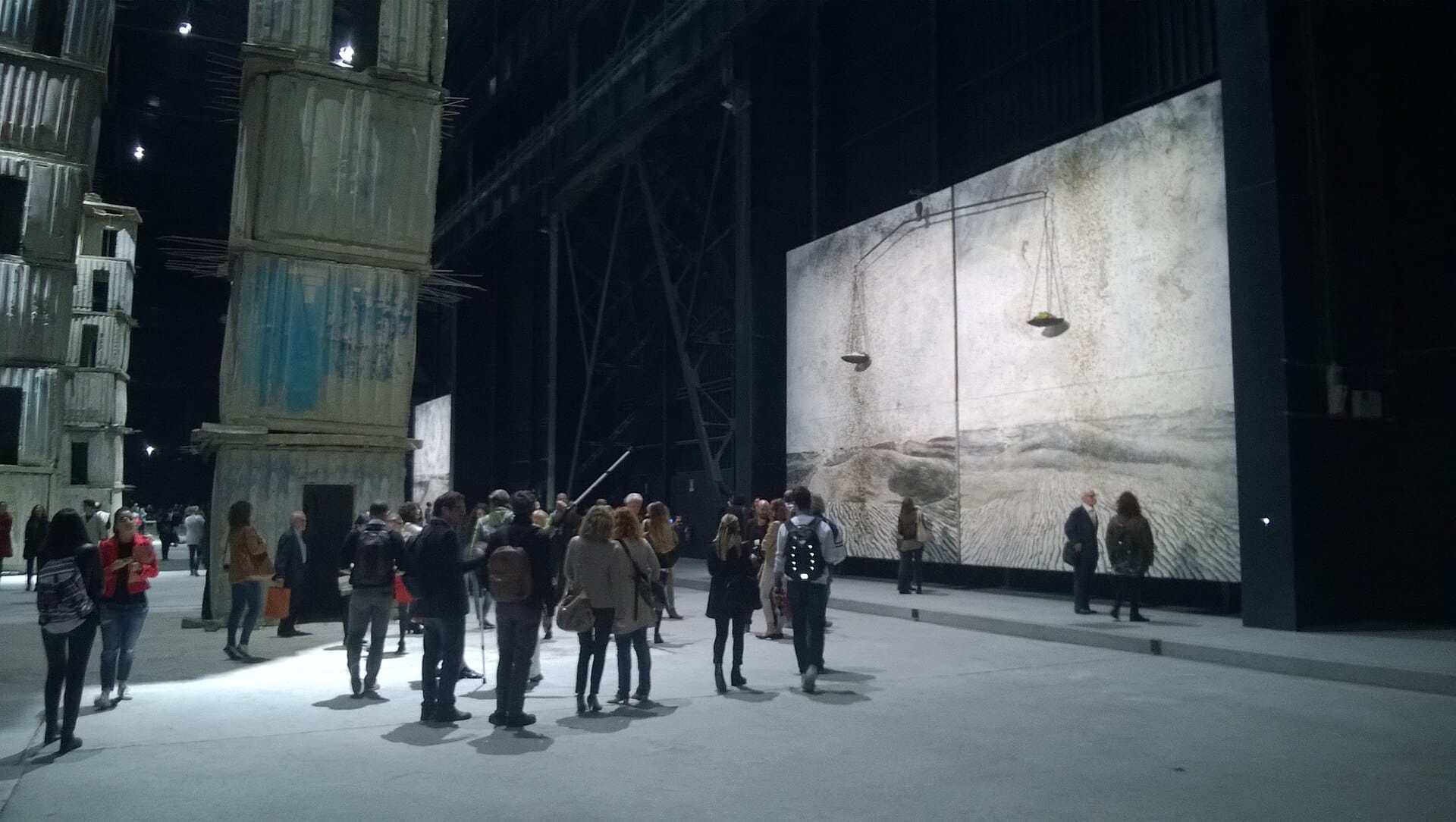
Pirelli HangarBicocca is a non-profit contemporary art foundation established by Pirelli in 2004 inside a former industrial complex in Milan's Bicocca district. The building was originally a factory producing locomotives, and its bones are still visible: raw steel trusses overhead, concrete floors underfoot, and ceiling heights that dwarf even the most oversized installations. With roughly 15,000 square metres of exhibition space spread across a single floor, it ranks among the largest of its kind in Europe.
This is not a white-cube gallery experience. The scale of the space shapes everything, from the artists invited to show here to the way visitors move through it. Works that would feel theatrical in a conventional museum feel almost matter-of-fact here. The foundation's operating model is equally notable: admission is free, and the programming is serious, with solo commissions and large-scale retrospectives that international art institutions tend to cover closely.
ℹ️ Good to know
Opening hours: Thursday to Sunday, 10:30–20:30. Closed Monday to Wednesday. Always confirm on the official website before visiting, as special events can affect access.
The Kiefer Rooms: A Permanent Landmark
The one constant in a programme that rotates regularly is Anselm Kiefer's permanent installation, "The Seven Heavenly Palaces". Seven monolithic towers occupy a dedicated section of the nave. They are not displayed behind barriers. You walk among them, close enough to read the surface textures: calcified concrete, oxidised metal, embedded books turned to matter.
Kiefer's work draws on Jewish mysticism, specifically the Kabbalistic concept of the palaces through which the soul ascends. The towers feel simultaneously ancient and post-industrial, which is part of why they belong so completely in this particular building. Morning light filters through industrial-gauge skylights and rakes across the surfaces differently than the flat artificial light of the afternoon. If you have any flexibility on timing, arriving when the space opens at 10:30 gives you the Kiefer rooms at their most atmospheric.
💡 Local tip
Photography is generally permitted in the permanent installation areas. Check current rules at the entrance desk before shooting, as temporary exhibitions sometimes have restrictions.
Tickets & tours
Hand-picked options from our booking partner. Prices are indicative; availability and final rates are confirmed when you complete your booking.
Duomo Cathedral private tour with a local guide
From 105 €Instant confirmationFree cancellationSforza Castle entry and self-guided tour
From 15 €Instant confirmationFree cancellationSkip-the-line Duomo tour in Milan
From 40 €Instant confirmationFree cancellationNavigli Canals of Milan private walking tour with a local guide
From 40 €Instant confirmationFree cancellation
Temporary Exhibitions: What to Expect
The temporary programme at Pirelli HangarBicocca tends toward large-scale, often kinetic or immersive work that exploits the industrial volume of the space. The foundation has hosted major commissions from artists including Carsten Höller, Joan Jonas, and Jean Tinguely, whose retrospective drew international attention. These are not modest shows. The selection prioritises work that would be difficult or impossible to realise in a conventional gallery context.
Exhibitions typically run for several months, so checking what is on before you visit is worthwhile rather than treating the visit as spontaneous. The official website lists current and upcoming shows with opening dates. Given the foundation's track record, there is rarely a period when nothing is on, but the gap between exhibitions can occasionally coincide with your trip.
If your visit aligns with Milan Design Week or the city's broader art calendar, Pirelli HangarBicocca occasionally runs programming in parallel with those events, sometimes with extended hours or special openings. Worth checking.
The Building and the Bicocca District
The Bicocca district sits in the northern part of Milan, well outside the historic centre, and it has a character all its own. The area was one of the city's major industrial zones through the twentieth century, dominated by large manufacturing plants. In the 1980s and 1990s it underwent a significant urban redevelopment project, absorbing a university campus, technology companies, residential blocks, and cultural institutions alongside the surviving industrial structures.
HangarBicocca occupies one of the former factory buildings from that industrial era. The exterior is deliberately understated: there is no grand entrance sequence, no architectural gesture signalling that something remarkable is inside. You approach via Via Chiese through a stretch of mixed-use urban fabric that could belong to dozens of European cities. This low-key approach to arrival makes the interior all the more disorienting when you step through the door into the full scale of the nave.
The Bicocca trip also works well as part of a broader exploration of Milan's contemporary architecture. The city's modern and innovative structures, from the Bosco Verticale in Porta Nuova to the towers of CityLife, tell a story about how Milan has been reinventing its industrial and postindustrial identity since the 1990s.
Getting There and Getting Around
The most direct route by public transport is Milan Metro Line 5 (the Lilla line), alighting at Ponale or continuing from Sesto Marelli, then taking bus 51 or 87 to Via Chiese 2. From there the walk is short. Trams and buses also serve the general area. Journey planners on ATM's official app or Google Maps will give you the most accurate routing from wherever you are staying.
Bicocca is not a neighbourhood you are likely to pass through by accident, so the visit involves a deliberate detour from the centre. From Piazza del Duomo, budget around 25 to 30 minutes door to door by public transport. That commute filters the crowd somewhat: the people here chose to come, which gives the space a more focused atmosphere than some of the city's better-known cultural venues.
💡 Local tip
Wear flat, comfortable shoes. The floor surface throughout the complex is hard concrete and the distances between works can be substantial. There is no café seating inside the exhibition spaces themselves, though facilities are available in the building.
Crowd Patterns and Best Times to Visit
Thursday and Friday mornings tend to be the quietest periods. The space is large enough that even on a Saturday afternoon it rarely feels uncomfortably crowded, but the Kiefer towers are best experienced with room to move and minimal conversation in the background. Sunday afternoons draw a local crowd, particularly families with older children, and the mood shifts toward something slightly more social.
The foundation's late closing time of 20:30 is genuinely useful. Arriving around 18:00 on a Thursday or Friday gives you the exhibition space with substantially fewer visitors and a different quality of light filtering through the skylights as the afternoon fades. This is not a venue where the light changes dramatically with the season in the way an outdoor site does, but the low-angle late-afternoon sun does affect the Kiefer rooms in particular.
If you are planning a multi-day trip and want to structure your time well, a visit to Pirelli HangarBicocca pairs logically with other major Milan art institutions. The Fondazione Prada and the Triennale Design Museum represent different points on the spectrum of contemporary and applied art in the city.
Accessibility and Practical Notes
The foundation describes itself as a free, accessible and open museum space, and the single-storey layout removes the staircase barriers that complicate access at many historic Milan venues. The ground-level floor plan means that wheelchair users and visitors with mobility limitations can in principle reach all major areas without needing lifts. However, the concrete floor is uneven in places, and the specific provisions in place, such as accessible entrances or dedicated facilities, should be confirmed directly with the foundation before visiting.
Children are welcome, though the tone of the programming is emphatically adult and contemporary. The Kiefer towers tend to make a strong impression on children precisely because of their scale and material strangeness. Dogs are not permitted in indoor spaces. Bags can be left at the cloakroom near the entrance.
⚠️ What to skip
The foundation is closed Monday to Wednesday. A significant number of visitors arrive on weekdays only to find it shut. Double-check the day before you go.
Insider Tips
- The closing time of 20:30 is later than most Milan museums. A Thursday evening visit after dinner is a legitimate option that almost nobody takes advantage of, and the space empties out noticeably after 19:00.
- The Kiefer towers read very differently at close range than in photographs. Allow at least 20 minutes in that room alone, walking the perimeters of each tower rather than viewing them from a single vantage point.
- Check the foundation's website a week before your visit, not just on the day. Knowing in advance what the temporary show is allows you to do minimal background reading, which significantly improves what you take away from the experience.
- The neighbourhood around the foundation is not tourist Milan. There are decent neighbourhood cafes and restaurants on the streets nearby that offer a break from the centro storico pricing. Ask locally rather than relying on apps.
- If you are visiting during a period when Milan's larger museums are running major ticketed blockbusters, Pirelli HangarBicocca is consistently overlooked by the mainstream tourist flow. The quality-to-crowd ratio is unusually good.
Who Is Pirelli HangarBicocca For?
- Contemporary art enthusiasts who want serious programming outside the conventional museum circuit
- Architecture and industrial heritage visitors drawn to adaptive reuse projects at scale
- Repeat Milan visitors who have already covered the main historic sites and want something different
- Travellers with a morning or afternoon free who want cultural depth without paying an entry fee
- Photographers working in documentary or architectural modes
Nearby Attractions
Combine your visit with:
- Abbazia di Chiaravalle
Founded in 1135 by Saint Bernard of Clairvaux, the Abbazia di Chiaravalle is one of the earliest examples of Gothic architecture in northern Italy. Tucked into the agricultural parkland south of Milan, it remains an active Cistercian monastery and offers a rare counterpoint to the city's more trafficked landmarks.
- Idroscalo di Milano
Built in the late 1920s as a seaplane runway, the Idroscalo di Milano is now a sprawling park wrapping a roughly 0.8 km² artificial lake on Milan's eastern fringe. Entry to the park is free, the perimeter path stretches over 6 km, and the facilities range from open-air swimming pools to kayaking and concert venues. It is the closest thing Milan has to a beach resort within city reach.
- Rotonda della Besana
Built between 1695 and 1732 as a burial ground for the Ospedale Maggiore, the Rotonda della Besana is a late-Baroque complex of striking architectural beauty. Today it functions as a free public garden and culture centre, with a children's museum inside the central church. Few places in Milan carry this much layered history so quietly.
- San Siro Stadium (Stadio Giuseppe Meazza)
Stadio Giuseppe Meazza, universally known as San Siro, is Italy's largest football stadium and one of the most recognizable sports arenas in the world. Home to both AC Milan and Inter Milan, it holds 75,817 spectators and opens its doors to visitors through a guided stadium tour and dedicated museum. Whether you attend a match or explore on a quiet weekday morning, the sheer scale of the place makes an impression that photographs cannot prepare you for.