Fondazione Prada Milan: Inside Rem Koolhaas's Radical Art Complex
Fondazione Prada occupies a transformed 1910s distillery in Milan's Porta Romana area, redesigned by architecture firm OMA into one of Europe's most ambitious contemporary art spaces. Across 19,000 m² of galleries, towers, and courtyard pavilions, the foundation presents rotating exhibitions alongside a permanent collection that rewards serious looking. Bar Luce, designed by Wes Anderson, is reason enough to linger.
Quick Facts
- Location
- Largo Isarco 2, 20139 Milan (Porta Romana area)
- Getting There
- Metro M3 (yellow line) to Lodi T.I.B.B., approx. 7-min walk; or Tram 24 to via Ripamonti/via Lorenzini
- Time Needed
- 2.5 to 4 hours for full complex; add 30 min for Bar Luce
- Cost
- €19 standard adult ticket; reduced rates for students and children; Bar Luce, bookshop, and outdoor spaces are free to enter
- Best for
- Contemporary art enthusiasts, architecture lovers, design-minded travelers, serious photographers
- Official website
- www.fondazioneprada.org
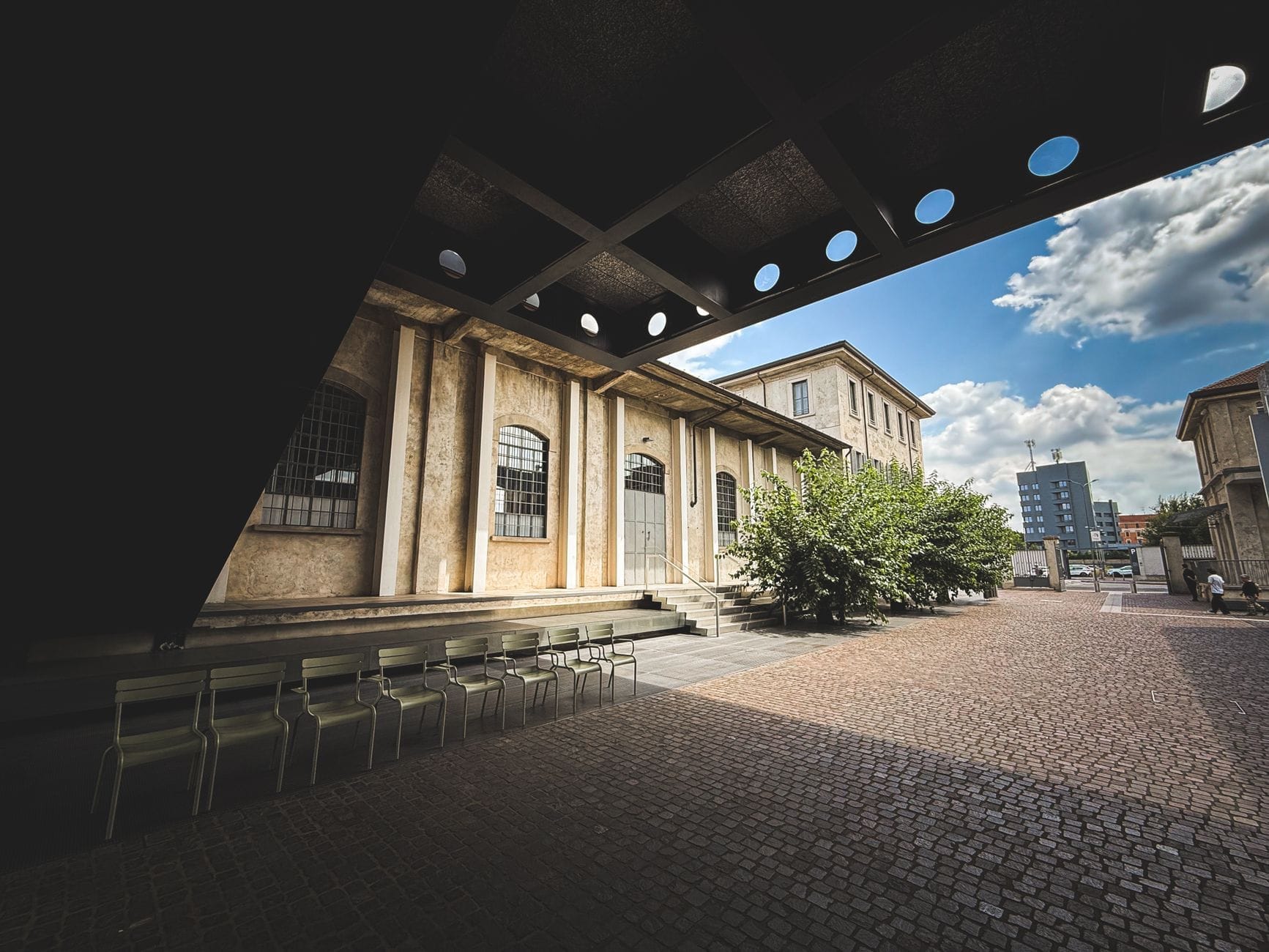
What Fondazione Prada Actually Is
Fondazione Prada is not a fashion museum. That distinction matters, because many visitors arrive expecting a showcase of Miuccia Prada's runway work and leave surprised by something far more intellectually demanding. Founded in 1993 as a cultural institution, the foundation commissions and presents contemporary art, film, philosophy, and architecture. It has no permanent fixation on the fashion house that bears its name.
The Milan headquarters, which opened on 9 May 2015, is the foundation's flagship space. Architecture firm OMA, led by Rem Koolhaas, converted a former distillery dating to the 1910s into a 19,000 m² campus that preserves the industrial bones while inserting new structures of striking contrast. The result is seven refurbished buildings, three new constructions, and a tall tower built in exposed structural white concrete. About 11,000 m² of that total is dedicated to exhibition space, making this one of the most generously scaled private art institutions in Italy.
ℹ️ Good to know
Opening hours: Monday and Wednesday to Sunday, 10:00 to 19:00. The foundation is closed on Tuesdays. Hours may vary around specific exhibitions, so check the official site before visiting.
The Architecture: What OMA Built and Why It Works
The decision to preserve the distillery rather than raze it shapes every spatial experience here. Walking across the main courtyard, you move between buildings that carry completely different textures and eras: pale render, weathered brick, raw concrete, and one structure clad entirely in gold leaf. That last one, the Haunted House, stops most visitors mid-stride. The gold cladding is not decorative whimsy; it marks a building conceived to hold works from the foundation's permanent collection that carry particular weight in the institution's programme.
The Torre, at 60 metres, is the most visible element from outside the complex. Its exposed white concrete reads as deliberately austere against the warmer industrial fabric below it. The upper floors house exhibition spaces with views over the surrounding Porta Romana neighbourhood. The climb through its levels gives a useful sense of scale: this is a serious institutional building, not a scenic viewpoint dressed up as a gallery.
If you have any interest in contemporary architecture, Fondazione Prada belongs in the same conversation as Milan's other major recent interventions in built form. For a wider picture of the city's architectural development, the Milan architecture guide covers the full range from medieval to present day.
Tickets & tours
Hand-picked options from our booking partner. Prices are indicative; availability and final rates are confirmed when you complete your booking.
Duomo Cathedral private tour with a local guide
From 105 €Instant confirmationFree cancellationSforza Castle entry and self-guided tour
From 15 €Instant confirmationFree cancellationSkip-the-line Duomo tour in Milan
From 40 €Instant confirmationFree cancellationNavigli Canals of Milan private walking tour with a local guide
From 40 €Instant confirmationFree cancellation
Moving Through the Complex: A Practical Walkthrough
Tickets are purchased at the entrance pavilion and can also be booked online for a specific date and time slot. The ticket covers all exhibition spaces, including the Torre floors. The bookshop, Bar Luce, and the outdoor courtyard areas are accessible without a ticket, which makes the complex approachable even on a brief visit.
There is no single prescribed route. Most visitors move from the entrance toward the Podium, a long horizontal hall used for major temporary exhibitions, before branching into the smaller refurbished buildings. The Cisterna, a low-ceilinged underground space with thick brick walls, carries the most atmospheric character of the original distillery. Smell, sound, and temperature all shift noticeably as you descend into it. The contrast with the Podium's controlled white cube environment, just a short walk away, is not accidental.
Guided tours are periodically offered and may focus on either permanent installations or temporary projects depending on the calendar; check the official site for current schedules and any additional costs, and book in advance if you want a guaranteed spot on a weekend.
💡 Local tip
Allow at least 2.5 hours for a thorough visit across all buildings. If the Torre queues are long when you arrive, start with the smaller gallery buildings and return to it toward the end of your visit when lines thin out.
Time of Day and Crowd Patterns
Weekday mornings, particularly Wednesday and Thursday between 10:00 and 12:30, are consistently the quietest windows. The courtyard feels different at that hour: the light falls low across the brick facades, and the Haunted House's gold cladding picks up a warm, almost amber tone rather than the harsher glare it catches at midday. The major gallery halls are largely empty, which matters enormously in a space where several permanent installations depend on immersive silence to function properly.
Saturday afternoons draw the largest crowds, particularly when a high-profile temporary exhibition is running. The Torre elevator can develop a queue during these periods. Sunday mornings are a reasonable middle ground: the complex opens at 10:00, and the first hour before the post-brunch crowd arrives tends to be calm. Note that the foundation is closed on Tuesdays, an easy scheduling mistake to make.
During Milan Design Week in April, visitor numbers spike significantly across the whole city, and Fondazione Prada typically programmes one of its more ambitious presentations to coincide. The foundation is worth planning a full morning around during that week, with reservations made well in advance.
Bar Luce: The One Non-Negotiable Stop
Wes Anderson designed Bar Luce, and it shows in every detail: the pastel formica surfaces, the vintage pinball machines, the curved wood-panelled ceiling, the Campari posters. It is a sincere recreation of the kind of Milanese bar that peaked in the 1950s and 1960s, but rendered with the heightened precision that Anderson brings to set design. Whether that reads as charming or slightly overwrought depends on your disposition, but the coffee is genuinely good and the pastries are made properly.
Because Bar Luce is free to enter, it draws its own audience separate from the exhibition visitors. On sunny weekend afternoons, the outdoor seating in the courtyard adjacent to the bar fills quickly. Coming for coffee after completing the galleries, rather than before, means you arrive with a natural reason to slow down and you avoid spending energy on a long queue before seeing anything.
Getting There and Practical Considerations
The address is Largo Isarco 2, in the Porta Romana area roughly two kilometres south of the city centre. The most direct approach by public transport is Metro Line M3 (yellow line) to Lodi T.I.B.B. station, using the exit marked Piazzale Lodi / Viale Isonzo, followed by a seven-minute walk. Tram 24, stopping at via Ripamonti/via Lorenzini, is an alternative that deposits you slightly closer to the entrance.
The surrounding neighbourhood, Porta Romana, is a low-key residential and commercial area with none of the tourist density of the historic centre. There are no major shops or restaurants immediately around the complex; the experience is self-contained. Visitors arriving by bike will find it easy to lock up along the surrounding streets.
For travelers building a full day in this part of Milan, the Fondazione Prada district page covers what else is walkable from here. Those combining a visit with the broader Milan contemporary arts circuit should also look at Pirelli HangarBicocca, which operates on a different scale and with a different programme.
⚠️ What to skip
The foundation is closed every Tuesday without exception. Arriving on a Tuesday is the most common visitor mistake. Always confirm hours directly at fondazioneprada.org before traveling, as exhibition changeovers can also affect partial closures.
Photography, Accessibility, and Who Should Consider Skipping
Photography is generally permitted in most areas of the complex, though specific installations or loans from other institutions may be restricted. The courtyard is excellent for architectural photography at any time, with the gold-clad Haunted House providing a subject that rewards patience with changing light. The Torre's upper gallery windows offer views over the surrounding streets that work well in the late afternoon.
Accessibility for visitors with reduced mobility is managed through visitor services. The external spaces, bookshop, and Bar Luce are accessible without a ticket; the complex terrain, which includes multiple buildings across an uneven courtyard, is worth checking in advance. Contact details for accessibility inquiries are listed on the official site.
Fondazione Prada is not the right choice for every visitor to Milan. Travelers with a primary interest in Italian Renaissance art, Baroque churches, or the canonical art-historical narrative of the city will be better served by the Pinacoteca di Brera or the Pinacoteca Ambrosiana. Families with young children may find the intellectual density of the programming here difficult to sustain across a two-hour visit, though Bar Luce provides a natural break point.
Insider Tips
- The Haunted House changes character dramatically depending on the light. If you visit on a clear day, the gold cladding looks completely different at 11:00 versus 16:00. Worth crossing the courtyard twice.
- Tickets purchased on-site are generally intended for use on the day of purchase. If you are visiting during a major exhibition opening, book online in advance; weekend slots for blockbuster shows can sell out by Thursday of that week.
- The Cisterna, the underground space in the former distillery, is easy to miss because the entrance is not prominently signposted. Ask a gallery attendant to point you toward it. It is consistently one of the most interesting spaces in the complex.
- Bar Luce does not take reservations. If you want a seat inside rather than in the courtyard, arrive before 11:30 or after 15:30 on weekends. The interior seats approximately 40 people and fills quickly.
- The foundation's bookshop carries a well-curated selection of art and architecture publications, including catalogue editions not widely available elsewhere in Milan. It is free to enter and worth browsing even if you are not visiting the exhibitions.
Who Is Fondazione Prada For?
- Contemporary art enthusiasts who want a serious institutional programme rather than a commercial gallery experience
- Architecture and design travelers interested in OMA's approach to adaptive reuse of industrial structures
- Visitors during Milan Design Week who want a culturally substantial anchor for their programme
- Those who appreciate the intersection of fashion, philosophy, and visual culture without wanting a straight fashion retrospective
- Photographers looking for architectural subjects with genuine compositional range across a single site
Nearby Attractions
Other things to see while in Fondazione Prada & South Milan:
- MUDEC – Museo delle Culture
Housed in a converted industrial complex in the Tortona district, MUDEC – Museo delle Culture brings together over 7,000 objects spanning multiple continents and three millennia of human history. The permanent collection is free to enter, while rotating blockbuster exhibitions pull from some of the world's great cultural traditions.