Pinacoteca di Brera: Milan's Greatest Art Gallery, Room by Room
The Pinacoteca di Brera holds one of Italy's most significant collections of Northern Italian Renaissance and Baroque painting, spread across 38 rooms inside the 17th-century Palazzo di Brera. Officially established in 1809, with roots in a teaching collection begun in 1776, it displays roughly 500 works including masterpieces by Mantegna, Raphael, Caravaggio, and Bellini. For anyone serious about Italian art, this is the destination in Milan.
Quick Facts
- Location
- Via Brera 28, 20121 Milan — Brera district, historic center
- Getting There
- Metro: Montenapoleone (M3) or Lanza (M2), both approx. 6 min walk
- Time Needed
- 2–3 hours for a focused visit; 4+ hours to explore thoroughly
- Cost
- €20 standard ticket (Grande Brera; verify current pricing at pinacotecabrera.org before visiting)
- Best for
- Renaissance and Baroque art, Italian painting history, quiet cultural immersion
- Official website
- pinacotecabrera.org
What the Pinacoteca di Brera Actually Is
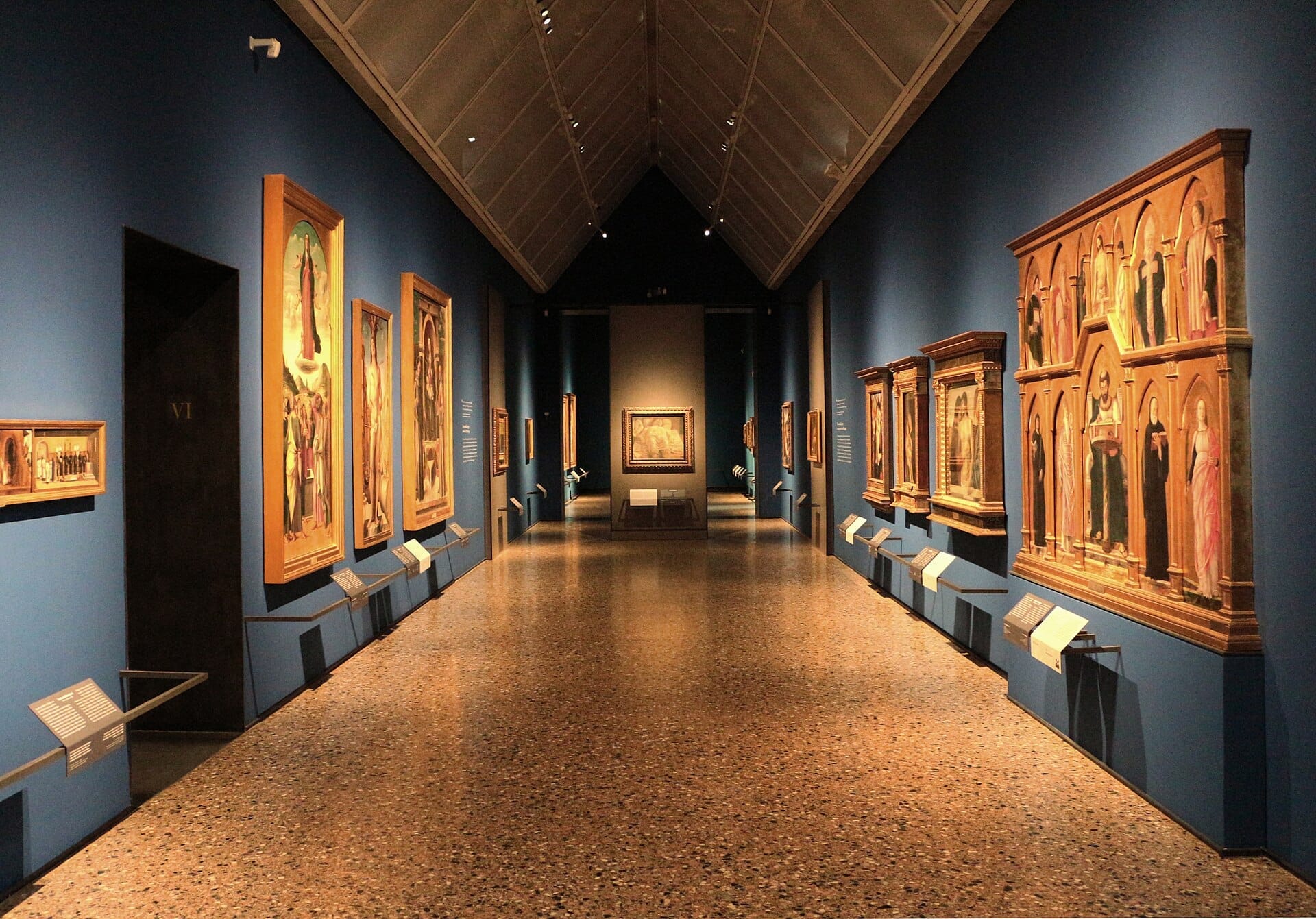
The Pinacoteca di Brera is a state art museum occupying the upper floor of the Palazzo di Brera, a sprawling 17th-century palace that also houses the Accademia di Belle Arti, Italy's oldest fine arts academy still in operation. The gallery runs across 38 rooms arranged around a courtyard of honor, displaying approximately 500 works from a total collection that numbers in the thousands. The focus is Italian painting from the 13th to the 20th century, with particular depth in the Northern Italian schools: Venice, Ferrara, Brescia, Mantua, and Milan itself.
Unlike the Uffizi in Florence, which draws far larger crowds and covers a broader European scope, the Pinacoteca di Brera is a specialist institution. Its collection was assembled with a clear didactic purpose: art education. That origin shapes the way the rooms feel. There is less spectacle, more precision. Labels and room layouts are curated to situate each work in its artistic lineage, not just its fame.
ℹ️ Good to know
Opening hours: Tuesday to Sunday, 08:30–19:15. Closed Mondays, 25 December, and 1 May. Last entry is typically accepted shortly before closing. Opening hours: Tuesday to Sunday, 08:30–19:15. Closed Mondays, 25 December, and 1 May. Last entry is typically accepted shortly before closing. Book tickets in advance on the official museum website, especially on weekends and during Milan's busier cultural seasons., especially on weekends and during Milan's busier cultural seasons.
The History Behind the Collection
The Brera's origins trace to 1776, when Empress Maria Theresa of Austria founded the Accademia di Belle Arti alongside a teaching collection of works students could study directly. The idea was practical, not prestige-driven: young painters needed originals to copy and analyze. But the collection that defines the museum today came from a different political moment entirely.
In 1809, Napoleon Bonaparte officially established the Pinacoteca di Brera as a public museum, after earlier educational collections had been assembled from 1776 onward under Maria Theresa of Austria. Napoleon's armies had systematically confiscated paintings from churches, convents, and monasteries across northern Italy and the territories he controlled, and Milan became the designated repository. Napoleon's armies had systematically confiscated paintings from churches, convents, and monasteries across northern Italy and the territories he controlled, and Milan became the designated repository. Works that had hung above altars in Brescia, Mantua, and Ferrara arrived in Brera as spoils of a cultural reorganization as much as a military conquest. The ethical complexity of that origin is real, and worth knowing when you stand in front of works that were removed from their devotional contexts and never returned.
The palace itself covers over 24,000 square meters and hosts multiple institutions beyond the gallery. As you pass through the main entrance on Via Brera 28 and cross the courtyard, you'll see students from the Accademia carrying portfolios and canvases, a reminder that the building is still very much a living center of art education. The bronze statue at the center of the courtyard is Napoleon himself, depicted as a Roman emperor, cast by Antonio Canova. It is one of the more thought-provoking pieces in the entire complex. For broader context on Brera as a neighborhood, the Brera district guide covers the surrounding streets, galleries, and cafes.
Tickets & tours
Hand-picked options from our booking partner. Prices are indicative; availability and final rates are confirmed when you complete your booking.
Brera district and Pinacoteca guided experience
From 60 €Instant confirmationFree cancellationEntrance ticket to Pinacoteca di Brera
From 18 €Instant confirmationPinacoteca Ambrosiana entrance tickets
From 17 €Instant confirmationThe art thief online exploration game in Milan Brera
From 7 €Instant confirmationFree cancellation
The Works You Came to See
The collection's most iconic work is Andrea Mantegna's Dead Christ, painted around 1480. It depicts the body of Christ lying horizontally, foreshortened dramatically so that the viewer confronts the soles of his feet first, with the wounds clearly visible. The perspective is brutal and anatomically exact. If you arrive early when the gallery is quiet, the room where it hangs has an unusually still quality. Most visitors stop for a long time in front of it.
Raphael's Marriage of the Virgin (Lo Sposalizio della Vergine, 1504) occupies its own space and draws concentrated attention. Painted when Raphael was around 21 years old, the composition is circular, serene, and technically astonishing. The mathematical precision of the temple in the background and the rhythmic arrangement of figures across the foreground are textbook demonstrations of High Renaissance ideals. Piero della Francesca's Montefeltro Altarpiece, also known as the Brera Madonna, is another room that rewards patience: the suspended egg above the Virgin has generated scholarly debate for centuries.
Beyond these headline works, the gallery has exceptional depth in Venetian painting. Giovanni Bellini is represented by multiple altarpieces, Gentile Bellini by large narrative canvases, and Tintoretto and Veronese by works that demonstrate the full range of Venetian color and drama. The Lombard rooms feature Vincenzo Foppa and Bramantino, painters who are rarely seen in depth outside northern Italy. For anyone working through the history of Italian art, these lesser-publicized rooms are often more rewarding than the famous ones.
The 20th-century section, added in later decades, includes works by Umberto Boccioni, Carlo Carrà, and Amedeo Modigliani, giving the collection a modern Italian thread that most visitors don't expect. If you're planning a focused art itinerary across Milan's museums, the best museums in Milan guide places the Brera in the context of the city's full cultural landscape.
How the Experience Changes Through the Day
At opening time, around 08:30, the gallery is genuinely quiet. The light in the rooms comes from natural skylights in some sections and carefully positioned artificial lighting in others. In the first hour, you can stand directly in front of the Dead Christ or the Raphael without other visitors in your frame. The marble floors produce a clean echo when the rooms are empty, and the scale of the large altarpieces reads differently without a crowd in front of them.
By mid-morning, school groups arrive. Italian school visits to Brera are common and can fill several rooms simultaneously. The groups are usually guided and move quickly, so if you linger in one room they will pass through. Midday on weekends is the busiest period, particularly around the Mantegna and Raphael rooms. Late afternoon, especially from around 16:00 onward, tends to thin out again as tour groups wrap up and day visitors leave.
💡 Local tip
For the best light and fewest people: arrive at opening on a Tuesday or Wednesday. Avoid visiting on Saturday afternoons and on days following public holidays, when demand is compressed into the open days.
Navigating the 38 Rooms: Practical Walkthrough
The gallery is laid out on a single floor accessed from the main staircase off the courtyard. There is no strict one-way route, which is unusual for a major Italian museum. This gives flexibility but also means it is easy to miss entire sections. Pick up the free floor plan at the entrance, which identifies the rooms by number and school. The Italian Ministry of Culture signage is clear, with room labels identifying the artistic period and region.
The audioguide covers the major works and is available at the museum in multiple languages. For the altarpieces that have been removed from their original architectural settings, the audioguide provides useful context about where each work originally hung and what it would have looked like in situ. The bookshop near the exit has one of the better selections of Italian art history publications in the city, including scholarly catalogs of the permanent collection.
The café inside the museum is modest but functional. There are benches in several of the larger rooms for resting, which matters on a long visit. Photography without flash is permitted throughout the permanent collection, and the natural and diffuse artificial lighting in most rooms produces clean results on a standard camera. The large altarpieces are difficult to photograph completely given their height, but the Mantegna and Raphael works are at accessible eye level.
Getting There and the Surrounding Area
Via Brera 28 is roughly equidistant from two metro stations. Montenapoleone on Line 3 (yellow) and Lanza on Line 2 (green) are each about a short walk away. From Montenapoleone, the approach passes through the northern edge of the Quadrilatero della Moda, before the streets narrow and shift into the quieter Brera neighborhood. From Lanza, you walk through streets with independent bookshops and smaller galleries before reaching the palace entrance.
The Brera neighborhood around the gallery is well worth an hour before or after the museum. The streets between Via Brera and Via Fiori Chiari have concentrated clusters of independent art dealers and antique shops, particularly active on Saturday mornings. The Orto Botanico di Brera, the small botanical garden attached to the Palazzo di Brera complex, is accessible from inside the courtyard and provides a quiet place to sit after a long visit. It is easy to miss and often overlooked.
If you are combining Brera with a wider walk, Castello Sforzesco and Parco Sempione are both reachable on foot in around 15 minutes northwest. The Duomo and Galleria Vittorio Emanuele II sit about 15 minutes south, making a natural half-day circuit through Milan's historic and cultural center.
Is the Brera Worth It?
For visitors who have a real interest in Italian painting, the Pinacoteca di Brera is the most important museum in Milan without qualification. The depth of the Northern Italian Renaissance collection is matched only by the Accademia in Venice and the Uffizi in Florence, and in some areas, particularly Lombard and Ferrarese painting of the 15th century, it is unmatched anywhere.
For casual visitors with limited time in Milan, the calculus is different. At €20 and 2-3 hours minimum, it is a significant investment. If your primary interest is the city's architecture, fashion, or contemporary design scene, there are arguments for prioritizing other experiences. But if you are spending more than two days in Milan and have any interest in how Italian painting developed, the Brera is not a museum to skip in favor of a shorter queue elsewhere.
⚠️ What to skip
The Pinacoteca di Brera is closed every Monday, as well as on 25 December and 1 May. Visitors often arrive to find it shut on these days, particularly on holiday Mondays. Plan accordingly and check the official site for any additional closure dates around exhibitions or restoration work.
Insider Tips
- The first room off the main staircase is often passed through quickly, but it contains some of the earliest works in the collection, including Byzantine-influenced panels that set the chronological context for everything that follows. Spending five minutes here helps the later rooms make more sense.
- The Mantegna Dead Christ is in a dedicated room. The room is small and the painting is displayed at eye level behind glass. Visit before 10:00 or after 16:00 to avoid the moments when guided groups compress into the space. The room is small and the painting is displayed at eye level behind glass. Visit before 10:00 or after 16:00 to avoid the moments when guided groups compress into the space.
- The Orto Botanico di Brera, the historic botanical garden inside the palace complex, is accessible through the courtyard and is free to enter. It is almost never crowded and provides a genuine break in the middle of a long visit.
- On the first Sunday of each month, Italian state museums including the Pinacoteca di Brera offer free admission under the Domenica al Museo initiative. Queues are longer on these days, so arrive at opening time.
- The bookshop stocks scholarly catalogs and art history texts that are harder to find outside specialist Italian bookshops. If you have a serious interest in any of the schools represented, browse before you leave rather than planning to return later.
Who Is Pinacoteca di Brera For?
- Art history enthusiasts focused on Italian Renaissance and Baroque painting
- Students and researchers interested in Northern Italian artistic schools
- Travelers combining a cultural itinerary across Milan's major museums
- Anyone seeking a quieter, more contemplative alternative to larger European museums
- Visitors with at least two full days in Milan who want to go beyond the Duomo circuit
Nearby Attractions
Other things to see while in Brera:
- Museo Poldi Pezzoli
Tucked along Via Manzoni, a short walk from La Scala, the Museo Poldi Pezzoli transforms a nobleman's former home into one of Italy's most personal and rewarding art experiences. With over 5,000 objects spanning painting, armour, jewellery, and decorative arts, it rewards slow, attentive visitors far more than a rushed pass-through.
- Orto Botanico di Brera
Founded in 1774 by order of Empress Maria Theresa of Austria, the Orto Botanico di Brera occupies a compact but remarkably serene courtyard within the Palazzo Brera complex. Free to enter during opening hours and easy to miss, it offers a genuine pause from the pace of central Milan — surrounded by centuries of botanical and academic history.