Pinacoteca Ambrosiana: Milan's Oldest Museum and Its Unmissable Masterpieces
Founded in April 1618 by Cardinal Federico Borromeo, the Pinacoteca Ambrosiana is Milan's oldest museum and one of its most rewarding art galleries. Tucked into the Ambrosian Library complex near the Duomo, its 24 rooms hold over 1,500 works by Leonardo da Vinci, Raphael, Caravaggio, Titian, and Botticelli. This is not a blockbuster attraction built for crowds. It is a serious, intimate collection that rewards visitors who come prepared.
Quick Facts
- Location
- Piazza Pio XI, 2, 20123 Milan (Duomo district)
- Getting There
- Metro M1/M3 to Duomo or M1 to Cordusio; Trams 12, 14, 16 to Orefici/Cantù
- Time Needed
- 1.5 to 2.5 hours for the full gallery
- Cost
- Pinacoteca €17 adults; combined with Crypt of San Sepolcro €20; under 6 free. Verify current prices before visiting.
- Best for
- Art enthusiasts, Renaissance history lovers, travelers wanting a quieter alternative to the major Milanese museums
- Official website
- www.ambrosiana.it/en/ambrosiana-info/pinacoteca
What Is the Pinacoteca Ambrosiana?
The Pinacoteca Ambrosiana is Milan's oldest public museum, founded in April 1618 when Cardinal Federico Borromeo donated his personal collection of paintings, sculptures, and drawings to the Ambrosian Library he had established eleven years earlier. That founding act was not simply a gesture of patronage. Borromeo intended the gallery to serve as an educational resource open to scholars and artists, at a time when most great collections in Europe remained locked inside private residences. That spirit of access still shapes the museum today.
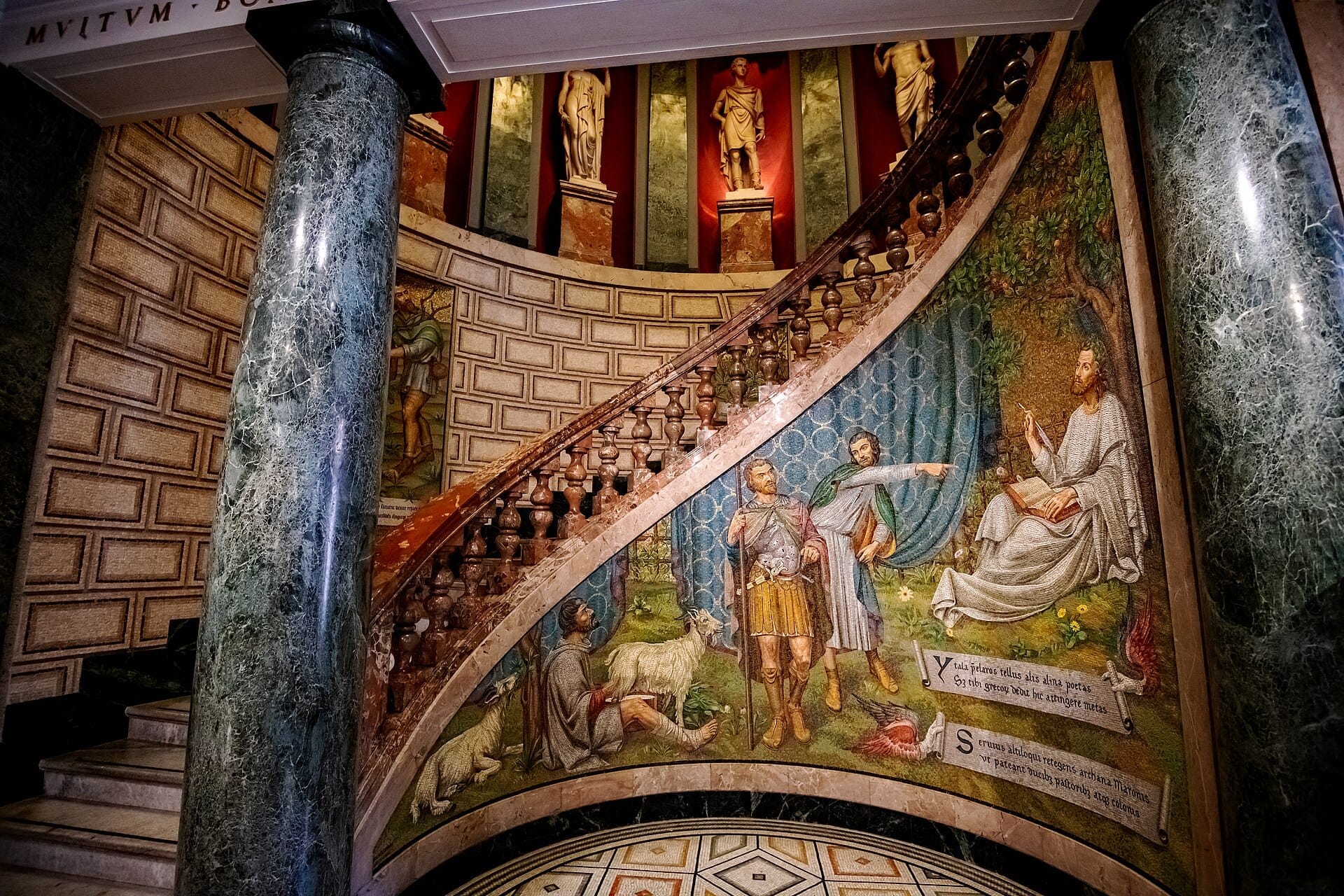
The gallery occupies part of the larger Ambrosiana complex at Piazza Pio XI, 2, a few minutes' walk southwest of the Duomo di Milano. From the street, the building reads as sober and institutional. Step inside and the atmosphere shifts: cool marble floors, high ceilings, and the particular hush that settles over serious art collections. This is a place where visitors tend to slow down.
ℹ️ Good to know
Opening hours: Monday, Tuesday, Thursday, Friday, Saturday, and Sunday, 10:00–18:00 (last admission 17:30). Closed on Wednesdays. Arrive at opening time on Tuesday, Thursday, or Friday for the most comfortable experience.
The Collection: What You Will Actually See
The Pinacoteca spreads across 24 rooms and holds more than 1,500 works on canvas, wood, and copper. The range is genuinely unusual: Flemish still lifes hang near Milanese altarpieces, and early Renaissance panels sit alongside Baroque canvases. The scale is manageable. Unlike the sprawling civic collections at the Pinacoteca di Brera, this gallery can be absorbed in a single focused visit.
The undisputed centerpiece is Leonardo da Vinci's Portrait of a Musician, the only known oil portrait by Leonardo in which the subject is male. Painted around 1490, the work shows his characteristic sfumato modelling at its most controlled: the musician's face emerges from shadow with an almost photographic depth that stops visitors mid-step. The surrounding rooms provide context, including drawings and manuscript pages from Leonardo's extensive codices held in the adjacent library.
Raphael's cartoon for the School of Athens, the full-scale preparatory drawing he produced before painting the Vatican fresco, is displayed in its own room and draws considerable attention. At roughly 2.7 metres tall and nearly 8 metres wide, it is one of the largest surviving Renaissance cartoons in existence. The pencil lines, corrections, and pentimenti visible in the drawing offer a transparency into Raphael's working process that the finished fresco cannot.
Caravaggio's Basket of Fruit, painted around 1599, is considered one of the first pure still-life paintings in Western art and is often cited as a foundational work for the genre. The composition is deceptively simple: a wicker basket of fruit, some of it overripe, set against a neutral background. The shadows and light are Caravaggio's own. Titian, Botticelli, and Jan Brueghel the Elder are also well represented across the rooms. For a broader look at how these artists fit into Milan's Renaissance and Baroque heritage, the Milan architecture and culture guide provides useful context.
Tickets & tours
Hand-picked options from our booking partner. Prices are indicative; availability and final rates are confirmed when you complete your booking.
Pinacoteca Ambrosiana entrance tickets
From 17 €Instant confirmationBrera district and Pinacoteca guided experience
From 60 €Instant confirmationFree cancellationEntrance ticket to Pinacoteca di Brera
From 18 €Instant confirmationDuomo Cathedral private tour with a local guide
From 105 €Instant confirmationFree cancellation
How the Experience Changes Through the Day
The gallery opens at 10:00 and the first hour is consistently the quietest. At that time, most of the morning foot traffic in this part of the city is still flowing toward the Duomo and the Galleria Vittorio Emanuele II, a few blocks away. The Ambrosiana receives far fewer walk-in visitors than those landmarks, which means even in peak season you can stand in front of the Portrait of a Musician without anyone at your shoulder.
By mid-morning, school groups and guided tours begin arriving. The Raphael cartoon room, in particular, can become crowded with student groups between roughly 10:30 and 12:30. If you want an uninterrupted look at that work, go directly there when you arrive or return after 15:00 when the groups have typically left.
The final hour before closing, from around 16:30 onward, brings a different kind of visitor: fewer tourists, more local art students and researchers who have slipped in after work or afternoon classes. The light inside the gallery does not change dramatically, as most rooms rely on controlled artificial lighting rather than natural windows, which is a deliberate conservation choice. There is no single dramatic late-afternoon light effect to chase here.
💡 Local tip
Wednesday is the one day the museum rooms are closed. If your Milan itinerary is flexible, build in a Tuesday or Thursday visit to the Ambrosiana and save Wednesday for the Duomo terraces or nearby Castello Sforzesco.
Getting There and Navigating the Duomo District
The museum sits in the dense core of the Duomo district, where the street grid narrows and the medieval layout of central Milan becomes tangible. From the Duomo Metro station (Lines M1 and M3), the walk takes approximately five minutes heading southwest along Via dei Mercanti and into Piazza Pio XI. From the M1 Cordusio stop, the approach is even more direct, roughly three minutes on foot along Via Bocchetto.
Trams 12, 14, and 16 stop at Orefici/Cantù, placing you within two minutes of the entrance. If you are arriving from the Navigli area or Ticinese, these tram lines are often the most comfortable option. The neighborhood around the museum is compact and pedestrian-heavy; parking nearby is impractical and unnecessary.
The Ambrosiana is logically combined with other sites in this part of the city. The Galleria Vittorio Emanuele II is a four-minute walk north, and the Duomo Museum is nearby on the eastern side of the cathedral. Grouping these three in a single day gives you a morning of serious art, an architectural landmark at midday, and a cathedral collection in the afternoon without excessive transit.
The Ambrosian Library: A Separate World Within the Complex
Visitors focused on the painting collection sometimes overlook the fact that the Biblioteca Ambrosiana, the library Cardinal Borromeo founded in 1607, remains one of the most significant manuscript libraries in Italy. It holds Leonardo's Codex Atlanticus, the largest known collection of Leonardo's drawings and writings, comprising around 1,119 pages. The library reading room (open Monday to Friday, 09:00–16:50) operates under a separate access system for researchers, but exhibitions and display cases within the museum circuit offer non-specialist visitors a view of key folios.
If the Leonardo connection is your primary motivation for visiting Milan, the Pinacoteca Ambrosiana pairs naturally with the Cenacolo Vinciano across town, and the Museo Nazionale della Scienza e della Tecnologia for a broader view of his technical work. The complete guide to Leonardo da Vinci sites in Milan outlines how to plan these visits efficiently.
Practical Details: What to Know Before You Go
Tickets are available at the entrance or in advance via the official website. During peak tourist months (April through June and September through October), buying in advance is advisable to secure a specific entry slot, though queues here are rarely as severe as those at the Last Supper. Current adult admission for the Pinacoteca alone is €17; a combined ticket including the Crypt of San Sepolcro is €20. Children under six enter free. Concession rates apply for under-18s, university students, and visitors over 65 at €15.00 for the full combined ticket. Prices should be verified on the official site before your visit, as they are subject to change.
Photography is permitted in most areas of the gallery, but flash is prohibited and tripods are generally not allowed inside museum rooms. The lighting over key works like the Portrait of a Musician is deliberately controlled, so expect some exposure challenges on handheld devices. Natural light from the courtyard areas is available during specific parts of the circuit and gives cleaner photographic opportunities.
Accessibility is partial. The historic building structure means the tour route is not fully wheelchair-accessible. Visitors with significant mobility impairments should consult the official site or contact the museum before visiting to understand which rooms are reachable. The entrance itself is at street level, but internal circulation across 24 rooms includes stairs that cannot all be bypassed.
⚠️ What to skip
The museum is closed every Wednesday. Many visitors arrive from the Duomo area and discover this only at the door. Check the official site for any additional closures during national holidays before planning your day.
Is the Pinacoteca Ambrosiana Worth Your Time?
For visitors with a genuine interest in Renaissance and Baroque painting, this is one of the most satisfying museum hours you can spend in Milan. The collection is dense with significance: the Portrait of a Musician, the Raphael cartoon, the Caravaggio still life, and the Flemish cabinet paintings create a breadth that most single-artist or single-period galleries cannot match. The atmosphere is consistently calmer than Milan's better-publicized museums.
Visitors who find undirected museum wandering tedious and have little prior interest in Renaissance art may find the experience slow. The rooms do not dramatize themselves. There are no interactive installations or theatrical lighting effects. The works stand on their own terms, and the space asks you to meet them there. If that is not what you are looking for from Milan, the city has no shortage of alternatives.
For travelers building a broader art itinerary, the guide to the best museums in Milan compares the Ambrosiana against the Pinacoteca di Brera, the Museo del Novecento, and other major collections, helping you prioritize based on your interests and available time.
Insider Tips
- Go directly to the Raphael cartoon room when the museum opens. School groups arrive mid-morning and the room fills quickly. Fifteen minutes alone with that drawing at 10:05 is worth the early start.
- The museum shop, located near the exit, carries high-quality art books and reproductions not commonly found in the souvenir shops around the Duomo. If you are interested in the Codex Atlanticus or Borromeo's collection, the catalogues here are the real thing.
- Carry a small notebook or use your phone's note function as you move through the rooms. The density of the collection means details blur together by room 18. Brief notes on what struck you help reconstruct the experience afterward.
- The combined ticket including the Crypt of San Sepolcro adds a distinctly different dimension to the visit: a subterranean Roman-era archaeological layer beneath the modern city. At €20 versus €17, the addition is reasonable if you have the time.
- The courtyard between the library and gallery sections offers a quiet pause mid-visit. In warmer months, it is worth a few minutes outside before continuing into the second half of the circuit.
Who Is Pinacoteca Ambrosiana For?
- Art lovers who want to see key Renaissance and Baroque works in an uncrowded, serious setting
- Leonardo da Vinci enthusiasts building an itinerary around his Milanese works and manuscripts
- Visitors on a second or third trip to Milan who have already covered the major blockbuster attractions
- Travelers pairing the gallery with the Duomo district for a focused half-day in the historic center
- Anyone interested in the history of public art collections and the role of Counter-Reformation patronage in Italian cultural life
Nearby Attractions
Other things to see while in Duomo District:
- Chiesa di San Bernardino alle Ossa
Tucked into Piazza Santo Stefano a short walk east of the Duomo, the Chiesa di San Bernardino alle Ossa is one of Milan's most arresting and least-crowded historic interiors. Its 17th-century ossuary chapel is lined floor to ceiling with human skulls and bones, crowned by a luminous baroque fresco. Entry is free.
- Duomo di Milano
The Duomo di Milano is one of the largest Gothic cathedrals in the world, nearly six centuries in the making and still the physical and symbolic heart of the city. This guide covers what to expect inside, how to reach the rooftops, when to visit, and the practical details that make the difference between a rushed stop and a memorable experience.
- Museo del Duomo
The Museo del Duomo di Milano, housed inside Palazzo Reale on Piazza del Duomo, holds six centuries of sculpture, stained glass, and architectural models that the cathedral itself can no longer display. It is quieter than the church next door, considerably less crowded than the rooftop terraces, and far more revealing about how one of the world's most complex Gothic buildings actually came to be.
- Galleria Vittorio Emanuele II
Built between 1865 and 1877 and inaugurated in 1867, the Galleria Vittorio Emanuele II connects Piazza del Duomo to Piazza della Scala beneath a soaring 47-metre glass dome. Entry is free and the arcade never closes, making it one of the most accessible landmarks in northern Italy. Whether you stop for an espresso at a historic café or simply pass through on foot, the architecture alone rewards the detour.