Bosco Verticale: Milan's Vertical Forest Up Close
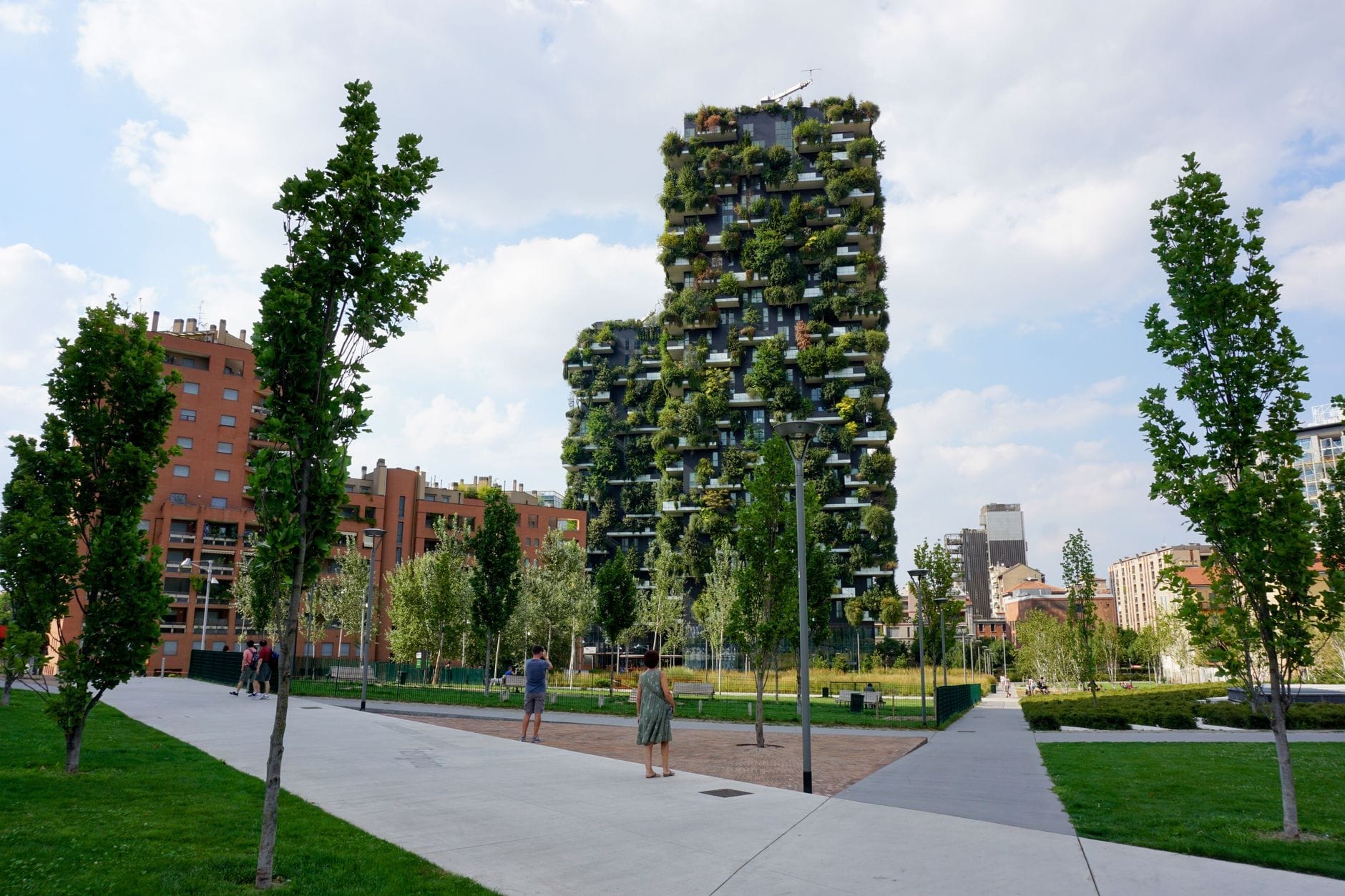
Bosco Verticale, or Vertical Forest, is a pair of residential towers in Milan's Porta Nuova district clad in over 800 trees and thousands of plants. Visitors cannot enter the towers, but the surrounding public spaces offer striking views of one of the most photographed buildings in contemporary architecture.
Quick Facts
- Location
- Via Federico Confalonieri / Via Gaetano de Castillia, Porta Nuova / Isola, Milan
- Getting There
- Isola (M5, 3-min walk) or Gioia (M2, 5-min walk)
- Time Needed
- 20–45 minutes for exterior viewing and photography
- Cost
- Free — exterior viewing from public streets and BAM park
- Best for
- Architecture lovers, photographers, design-minded travelers
- Official website
- www.stefanoboeriarchitetti.net/en/project/vertical-forest
What Bosco Verticale Actually Is
Bosco Verticale is a residential complex, not a museum, observation deck, or public attraction in the conventional sense. Two towers, one rising approximately 110 metres and the other 76 metres, are wrapped in terraces planted with roughly 800 trees, 4,500 shrubs, and 20,000 plants drawn from around 100 species. The result is a high-rise building that looks, from a distance, like a green cliff face in the middle of a city.
Designed by Stefano Boeri Architetti, the project was conceived starting in 2007 and completed in October 2014. It sits at the edge of the Isola neighbourhood where it meets the Porta Nuova business district, a zone that has undergone dramatic transformation since the early 2000s. The towers won the International Highrise Award in 2014 and have since become a reference point in discussions about urban ecology and biophilic architecture worldwide.
ℹ️ Good to know
Important: Bosco Verticale is a private residential building. There is no entry for visitors. All viewing is done from the surrounding streets and the adjacent Biblioteca degli Alberi park (BAM), which is fully public and free.
The Experience of Being There
Your first clear view of the towers tends to arrive as you exit Isola metro station and walk south along Via Federico Confalonieri. The buildings appear suddenly at the end of the street, and the effect is genuinely disorienting in the best way. From ground level, the vegetation appears dense enough that you can barely distinguish the concrete floors beneath it. In spring and summer, the canopy of leaves creates a layered, almost shimmering surface. In autumn, the foliage shifts through yellows and reds before the trees shed their leaves, revealing the structural terraces underneath and a completely different silhouette.
Getting close to the base means standing on Via Gaetano de Castillia, the residential street that runs between the two towers. Here, the sense of scale becomes clear. Trees planted on balconies at the 20th floor are at full height, their trunks horizontal against the sky. The sound is noticeably quieter here than on the main Porta Nuova boulevard; sparrows and other small birds have colonised the terraces, and on still mornings their calls filter down to street level.
Tickets & tours
Hand-picked options from our booking partner. Prices are indicative; availability and final rates are confirmed when you complete your booking.
Duomo Cathedral private tour with a local guide
From 105 €Instant confirmationFree cancellationSforza Castle entry and self-guided tour
From 15 €Instant confirmationFree cancellationSkip-the-line Duomo tour in Milan
From 40 €Instant confirmationFree cancellationNavigli Canals of Milan private walking tour with a local guide
From 40 €Instant confirmationFree cancellation
The Best Vantage Points
The Biblioteca degli Alberi, also known as BAM, is the most rewarding place to spend time around Bosco Verticale. This public urban park sits directly adjacent to the towers and provides clear, unobstructed angles for viewing both buildings together. Benches and open lawn areas allow you to sit back and take in the full height of the taller tower without craning your neck. The park is well-maintained, free to enter during opening hours (06:30–21:00 in winter, until 23:30 in summer), and rarely overcrowded outside of weekend afternoons in good weather.
For the best long-distance perspective, walk north into the Isola neighbourhood itself. The area around Piazza Gae Aulenti, part of the broader Porta Nuova and Isola district, gives you a view that places Bosco Verticale in context alongside the UniCredit Tower and other contemporary structures. From this angle, the contrast between the green-clad residential towers and the glass corporate high-rises nearby is at its most striking.
Photography works best from BAM park level, shooting upward in early morning or late afternoon when the sun hits the western face of the taller tower at an angle that picks out individual trees. At midday in summer, the light is flat and the vegetation appears uniformly dark. Smartphone cameras handle the scene well from 30 to 50 metres away; telephoto lenses allow close-up detail of individual terraces.
💡 Local tip
For the cleanest photographs, position yourself in BAM park about 40 metres from the base and shoot toward the taller tower in the hour after sunrise. The light catches the eastern terraces and the foliage appears its most varied and detailed at this time.
Historical and Architectural Context
The idea behind Bosco Verticale was to concentrate the equivalent of about five hectares of forest onto the surface area of a high-rise building. The architects worked with botanists and arborists to select species suited to survival at altitude: each tree was grown in custom soil substrates with irrigation systems built into the terraces. The root systems are contained in large concrete planters integrated into the balcony slabs, and the entire structure was engineered with the additional load of mature trees in mind.
The towers belong to a broader regeneration of the Porta Nuova area, which transformed a largely industrial and rail-adjacent zone into a mixed-use district between approximately 2004 and 2015. Bosco Verticale stands at the northern tip of this transformation, between the polished commercial plaza of Porta Nuova to the south and the more residential Isola neighbourhood to the north. Isola was a working-class district that developed its own distinct character precisely because it was cut off from surrounding areas by railway lines; that enclosure has now become part of its identity.
The project has influenced urban architecture globally, spawning vertical garden towers in other cities. For visitors interested in the broader context of Milan's design culture, the Milan architecture guide puts Bosco Verticale alongside the city's other defining structures, from the 14th-century Duomo to the 20th-century Torre Velasca.
Time of Day and Seasonal Changes
Morning visits, roughly 7 to 9 am, offer the quietest conditions. The park is occupied mostly by local residents walking dogs or running. The towers catch direct light early, and the difference between the greened terraces and the bare concrete of adjacent buildings is sharpest at this hour. There are few other tourists and the area feels like a neighbourhood rather than a landmark.
Weekend afternoons from April through October bring groups of visitors and design students, particularly around BAM park. The park itself can feel crowded near its central lawn areas, though the sightlines to the towers remain clear. Weekday visits avoid this entirely.
Seasonal change is well worth considering when timing a visit. Spring (March to May) brings fresh pale green foliage that contrasts well against the tower's concrete. Autumn (October) offers the richest colour variation across the 100 plant species. Winter strips the deciduous species bare, which many visitors find unexpectedly revealing: the structural terraces become visible as a composition of concrete shelves, and the few evergreens take on greater prominence. None of these versions of the building is objectively better; they are different buildings.
Getting There and Practical Notes
The simplest approach is Line M5 (lilac line) to Isola station, which places you a three-minute walk from the towers. Line M2 (green line) to Gioia station adds roughly two more minutes on foot. Both options involve straightforward, flat walking through safe streets. The area is easily combined with a broader Porta Nuova walk.
If you are visiting the Biblioteca degli Alberi on the same trip, note that the park effectively surrounds the southern side of the Bosco Verticale complex. There is no need to plan separate journeys; the two are a single coherent walk.
Accessibility around the viewing areas is good. BAM park is flat, has paved paths throughout, and is navigable by wheelchair. The surrounding streets are standard urban pavement with kerb cuts at crossings. There is no need to climb stairs or traverse uneven terrain for the best views.
⚠️ What to skip
Do not attempt to enter the towers or approach private entrance areas. Bosco Verticale is a residential building with security. The best views are from public space and do not require getting close to the building's entrances.
Who Should Adjust Their Expectations
Visitors who arrive expecting an immersive architectural experience, such as a lobby tour, a rooftop viewpoint, or an exhibition about the building's design, will be disappointed. There is no interpretive content on site, no café attached to the project, and no way to access the upper levels. What you get is a view of a building from public space, which is rewarding if you care about contemporary architecture and landscaping, but straightforward if you do not.
Travelers who have already seen extensive coverage of Bosco Verticale in magazines or online may find the in-person experience confirms rather than exceeds their expectations. The scale is impressive, but the building is ultimately a residential tower. Those with limited time in Milan and little specific interest in architecture might find other stops more immediately engaging.
Insider Tips
- Walk the full perimeter of both towers rather than stopping at a single angle. The northeast corner, viewed from inside BAM park, shows both towers in relation to each other and gives the clearest sense of how the vegetation density varies by terrace exposure.
- Visit on a weekday morning in October if your travel dates allow. Autumn foliage across 100 plant species produces colour variation that peak-season visitors never see, and the building looks structurally quite different when the deciduous canopy thins.
- The towers are easier to photograph with a slight zoom rather than ultra-wide. A focal length of around 35 to 50mm equivalent keeps vertical lines clean and places emphasis on the vegetation rather than creating geometric distortion.
- Combine the visit with BAM park's plant installation itself. The ground-level garden in Biblioteca degli Alberi uses many of the same species found on the towers, giving you a way to identify individual plants before looking up to spot them on the terraces.
- If you are visiting Milan during the Salone del Mobile or Design Week in April, the Porta Nuova area around Bosco Verticale often hosts outdoor installations and events. The towers become a backdrop for additional programming, making the visit richer without requiring any additional entry fee.
Who Is Bosco Verticale For?
- Architecture and design enthusiasts seeking Milan's most discussed contemporary building
- Photographers looking for a structured, high-impact subject with natural and built elements
- Travelers combining a Porta Nuova walk with BAM park and the surrounding neighbourhood
- Those interested in urban ecology and green building design as a contemporary practice
- Visitors on a tight budget who want a significant architectural landmark without any admission cost
Nearby Attractions
Other things to see while in Porta Nuova & Isola:
- Biblioteca degli Alberi
The Biblioteca degli Alberi Milano, or BAM Library of Trees, is a 10-hectare public park in the Porta Nuova district, framed by contemporary towers and designed around circular forests of over 500 trees. Entry is free every day of the year, making it one of the most accessible and architecturally significant green spaces in the city.
- Cimitero Monumentale di Milano
Opened in 1866, the Cimitero Monumentale di Milano is one of Europe's most architecturally ambitious cemeteries. Spanning 25 hectares, it functions as a permanent exhibition of Italian funerary art, with sculptures, mausoleums, and monuments that rival any city museum. Admission is free.
- Palazzo Lombardia
Palazzo Lombardia is the headquarters of the Lombardy Regional Government and one of the tallest buildings in Milan. Rising 161 metres over Milan's Porta Nuova district, its glassy curves and open public piazza make it a landmark of contemporary Italian architecture, while the rooftop Belvedere offers one of the most rewarding elevated views in the city.