Biblioteca degli Alberi Milano (BAM): Milan's Living Park Between the Skyscrapers
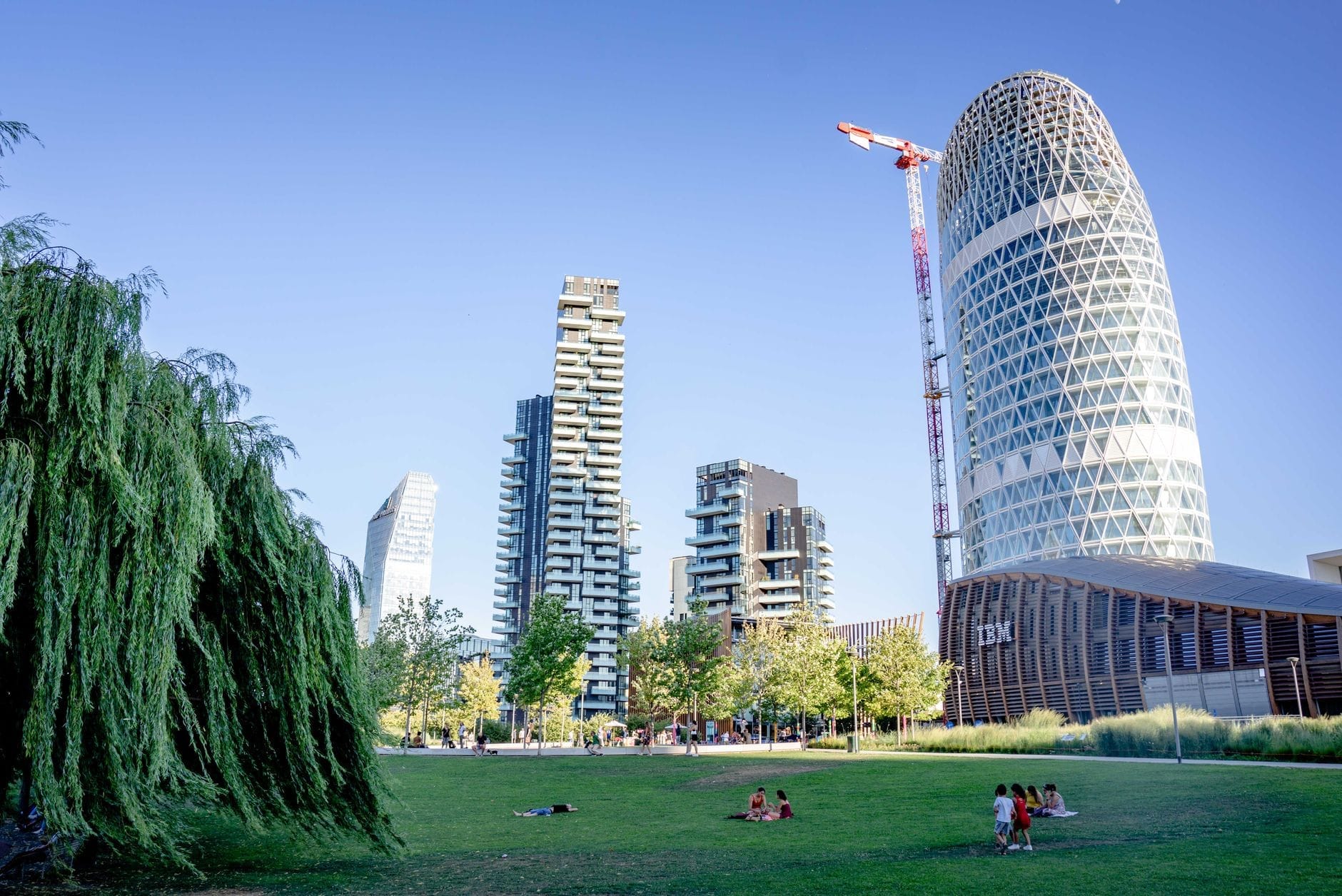
The Biblioteca degli Alberi Milano, or BAM Library of Trees, is a 10-hectare public park in the Porta Nuova district, framed by contemporary towers and designed around circular forests of over 500 trees. Entry is free every day of the year, making it one of the most accessible and architecturally significant green spaces in the city.
Quick Facts
- Location
- Porta Nuova district, between Piazza Gae Aulenti, Isola, Via Melchiorre Gioia and the Varesine promenade
- Getting There
- Metro Garibaldi (M2 & M5), 5-min walk; Milano Centrale rail station, 10-min walk
- Time Needed
- 45 minutes to 2 hours depending on pace and events
- Cost
- Free – public park, open every day of the year. Winter hours: 06:30–21:00; Summer hours: open until 23:30
- Best for
- Urban nature walks, families, architecture enthusiasts, picnics, evening strolls
- Official website
- bam.milano.it
What Is the Biblioteca degli Alberi?
The Biblioteca degli Alberi Milano, known by its acronym BAM and translated into English as the Library of Trees Milan, is a 10-hectare public park in the heart of Milan's Porta Nuova district. It is managed by the Fondazione Riccardo Catella in partnership with the Municipality of Milan, and it sits in one of the most architecturally charged urban environments in Italy: a zone of glass towers, elevated walkways, and renovated post-industrial streetscapes.
The park's design concept came from Dutch studio Inside Outside, led by landscape architect Petra Blaisse, whose winning proposal dates to 2004. The central idea is deceptively simple: arrange trees into 22 distinct circular 'forests', each planted as a ring of the same species, so that visitors move between self-contained ecosystems rather than through a single undifferentiated green space. With more than 500 trees representing over 100 plant species, and roughly 135,000 plants total, BAM reads as a living catalogue of botanical variety. The name itself is the point: this is a library where each grove is a chapter. For more on how BAM fits into Milan's architectural evolution, see the Milan architecture guide.
💡 Local tip
No fences, no gates, no ticket queues. BAM has multiple step-free entrances from Via G. de Castillia, Piazza Gae Aulenti, and the Passeggiata Veronelli — walk in from any direction.
A Brief History: From Industrial Wasteland to Urban Forest
The land now occupied by BAM was not always so green. The Porta Nuova zone was for decades a fragmented mix of rail yards, industrial plots, and underused urban land on the northern edge of Milan's historic center. The decision to redevelop it into a new business district, anchored by the UniCredit Tower and Piazza Gae Aulenti, was one of the most significant urban planning interventions in 21st-century Milan.
The park's journey to completion took well over a decade from Petra Blaisse's 2004 design commission. A particularly notable cultural moment came during Expo Milano 2015, when artist Agnes Denes created her installation 'Wheatfield' on this very ground, a reference to her landmark 1982 Manhattan land art work. The park was inaugurated for public use on 27 October 2018 under its current name and cultural program.
That cultural dimension is not incidental. BAM operates not merely as a park but as a year-round outdoor programming platform, hosting concerts, yoga sessions, outdoor cinema, workshops for children, and community events. The Fondazione Riccardo Catella publishes a seasonal calendar on the official website, and many events carry no admission charge.
Tickets & tours
Hand-picked options from our booking partner. Prices are indicative; availability and final rates are confirmed when you complete your booking.
Duomo Cathedral private tour with a local guide
From 105 €Instant confirmationFree cancellationSforza Castle entry and self-guided tour
From 15 €Instant confirmationFree cancellationSkip-the-line Duomo tour in Milan
From 40 €Instant confirmationFree cancellationNavigli Canals of Milan private walking tour with a local guide
From 40 €Instant confirmationFree cancellation
What It Actually Feels Like to Walk Through
Enter from the Piazza Gae Aulenti side and the first impression is spatial contrast. Behind you: polished stone plazas, the circular fountain bowl, glass-clad office towers. Ahead: soft grass, the rustle of birch or hornbeam, and a drop in ambient temperature that is immediately noticeable on a warm afternoon. The park does not feel large from a map, but the circular grove structure means you are constantly turning, re-orienting, discovering a different canopy overhead.
The planting is organized so that each circular forest has a distinct sensory character. Some groves are dense enough that you lose the skyline entirely for a few seconds; others are open-topped rings where the tower blocks frame the sky above the branches. The ground between the circles varies: broad grass meadows suited to sitting and picnicking, narrower gravel paths connecting one ring to the next, and a dedicated picnic area with accessible tables.
The park has no formal 'route'. Most visitors drift from the Piazza Gae Aulenti entrance toward the central meadow, then follow the circular groves in loose arcs toward the Isola neighborhood side. The Passeggiata Veronelli, a raised pedestrian promenade along the park's eastern edge, offers a slightly elevated view over the tree canopies — a good spot for a quiet moment away from the main lawns.
ℹ️ Good to know
Dogs are welcome in BAM. On weekend mornings, the lawns fill quickly with dog walkers and families — plan your visit accordingly if you prefer a quieter atmosphere.
Time of Day: How BAM Changes by the Hour
Early morning (before 09:00) is when the park belongs almost entirely to joggers and dog owners. The light filters through the circular canopies at low angles, the city noise is still manageable, and the air carries a genuine green smell — damp earth and leaf rather than exhaust. For photography, this is the most rewarding window: the contrast between the organic forms of the tree rings and the steel-and-glass towers behind them is sharpest in raking morning light.
Midday on weekdays brings office workers from the surrounding Porta Nuova towers, eating lunch on the grass. Weekday afternoons are relatively calm. Weekends between about 11:00 and 17:00 are the busiest periods, particularly when outdoor events are scheduled — the central meadow can hold a significant crowd for concerts or markets, though the grove paths remain navigable.
Summer evenings are arguably the best time to visit. The park stays open until 23:30 and the atmosphere shifts: the heat of the day dissipates, the towers glow, and the cultural program often places musicians or film screenings in the park. Families, couples, and groups of friends occupy the grass with picnic blankets well into the evening. In winter, the park closes at 21:00 but the bare-branched circular groves take on a sculptural quality that is genuinely striking — particularly after rain, when the ground reflects the ambient lighting of the surrounding district.
Getting There and Moving Around the Neighborhood
BAM sits squarely in the Porta Nuova and Isola district, making it easy to combine with other nearby attractions. The most direct metro access is Garibaldi station, served by M2 (green line) and M5 (lilac line), a five-minute walk from the park's southern entrance. From Milano Centrale railway station, allow around ten minutes on foot or take any tram heading northwest. The nearest metro stations listed on BAM's own map are Garibaldi, Gioia, and Isola.
The park itself requires no transportation within its grounds. It is entirely flat and step-free across its main paths, with wheelchair access confirmed from Via G. de Castillia, Piazza Gae Aulenti, and the Passeggiata Veronelli. The kids' play area is designed to be accessible for children with disabilities. For visitors planning a full Porta Nuova day, the Bosco Verticale — the planted residential towers designed by Boeri Studio — is visible from within BAM and only a short walk away.
⚠️ What to skip
There is no dedicated parking within BAM. The surrounding Porta Nuova district has limited street parking and is subject to Milan's Area C congestion charge zone boundaries — check current zone limits before driving.
Photography and Practical Considerations
BAM is one of the more photogenic parks in northern Italy, precisely because the contrast between designed nature and contemporary urbanism is so deliberate. The circular grove entrances, where a ring of identical trunks frames a patch of sky or a distant tower, produce strong geometric compositions. A standard wide-angle lens covers most scenarios; a short telephoto (85–135mm equivalent) is useful for isolating specific tree rings against the architectural backdrop.
There are no restrictions on amateur photography within the park. Drone use is subject to Italian civil aviation authority regulations and local municipal rules — do not assume it is permitted without checking current guidance.
What to bring: comfortable flat shoes (the grass areas are soft after rain), a layer for evenings even in summer, and a refillable water bottle. There are cafes and food options in the surrounding Porta Nuova district but no fixed kiosk within the park itself at all times — check the BAM website for seasonal concessions and event catering.
If you are building a broader itinerary around this area, the Milan 3-day itinerary places BAM logically alongside the Isola neighborhood and Piazza Gae Aulenti into a coherent half-day route.
Who Should Skip BAM (Or Adjust Expectations)
BAM is not a historic garden. Visitors expecting the formal geometry of Italian Renaissance gardens, the ornamental fountains of a classical park, or the depth of botanical collections found in a dedicated garden institution may find it pared down. The plant labeling is minimal compared to, say, a university arboretum.
Those visiting Milan on a tight itinerary focused entirely on historic art and architecture may reasonably prioritize other sites — though BAM is unusual enough in concept that it rewards even a brief stop if you are already in the Porta Nuova area. Visitors specifically interested in Milan's green spaces should also consider the Parco Sempione near Castello Sforzesco, which offers a very different, more expansive parkland experience, and the Orto Botanico di Brera for a more traditional botanical garden setting.
Insider Tips
- Check the BAM events calendar on bam.milano.it before you visit. Many outdoor concerts, yoga sessions, and film screenings are free and add significantly to the experience, but the schedule changes seasonally.
- The Passeggiata Veronelli along the park's eastern edge is less trafficked than the central lawn. It gives you an elevated line-of-sight over the circular canopies — a perspective most casual visitors miss entirely.
- For the clearest views of the Bosco Verticale towers framed by BAM's tree rings, position yourself in the groves nearest the Via G. de Castillia entrance and look southeast. The planted balconies of the towers appear at mid-height directly above the circular groves.
- The park's sensory character changes dramatically between seasons: the circular groves are most legible as distinct botanical rooms in winter (when bare branches reveal the ring structure) and most immersive in late spring (when full canopy closes overhead). Plan accordingly.
- Early evening in summer (19:00–21:00) offers the rare combination of golden light on the towers, a drop in temperature, reduced crowds compared to midday weekends, and the longest opening hours of the year.
Who Is Biblioteca degli Alberi For?
- Urban walkers who want green space without leaving the contemporary city behind
- Families with children, including those with accessibility needs
- Photographers interested in the intersection of landscape design and modern architecture
- Visitors combining a Porta Nuova architecture circuit with outdoor relaxation
- Locals and travelers looking for free outdoor events and seasonal cultural programming
Nearby Attractions
Other things to see while in Porta Nuova & Isola:
- Bosco Verticale
Bosco Verticale, or Vertical Forest, is a pair of residential towers in Milan's Porta Nuova district clad in over 800 trees and thousands of plants. Visitors cannot enter the towers, but the surrounding public spaces offer striking views of one of the most photographed buildings in contemporary architecture.
- Cimitero Monumentale di Milano
Opened in 1866, the Cimitero Monumentale di Milano is one of Europe's most architecturally ambitious cemeteries. Spanning 25 hectares, it functions as a permanent exhibition of Italian funerary art, with sculptures, mausoleums, and monuments that rival any city museum. Admission is free.
- Palazzo Lombardia
Palazzo Lombardia is the headquarters of the Lombardy Regional Government and one of the tallest buildings in Milan. Rising 161 metres over Milan's Porta Nuova district, its glassy curves and open public piazza make it a landmark of contemporary Italian architecture, while the rooftop Belvedere offers one of the most rewarding elevated views in the city.