Tre Torri (CityLife Towers): Milan's Architectural Statement in Steel and Glass
Three towers by three of the world's most celebrated architects define Milan's western skyline. The Tre Torri complex in the CityLife district is free to visit, easily reached by metro, and offers one of the sharpest contrasts between old and new Italy you'll find anywhere in the city.
Quick Facts
- Location
- Piazza Tre Torri, CityLife district, Milan (20145)
- Getting There
- Tre Torri station, Metro Line M5 (directly beneath the plaza)
- Time Needed
- 30–60 minutes for the plaza; 2–3 hours if combining with CityLife shopping and park
- Cost
- Free — the plaza and exterior views are fully public
- Best for
- Architecture enthusiasts, photography, design lovers, evening walks
- Official website
- www.city-life.it/en/the-skyline
What Tre Torri Actually Is
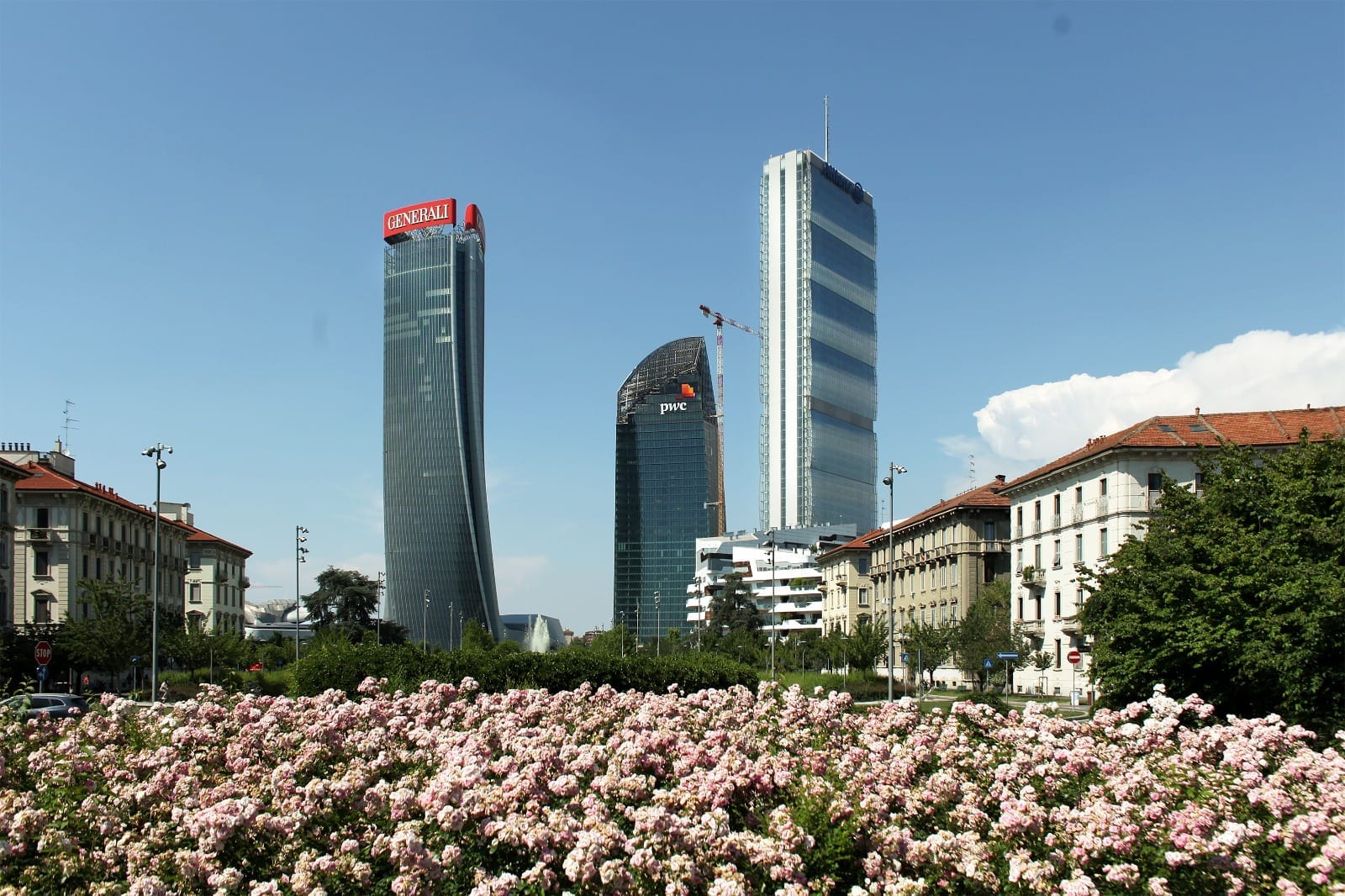
Tre Torri, meaning 'Three Towers,' is the architectural centerpiece of Milan's CityLife district, a large urban redevelopment project built on the site of the old Fiera Milano trade fair grounds in the city's west. Three separately commissioned skyscrapers rise side by side from a shared public plaza, each designed by a different global architecture firm: the twisting Generali Tower by Zaha Hadid Architects (nicknamed 'Lo Storto,' the crooked one), the straight-edged Allianz Tower by Arata Isozaki and Andrea Maffei (the tallest of the three, standing approximately 209 meters across 50 floors), and the asymmetric PwC Tower by Studio Libeskind. Together they form one of the most photographed modern skylines in Italy.
The towers are primarily occupied by corporate tenants, so there are no observation decks or ticketed interior experiences open to the general public. What draws visitors here is the plaza itself, the scale of the architecture at ground level, and the way the three very different silhouettes read against the sky. This is not an attraction you consume. It is one you walk through, look up at, and absorb.
ℹ️ Good to know
Entry to Piazza Tre Torri is free at all hours, though access via the Tre Torri metro station (Line M5) is limited to the operating hours of the metro. The station exits open directly onto the plaza, so there is effectively no walking required from the station to the towers.
The Architecture: Three Buildings, Three Personalities
Generali Tower (Hadid Tower / Lo Storto)
The Generali Tower is the one visitors gravitate toward first. Zaha Hadid's signature formal language, all curves and counter-rotations, makes the building appear to spiral as you walk around it. The facade is clad in triangulated glass panels that shift tone with light conditions, catching warm amber at dusk and a cooler silver-blue in overcast weather. It is visually arresting from nearly every angle, and the base of the tower, where the tapered form meets the plaza level, is where the geometry becomes most dramatic and legible.
Allianz Tower (Isozaki Tower)
The Allianz Tower is the tallest structure in the complex and was designed by Japanese architect Arata Isozaki in collaboration with Andrea Maffei. Its silhouette is the most restrained of the three: a clean rectangular prism with a glass curtain wall that reflects the sky and surrounding towers rather than asserting its own texture. The design phase began in the early 2000s, construction started in 2012, and completion came in 2015. Standing beneath it and tilting your head straight back gives a genuine sense of disorienting height that photographs do not convey.
PwC Tower (Libeskind Tower)
The PwC Tower by Studio Libeskind is the lowest of the three but arguably the most angular and expressive. Its facade breaks into faceted planes that project and recess in sharp diagonals, a signature of Daniel Libeskind's deconstructivist approach. It catches light differently from the other two and creates strong shadow lines that change significantly depending on the time of day and the season.
Tickets & tours
Hand-picked options from our booking partner. Prices are indicative; availability and final rates are confirmed when you complete your booking.
Street tour and food tasting with the best bars of Milan
From 85 €Instant confirmationFree cancellationWine tasting experience in Milan city centre
From 36 €Instant confirmationFree cancellationStreet food walking tour of Milan with a local guide
From 65 €Instant confirmationFree cancellationLa Scala Theatre guided tour
From 47 €Instant confirmationFree cancellation
How the Experience Changes by Time of Day
Morning, roughly between 8 and 10 a.m., brings a steady stream of workers arriving for the corporate offices. The plaza has an efficient, purposeful energy, with coffee cups and briefcases rather than cameras. The light at this hour comes in low from the east and catches the glass of the Isozaki Tower particularly well, making the facade glow while the Hadid Tower's curves cast interesting early shadows.
Midday is the flattest time photographically but the most comfortable for lingering. The plaza's pedestrianized design means there is no traffic noise, and the landscaping provides some shade. Families with strollers and people walking dogs are common during weekday lunch hours. The scale of the buildings becomes most apparent when you see other people dwarfed beside them.
Late afternoon into early evening is when the complex genuinely earns its reputation. From around 5 p.m. onward, the low western light catches all three towers simultaneously. The Hadid Tower's triangulated panels flare in warm tones, the Libeskind's angular breaks sharpen into high contrast, and the Isozaki reads as a mirror of shifting color. This is the window serious architectural photographers aim for. After sunset, the buildings are lit artificially and the plaza fills with people from the adjacent CityLife shopping district and park.
💡 Local tip
For the best photography, arrive 45 minutes before sunset. Position yourself on the western side of the plaza to catch the light hitting all three facades simultaneously. A wide-angle lens is useful given how close together the towers are.
Context: Why CityLife Matters to Milan
The CityLife project represents one of the most significant urban transformations in Milan since the postwar period. The site was formerly occupied by the Fiera Milano trade fair grounds, a sprawling exhibition complex that had anchored this part of the city for decades. When the trade fair relocated to the new Fiera Milano in Rho-Pero, the land became available for redevelopment, resulting in the mixed-use CityLife district: towers, park, residential blocks, and a major retail center. It is a useful case study in how contemporary Milan has approached density and design, and it sits in interesting contrast to the more chaotic architectural growth of the Porta Nuova and Isola area on the other side of the city center, where the Bosco Verticale towers have become an equally prominent symbol of Milan's contemporary identity.
Understanding this planning context makes the visit richer. CityLife was not a spontaneous development. It was a deliberate attempt to build a world-class modern district with named architects and integrated public space, comparable in ambition to developments in Dubai, London, or Singapore. Whether it fully succeeds as urban fabric is a fair question. The plaza between the towers can feel vast and exposed on cold or rainy days, and the overall district lacks the organic grain of older neighborhoods like Brera or the Navigli. But as an exercise in architectural ambition, it is undeniably serious.
Getting There and Getting Around
The fastest and simplest way to reach Tre Torri is the Milan Metro Line M5 (the lilac line). The Tre Torri station exits directly into Piazza Tre Torri, so you step out of the turnstile and the towers are immediately overhead. From the Duomo area, take Line M1 west to Cadorna and transfer to M5, or take M5 directly from Porta Garibaldi. Journey times from central Milan are typically around 20 minutes depending on your starting point.
The CityLife district is fully pedestrianized around the towers and connecting park, so once you arrive there is no traffic to contend with. The surface is smooth paving throughout, making it accessible for wheelchairs and strollers. The landscaping between the towers includes seating areas and open lawn sections. The adjacent CityLife Shopping District is directly connected to the plaza and provides indoor facilities including restrooms.
⚠️ What to skip
The plaza is very exposed. On cold or windy days, the open space between the towers creates a significant wind tunnel effect. Bring an extra layer in autumn and winter, even if the temperature elsewhere in the city seems mild.
Combining Tre Torri with the Surrounding Area
Tre Torri sits within a larger CityLife development that includes a landscaped park designed as an extension of the public space around the towers. The park connects westward toward residential blocks and is used primarily by local residents, which gives it a quieter and more everyday character than the plaza itself. Heading in the opposite direction, the Arco della Pace and Parco Sempione are reachable on foot in under 30 minutes through the Corso Sempione corridor, making it straightforward to combine a modern architecture visit with the older, greener park and the Castello Sforzesco beyond.
For travelers with a specific interest in Milan's contemporary architecture, pairing a visit here with the Bosco Verticale in Porta Nuova makes for a coherent half-day focused entirely on the city's 21st-century building ambitions. The two sites represent different approaches: CityLife aims for corporate prestige through signature architects, while Porta Nuova integrates ecological thinking through its residential towers. Both are accessible by metro and free to view from the street level.
Who Should Reconsider This Visit
If you are primarily interested in Milan's historic heritage, medieval churches, or Renaissance art, Tre Torri will not compete for your attention. The towers have no interiors open to tourists, no exhibitions, and no narrative layering beyond the buildings themselves. First-time visitors to Milan with limited days are generally better served prioritizing the Duomo, the Pinacoteca di Brera, or the Last Supper before making the trip west to CityLife. The area is also noticeably corporate in character, and on weekends it can feel underpopulated compared to the rest of the city.
Travelers who tend to prefer atmosphere over form may find the plaza somewhat cold and impersonal regardless of the weather. If that describes you, the neighborhood energy of the Navigli or the historic streets around Basilica di Sant'Ambrogio will likely satisfy more than a walk through a corporate plaza, however architecturally distinguished.
Insider Tips
- Line M5 is one of Milan's quieter metro lines and runs automatically without a driver. The Tre Torri station itself is worth a look: its interior uses geometric lighting panels that echo the angular design language of the towers above.
- The best unobstructed view of all three towers together requires some distance. Walk north along Via Senofonte or step back into the park access path on the western edge of the plaza to get a wide enough angle to fit all three in frame without distortion.
- The CityLife Shopping District, directly adjacent to the plaza, has clean public restrooms accessible without a purchase and is one of the few reliable options in this part of the city.
- On clear evenings, the illuminated towers reflect visibly in the glass facades of each other. The Isozaki Tower in particular mirrors the Hadid Tower's curves, creating a distorted echo effect that is easier to see than to anticipate.
- If you visit during Milan Design Week (typically held in April), the CityLife district frequently hosts satellite events and installations around the plaza that add a temporary programmatic layer to the visit.
Who Is Tre Torri (CityLife Towers) For?
- Architecture enthusiasts who want to compare three landmark contemporary skyscrapers in a single visit
- Photographers, particularly for late-afternoon golden hour shots with strong directional light
- Travelers with a specific interest in modern urban planning and large-scale redevelopment projects
- Visitors who have already covered Milan's main historic sites and want to explore its 21st-century identity
- Evening walkers looking for a scenic, car-free route with dramatic skyline views and access to nearby dining