San Siro Stadium (Stadio Giuseppe Meazza): The Complete Visitor Guide
Stadio Giuseppe Meazza, universally known as San Siro, is Italy's largest football stadium and one of the most recognizable sports arenas in the world. Home to both AC Milan and Inter Milan, it holds 75,817 spectators and opens its doors to visitors through a guided stadium tour and dedicated museum. Whether you attend a match or explore on a quiet weekday morning, the sheer scale of the place makes an impression that photographs cannot prepare you for.
Quick Facts
- Location
- Piazzale Angelo Moratti, 20151 Milan (San Siro district, western Milan)
- Getting There
- Metro Line 5 – San Siro Stadio stop (approx. 4-min walk); also Tram 16
- Time Needed
- 1.5–2.5 hours for the museum and tour; longer on match days
- Cost
- Museum & Tour: ~€30 adults, ~€25 children (6–14; younger children often free). Verify prices before booking.
- Best for
- Football fans, architecture enthusiasts, families, sports history lovers
- Official website
- sansirostadium.com/the-stadium/?lang=en
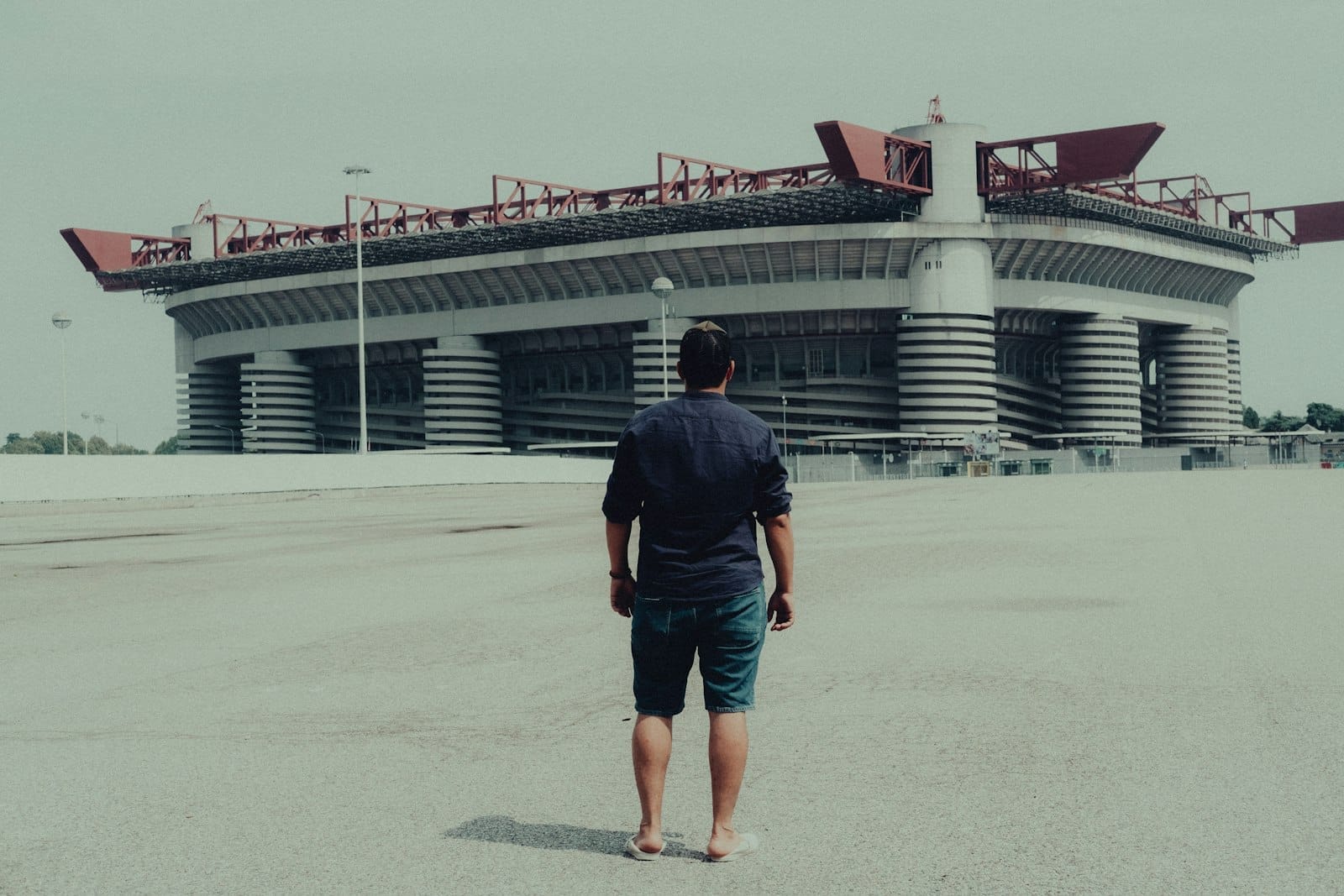
What San Siro Actually Is
Stadio Giuseppe Meazza, still called San Siro by almost everyone who lives in Milan, is not just a football ground. It is Italy's largest stadium by seated capacity, at 75,817 places, and it holds a singular position in European football culture as the shared home of two of the continent's most decorated clubs: AC Milan and Inter Milan. That two bitter rivals have played here since the 1940s is one of the stranger facts of Italian football, and the stadium's geography reflects the tension: each club occupies separate sections, with color-coded areas and prominent club branding around different entrances and concourses.
The stadium sits in the western San Siro district, about 7 km from the city center, in a residential neighborhood of broad streets and low-rise apartment blocks. On non-match days, the area is remarkably quiet for somewhere connected to such global noise. You approach along wide, tree-lined avenues, and then the three cylindrical towers of the stadium's exterior appear above the roofline, concrete and unmistakably 20th-century industrial in character. Architecturally, it is a building that earns its reputation: not beautiful in the conventional sense, but imposing in a way that few sports venues manage.
💡 Local tip
Book your stadium tour ticket online in advance through the official San Siro Stadium website. Tours can sell out, particularly on weekends, and walk-up availability is not guaranteed on busy dates.
A Century of History on the Pitch
The stadium was built between 1925 and 1926, inaugurated on 19 September 1926 with a derby between AC Milan and Inter, which Inter won 6–3. It was originally conceived as a facility for AC Milan, with Inter adopting it as a shared venue in later decades. The ground underwent significant expansions over the following decades, most dramatically before the 1990 FIFA World Cup when a third tier was added and the distinctive 11 helical ramps, now among the most recognizable structural elements, were installed on the exterior.
The official renaming to Stadio Giuseppe Meazza came in 1980, honoring the Milanese footballer who won two World Cups with Italy (1934 and 1938) and spent much of his career at Inter. The name Meazza carries deep local meaning, yet the San Siro nickname has never disappeared from everyday speech. Meazza played here, as did Rivera, Mazzola, Ronaldo, Maldini, and Baresi. The list of World Cup matches, European Cup finals, and championship deciders played on this pitch is long enough to fill its own museum, which it essentially does.
The stadium holds UEFA Category 4 status, the highest classification in European football in terms of stadium infrastructure requirements, which speaks to the standards it meets. For broader context on what makes Milan's architecture significant across eras, the Milan architecture guide covers everything from the Duomo to CityLife's contemporary towers.
Tickets & tours
Hand-picked options from our booking partner. Prices are indicative; availability and final rates are confirmed when you complete your booking.
Inter Milan football game ticket at San Siro Stadium
From 0 €Instant confirmationInter Milan football game ticket at San Siro Stadium
From 0 €Instant confirmationInter Milan football game ticket at San Siro Stadium
From 0 €Instant confirmationInter Milan football game ticket at San Siro Stadium
From 0 €Instant confirmation
The Museum and Stadium Tour: What to Expect
The museum and guided tour run daily, with indicative hours of 10:00 to 18:00, though specific dates in June and July may see partial closures, and match days typically suspend or modify tours. Always check the official website before making travel plans around a visit. Tickets cost approximately €30 for adults and €25 for children aged 6 to 14, though prices are subject to change.
The tour covers the areas most visitors imagine: the players' tunnel, the pitch-side view, the home and away changing rooms, the press room, and the VIP areas. Walking the tunnel toward the pitch, the scale of the bowl becomes physical rather than statistical. The lower tier angles steeply upward on all sides, and even empty, there is a particular acoustic quality to the space, a low resonance that hints at what 75,000 people create on a derby night. The grass carries the patterned mowing typical of UEFA-standard pitches, and the smell of a well-maintained sports turf is one of those sensory details that photographs never capture.
The museum section is split between AC Milan and Inter displays, with trophies, kits, boots, match balls, and photographic archives from both clubs presented in parallel. If you carry a strong allegiance to one club, you may find the shared format slightly jarring, but it is a reasonable solution to an unusual situation. The historical depth is impressive, with material going back to the early 20th century.
ℹ️ Good to know
The museum and tour are unavailable on certain match days and may close on short notice for events. Check the official San Siro Stadium site for real-time availability before your visit.
Attending a Match: The Real San Siro Experience
No guided tour replicates a match day at San Siro. Serie A or Champions League nights, particularly during derbies between AC Milan and Inter, represent one of the most charged atmospheres in European football. The crowd noise under the partially-covered third tier creates an amplification effect that feels almost physical. Supporters arrive from the metro in waves from around two hours before kickoff, and the street food stalls outside begin trading from mid-afternoon: panini, roasted chestnuts in winter, and beer sold from temporary kiosks around the perimeter.
Tickets for high-profile matches can be extremely difficult to obtain and should be purchased through official club channels only. The stadium fills unevenly depending on the opponent, with Milanese supporters showing selective enthusiasm for lower-tier Serie A fixtures. For a Champions League game or a derby, plan well in advance. The match day experience at the stadium contrasts sharply with the polished gallery culture of the rest of Milan, and that contrast is part of its appeal.
Dress for the season rather than the occasion. San Siro's design, with its open sections and the wind channeling through the upper tiers, makes it cold in autumn and winter evenings even when air temperatures feel moderate. A jacket is worth bringing even in September for evening fixtures. On summer afternoons during a tour visit, the metal walkways and concrete exterior absorb heat significantly, so water and sun protection matter.
Getting There and Practical Logistics
The most straightforward route from central Milan is Metro Line 5 (the Lilac/Purple Line) to the San Siro Stadio stop, from which the stadium is around a 4-minute walk. Tram 16 also serves the area for those approaching from different parts of the city. By car, the stadium is approximately 7 km from the city center, though match-day traffic can extend that journey considerably. Parking near the stadium fills quickly on event days.
The surrounding neighborhood offers limited dining options compared to central Milan. There are a few neighborhood bars and a cluster of food stalls near the entrance on event days, but for a proper meal before or after a visit, plan to eat elsewhere. The CityLife district, a short distance east, has restaurants and the large CityLife Shopping Centre if you want to combine the stadium visit with something broader.
Navigating the Milan metro system is straightforward, and the network covers most tourist destinations efficiently. For a full overview of transport options across the city, the guide to getting around Milan covers metro lines, trams, and how to buy tickets.
Accessibility and Practical Notes
The stadium provides 244 designated disabled seats within its overall capacity of 75,817, and the facility is rated to UEFA Category 4 standards, which includes requirements around accessibility, safety, and visitor comfort. That said, the sheer size of the structure means that some sections involve significant walking distances and steps. If mobility is a concern, it is worth contacting the stadium directly to understand which tour elements are fully accessible before booking.
Photography on the tour is generally permitted in most areas, and the pitch-side view offers the most striking perspective for wide-angle shots. The changing rooms tend to be dimly lit, so a phone with strong low-light performance will produce better results. For match day photography, check the event-specific rules, as professional equipment restrictions often apply.
⚠️ What to skip
San Siro's future is subject to ongoing debate. As of recent years, both clubs have discussed proposals for a new stadium in Milan. Verify the stadium's operational status before planning a visit, particularly for visits beyond 2026.
Who This Attraction Is and Is Not For
For anyone with a genuine interest in football history, Italian sport, or the cultural place football occupies in Italian life, San Siro delivers clearly. The museum content is substantial, the architectural experience is genuinely unusual, and attending a live match here is the kind of experience that tends to stay with people. Families with children who follow football will find the tour well-paced and accessible.
Visitors with no interest in football, however, may find the tour underwhelming relative to the time and cost involved. Milan's museum offerings are exceptional, from the Pinacoteca di Brera to the Fondazione Prada, and those attractions will likely offer more to visitors whose interests lie in art or design rather than sport. The stadium's location, away from the historic center, also means a deliberate journey rather than a casual detour.
If you are building a multi-day itinerary for Milan, the 3-day Milan itinerary can help you decide whether San Siro fits alongside the city's other major draws.
Insider Tips
- Arrive at the stadium for the tour opening time of 10:00 on weekdays for the quietest experience. Weekday mornings see significantly fewer visitors than weekend slots, which means more time in the changing rooms and pitch-side areas without crowds.
- The external spiral ramps are one of the most photographed architectural elements in Milanese sport. Walk around the full perimeter of the stadium before entering to appreciate the three towers and helical ramps from different angles. The northwest corner offers the best framing.
- If you plan to attend a match, choose your sector carefully when buying tickets. The Curva Nord is Inter's traditional ultras section and the Curva Sud is AC Milan's, both characterized by standing, chanting, and dense atmosphere. Seated lateral sections offer better sightlines and a calmer environment if you want to watch the football itself.
- The club stores inside the stadium carry official merchandise at official prices. Avoid unlicensed vendors on the surrounding streets, where counterfeit goods are common and quality is unpredictable.
- For match evenings, take the metro rather than a taxi or rideshare. The post-match crowd surge makes road access around the stadium slow, while the metro runs additional capacity after final whistle and clears quickly.
Who Is San Siro Stadium (Stadio Giuseppe Meazza) For?
- Football fans, whether supporting AC Milan, Inter, or simply appreciating the game's history
- Architecture enthusiasts interested in mid-20th-century stadium design and structural engineering
- Families with older children who follow Serie A or European football
- Sports history travelers building an Italian football itinerary
- Visitors attending a live Serie A or Champions League match as a one-off experience
Nearby Attractions
Combine your visit with:
- Abbazia di Chiaravalle
Founded in 1135 by Saint Bernard of Clairvaux, the Abbazia di Chiaravalle is one of the earliest examples of Gothic architecture in northern Italy. Tucked into the agricultural parkland south of Milan, it remains an active Cistercian monastery and offers a rare counterpoint to the city's more trafficked landmarks.
- Idroscalo di Milano
Built in the late 1920s as a seaplane runway, the Idroscalo di Milano is now a sprawling park wrapping a roughly 0.8 km² artificial lake on Milan's eastern fringe. Entry to the park is free, the perimeter path stretches over 6 km, and the facilities range from open-air swimming pools to kayaking and concert venues. It is the closest thing Milan has to a beach resort within city reach.
- Pirelli HangarBicocca
Housed in a converted locomotive factory in Milan's Bicocca district, Pirelli HangarBicocca is one of Europe's largest single-storey exhibition spaces. Entry is free, shows are ambitious, and the permanent installation by Anselm Kiefer alone justifies the trip across town.
- Rotonda della Besana
Built between 1695 and 1732 as a burial ground for the Ospedale Maggiore, the Rotonda della Besana is a late-Baroque complex of striking architectural beauty. Today it functions as a free public garden and culture centre, with a children's museum inside the central church. Few places in Milan carry this much layered history so quietly.