Ritan Park (Temple of the Sun): The Diplomat Quarter's Living Backyard
Built in 1530 as a Ming-dynasty imperial altar, Ritan Park is one of Beijing's oldest surviving ceremonial spaces. Today it functions as a relaxed neighborhood park in Chaoyang's embassy quarter, where locals practice tai chi at dawn, office workers eat lunch on stone steps, and elderly residents play chess under willow trees. Entry is free.
Quick Facts
- Location
- No. 6, Ritan North Road, Chaoyang District, Beijing
- Getting There
- Dongdaqiao, Jianguomen, or Chaoyangmen subway stations (walk ~15 min); buses 43, 403, 120, 28 to Fangcaodi
- Time Needed
- 1 to 2 hours
- Cost
- Free (¥0 admission)
- Best for
- Morning walks, local atmosphere, photography, imperial history
What Ritan Park Actually Is
Ritan Park, known formally in Chinese as 日坛公园 (Rìtán Gōngyuán), translates literally as "Temple of the Sun Park." The name is not decorative. At the park's heart sits a circular stone altar platform, built in 1530 under the Jiajing Emperor of the Ming dynasty, where emperors performed ceremonies to worship the sun. After post-1949 reconstruction and expansion, the site became a public park and opened to visitors in 1956.
The park covers approximately 19.8 hectares in Chaoyang District, putting it close to the embassy quarter and the business district around Jianguomenwai Avenue. The park covers approximately 19.8 hectares in Chaoyang District, putting it in Beijing's First Embassy District and close to the business district around Jianguomenwai Avenue. Its setting gives it a neighborhood-park character alongside its historic altar.
💡 Local tip
Admission is free. The park opens at 06:00 daily (closing at 21:00 in peak season and 22:00 in off-season). Arrive before 08:00 if you want to witness the morning routines without crowds.
The Altar and Its Ritual History
The sun altar is a historic ceremonial structure associated with imperial worship of the sun. The Jiajing Emperor was responsible for establishing the altar in 1530, as part of the Ming dynasty’s imperial ritual system.
The altar compound is surrounded by mature cypress trees that are centuries old in some sections. The smell of the bark on a warm afternoon is one of those details that lingers. These trees were considered sacred in Chinese imperial ritual practice, and their presence connects Ritan to the same aesthetic logic you find at the Temple of Heaven and the Old Summer Palace. Walking among them gives a sense of the original enclosure that a photograph rarely captures.
After 1949, the altar was incorporated into a public park. The Beijing municipal government decided in 1951 to rebuild Ritan, and the surrounding land was expanded before the park opened to visitors in 1956. The site was thereby reoriented toward public recreation while preserving its historic ceremonial association.
Tickets & tours
Hand-picked options from our booking partner. Prices are indicative; availability and final rates are confirmed when you complete your booking.
Small group tour of Tian'anmen Square and the Forbidden City
From 43 €Instant confirmationFree cancellationBeijing Summer Palace Entrance Ticket
From 7 €Instant confirmationFree cancellationMutianyu Great Wall and Summer Palace small-group tour from Beijing
From 171 €Instant confirmationFree cancellationPrivate Guided Tour to Temple of Heaven, Panda House and Summer Palace
From 67 €Instant confirmationFree cancellation
How the Park Changes Through the Day
Between 06:00 and 08:00, Ritan belongs to its regulars. Groups of older men and women move through tai chi forms in the open areas near the main gate, their movements slow and deliberate against the sound of birdsong and the occasional bicycle bell. Others use the perimeter paths for brisk walking circuits. A few practice erhu or bring small speakers playing traditional melodies. The light at this hour, filtered through cypress branches onto stone paths, is the best photographic light in the park.
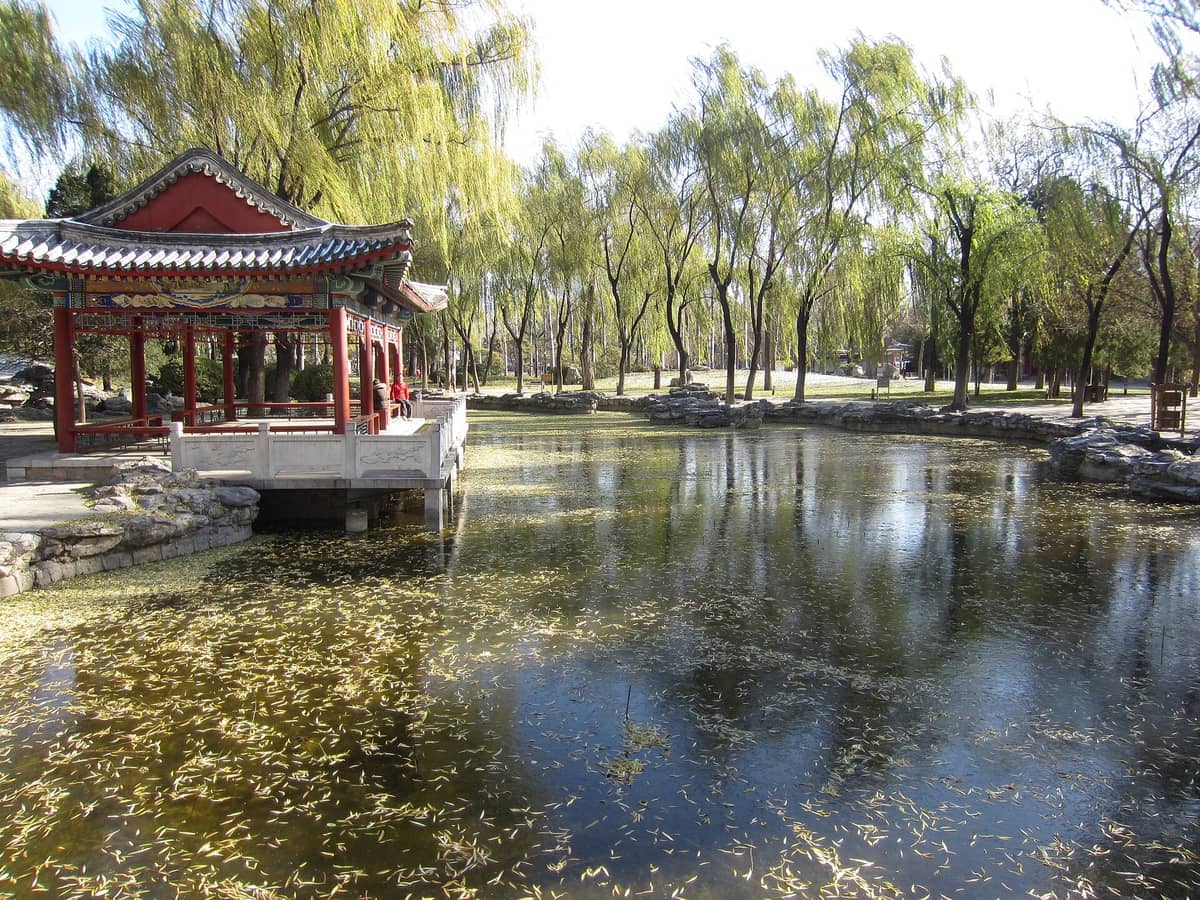
By 10:00 the character shifts. Nannies arrive with young children. Older residents begin long games of chess on the stone tables near the lake. The small lake itself, which has rowboats available for hire at certain times of year, becomes a focal point. The water reflects the trees and, in autumn, turns copper and gold with fallen leaves. In summer, lotus pads spread across part of the surface.
Midday and the afternoon hours bring office workers and embassy staff using the park as a lunch escape. The stone steps near the altar compound become informal seating. On weekday afternoons the park is genuinely quiet. Weekends draw larger numbers but nothing approaching the volume at Beihai or Jingshan.
ℹ️ Good to know
Autumn (September to November) is the best season to visit. The cypress and willow trees turn, the air is dry and clear, and the low-angle morning light hits the stone altar structures at a flattering angle. Spring (April to May) is also pleasant, though windier.
Walking Through the Park: A Practical Orientation
The park has several gates. The park has several gates, including entrances on and around Ritan North Road. The altar compound is the principal historic focus of the park; follow the internal paths and posted signs when visiting it.
The ornamental lake is positioned to the west of the altar area. A path circles it, taking perhaps ten minutes at a slow pace. Weeping willows trail into the water at several points. On the east side of the park there is a children's playground and a small area with commercial food and drink stalls. The quality of these stalls is functional rather than noteworthy; you're better off eating before you arrive or heading to the restaurants on Ritan Road, which borders the park to the east and has a mix of international and Chinese dining options reflecting the area's expat population.
The surrounding Chaoyang neighborhood is worth understanding as context. Ritan Park sits within one of Beijing's most internationally oriented areas, close to Sanlitun's commercial strip and the Central Business District. If you're combining visits, the Dongyue Temple is a short taxi or bus ride northeast and offers a sharply different, more intense religious atmosphere. For a day structured around Chaoyang's distinct character, see the Chaoyang neighborhood guide.
Photography and Seasonal Conditions
The best photography in Ritan Park happens early in the morning and in autumn. The morning tai chi sessions are photographically rich if you position yourself with the cypress trees in the background and use the light coming from the east. Most participants are accustomed to the presence of other visitors but basic courtesy applies: don't interrupt a session or push close with a lens.
The altar's whitewashed walls photograph well in overcast light, which smooths out harsh shadows on the stone texture. The circular geometry of the altar compound also works better from elevated angles, but there is no formal viewpoint within the park for this. If photography is a central goal of your Beijing trip, the Beijing photography guide covers optimal timing and locations across the city.
Beijing's air quality varies considerably by season and weather system. On days with poor air quality, the soft colors of the park feel flat and the light is chalky. Check an air quality monitor before planning a visit where outdoor photography matters. Winter visits are cold and quiet; the park is operationally open but the experience is stark, with bare willows and few visitors. Some find the emptiness appealing.
Getting There and Practical Notes
Ritan Park is served by buses 43, 403, 120, and 28 to Fangcaodi. Beijing’s official tourism information also identifies Yong'an Li Station on Line 1 as a subway access point; check current transit directions for the most convenient walk from your arrival station. Taxis and ride-hailing via DiDi are the most direct option if you're arriving from a hotel; the park's address, No. 6, Ritan North Road, Chaoyang District, is clear enough to communicate.
Paths within the park may include steps and uneven stone surfaces around historic areas. Visitors with mobility needs should check current accessibility information with the park before visiting.
There is no bag check or security line at the gate. You walk in freely. This absence of infrastructure is itself part of the experience: Ritan doesn't feel like a tourist attraction being managed. It feels like a park that happens to have a 500-year-old altar in it.
Who This Park Is and Isn't For
Ritan Park rewards visitors who are interested in what daily Beijing life actually looks like. It is not a spectacle. If you are working through Beijing's major imperial sites, it fits naturally into a broader exploration of the city's ceremonial geography alongside the Temple of Heaven and the Forbidden City, though it is far less grand than either. The Beijing imperial history guide puts all of these sites in broader context if you want to understand how the ritual altar system worked.
Visitors who need clear narrative drama or visual spectacle to feel satisfied will find Ritan underwhelming. The altar is modest. There are no grand gateways, no towering halls, no viewing platforms. The park's value is cumulative and atmospheric rather than immediate. That said, if you have a free morning and your hotel is anywhere near Chaoyang, it is one of the more honest windows into how a city of 21 million actually functions day to day.
Families with children can use the playground area and the lake, and the open paths are good for children who need space to move. The park is free, which makes it a low-commitment stop on any itinerary.
Insider Tips
- The stretch of Ritan Road along the park's eastern boundary has some of Beijing's better international restaurants, catering to the embassy community. It makes a natural lunch stop after a morning visit.
- The stone chess tables near the lake are in use most mornings. Sitting nearby to watch a game is perfectly acceptable and gives you an extended, unhurried look at a genuinely local scene.
- The park's peak-season and off-season closing hours differ (21:00 versus 22:00), but the best time to visit is always the first hour after opening at 06:00, regardless of season.
- If you visit in October, look for the osmanthus flowering near the altar compound. The scent is distinctive and brief, lasting only a few weeks in early autumn.
- The north gate is the most practical entrance, but the east gate puts you closer to the lake and children's area if that is your focus. Maps at the gates are in Chinese but the park is small enough that orientation takes about two minutes.
Who Is Ritan Park (Temple of the Sun Park) For?
- Travelers who want to observe genuine local daily life rather than curated tourist experiences
- Photographers interested in morning light, tai chi sessions, and classical Chinese garden composition
- History-focused visitors building an understanding of Beijing's imperial altar and ritual geography
- Visitors staying in Chaoyang who want a calm morning walk within easy reach of their hotel
- Budget travelers: the park is entirely free and requires no booking
Nearby Attractions
Other things to see while in Chaoyang District:
- 798 Art District
The 798 Art District in Chaoyang is Beijing's most concentrated hub for contemporary art, housed in a repurposed 1950s military electronics factory complex. Entry to the district is free, galleries cluster along wide concrete lanes, and the atmosphere shifts dramatically between a quiet Tuesday morning and a packed Saturday afternoon. Here is what to expect, and whether it deserves your time.
- Beijing National Stadium (Bird's Nest)
The National Stadium, universally known as the Bird's Nest, is Beijing's most recognizable piece of contemporary architecture. Built for the 2008 Summer Olympics, it now operates as a visitor attraction and events venue in the Olympic Park area of Chaoyang District. Here is everything you need to know to decide whether it belongs on your itinerary.
- Olympic Park
Beijing Olympic Park, the remains one of the city's most architecturally striking outdoor spaces. Entry to the park is free, remains one of the city's most architecturally striking outdoor spaces. Entry to the park is free, and the Bird's Nest and Water Cube stadiums stand as permanent landmarks of modern Chinese ambition. This guide covers what to see, when to go, and how to make the most of a half-day visit.
- China National Film Museum
The China National Film Museum in Chaoyang is one of the largest film museums in the world, covering approximately 38,000 square metres across 20 exhibition halls. Admission to the permanent collection is free, and the complex includes working cinema screens for classic and contemporary films. It rewards curious visitors with surprising depth on Chinese film history.