Riga Town Hall Square (Rātslaukums): The Civic Heart of Old Town
Rātslaukums, or Riga Town Hall Square, is the open plaza at the center of Old Town that has served as Riga’s civic core since the early 13th century. Framed by the rebuilt Town Hall and the ornate House of the Blackheads, it is free to enter at any hour and carries more historical weight than almost anywhere else in the city.
Quick Facts
- Location
- Kaļķu iela, Riga LV-1050, Latvia (in Old Town/Vecrīga)
- Getting There
- 10-15 min walk from Riga Central Station via Kaļķu iela; city buses and trams stop along 13. janvāra iela at the Old Town edge
- Time Needed
- 30-60 min for the square itself; allow 2-3 hours if you enter surrounding buildings
- Cost
- Free to access the square; individual buildings have separate entry fees
- Best for
- History, architecture, photography, and orientation walks through Old Town
- Official website
- www.liveriga.com/en/3232-town-hall-square
What Is Riga Town Hall Square?
Rātslaukums, known in English as Riga Town Hall Square, is the principal civic plaza of Riga's Old Town. It sits at the convergence of several medieval streets, most prominently Kaļķu iela, and has served as the administrative and symbolic center of the city since Riga was founded in the early 13th century. Unlike some European city squares that have gradually been taken over by cafes and souvenir stalls, Rātslaukums retains a sense of official weight. The Town Hall occupies the northern side, the rebuilt House of the Blackheads faces it from the south, and the statue of Roland stands at the center of the plaza as it has, in various forms, for centuries.
The square is the natural starting or ending point for any walking tour of Old Town. If you are planning a structured route through the historic center, the Riga Old Town walking tour guide maps out how Rātslaukums connects to the surrounding medieval streets and major landmarks.
ℹ️ Good to know
The square is open 24 hours a day, year-round, with no admission charge. Buildings on the square, including the House of the Blackheads, operate their own separate entry fees and hours.
A History Written in Stone, Then Rebuilt from Rubble
The history of Riga Town Hall Square stretches back to the city's earliest days. By the 13th century, when Riga was establishing itself as a key trading hub on the Baltic, this square was already functioning as the civic core: the place where merchants gathered, laws were proclaimed, and the authority of the city made itself visible. The Roland Statue at the center of the square is a direct symbol of that civic tradition. Roland figures, common across the Hanseatic cities of northern Europe, signified a town's right to hold markets and administer its own justice.
That continuity was violently interrupted during World War II, when bombing destroyed the square's historic ensemble almost entirely. The Town Hall and the House of the Blackheads, two of its most recognizable structures, were reduced to ruins. For decades the square existed in a compromised state, caught between the difficulty of reconstruction and the ideological constraints of the Soviet period. It was only after Latvia regained independence that serious restoration work began. The current Town Hall building was completed in 2003 and the reconstructed House of the Blackheads in 1999, in time for Riga's 800th anniversary celebrations in 2001.
This act of reconstruction is itself historically significant. The rebuilt square is not a fakery of the past but a deliberate civic statement about identity and recovery. For deeper context on how Soviet-era decisions shaped what survived and what was lost across Riga, the Riga Soviet history guide is worth reading alongside a visit here.
Tickets & tours
Hand-picked options from our booking partner. Prices are indicative; availability and final rates are confirmed when you complete your booking.
Art and culture walking tour of Riga with a local
From 66 €Instant confirmationFree cancellationSelf-guided discovery walk in Riga - the essential old town and its secrets
From 30 €Instant confirmationFree cancellationRiga 24 or 48-hour hop-on hop-off sightseeing bus tour
From 0 €Instant confirmationFree cancellationRiga 24 or 48-hour hop-on hop-off sightseeing bus tour
From 0 €Instant confirmationFree cancellation
What You See When You Arrive
Entering the square from Kaļķu iela, the first thing you notice is the scale. Rātslaukums is larger than it appears in photographs, broad enough that the surrounding buildings do not crowd you. The cobblestone surface underfoot is uneven in the way of genuinely old city centers, worn smooth in patches by decades of foot traffic.
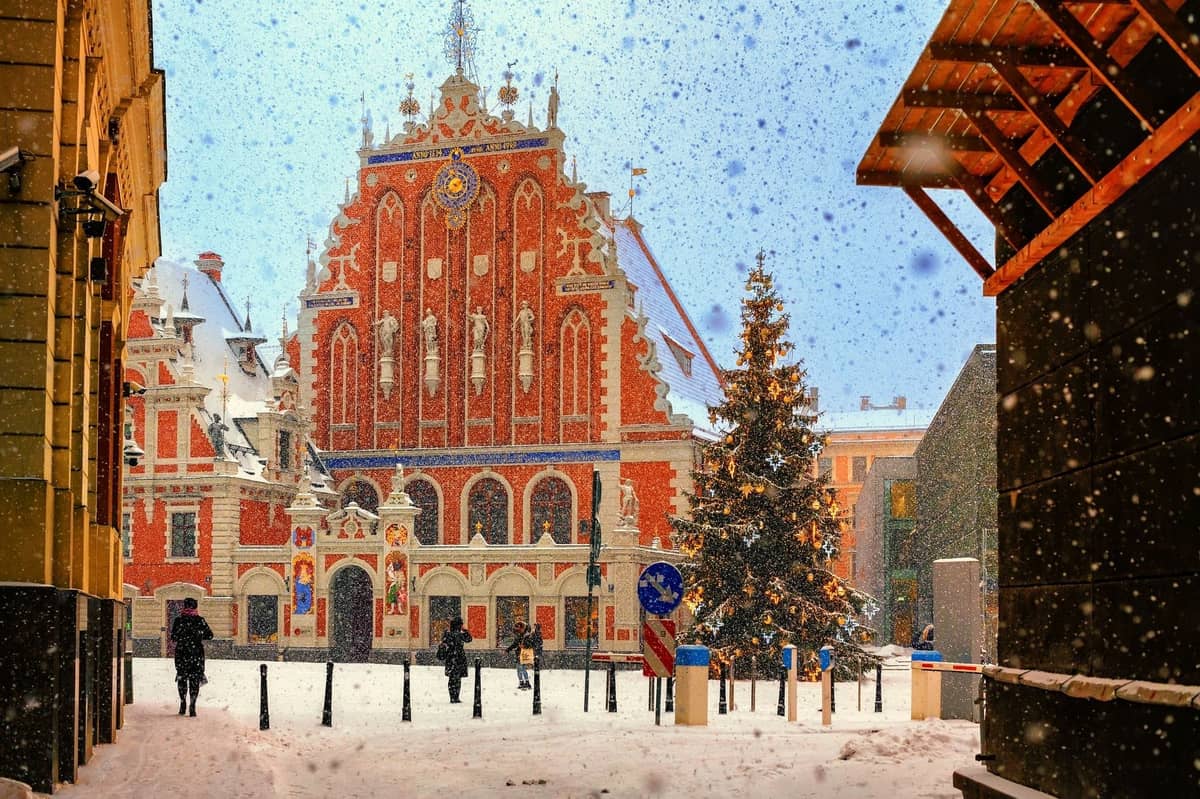
The House of the Blackheads is the most immediately striking structure. Its gabled Flemish-Gothic facade, decorated with carved stonework and dating in its reconstructed form to the late 1990s, is the most photographed building on the square. Originally built for the Brotherhood of Blackheads, a guild of unmarried foreign merchants that held significant commercial power in medieval Riga, the building now functions as a museum and event venue. The detail work on the facade, including the coats of arms and the figure of St. Maurice, rewards close inspection.
Directly facing it, the Town Hall presents a more restrained neoclassical face. Between them, the Roland Statue anchors the open space. To the south of the square, you can see the edge of the Riga Museum of History and Navigation, one of Latvia's oldest museums, which occupies a building adjacent to the square.
How the Square Changes Through the Day
Early morning, before 9 am, is the most peaceful time to visit. The cobblestones are often damp from overnight moisture, the light from the east catches the facade of the House of the Blackheads cleanly, and the only other people present are usually dog walkers and the occasional early-shift worker crossing through. This is the window for photography without crowds or tour group flags in the frame.
By mid-morning, organized tours arrive in quantity. Groups cluster around the Roland Statue while guides point toward the facades. The rhythm accelerates through lunchtime and peaks in the mid-afternoon, when the square is at its most crowded. Noise levels rise, the small cafe terraces on the periphery fill, and finding an unobstructed view for photographs becomes difficult.
Evening brings a different character entirely. When the tour groups clear after 6 pm, the square settles into a slower pace. If you are visiting in summer, the long Latvian twilight keeps the sky bright until near 11 pm, and the facade lighting that activates after dark gives the House of the Blackheads a theatrical quality. In winter, the square hosts Riga's Christmas market, which transforms the open space with stalls and a large decorated tree. The cold is sharp, often below freezing, but the atmosphere during those weeks is markedly different from any other time of year.
💡 Local tip
For the best facade photographs of the House of the Blackheads, come before 8:30 am in summer or after 7 pm when the light softens and tour groups thin out. The eastern morning light hits the Flemish gable directly.
Practical Walkthrough: Getting There and Getting Around
The square is about a 10 to 15 minute walk from Riga Central Station. Follow Kaļķu iela west through Old Town and the square opens in front of you. There is no particularly complicated navigation involved once you are in the historic center; the medieval street grid is compact enough that most wrong turns correct themselves within a block or two.
City buses and trams stop along 13. janvāra iela at the western boundary of Old Town, a short walk from the square. If you are oriented around getting efficiently between the major sites on foot, the guide to getting around Riga covers the transit options in detail.
The cobblestone surface of the square is manageable for most visitors but genuinely uneven in places. Wheelchair users and anyone with significant mobility limitations will find the terrain challenging, as is typical of historic European city centers. Flat, smooth sections exist on the square's edges, but the central area near the Roland Statue is fully cobbled.
⚠️ What to skip
Wear shoes with solid soles. The cobblestones are slippery when wet and uneven throughout. This matters especially in autumn and winter, when rain and frost are common.
The Buildings Around the Square: What to Prioritize
The House of the Blackheads is the single building most worth entering if you choose only one. The interior includes ceremonially decorated halls, a permanent exhibition on the Brotherhood's history and the building's reconstruction, and a rooftop terrace that offers views across the square and surrounding Old Town rooflines. Check current opening hours and admission prices before visiting, as these apply separately from the square itself.
The Town Hall is primarily a working civic building housing Riga's city council, not a tourist destination in itself. Its exterior is worth viewing as part of the square's composition, but visitors generally do not enter.
A short walk from Rātslaukums, the Riga Dome Cathedral is the other major architectural anchor of Old Town and connects naturally to any visit to the square. Similarly, the Freedom Monument, Riga's most symbolic public structure, is about a 10-minute walk north through the Old Town streets.
Who Will Enjoy This, and Who Might Not
Rātslaukums works well as an orientation anchor for any visit to Riga. Even travelers who are not especially drawn to history or architecture will find the scale and visual drama of the square rewarding. First-time visitors to Riga consistently name it as one of the most immediately impressive spaces in the city.
That said, the square is genuinely busy in peak summer months, and the experience at midday in July is quite different from a quiet morning in October. Travelers who prioritize solitude or who dislike large tour groups should time their visit carefully. The square also has limited shade, which is worth noting on hot summer days.
For those traveling with children, the open space gives kids room to move, and the scale of the buildings tends to register even with young visitors. The uneven cobblestones make strollers slow going, but the square is navigable. Families will likely spend 20 to 30 minutes here before moving on, which is entirely appropriate.
Insider Tips
- The best unobstructed photographs of the House of the Blackheads facade are taken from the far western edge of the square, low and wide, ideally in early morning light. Mid-square shots are often cluttered with visitors and signage.
- If you visit during the Christmas market season (typically late November through early January), arrive on a weekday afternoon rather than a weekend. Weekend evenings draw very large local crowds and moving around the stalls becomes difficult.
- The Roland Statue in the center of the square is a 20th-century reconstruction of a much older civic tradition. The original Riga statue dates from 1897, reflecting medieval Roland symbolism across Hanseatic Europe. Look for the small plaque at the base for dating information.
- The area directly behind the House of the Blackheads opens onto a quieter lane that gives you a side-angle view of the building's lesser-photographed flank and a moment away from the main square crowd.
- If you want to see the square without any crowds at all, the absolute best time is a weekday morning in late October or November, when tourism volume drops sharply and the autumn light is strong and low.
Who Is Riga Town Hall Square For?
- First-time visitors to Riga who want a central orientation point for Old Town
- Architecture and history enthusiasts drawn to Hanseatic and Gothic civic design
- Photographers looking for the most dramatic single facade in the city
- Travelers combining a walking route through Old Town across a half or full day
- Winter visitors during the Christmas market season
Nearby Attractions
Other things to see while in Old Town (Vecrīga):
- Bremen Town Musicians Sculpture
Standing on Skārņu iela in Riga's medieval Old Town, this bronze sculpture of four stacked animals tells a Brothers Grimm story while carrying a quietly powerful political message about the end of the Iron Curtain. Cast in 1990 and gifted by the city of Bremen, it's free to visit, open around the clock, and one of the most photographed corners of Vecrīga.
- House of the Blackheads
Standing on Town Hall Square in Riga's Old Town, the House of the Blackheads is a reconstructed 14th-century guild hall with an ornate Dutch Renaissance facade that stops pedestrians cold. Behind the stone and gilded detail lies a layered story of medieval merchant culture, wartime destruction, and Latvian national pride.
- Museum of the Occupation of Latvia
Housed in the heart of Riga Old Town, the Museum of the Occupation of Latvia documents 51 years of Soviet and Nazi rule from 1940 to 1991. It is one of the most carefully assembled historical museums in the Baltic states, and a visit here fundamentally changes how you understand the country around you.
- Powder Tower & Latvian War Museum
The Powder Tower (Pulvertornis) is the sole surviving tower from Riga's medieval city walls, first recorded in 1330. Today it houses the Latvian War Museum, a free, well-curated institution spanning centuries of Baltic military history. It stands at the northern edge of Old Town, easy to find and easier to underestimate.