Powder Tower & Latvian War Museum: Riga's Most Overlooked Free Attraction
The Powder Tower (Pulvertornis) is the sole surviving tower from Riga's medieval city walls, first recorded in 1330. Today it houses the Latvian War Museum, a free, well-curated institution spanning centuries of Baltic military history. It stands at the northern edge of Old Town, easy to find and easier to underestimate.
Quick Facts
- Location
- Smilšu iela 20, Vecrīga (Old Town), Riga, Latvia
- Getting There
- 10-15 min walk from Riga Central Station; nearest stops cluster around the Freedom Monument
- Time Needed
- 1.5 to 2.5 hours for the full museum; 15 minutes if visiting the exterior only
- Cost
- Free admission; guided tours available for a fee (inquire on-site)
- Best for
- History enthusiasts, budget travelers, rainy-day alternatives, families with older children
- Official website
- www.karamuzejs.lv
What the Powder Tower Actually Is
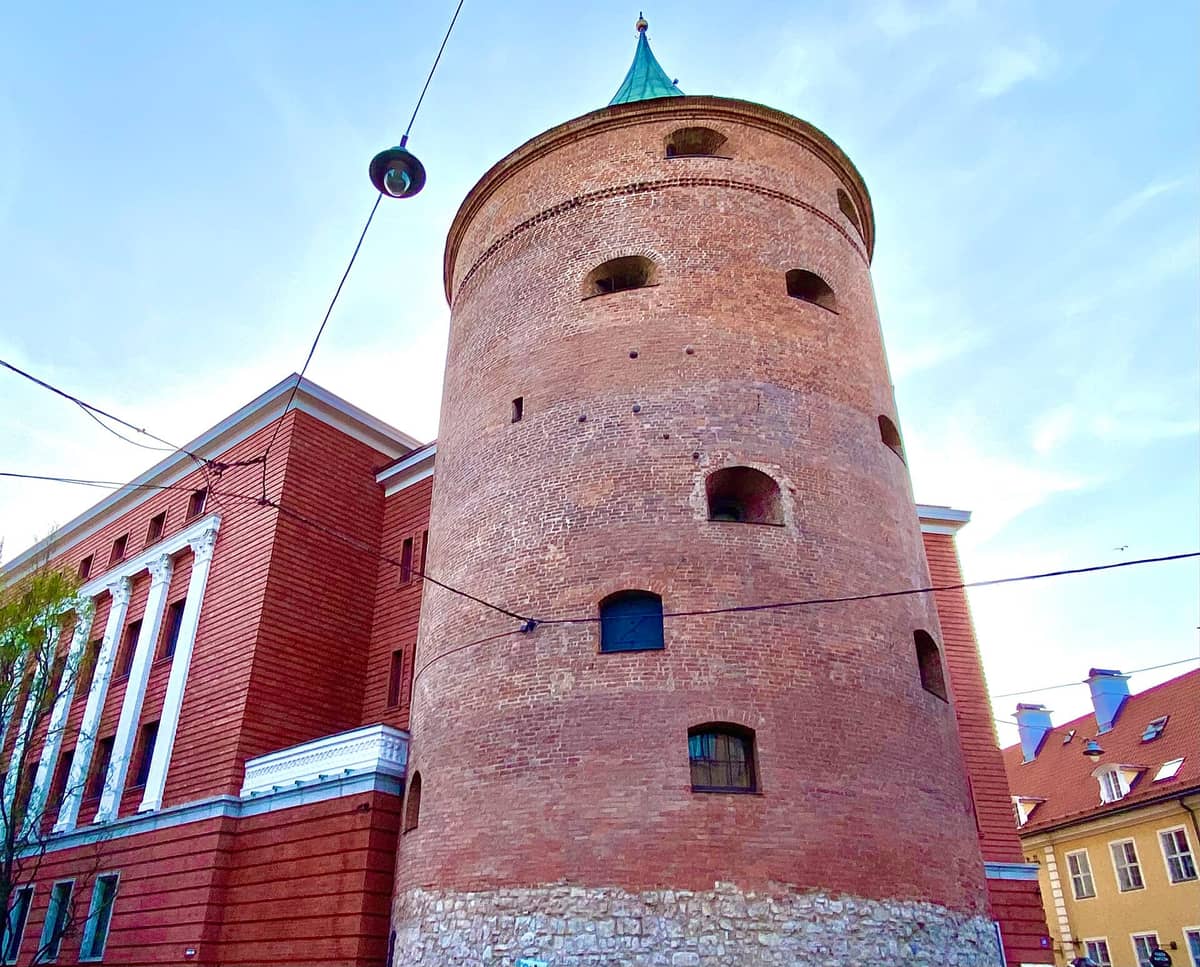
The Powder Tower (Latvian: Pulvertornis) is the only surviving tower from Riga's medieval city walls that is still standing. It sits at Smilšu iela 20, just inside the northern edge of Old Town, where the old defensive wall once curved toward the city gate. First documented in 1330 under the name the Sand Tower (Smilšu tornis), it was destroyed in 1621 during one of the many conflicts that swept through the Baltic, then rebuilt in 1650 in the round, squat form you see today. The walls are 3 metres thick, the diameter stretches to 14.3 metres, and the total height reaches 25.6 metres. These are not decorative proportions; they are engineering designed to absorb cannon fire.
The tower earned its current name in the 17th century, when the city began storing gunpowder inside its thick walls. That function is long gone, but physical evidence of the tower's military past is literally embedded in the facade: several cannonballs from various sieges are set into the red brick exterior, easy to spot once you know to look for them. They are not a reconstruction or a decoration. They were recovered and mounted in place as historical markers.
💡 Local tip
Before entering, walk around the tower's exterior on Smilšu iela and examine the cannonballs lodged in the brick. Most visitors walk straight inside and miss this entirely.
The Latvian War Museum: What's Inside
The tower was integrated into the Latvian War Museum building during a reconstruction project completed between 1937 and 1940. The museum itself occupies both the historic tower and a purpose-built annexe. The collection is large and seriously assembled: armour, weapons, uniforms, maps, documents, photographs, and personal objects that chart Latvian military history from medieval city defence through the Northern Wars, the Latvian War of Independence (1918-1920), both World War occupations, the Soviet period, and Latvia's re-establishment of independence in 1991.
The World War II and Soviet occupation sections are the most emotionally dense. Display cases hold items that belonged to specific named individuals, and the curatorial voice throughout is measured rather than propagandistic. The museum does not shy away from difficult material, including the German and Soviet occupations, but it presents context rather than slogans. English translations are available throughout, which is not guaranteed at every Riga museum.
For visitors who want to understand why Latvian national identity carries such intensity, a few hours here will do more than any article. It pairs naturally with a visit to the Museum of the Occupation of Latvia, which covers the Soviet and Nazi occupation periods in much greater depth, and together the two institutions give a comprehensive picture of the 20th century in this part of Europe.
Tickets & tours
Hand-picked options from our booking partner. Prices are indicative; availability and final rates are confirmed when you complete your booking.
Canal boat sightseeing tour in Riga
From 13 €Instant confirmationArt and culture walking tour of Riga with a local
From 66 €Instant confirmationFree cancellationSelf-guided discovery walk in Riga - the essential old town and its secrets
From 30 €Instant confirmationFree cancellationExclusive private guided tour of Riga's architecture with a local
From 175 €Instant confirmationFree cancellation
How the Visit Unfolds Hour by Hour
The entrance is off Smilšu iela, set slightly back from the street. The ground floor introduces the medieval and early modern periods, and the layout guides visitors upward through chronological floors. The staircase inside the tower itself is narrow and stone, worn smooth in the centre, with the specific cold-air smell that belongs to structures built before central heating existed. Upper floors use the tower's curved walls as display space, which creates an unusual viewing angle: you are reading history while standing inside history.
The museum has a lift serving the ground floor and several upper levels, so wheelchair users and visitors with mobility limitations can access the main collection. The very top of the tower is reachable only via narrow stairs and is not suitable for all visitors. The exterior of the tower can be viewed any time of day or night from the street at no cost.
Expect to spend between 90 minutes and two and a half hours if you read the exhibits carefully. If you move quickly or focus only on specific periods, an hour is enough to cover the highlights. The museum is not loud and tends to attract a quieter visitor than the Old Town's more touristic sites. Weekday mornings are noticeably calm, with small numbers of visitors and almost no group tours competing for space.
ℹ️ Good to know
Opening hours: typically Tuesday to Sunday, around 10:00–17:00 with longer hours in summer. Closed Mondays. Verify current hours before visiting, as schedules can shift.
The Tower in Context: Old Town's Medieval Layers
The Powder Tower sits at a point where Old Town transitions toward the canal ring and the parks beyond. The Swedish Gate, the only surviving city gate from Riga's fortification system, is a short walk away along Torna iela, and together the two structures give a rare sense of the city's former defensive perimeter. Most of Riga's medieval walls were demolished in the 19th century as the city expanded, which makes the Powder Tower's survival more significant than its modest profile might suggest.
If you are following a structured itinerary through the historic core, the tower fits naturally into a broader walking route that includes the Three Brothers, the oldest residential complex in Riga, and Riga Dome Cathedral a few minutes further into Old Town. A dedicated Old Town walking tour makes it easy to sequence these sites without backtracking.
Practical Details: Getting There, What to Bring, Photography
The tower is straightforward to reach on foot from almost anywhere in central Riga. From the Freedom Monument, walk northeast along Brīvības iela and turn onto Smilšu iela; the tower appears within five minutes. From Riga Central Market or the train station, the walk takes around 15 minutes. There is no dedicated parking directly beside the tower; the Old Town is largely pedestrianised in its core.
Photography is permitted in most areas of the museum. The interior lighting in the tower sections is relatively low, which suits atmospheric shots but challenges phone cameras. Bring a small torch if you want to examine detail displays closely. The exterior photographs well in morning light, when the red brick catches the low eastern sun and the street is quiet enough for an unobstructed shot of the cannonballs.
There is no café inside the museum. The surrounding streets on Smilšu iela and nearby Meistaru iela have several cafes and lunch spots within a two-minute walk, so timing your visit around midday is practical.
⚠️ What to skip
The tower interior is cool year-round due to its thick stone walls. In winter, it can feel genuinely cold. Bring a layer even in summer if you plan to spend extended time inside.
Practical Assessment: Is It Worth Your Time?
The Powder Tower and Latvian War Museum is not a spectacle. It does not have a rooftop view, an immersive experience installation, or a gift shop stocked with novelties. What it has is substance: genuine artefacts, careful curation, and the physical weight of a 700-year-old structure around you as you move through it. The free admission removes any hesitation about whether it is worth the detour.
Visitors who are primarily interested in architecture and scenery over history may find an hour here sufficient before moving on. Families with young children should be aware that much of the content is text-heavy and the subject matter is adult. Teenagers and adults with any interest in European history, Baltic identity, or military history specifically will find the museum consistently rewarding.
Riga has several strong museums, and it is worth thinking about which ones suit your priorities before you arrive. The best museums in Riga guide covers the full range and can help sequence a visit efficiently. For travellers on a tight budget, the free admission here makes the Powder Tower one of the strongest entries on any free things to do in Riga list.
Insider Tips
- The cannonballs embedded in the exterior brick are original battlefield artefacts, not replicas. They are easy to miss if you walk straight to the entrance; take 90 seconds to circle the base of the tower first.
- Weekday mornings before noon are the quietest time to visit. Afternoon slots, particularly in summer, see more tour groups moving through the floors.
- The museum's coverage of the Latvian War of Independence (1918-1920) is one of the best in English in the city. This period is often skipped by general history visitors but is essential context for understanding modern Latvia.
- If you are visiting in winter, the tower's stone walls make it noticeably colder inside than the heated modern annexe. Spend your time in the annexe galleries first to warm up before entering the tower floors.
- Guided tours are available for a fee and cover material not always obvious from the exhibits alone. Ask at the front desk about English-language options, as availability varies by day.
Who Is Powder Tower & Latvian War Museum For?
- History enthusiasts, particularly those interested in Baltic or Eastern European 20th-century history
- Budget and independent travellers looking for free, substantive attractions in Old Town
- Visitors who want context for understanding modern Latvian national identity
- Travellers seeking indoor alternatives on cold or wet days in Riga
- Architecture and heritage visitors interested in surviving medieval structures
Nearby Attractions
Other things to see while in Old Town (Vecrīga):
- Bremen Town Musicians Sculpture
Standing on Skārņu iela in Riga's medieval Old Town, this bronze sculpture of four stacked animals tells a Brothers Grimm story while carrying a quietly powerful political message about the end of the Iron Curtain. Cast in 1990 and gifted by the city of Bremen, it's free to visit, open around the clock, and one of the most photographed corners of Vecrīga.
- House of the Blackheads
Standing on Town Hall Square in Riga's Old Town, the House of the Blackheads is a reconstructed 14th-century guild hall with an ornate Dutch Renaissance facade that stops pedestrians cold. Behind the stone and gilded detail lies a layered story of medieval merchant culture, wartime destruction, and Latvian national pride.
- Museum of the Occupation of Latvia
Housed in the heart of Riga Old Town, the Museum of the Occupation of Latvia documents 51 years of Soviet and Nazi rule from 1940 to 1991. It is one of the most carefully assembled historical museums in the Baltic states, and a visit here fundamentally changes how you understand the country around you.
- Riga Castle
Riga Castle at Pils laukums 3 is one of the oldest continuously occupied buildings in the Baltic states. Serving simultaneously as the official residence of the President of Latvia and the home of the Latvian National Museum of History, it rewards visitors who understand what it is before they arrive.