House of the Blackheads: Riga's Most Photographed Facade
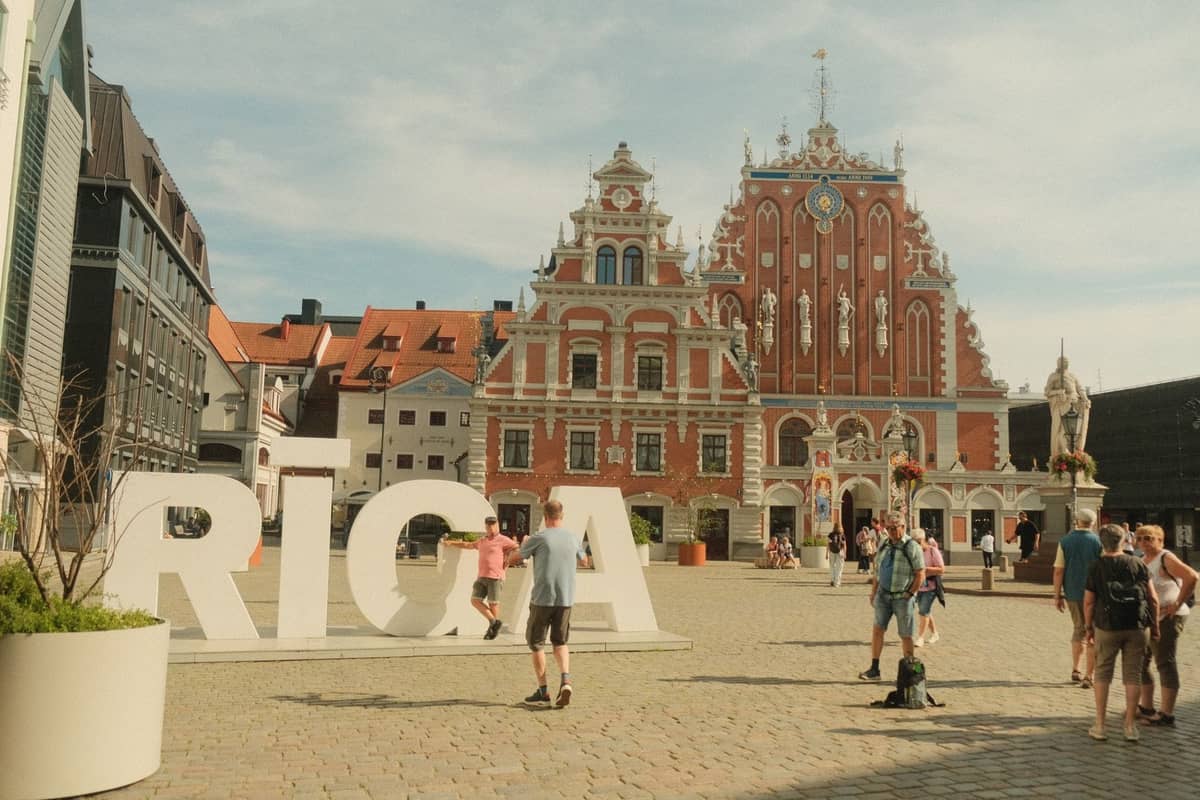
Standing on Town Hall Square in Riga's Old Town, the House of the Blackheads is a reconstructed 14th-century guild hall with an ornate Dutch Renaissance facade that stops pedestrians cold. Behind the stone and gilded detail lies a layered story of medieval merchant culture, wartime destruction, and Latvian national pride.
Quick Facts
- Location
- Rātslaukums 7, Old Town (Vecrīga), Riga
- Getting There
- Walk from central tram/bus stops along Kaļķu iela to Town Hall Square
- Time Needed
- 45–90 minutes for exterior and interior museum
- Cost
- Adults €10, Students/Seniors €5, Pre-school children free
- Best for
- History lovers, architecture enthusiasts, first-time visitors to Riga
- Official website
- www.melngalvjunams.lv/en
What Is the House of the Blackheads?
The House of the Blackheads (Latvian: Melngalvju nams) sits at Rātslaukums 7 on Riga's Town Hall Square, and it is impossible to walk past without stopping. The facade is an eruption of white stone, Gothic spires, Dutch Renaissance ornament, terracotta relief, and gilded clock faces packed onto a narrow frontage that seems too theatrical to be real. That reaction is understandable: what you are looking at is a 1999 reconstruction, not the original. The original was built in 1334, rebuilt and expanded several times from 1522 onward, and ultimately destroyed in 1941 during the Second World War. The Soviet authorities later demolished the ruins entirely. What stands today is a meticulous replica, reopened just in time for Riga's 800th anniversary.
The building's name comes from the Brotherhood of Blackheads, a guild of unmarried foreign merchants who used it as their clubhouse from the 14th century onward. Their patron saint was Saint Maurice, a North African martyr depicted with dark skin, which is where both the name and the Moorish head on the guild's coat of arms originate. The Brotherhood was one of medieval Riga's most powerful institutions, controlling substantial trade and hosting elaborate banquets and ceremonies in these halls.
ℹ️ Good to know
Opening hours are reported as Tuesday to Sunday, 10:00–17:00 (some sources list 11:00–18:00 with last entry at 17:00). Hours can change seasonally. Check the official site at melngalvjunams.lv before your visit to confirm current times.
The Exterior: Reading the Facade
Even if you skip the interior museum, the facade alone warrants time. Face it straight on and work from the ground up: the arched doorway carries coats of arms and inscriptions; the middle tier holds large windows framed with sculpted detail; the upper section breaks into stepped Dutch gables decorated with astronomical clock faces, a carillon, and allegorical statues. The whole effect is vertical and compressed, designed to project prestige on a plot that is not especially wide. In a medieval trading city, architectural swagger was commercial signaling.
Morning light hits the facade directly, which makes the relief work pop and gives photographs a clean, shadow-free look. By midday the square fills with tour groups and the light flattens. Late afternoon, particularly in summer, throws warm color across the stone and empties the square somewhat as groups move on. If you want the building to yourself in a photograph, arrive before 9:30 on a weekday or after 17:00 when the museum has closed but the square is still accessible.
Town Hall Square is also worth taking in as a whole. The square was also heavily damaged during World War II and reconstructed in the post-Soviet period. The Riga Town Hall Square page covers the broader space, including the nearby Town Hall building and Roland's statue.
Tickets & tours
Hand-picked options from our booking partner. Prices are indicative; availability and final rates are confirmed when you complete your booking.
Exclusive private guided tour of Riga's architecture with a local
From 175 €Instant confirmationFree cancellation1-hour walking tour of Riga with a local
From 51 €Instant confirmationFree cancellationExclusive historical walking tour of Riga with a local
From 600 €Instant confirmationFree cancellationEntrance ticket to the House of the Black Heads in Riga
From 7 €Instant confirmationFree cancellation
Inside the Museum
Admission (€10 for adults, €5 for students, seniors, and pupils, free for pre-school children and persons with disabilities of groups I and II) gives access to the interior exhibition, which covers the history of the Brotherhood of Blackheads, the medieval building, and the reconstruction process. The rooms are furnished to reflect the ceremonial character of the original guild hall, with period silverware, portraits, documents, and reproductions of historic interiors.
The Great Hall on the upper floor is the visual centerpiece: high ceilings, elaborate chandeliers, painted walls, and a collection of silver guild pieces that would have been displayed during the Brotherhood's banquets. It is also used today for concerts and civic events, which means access to certain rooms can be restricted on event days. If your visit coincides with a concert, the building often has improved acoustics and atmosphere worth experiencing separately.
Be honest about expectations: the interior is handsome but the museum content is modest in scope. Allow 45 minutes to an hour for a thorough visit. Families with children may find the space slightly formal, but the architectural spectacle keeps most age groups engaged.
💡 Local tip
Call ahead or check the official website if you are visiting specifically for the Great Hall. Events and private functions occasionally close sections of the interior without advance public notice.
Historical Weight: Destruction and Reconstruction
The decision to rebuild the House of the Blackheads after Latvian independence was not without debate. A reconstructed building is not a historic building in any strict preservation sense, and critics argued the funds and attention could have gone elsewhere. Supporters countered that the reconstruction was an act of cultural reclamation after fifty years of Soviet rule, restoring a symbol that had been physically erased.
The completed replica opened in 1999 and has since become one of Riga's most-recognized landmarks. Whether you see it as a triumph of urban restoration or an expensive approximation, the building forces a useful question: what does authenticity mean for a city that lost so much of its historic fabric to war and occupation? Riga's Old Town holds that tension in many places, and the House of the Blackheads makes it visible.
For more on how Soviet-era history reshaped Riga's urban fabric, the Riga Soviet history guide puts the reconstruction debate into useful context.
Fitting It Into Your Riga Itinerary
The House of the Blackheads is in the geographic heart of Old Town, which makes it easy to pair with other major sights on foot. From the square you can reach St. Peter's Church in under two minutes, the Latvian National Opera on foot in about ten, and the Freedom Monument in fifteen. A half-day in this part of Old Town can comfortably combine the exterior photography, the museum interior, and several other stops.
If you are planning a walking route through the medieval core, the Riga Old Town walking tour guide structures a logical sequence through the major sites. The Three Brothers medieval residential complex is a short walk north and offers a contrasting sense of domestic-scale medieval architecture.
If you are working with a tight schedule, the honest answer is that the exterior can be experienced completely for free in ten minutes. The interior is worth the ticket price if you are genuinely interested in guild history or Latvian civic heritage, but travelers on a single day in Riga should weigh it against the volume of other sights within walking distance.
⚠️ What to skip
The square gets crowded with cruise ship groups between roughly 10:00 and 14:00 in the peak summer months (June–August). If you are arriving by cruise, consider visiting early morning or in the late afternoon to avoid the largest crowds.
Practical Details and Accessibility
The building is on a flat cobblestoned square, which is manageable but can be uneven underfoot. Persons with disabilities in groups I and II qualify for free admission; however, detailed physical accessibility information (lifts, ramps, accessible restrooms) is not fully specified in public sources. Visitors with specific mobility needs should contact the museum directly via the official website before visiting.
Photography is generally permitted in the exterior and in much of the interior, though restrictions may apply in specific rooms or during events. The facade is well-lit at night when the square's lighting is active, and it photographs cleanly after dark with a wide lens. Riga's Old Town streets are generally safe for evening walks, though normal urban awareness applies.
For general orientation on navigating Riga safely, the Riga safety tips guide covers the relevant basics for Old Town specifically.
Insider Tips
- Arrive before 9:30 on a weekday morning for the quietest exterior experience and the best direct-light photography conditions. The square is essentially empty at that hour.
- The building hosts concerts in the Great Hall, particularly chamber music events. These are separately ticketed but provide a rare chance to experience the interior in a different context. Check the official site's events calendar.
- Look at the roofline from across the square rather than from directly in front: the full silhouette of the stepped Dutch gables reads much better at a slight distance of 20–30 meters.
- Pre-school children enter free and students pay a reduced rate (€5), making it a reasonable stop for family visitors despite the formal interior atmosphere.
- Combine the visit with a walk along the nearby Daugava riverfront afterward: it takes about ten minutes on foot and offers an entirely different perspective on the Old Town skyline.
Who Is House of the Blackheads For?
- First-time visitors to Riga wanting to understand the city's medieval merchant history
- Architecture and photography enthusiasts drawn to ornate historic facades
- History travelers interested in Baltic identity, wartime loss, and post-Soviet reconstruction
- Travelers on a walking tour of Riga's Old Town combining multiple sites in a half day
- Visitors attending a concert or cultural event in the Great Hall
Nearby Attractions
Other things to see while in Old Town (Vecrīga):
- Bremen Town Musicians Sculpture
Standing on Skārņu iela in Riga's medieval Old Town, this bronze sculpture of four stacked animals tells a Brothers Grimm story while carrying a quietly powerful political message about the end of the Iron Curtain. Cast in 1990 and gifted by the city of Bremen, it's free to visit, open around the clock, and one of the most photographed corners of Vecrīga.
- Museum of the Occupation of Latvia
Housed in the heart of Riga Old Town, the Museum of the Occupation of Latvia documents 51 years of Soviet and Nazi rule from 1940 to 1991. It is one of the most carefully assembled historical museums in the Baltic states, and a visit here fundamentally changes how you understand the country around you.
- Powder Tower & Latvian War Museum
The Powder Tower (Pulvertornis) is the sole surviving tower from Riga's medieval city walls, first recorded in 1330. Today it houses the Latvian War Museum, a free, well-curated institution spanning centuries of Baltic military history. It stands at the northern edge of Old Town, easy to find and easier to underestimate.
- Riga Castle
Riga Castle at Pils laukums 3 is one of the oldest continuously occupied buildings in the Baltic states. Serving simultaneously as the official residence of the President of Latvia and the home of the Latvian National Museum of History, it rewards visitors who understand what it is before they arrive.