Three Brothers (Trīs brāļi): Riga's Oldest Medieval Houses
The Three Brothers on Mazā Pils iela are a trio of medieval stone houses dating from the 15th to 17th centuries, widely regarded as the oldest medieval dwelling-house ensemble in Riga. The complex sits in the heart of Old Town, houses the Latvian Museum of Architecture, and is free to view from the street whenever the lane is open to the public.
Quick Facts
- Location
- Mazā Pils iela 17, 19, 21, Old Town (Vecrīga), Riga, LV-1050
- Getting There
- 15-minute walk from Riga Central Station; on foot from Dome Square or Castle Square
- Time Needed
- 15–30 min for the exterior; 1–1.5 hrs if visiting the Latvian Museum of Architecture inside No. 19
- Cost
- Exterior viewing is free. Museum admission: check current prices at archmuseum.lv
- Best for
- Architecture lovers, history enthusiasts, photography, self-guided Old Town walks
- Official website
- www.km.gov.lv/lv/latvijas-arhitekturas-muzejs
What the Three Brothers Actually Are
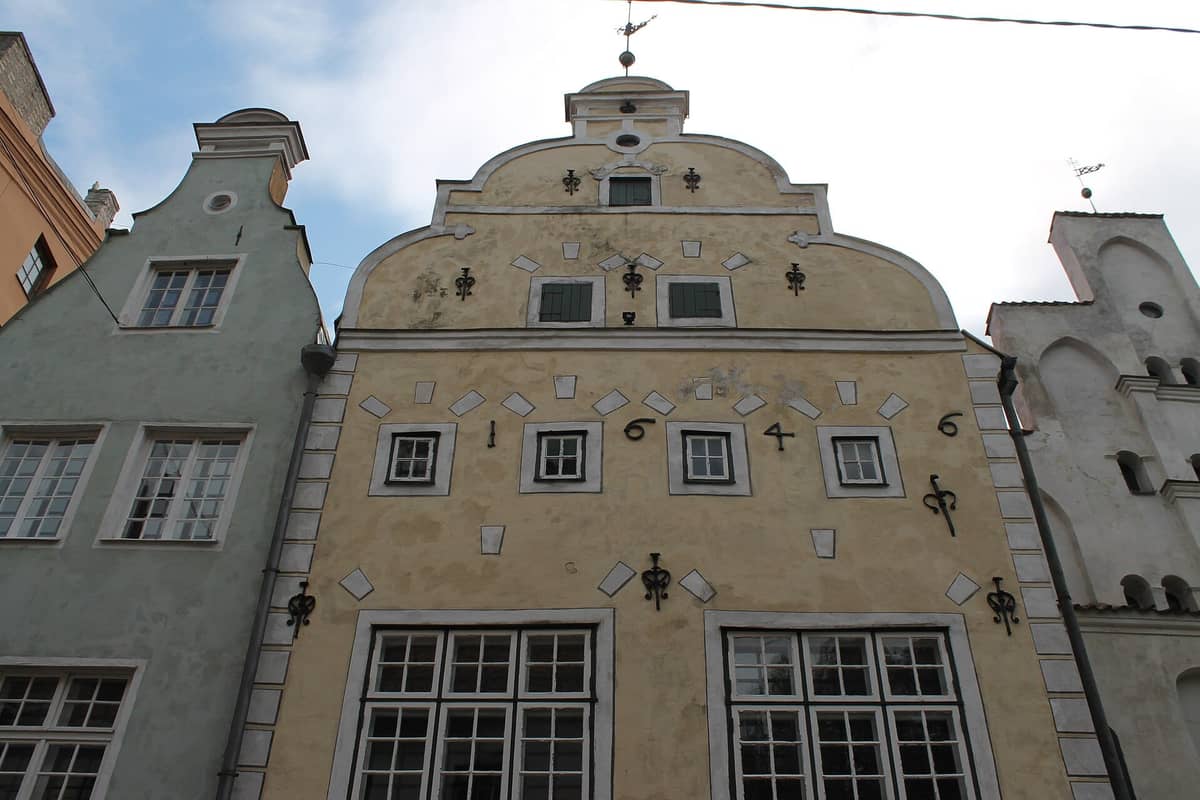
The Three Brothers (Latvian: Trīs brāļi) are three adjoining masonry residential buildings at Mazā Pils iela 17, 19, and 21 in Old Riga. Together they form one of the oldest preserved ensembles of medieval dwelling houses in the city, with construction spanning the 15th to the 17th century. No. 17, the narrowest and oldest of the three, is considered the oldest surviving stone residential house in Riga. That description is accurate — it is a designation backed by the European Heritage Label, awarded to the complex in 2020, and by the ensemble's inclusion within the UNESCO World Heritage-listed historic centre of Riga, inscribed in 1997.
The buildings were not designed as a set. Each reflects the architectural norms of its era: the oldest shows late Gothic proportions with small windows and thick stone walls built for defence as much as dwelling; the middle house, No. 19, displays early Renaissance detailing, with its facade based on drawings by Hans Vredeman de Vries, the Flemish Renaissance artist and architect whose influence spread across northern Europe in the late 16th century; and the youngest, No. 21, is a broader Baroque townhouse with a more generous street presence. Standing side by side, they amount to roughly two centuries of architectural evolution compressed into a single street view.
ℹ️ Good to know
The ensemble sits on Mazā Pils iela, a short lane connecting Dome Square to Castle Square. You will almost certainly pass it during any self-guided walk through Old Riga — it is not a detour.
The Experience on the Street
Mazā Pils iela is a narrow cobblestone lane, and the Three Brothers occupy one side of it in a way that forces you to step back against the opposite wall to take in all three at once. The street is only a few metres wide at this point, which gives the experience an intimate, slightly compressed quality. You are not admiring them from across a plaza — you are standing close enough to read the texture of the stonework, the depth of the window reveals, and the way the Gothic gables of No. 17 give way to the Renaissance ornament of No. 19.
In the early morning, before the main flow of tourists enters Old Town, the lane can be almost entirely quiet. The cobblestones are uneven and often damp, catching whatever light filters through the narrow gap between the rooflines. By mid-morning in summer, small tour groups begin pausing here, guides gesturing upward at the gables. By early afternoon on a weekend, the lane sees steady foot traffic, though it never becomes as congested as Town Hall Square or the main shopping streets. The buildings are well-lit in the evening, and the stone facades take on a warm amber quality under artificial lighting, making dusk and early evening a worthwhile time to return if you have already visited by day.
Winter softens the crowds considerably. If there has been overnight snow, the cobblestones are slippery and the lane is quieter than at almost any other time of year, though the reduced daylight limits photography. For architectural detail shots, an overcast day in spring or autumn is ideal — the flat light eliminates the harsh shadows cast by deep window embrasures on sunny afternoons.
Tickets & tours
Hand-picked options from our booking partner. Prices are indicative; availability and final rates are confirmed when you complete your booking.
Canal boat sightseeing tour in Riga
From 13 €Instant confirmationArt and culture walking tour of Riga with a local
From 66 €Instant confirmationFree cancellationSelf-guided discovery walk in Riga - the essential old town and its secrets
From 30 €Instant confirmationFree cancellationExclusive private guided tour of Riga's architecture with a local
From 175 €Instant confirmationFree cancellation
Historical and Architectural Context
Medieval Riga was a prosperous Hanseatic trading city, and the stone houses along Mazā Pils iela were merchant residences built to signal permanence and wealth in an era when most urban dwellings were timber-framed. The oldest of the three, No. 17, dates to the 15th century. Its narrow gable, facing the street in the manner typical of Hanseatic merchant houses across the Baltic region, was a deliberate signal of civic standing. The width of a street-facing gable often reflected the value of the plot and the owner's tax obligations.
The Renaissance facade of No. 19, informed by the work of Hans Vredeman de Vries, situates Riga firmly within the broader intellectual and artistic currents of 16th-century northern Europe. De Vries published influential pattern books of architectural ornament that were widely used by builders across the Low Countries, the Baltic, and Scandinavia. Seeing his influence here connects the building directly to a European tradition that also shaped Antwerp, Gdańsk, and Tallinn. For a broader sense of how Riga's architectural history unfolds across different eras, the Art Nouveau district guide covers the city's later architectural chapter, which is equally significant.
Today, No. 19 houses the Latvian Museum of Architecture, which holds collections and documentation related to the country's built environment from medieval times to the present. The museum occupies the interior of the building, making it one of the few places in Old Riga where you can step inside a structure of this age. The museum is typically open Monday through Friday during daytime hours and closed on Saturdays and Sundays; confirm current hours and admission fees directly via the Latvian Museum of Architecture’s official pages before visiting, as these details are subject to change.
Getting There and Navigating the Old Town
The Three Brothers sit roughly midway between two of Old Riga's major anchor points: Riga Dome Cathedral to the south and Riga Castle to the north. Walking from either takes under five minutes. If you are arriving from the direction of Town Hall Square or House of the Blackheads, head north through the old merchant streets and you will reach Mazā Pils iela without needing a map.
There is no parking close to the lane, and driving into the historic core is restricted. Trams and buses stop on streets bordering Old Town; the walk into the centre from nearby stops is around 10 to 15 minutes. From Riga Central Station, allow around 15 minutes on foot. The cobblestone surface of Mazā Pils iela should be noted by visitors with reduced mobility: the stones are uneven, and sections can be wet and slippery after rain. Specific step-free access information for the museum interior is not published in widely available sources — contact the Latvian Museum of Architecture directly if this matters for your visit.
💡 Local tip
The Three Brothers fit naturally into a 90-minute loop of northern Old Town that also takes in St. Jacob's Cathedral, the Swedish Gate, and the city wall fragments behind it. Plan this walk in the morning to beat the tour groups.
Photography Notes
The lane is narrow enough that a standard wide-angle on a smartphone will capture all three facades in a single frame if you stand at the far end of the ensemble. A 16mm or 18mm lens on a mirrorless camera gives you more flexibility and allows you to include some foreground cobblestone for context. Early morning provides the cleanest light, with the facades in soft shadow and no tour groups to negotiate around. Afternoon sun on a clear day creates strong contrast between the gable ridges and the recessed stonework — dramatic, but you will lose detail in the shadows.
If you want an elevated angle, the upper floors of several nearby buildings have windows overlooking the lane, but these are private spaces. The best publicly accessible elevated view of the surrounding roofscape, including the general zone around Three Brothers, is from the observation deck of St. Peter's Church, a few minutes' walk to the south.
Practical Assessment: Worth Your Time?
The Three Brothers do not offer a long experience in themselves. If you are in Old Town at all, you will walk past them, and the exterior takes perhaps five minutes to absorb properly. The value is in knowing what you are looking at: six centuries of residential architecture compressed into one street view, each building a material record of the city that existed before Riga became famous for its 20th-century art nouveau boulevards. For anyone following the Old Town walking tour, the Three Brothers should be a deliberate stop, not just a backdrop for a passing photograph.
The Latvian Museum of Architecture inside No. 19 adds genuine depth for those interested in how Latvia's built environment developed. It is a specialist institution rather than a crowd-pleasing attraction, with a collection that rewards visitors who already have some interest in architectural history. If you are primarily looking for large-format exhibitions or interactive displays, manage expectations accordingly.
Visitors primarily interested in Riga's Soviet-era layer, or in the city's more recent history, may find the medieval ensemble less immediately engaging and should consider prioritising the Museum of the Occupation of Latvia or the KGB Building (Corner House) instead — though all three can fit into a single full day in the city.
Insider Tips
- The lane is at its quietest before 09:00, even in peak summer. If you want unobstructed photographs, this is the only reliable window.
- Look at the corbels and window surrounds on No. 19 up close — the Renaissance stonework detail is easy to miss from a distance and rarely noted in standard guidebook descriptions.
- The Swedish Gate, a surviving section of Riga's 17th-century city wall, is a 3-minute walk north. Combining these two sites gives you a more complete picture of medieval Old Town than either alone.
- The museum entrance at No. 19 is low-profile — there is no large sign. Look for the door within the central house of the three; the museum hours are sometimes posted on the door itself.
- If you are visiting in winter, the buildings are illuminated after dark and the quieter streets make for more atmospheric photographs than in summer.
Who Is Three Brothers For?
- Architecture enthusiasts who want to understand Riga's pre-Art Nouveau building history
- Photographers looking for medieval streetscapes with genuine age and texture
- Travellers doing a self-guided Old Town loop who want context beyond the obvious landmarks
- History-focused visitors interested in Hanseatic and Renaissance northern Europe
- Anyone with limited time who wants a high-density, low-effort historical experience
Nearby Attractions
Other things to see while in Old Town (Vecrīga):
- Bremen Town Musicians Sculpture
Standing on Skārņu iela in Riga's medieval Old Town, this bronze sculpture of four stacked animals tells a Brothers Grimm story while carrying a quietly powerful political message about the end of the Iron Curtain. Cast in 1990 and gifted by the city of Bremen, it's free to visit, open around the clock, and one of the most photographed corners of Vecrīga.
- House of the Blackheads
Standing on Town Hall Square in Riga's Old Town, the House of the Blackheads is a reconstructed 14th-century guild hall with an ornate Dutch Renaissance facade that stops pedestrians cold. Behind the stone and gilded detail lies a layered story of medieval merchant culture, wartime destruction, and Latvian national pride.
- Museum of the Occupation of Latvia
Housed in the heart of Riga Old Town, the Museum of the Occupation of Latvia documents 51 years of Soviet and Nazi rule from 1940 to 1991. It is one of the most carefully assembled historical museums in the Baltic states, and a visit here fundamentally changes how you understand the country around you.
- Powder Tower & Latvian War Museum
The Powder Tower (Pulvertornis) is the sole surviving tower from Riga's medieval city walls, first recorded in 1330. Today it houses the Latvian War Museum, a free, well-curated institution spanning centuries of Baltic military history. It stands at the northern edge of Old Town, easy to find and easier to underestimate.