Museum of the Occupation of Latvia: Riga's Most Important History Museum
Housed in the heart of Riga Old Town, the Museum of the Occupation of Latvia documents 51 years of Soviet and Nazi rule from 1940 to 1991. It is one of the most carefully assembled historical museums in the Baltic states, and a visit here fundamentally changes how you understand the country around you.
Quick Facts
- Location
- Latviešu strēlnieku laukums 1, Riga Old Town, LV-1050
- Getting There
- Walking distance from central Old Town; nearest bus and tram stops on the Old Town perimeter
- Time Needed
- 2 to 3 hours
- Cost
- Adults €8; students €5; free on designated days
- Best for
- History, context-seeking travelers, those interested in Soviet and WWII-era Europe
- Official website
- okupacijasmuzejs.lv/en
What the Museum of the Occupation of Latvia Actually Is
The Museum of the Occupation of Latvia, known in Latvian as Latvijas Okupācijas muzejs, sits on Latviešu strēlnieku laukums (Latvian Riflemen Square) in the center of Riga Old Town. Founded in 1993, it was established by Latvians in exile and local historians in the early years of restored independence, which itself tells you something about the urgency behind its creation. The core of the permanent exhibition covers 51 years: the first Soviet occupation of 1940 to 1941, the Nazi German occupation of 1941 to 1944/45, and the second Soviet occupation from 1944/45 until independence was restored in 1991.
This is not a triumphalist national museum. It is a documentation effort, and the distinction matters. The exhibits rely heavily on personal testimonies, documents, photographs, and physical artifacts. A replica of a Siberian deportation railcar occupies a portion of the exhibition floor and stops most visitors cold. You can step inside it. The dimensions, the darkness, and the stencilled markings on the wood communicate in a way that wall text alone cannot.
💡 Local tip
Opening hours are daily 10:00–18:00, except Thursdays when the museum is open until 19:00. The museum is closed on January 1, June 23–24 (Midsummer holidays), and December 24–26 and 31. Confirm current admission prices directly at okupacijasmuzejs.lv before you go, as pricing has changed over the years.
The Location and Approach
The building stands immediately adjacent to the House of the Blackheads and the Latvian Riflemen Monument on Riflemen Square, which places it in one of the most symbolically loaded corners of Old Town. The square functions as a kind of compressed history lesson on its own: the reconstructed medieval merchant guildhall, a Soviet-era monument to the riflemen who paradoxically became a symbol of revolution, and a museum to the occupation that followed. That layering is not accidental.
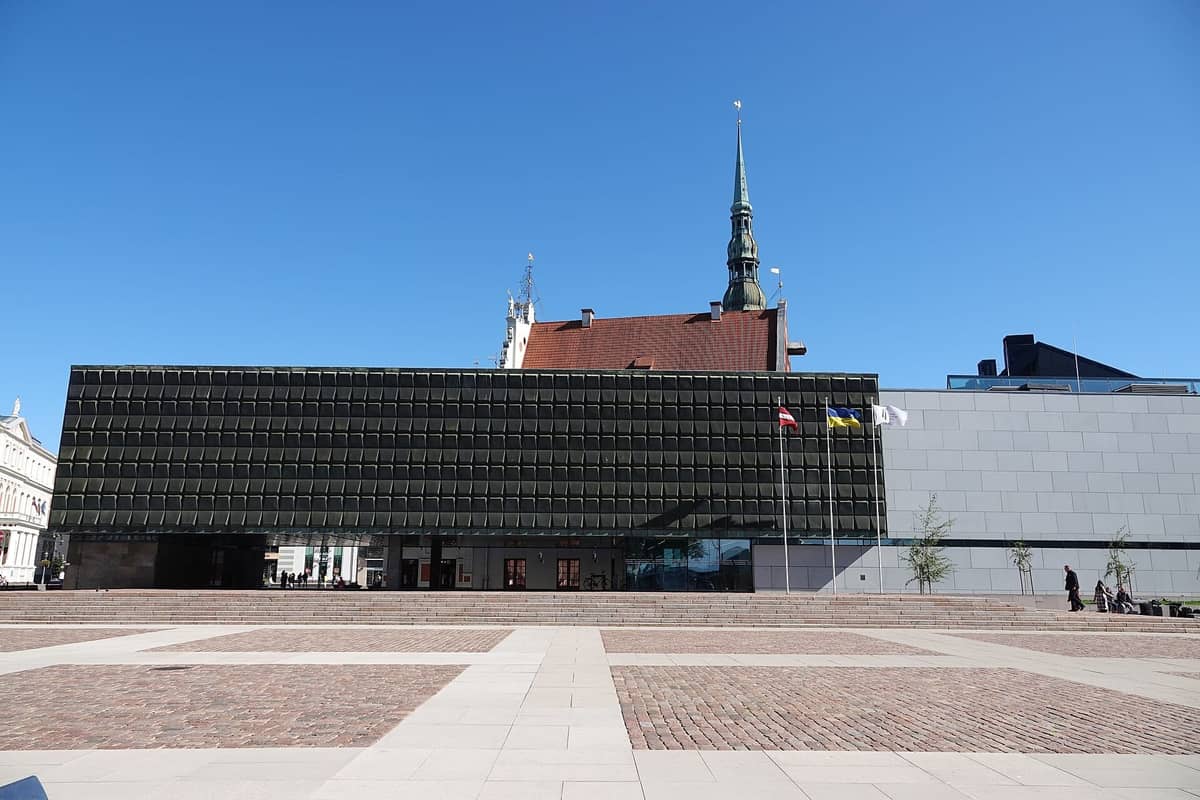
The exterior of the museum is a low, angular building from the Soviet period, originally constructed as an exhibition hall. It now wears its current purpose seriously. From the outside, it does not look like a conventional museum, which briefly disorients first-time visitors. Once you're oriented, it is less than five minutes on foot from Riga Town Hall Square and a short walk from the Old Town's main pedestrian routes. No special transport is needed if you are already exploring the medieval core.
Tickets & tours
Hand-picked options from our booking partner. Prices are indicative; availability and final rates are confirmed when you complete your booking.
Canal boat sightseeing tour in Riga
From 13 €Instant confirmationArt and culture walking tour of Riga with a local
From 66 €Instant confirmationFree cancellationSelf-guided discovery walk in Riga - the essential old town and its secrets
From 30 €Instant confirmationFree cancellationExclusive private guided tour of Riga's architecture with a local
From 175 €Instant confirmationFree cancellation
What You Will Encounter Inside
The permanent exhibition is organized chronologically, which is the right choice for this subject. You move through the sequence of occupations in order, and that progression matters: by the time you reach the second Soviet period, you understand it as a continuation rather than a separate event. Each section combines archival documents, propaganda posters, personal letters, clothing, and objects from daily life under occupation. The visual grammar shifts noticeably between sections covering the Soviet period and those covering the Nazi German occupation, reflecting both the nature of the regimes and the different archival sources available.
The deportation exhibits are the most discussed part of the museum, and with good reason. Latvia lost a disproportionate share of its population through deportations, executions, and flight during the occupation decades. The numbers here are not abstractions: the museum uses individual cases to prevent the statistics from becoming numb. Testimony panels give names, occupations, and fates. Many visitors slow significantly in this section.
There is also substantial material on resistance, on the illegal press, on the Singing Revolution of the late 1980s, and on the path back to independence. This prevents the museum from functioning purely as a catalogue of suffering. The final section, dealing with the restoration of independence in 1991, is notably more open in tone.
ℹ️ Good to know
The museum has a second location on Brīvības iela 61 with its own hours (daily 10:30–17:30, closed January 1, June 23–24, November 18, and December 24–26 and 31). Functions at the second site may differ from the main Old Town museum. Check the official website before planning a visit to that location.
How Visits Tend to Go at Different Times of Day
The museum draws a steady stream of visitors throughout the day, but mid-morning on weekdays is noticeably quieter than weekend afternoons. Groups, including school parties and organized tours, tend to arrive between 10:30 and noon. If you want to move through the deportation railcar exhibit and the testimony panels at your own pace without other visitors crowding the space, arriving at opening time or after 15:00 on a weekday gives you more room.
The interior is climate-controlled and largely silent apart from audio guides and the occasional hushed conversation. The lighting in the exhibition halls is deliberately subdued in sections dealing with the deportations and executions, which affects photography. Flash photography would be both practically and ethically inappropriate here. The mood inside is consistent and serious throughout the day; this is not a place where the atmosphere shifts depending on the crowd.
⚠️ What to skip
This museum covers executions, mass deportations, and systematic state violence in detail, with photographs. Parents visiting with younger children should assess the content level in advance. It is appropriate for teenagers with context, but not for young children expecting a conventional museum experience.
Historical and Cultural Context
Latvia's occupation history sits at the center of its national identity in a way that visitors from Western Europe or North America sometimes underestimate. The events documented here are within living memory for a significant portion of Latvia's current population. When you read deportation testimony in this museum, you are reading about people whose grandchildren now live in Riga. This is not distant history in the way that World War I exhibits can feel distant.
Understanding this context also helps explain aspects of Latvian public life and politics that can otherwise seem puzzling to outside visitors. If you want to understand why Latvia joined NATO with such conviction, why the Freedom Monument is treated with genuine reverence rather than civic indifference, or why the country's relationship with Russia remains as charged as it does, the Occupation Museum provides a foundation that no amount of general reading quite replaces.
The museum also provides useful context if you plan to visit other sites dealing with Soviet-era history in the city, particularly the KGB Building (Corner House), which served as the headquarters and detention facility of the Soviet security services and can be visited on guided tours. The two sites work well in sequence, though visit both in the same day only if you are prepared for a psychologically demanding afternoon.
Practical Details for Planning Your Visit
The museum is entirely accessible on foot from anywhere in Old Town. The building is at Latviešu strēlnieku laukums 1, a square you will walk through anyway if you are doing any standard Old Town itinerary. For those arriving by public transport, tram and bus routes serving the Old Town perimeter bring you within a 10-minute walk. Check current Rīgas Satiksme timetables for the most accurate routing.
Audio guides are available in multiple languages, and the English version is well-produced. Given the density of the material, an audio guide is worth using rather than relying solely on wall text. The museum shop stocks serious publications including academic histories and personal memoirs related to the occupation period, available in Latvian, English, and other languages. These are not souvenir items.
Plan 2 to 3 hours for a thorough visit. Rushing through in under 90 minutes means missing the testimony sections and the context panels that make the individual artifacts comprehensible. If your schedule is tight, the 2-day Riga itinerary suggests pairings that work well without overloading a single day.
Visitors with specific accessibility requirements should contact the museum directly at +371 67229255 or info@okupacijasmuzejs.lv before visiting, as detailed accessibility information is not fully documented in public sources.
Who This Museum Is For, and Who Might Skip It
The Occupation Museum is not a light or scenic attraction. It will not fit well into a day built around architecture walks, Riga's restaurant scene, or leisurely sightseeing. Visitors who are sensitive to graphic historical material, or who are looking for a casual cultural afternoon, are better served by the Latvian National Museum of Art or a walk through the Art Nouveau district. There is no shame in recognizing that this particular subject requires a specific kind of readiness.
For travelers genuinely interested in 20th-century European history, Soviet-era studies, Baltic identity, or the mechanics of occupation and resistance, this museum delivers substance that is rare even by the standards of European history museums. The curatorial approach is honest about complexity: it does not flatten the occupation period into a single narrative, and it does not avoid difficult questions about collaboration and survival. That intellectual seriousness is the museum's defining quality.
Insider Tips
- Arrive at opening time (10:00) on a weekday if you want the deportation railcar exhibit to yourself. It is the single most powerful object in the museum and deserves undivided attention.
- The audio guide in English is substantially more informative than the wall text alone for visitors without background knowledge of Baltic history. It is worth the extra minutes to collect one at the entrance.
- The museum shop carries English-language academic titles on Latvian history that are difficult to find outside Latvia. If you are a serious reader on the subject, budget time for the shop before you leave.
- Combine this visit with the KGB Building (Corner House) on the same trip to Riga, but not the same day unless you are specifically prepared for that. The two sites reinforce each other but the cumulative emotional weight is significant.
- Check the museum's official website for any temporary exhibitions or evening events, which occasionally feature survivor testimonies or documentary screenings not listed in standard tourist resources.
Who Is Museum of the Occupation of Latvia For?
- Travelers with a serious interest in 20th-century European and Soviet history
- Anyone wanting genuine context before exploring the rest of Latvia and the Baltic states
- Students and researchers working on occupation history, resistance movements, or post-Soviet identity
- Visitors who have already seen the physical landmarks of Old Town and want to understand the deeper historical layers beneath them
- Travelers from countries with their own occupation histories who want to compare experiences and archival approaches
Nearby Attractions
Other things to see while in Old Town (Vecrīga):
- Bremen Town Musicians Sculpture
Standing on Skārņu iela in Riga's medieval Old Town, this bronze sculpture of four stacked animals tells a Brothers Grimm story while carrying a quietly powerful political message about the end of the Iron Curtain. Cast in 1990 and gifted by the city of Bremen, it's free to visit, open around the clock, and one of the most photographed corners of Vecrīga.
- House of the Blackheads
Standing on Town Hall Square in Riga's Old Town, the House of the Blackheads is a reconstructed 14th-century guild hall with an ornate Dutch Renaissance facade that stops pedestrians cold. Behind the stone and gilded detail lies a layered story of medieval merchant culture, wartime destruction, and Latvian national pride.
- Powder Tower & Latvian War Museum
The Powder Tower (Pulvertornis) is the sole surviving tower from Riga's medieval city walls, first recorded in 1330. Today it houses the Latvian War Museum, a free, well-curated institution spanning centuries of Baltic military history. It stands at the northern edge of Old Town, easy to find and easier to underestimate.
- Riga Castle
Riga Castle at Pils laukums 3 is one of the oldest continuously occupied buildings in the Baltic states. Serving simultaneously as the official residence of the President of Latvia and the home of the Latvian National Museum of History, it rewards visitors who understand what it is before they arrive.