Latvian National Museum of Art: The Complete Visitor Guide
The Latvian National Museum of Art is the country's premier art institution, housed in a striking 1905 neoclassical building in central Riga. With over a century of collecting behind it, the museum traces Latvian painting and graphic art from the 18th century to the present day, offering genuine depth that rewards slower looking.
Quick Facts
- Location
- Jaņa Rozentāla laukums 1, Rīga LV-1010 (Centre, near Kr. Valdemāra iela)
- Getting There
- ~15-minute walk from Old Town; trams and buses run along nearby Kr. Valdemāra iela
- Time Needed
- 1.5 to 3 hours depending on interest in temporary exhibitions
- Cost
- Adults €15 combined / €7 permanent (combined), €7 (permanent only); free on last Sunday of each month
- Best for
- Art lovers, architecture enthusiasts, rainy-day cultural visits
- Official website
- lnmm.gov.lv/en/latvian-national-museum-of-art
What the Latvian National Museum of Art Actually Is
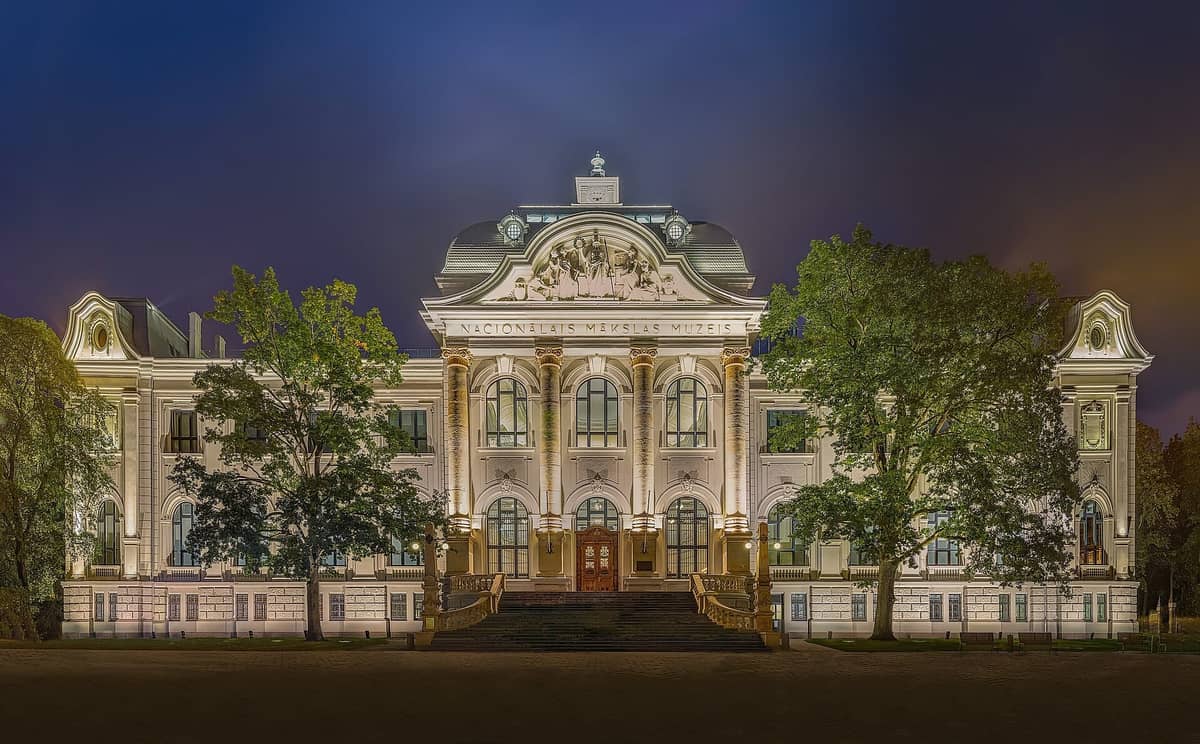
The Latvian National Museum of Art (Latvian: Latvijas Nacionālais mākslas muzejs) is the oldest and largest art museum in Latvia. Founded in 1869 as Riga's City Picture Gallery, it moved into its current purpose-built neoclassical home in 1905, a building that still defines the corner of Jaņa Rozentāla laukums in central Riga. The institution took its current name in 1995, following Latvian independence, and a major renovation between 2013 and 2016 modernized the interior while preserving the facade.
The collection spans roughly 52,000 works, though only a curated portion is on display at any given time. The permanent galleries focus on Latvian professional art from the late 18th century through to the late Soviet period, with particular strength in 19th and early 20th century painting. Names such as Janis Rozentals, Vilhelms Purvitis, and Johans Valters are central to the permanent hang, and their work offers real insight into how Latvian cultural identity was constructed and contested over more than a century.
💡 Local tip
The museum is free on the last Sunday of every month. If your travel dates align, this is by far the best value entry. Arrive by 10:00 to avoid the early-afternoon peak.
The Building: Why It Is Worth Arriving on Foot
The building was designed in the neoclassical style and completed in 1905, during a period of significant civic ambition in Riga. Its white facade, with a formal portico and symmetrical window arrangement, sits deliberately apart from the Art Nouveau flourishes that dominate the surrounding neighbourhood. Walking from the Old Town along Kr. Valdemāra iela, the museum announces itself gradually, framed by the mature trees of the adjacent Esplanade Park.
The relationship between the museum and Esplanade Park directly behind it is one of the underappreciated pleasures of the visit. In summer, the park fills with people before and after museum hours, and in winter the bare linden trees give the approach a certain austere quality that suits the building well. If you are already exploring the Centre district, the museum is a natural anchor point rather than a detour.
The 2013 to 2016 renovation added elevator access, updated the lighting throughout the galleries, and opened a rooftop terrace. The terrace is not widely advertised but provides one of the more unusual elevated views in this part of the city, looking out over the park and the surrounding early 20th century streetscape.
Tickets & tours
Hand-picked options from our booking partner. Prices are indicative; availability and final rates are confirmed when you complete your booking.
Art and culture walking tour of Riga with a local
From 66 €Instant confirmationFree cancellationRiga Rise observation wheel with digital art gallery
From 17 €Instant confirmationTour Riga's Art Nouveau scene in a city exploration game app
From 7 €Instant confirmationFree cancellationCanal boat sightseeing tour in Riga
From 13 €Instant confirmation
Inside the Permanent Collection: What You Will Actually See
The permanent exhibition is organized broadly chronologically, moving from early Baltic German-influenced portraiture and landscape painting through to the dramatic period around Latvian independence in 1918, and then into the Soviet decades. The late 19th and early 20th century rooms are the strongest. Vilhelms Purvitis's winter landscapes, rendered in cool silvery tones, have a stillness that photographs do not capture well. These rooms tend to feel quieter and more serious than visitors expect.
The Janis Rozentals rooms deserve particular attention. Rozentals, after whom the square outside is named, was central to developing a distinctively Latvian visual language at the turn of the 20th century. His portraits and figurative compositions show the influence of European Symbolism while remaining rooted in local subjects. The museum holds the largest concentration of his work anywhere.
The Soviet-era galleries can be approached in two ways: as propaganda artifacts, or as a record of how skilled painters worked within and sometimes around ideological constraints. Either reading is valid, and the curators do not force an interpretation. For visitors interested in understanding how Soviet cultural policy played out in a small nation, this section adds genuine substance to the visit.
ℹ️ Good to know
Temporary exhibitions occupy a separate section and require the combined ticket (€8 for adults). If your primary interest is the permanent collection, the permanent-only ticket at €3 covers the core galleries.
When to Go: How the Experience Changes by Time of Day
Weekday mornings between 10:00 and 12:00 are consistently the quietest window. School groups occasionally arrive mid-morning, but they tend to move through quickly and are generally contained to specific galleries. The museum's high-ceilinged rooms absorb sound well, so even on busier days the atmosphere stays calm.
Friday evenings, when the museum stays open until 20:00, offer a genuinely different experience. The late-afternoon light through the upper windows changes how the paintings read, particularly the landscape works. The visitor demographic shifts too: more adults coming directly after work, fewer tourists. If you want to look at paintings without any sense of being on a schedule, Friday evening is the right choice.
Saturday and Sunday afternoons (13:00 to 16:00) are the busiest periods. The last Sunday of the month, when admission is free, sees the highest attendance of all. This is not a reason to avoid it, but arrival early in the morning on free Sundays is strongly advisable.
Practical Information: Getting In, Getting Around, Getting There
Opening hours: Tuesday to Thursday 10:00 to 18:00, Friday 10:00 to 20:00, Saturday and Sunday 10:00 to 17:00. The museum is closed on Mondays and on certain public holidays including 1 January, Good Friday, Easter Sunday, 23 and 24 June, and 24 to 26 and 31 December. Confirm holiday closures on the official website before visiting during those periods.
- Adults (combined ticket): €15
- Adults (permanent exhibition only): €7
- Children and pupils, students and seniors: discounted tickets from €3.50–€5 depending on ticket type; check current categories on the official website.
- Students (18+) and seniors: discounted tickets currently €5 (combined/main visit); see official website for latest permanent-exhibition prices.
- Free admission: last Sunday of every month (permanent exhibition and main exhibition halls)
The museum is at Jaņa Rozentāla laukums 1, approximately 15 minutes on foot from Riga's Old Town. Trams and buses running along Kr. Valdemāra iela stop close to the building. The post-renovation building includes elevator access to all floors and improved facilities for visitors with reduced mobility. For specific accessibility needs beyond elevator access, contacting the museum directly before your visit is advisable.
If you are planning a broader cultural itinerary, the museum pairs naturally with the Riga Art Nouveau Museum on Alberta iela and the art collections housed in the nearby centre district. A half-day circuit covering both is entirely feasible on foot. For a broader overview of Riga's cultural institutions, the best museums in Riga guide outlines how the National Museum of Art fits relative to other major collections.
Photography, Accessibility, and What to Bring
Photography without flash is generally permitted in the permanent galleries. Some temporary exhibitions restrict photography; signage at the entrance to each exhibition space makes this clear. The high ceilings and natural light in several of the main rooms produce good conditions for handheld shots of the interiors, though glare from the lighting on framed works requires some adjustment of angle.
The museum has a cloakroom, which is practical in winter when heavy coats become cumbersome across multiple floors. There is a small museum shop and a cafe, though the cafe hours may not match the full museum opening window on all days.
⚠️ What to skip
The museum is closed on Mondays. This catches many visitors by surprise, particularly those arriving early in a trip without checking. Double-check before making a special journey.
Practical Assessment: Is It Worth Your Time?
For travellers with a genuine interest in European art history, Latvian cultural identity, or 19th and early 20th century painting, the answer is clearly yes. The collection is not encyclopedic in the way of a major national gallery in London or Amsterdam, but within its scope it is deep and carefully presented. The Purvitis winter landscapes alone justify the entry fee for anyone who responds to Nordic light in paint.
For travellers who are not strongly drawn to fine art museums and who are working through a long list of Riga sightseeing, the practical advice is: the permanent-only ticket at €3 gives you full access to the strongest material without requiring two to three hours. One focused hour in the late 19th and early 20th century galleries is a more satisfying experience than a rushed walk through everything.
Visitors who may not find this worthwhile: those focused exclusively on Riga's medieval architecture and Old Town (for whom the Riga Dome Cathedral and the House of the Blackheads are more relevant stops), and travellers with children under eight who tend to find the galleries difficult to sustain interest in. Families might instead consider the Ethnographic Open Air Museum for a more interactive cultural experience.
Insider Tips
- The rooftop terrace, added during the 2013 to 2016 renovation, is not prominently signed from inside. Ask at the information desk or look for the elevator access point. The view over Esplanade Park is worth the short detour.
- Friday evenings until 20:00 are the quietest weekday window outside of early mornings. The gallery lighting at dusk produces notably different conditions for looking at landscape paintings.
- The permanent-only ticket at €3 for adults covers the strongest galleries. If a temporary exhibition does not interest you specifically, there is no practical reason to buy the combined ticket.
- The square immediately outside is named after Janis Rozentals, whose work dominates one of the most rewarding rooms inside. Knowing this connection before you enter adds context to both the exterior and the collection.
- For the free last-Sunday visit, arrive at 10:00. Numbers build noticeably by 11:30 and the main rooms can feel crowded by 13:00.
Who Is Latvian National Museum of Art For?
- Travellers with specific interest in Latvian or Baltic art history
- Art lovers wanting to understand how European modernism was absorbed and adapted in a small nation
- Anyone visiting on a rainy day who wants a substantive indoor cultural experience
- Photography enthusiasts interested in neoclassical architecture and curated gallery interiors
- Budget-conscious visitors planning around the free last-Sunday admission
Nearby Attractions
Other things to see while in City Centre (Centrs):
- Bastejkalns Park & City Canal
Bastejkalns Park, also known as Bastion Hill Park, wraps around the edge of Riga's Old Town along the historic City Canal. Formed on the site of demolished 19th-century fortifications, it offers terraced lawns, stone cascades, canal-side paths, and a rare pocket of calm within easy walking distance of the Freedom Monument and the Art Nouveau district.
- Esplanade Park
Stretching across 8.75 hectares in the heart of Riga, the Esplanāde is the city's most centrally located public park. Framed by grand streets and a cluster of significant landmarks, it offers a quiet, unhurried counterpoint to Old Town's crowds — and it's completely free.
- Freedom Monument
The Freedom Monument is the symbolic heart of Riga, a 42.7-metre granite and travertine column that has stood at the intersection of the Old Town and the main boulevard since 1935. Entry is free, access is around the clock, and the hourly changing of the guard adds a living ritual to what might otherwise be a static landmark.
- KGB Building (Corner House)
At the corner of Brīvības iela and Stabu iela stands a building that once made Riga's residents cross to the other side of the street. The Corner House served as the KGB's Latvian headquarters from 1940 to 1991, housing interrogation rooms, cells, and a bureaucracy of fear. Today it functions as a museum that documents Soviet occupation with unflinching honesty.