Freedom Monument Riga: History, Ceremony, and Civic Pride at the City's Core
The Freedom Monument is the symbolic heart of Riga, a 42.7-metre granite and travertine column that has stood at the intersection of the Old Town and the main boulevard since 1935. Entry is free, access is around the clock, and the hourly changing of the guard adds a living ritual to what might otherwise be a static landmark.
Quick Facts
- Location
- Raiņa bulvāris / Brīvības bulvāris, Central District, Riga
- Getting There
- Multiple tram and bus lines along Brīvības bulvāris; walkable from Old Town in under 10 minutes
- Time Needed
- 20–40 minutes for the monument and square; longer if you time a guard change
- Cost
- Free, no tickets required
- Best for
- History, photography, understanding Latvian national identity
- Official website
- www.latvia.travel/en/sight/freedom-monument
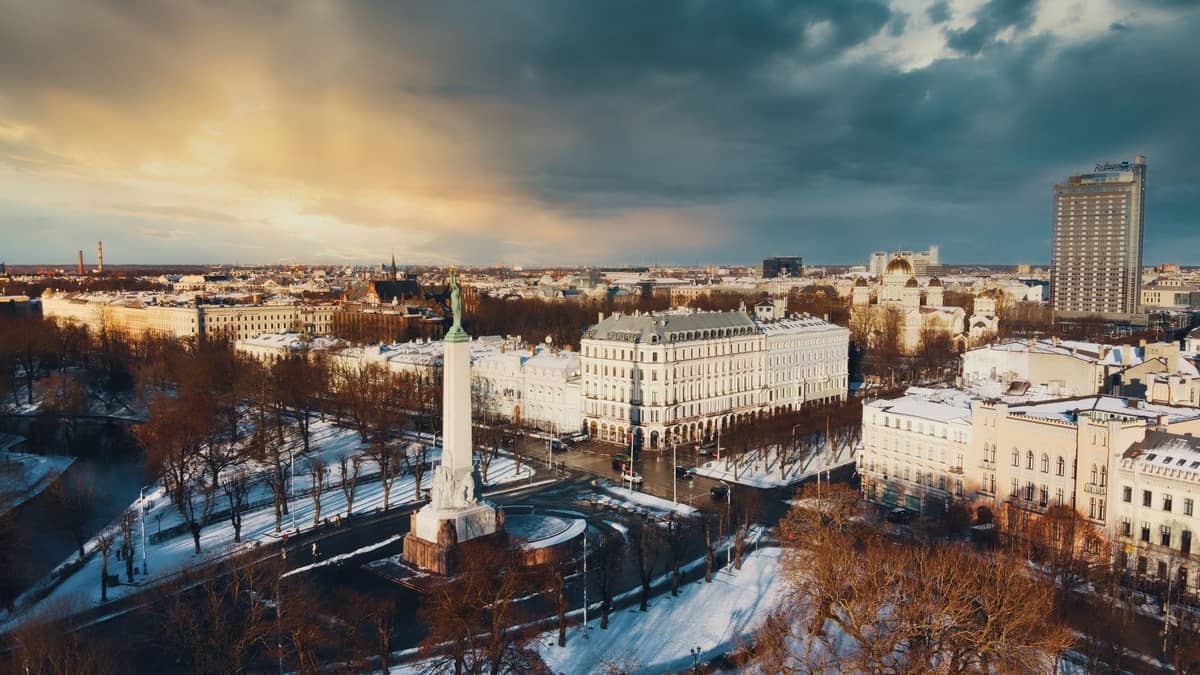
What Is the Freedom Monument?
The Freedom Monument, known in Latvian as Brīvības piemineklis, is a public monument in central Riga dedicated to the soldiers who died during the Latvian War of Independence from 1918 to 1920. Unveiled in 1935 and designed by sculptor Kārlis Zāle, the monument rises 42.7 metres above a flat urban plaza at the intersection of Brīvības bulvāris and Raiņa bulvāris, precisely at the boundary between the medieval Old Town and the city's grand 19th-century boulevard district. It is not a museum, not a paid attraction, and not gated. It is simply a landmark you walk up to, and that directness is part of its power.
The figure at the summit, a copper-clad woman raising three golden stars above her head, is so embedded in Latvian visual culture that her silhouette appears on everything from tourist postcards to official state imagery. The three stars represent the three historical regions of Latvia: Vidzeme, Kurzeme, and Latgale. At street level, the base is carved with relief figures of Latvian folk scenes, warriors, and allegorical groups that reward close inspection.
💡 Local tip
The honour guard changes at the top of every hour between 10:00 and 16:00. Arrive five minutes early to secure a clear view of the ceremony from the steps below.
The Changing of the Guard: A Ceremony Worth Timing Your Visit Around
Two soldiers in grey dress uniforms stand motionless at the base of the monument during daylight hours. On the hour, a small replacement detail marches in from the nearby guard post with formal precision: deliberate pace, synchronized turns, and a quiet solemnity that draws onlookers into a respectful silence. The entire ceremony takes only a few minutes, but it gives the space a weight that distinguishes the Freedom Monument from similar civic statues elsewhere in Europe.
This is not a theatrical performance staged for tourists. The guard is a genuine state honour detail, and the Latvian public treats it accordingly. You will notice locals pausing on their morning commute to watch the change, schoolchildren visiting on class trips, and occasional wreath-laying ceremonies by officials or visiting dignitaries. The monument functions as an active site of national memory, not a fossilized piece of public art.
If the ceremony is not a priority, the monument still warrants a visit for its architectural presence alone. The shaft is clad in travertine and rises through a series of setbacks before reaching the sculpted figure at the top. In direct sunlight, the surface has an almost warm, sandstone-like quality. In overcast grey Baltic light, it reads as more austere.
Tickets & tours
Hand-picked options from our booking partner. Prices are indicative; availability and final rates are confirmed when you complete your booking.
Self-guided discovery walk in Riga through parks and time
From 24 €Instant confirmationFree cancellationCanal boat sightseeing tour in Riga
From 13 €Instant confirmationArt and culture walking tour of Riga with a local
From 66 €Instant confirmationFree cancellationSelf-guided discovery walk in Riga - the essential old town and its secrets
From 30 €Instant confirmationFree cancellation
How the Experience Changes by Time of Day
Early morning, before the guard is posted, the plaza is quiet. Commuters cut across the surrounding paths, a few joggers pass through Bastejkalns Park to the south, and the monument stands unattended except for pigeons that settle on the lower ledges. At this hour, you can photograph the full column without other visitors in the frame, and the low northern light in summer or the flat grey of a winter morning gives the stonework a clarity that midday crowds and harsh sun eliminate.
From around 10:00 onward, tour groups begin to arrive from the adjacent Old Town, and the square takes on the texture of a working tourist site. This is the peak period for guided commentary and the best time to overhear context about the monument's history. If you are walking the Old Town walking tour, the Freedom Monument is a natural endpoint: it sits at the edge of Vecrīga where the medieval street grid gives way to the wider boulevard network.
Evening visits offer a different quality. The monument is lit at night, and the golden stars catch the light in a way that makes the summit feel more prominent than during daylight hours. The surrounding paths fill with people walking between restaurants and bars rather than sightseeing, and the atmosphere is looser and more local. National holidays and commemorative dates bring crowds at any hour, with candles, flowers, and sometimes spontaneous gatherings that can turn a casual evening walk into something unexpectedly moving.
Historical Context: Why This Monument Matters
Latvia declared independence on 18 November 1918, emerging from the collapse of the Russian Empire. The subsequent War of Independence lasted until 1920, when the Treaty of Riga formally secured Latvia's sovereignty. The Freedom Monument was conceived as a permanent memorial to the approximately 4,000 soldiers who died in that conflict, and its unveiling in 1935 was a major national event.
What gives the monument its additional layer of meaning is what happened after 1940. When the Soviet Union occupied Latvia, the monument was not demolished, which was unusual: Soviet authorities typically removed symbols of bourgeois nationalism. Instead, it survived, partly because removing a 42-metre stone column in the centre of a city is logistically difficult, and partly due to periodic debates about its fate within the administration. For Latvians living through the occupation, the monument became a quiet, persistent symbol. Unauthorized gatherings here during the Soviet period carried real risk. When Latvia reasserted independence in 1991, the square around the Freedom Monument became one of the focal points of public celebration.
That history is not incidental. Visiting the Freedom Monument alongside the nearby Museum of the Occupation of Latvia gives you a far more complete picture of Latvian 20th-century history than either site provides alone. The two are roughly ten minutes apart on foot.
Getting There and Practical Logistics
The monument stands at a major intersection in central Riga, and arriving on foot from the Old Town is straightforward. Walk north along Kaļķu iela, exit through the old town edge, and the column is visible immediately across the small canal. From the central station area, it is a ten-minute walk north along the boulevard. Multiple tram and bus lines run along Brīvības bulvāris, so if you are coming from further out, disembark at the central stops and walk the final stretch.
There are no tickets to buy and no queues to join. The plaza is fully accessible, with flat paved surfaces on all sides. Wheelchair users and those with pushchairs can circulate the entire base without obstruction. The monument itself has no interior access.
ℹ️ Good to know
The monument is accessible 24 hours a day, seven days a week, at no charge. The honour guard operates daily from 10:00 to 16:00, with changes on the hour.
If you are working out a broader itinerary for the city, the monument slots neatly into a morning that also takes in the Bastejkalns Park immediately to the south, where the canal path and small bridges offer a pleasant walking loop before or after your visit to the monument.
Photography and Weather Considerations
The monument is tall enough that getting the full column in a single frame requires stepping well back, which is easy given the open plaza. The copper figure at the top reflects light differently depending on the angle and hour. For clean shots of the base reliefs, overcast light is actually preferable to direct sun, which creates harsh shadows across the carved figures.
Rain does not significantly diminish the visit since there is nothing enclosed to shelter in anyway, but wet weather does reduce the quality of photographs and makes the surrounding pavement slippery. In winter, snow on the base ledges and the shaft can look striking in photographs, but the guard ceremony in January or February means standing in sub-zero temperatures if you plan to watch. Dress accordingly: there is no shelter in the square.
For context on how seasons affect Riga generally, see the guide to the best time to visit Riga. The monument is worth seeing in any season, but the most comfortable conditions for an extended visit are May through September.
Who Should Skip This Attraction
The Freedom Monument is worth a look for almost any visitor to Riga, but it is not a destination for a long stay. If you are not interested in civic monuments or national history, five minutes at the base to register its scale and move on is completely reasonable. The monument does not have an interior, a museum annex, or a viewing platform. What you see is the exterior, the reliefs, and the ceremony. Travelers who have no interest in the historical context will find it a fine landmark to walk past rather than a reason to rearrange their day.
Anyone visiting primarily for architecture will find more concentrated interest a short distance away in the Art Nouveau district, where the density and variety of decorated facades is far greater. The Freedom Monument is a single structure in an open square, impressive for what it represents as much as for how it looks.
Insider Tips
- If you want to photograph the changing of the guard without smartphone screens blocking your view, position yourself on the steps to the left or right of the ceremony rather than directly behind the crowd that gathers in front.
- The canal-side path along Bastejkalns Park, which runs parallel to the monument's southern side, gives you a longer elevated view of the column that most visitors miss because they approach from the Old Town side.
- On 18 November, Latvian Independence Day, the square fills with official ceremonies, candle lighting, and public gatherings. It is the most emotionally resonant time to visit, but expect significant crowds and some street closures nearby.
- The relief carvings on the base of the monument repay close inspection. Carved scenes from Latvian folk tradition and war imagery are layered across multiple registers. Most visitors glance at the upper figure and miss the storytelling at eye level.
- If you plan to combine this with the Occupation Museum, visit the museum first. Understanding the Soviet period before you stand at the monument adds a layer of meaning to the space that cannot be replicated the other way around.
Who Is Freedom Monument For?
- Travelers interested in Baltic history and the politics of national memory
- First-time visitors to Riga who want to orient themselves at the city's symbolic centre
- Photographers looking for a landmark with strong vertical lines and sculptural detail
- Anyone passing between the Old Town and the central boulevard district on foot
- Visitors who want to understand why Latvian independence matters so deeply to the people who live here
Nearby Attractions
Other things to see while in City Centre (Centrs):
- Bastejkalns Park & City Canal
Bastejkalns Park, also known as Bastion Hill Park, wraps around the edge of Riga's Old Town along the historic City Canal. Formed on the site of demolished 19th-century fortifications, it offers terraced lawns, stone cascades, canal-side paths, and a rare pocket of calm within easy walking distance of the Freedom Monument and the Art Nouveau district.
- Esplanade Park
Stretching across 8.75 hectares in the heart of Riga, the Esplanāde is the city's most centrally located public park. Framed by grand streets and a cluster of significant landmarks, it offers a quiet, unhurried counterpoint to Old Town's crowds — and it's completely free.
- KGB Building (Corner House)
At the corner of Brīvības iela and Stabu iela stands a building that once made Riga's residents cross to the other side of the street. The Corner House served as the KGB's Latvian headquarters from 1940 to 1991, housing interrogation rooms, cells, and a bureaucracy of fear. Today it functions as a museum that documents Soviet occupation with unflinching honesty.
- Latvian Academy of Sciences Panorama Tower
The Panorama Riga observation deck crowns the Latvian Academy of Sciences, a Soviet-era Stalinist skyscraper completed in 1961. At roughly 65 metres above street level, the open-air circular terrace delivers unobstructed 360-degree views across Riga's rooftops, the Daugava River, and the Old Town spires. It is one of the most accessible and affordable high-level vantage points in central Riga.