Panorama Riga Observation Deck: Riga from 65 Metres Up
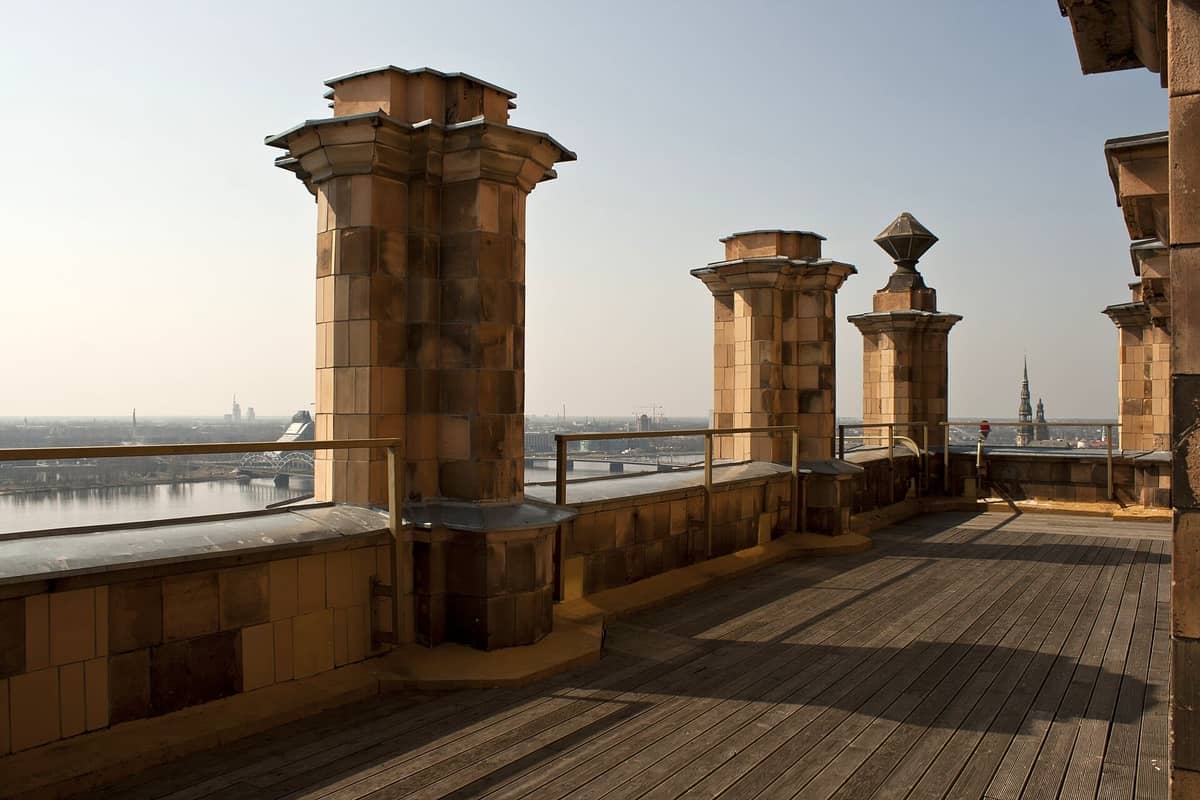
The Panorama Riga observation deck crowns the Latvian Academy of Sciences, a Soviet-era Stalinist skyscraper completed in 1961. At roughly 65 metres above street level, the open-air circular terrace delivers unobstructed 360-degree views across Riga's rooftops, the Daugava River, and the Old Town spires. It is one of the most accessible and affordable high-level vantage points in central Riga.
Quick Facts
- Location
- Akadēmijas laukums 1, Rīga LV-1050 — central Riga, approx. 1.5 km from Old Town
- Getting There
- A short walk from Riga Central Station; trams and buses serving Riga Central Market stop nearby.
- Time Needed
- 45–90 minutes
- Cost
- Approx. 6–8 EUR per adult; children under 12 free; group discounts available. Verify current prices at entrance or official site.
- Best for
- City panoramas, Soviet architecture, photography, orientation before exploring Riga
- Official website
- panoramariga.lv
What Is the Panorama Riga Observation Deck?
The Panorama Riga observation deck sits at the top of the Latvian Academy of Sciences building, a roughly 108-metre Stalinist high-rise in central Riga. The tower was completed in 1961 and stands as one of Latvia's tallest structures. It belongs to a small family of Soviet-era skyscrapers built across Eastern European capitals in the 1950s and early 1960s, modelled loosely on Moscow's Seven Sisters. The Riga version is shorter than its Moscow counterparts but no less striking: its ornate crown, stone-clad facades, and symmetrical massing make it immediately recognisable on the city skyline.
The building itself still houses the Latvian Academy of Sciences, Latvia's national academy. For visitors, though, the draw is purely the open-air circular terrace on the 17th floor, positioned at approximately 65 metres above street level. From here, on a clear day, you can trace the full arc of the Daugava River, identify every major church spire in the Old Town, and watch trams threading through the city grid far below.
💡 Local tip
The deck is open daily from 10:00 to 22:00. Evening slots in summer offer the best of both worlds: golden-hour light followed by the city lights coming on after sunset. Arrive about an hour before sunset to catch both.
The Building's Soviet History
Constructed under Soviet rule and completed in 1961, the Academy of Sciences tower was the prestige architectural project of its era in Latvia. The Soviets used it to signal modernisation and scientific progress, which is why the building was assigned to the Academy rather than a government ministry or hotel, as was typical in other cities. Latvians have had a complicated relationship with the structure ever since. For decades it was seen as an unwanted symbol of occupation, earning the sardonic local nickname 'Stalin's birthday cake', a reference shared with similar towers in Warsaw and Bucharest.
Today, attitudes have shifted. The tower is listed among Latvia's significant 20th-century architectural monuments, and the observation deck was opened specifically to give the public access to a building that was largely off-limits for most of its history. If you are tracing Riga's Soviet-era layers, this pairs naturally with a visit to the KGB Building (Corner House) and the Museum of the Occupation of Latvia. The Academy tower represents a different register of that history: the grandiose public face of Soviet power, rather than its hidden machinery.
Tickets & tours
Hand-picked options from our booking partner. Prices are indicative; availability and final rates are confirmed when you complete your booking.
Canal boat sightseeing tour in Riga
From 13 €Instant confirmationArt and culture walking tour of Riga with a local
From 66 €Instant confirmationFree cancellationSelf-guided discovery walk in Riga - the essential old town and its secrets
From 30 €Instant confirmationFree cancellationExclusive private guided tour of Riga's architecture with a local
From 175 €Instant confirmationFree cancellation
The View: What You Actually See
The terrace wraps fully around the building, meaning you get an uninterrupted 360-degree panorama without having to jostle for position. The perspective from 65 metres is different from a glass-box observation floor in a modern skyscraper: you are close enough to identify individual streets and squares, far enough to read the city's structure as a whole. On the north and west sides, you look across the compact grid of central Riga toward the church towers of the Old Town. St. Peter's needle-thin spire and the green copper domes of the Nativity of Christ Cathedral are the easiest landmarks to lock onto.
Looking south, the Daugava River takes up much of the frame, wide and flat, with the National Library of Latvia's angular glassy form on the opposite bank and the Pardaugava district beyond it. To the east, the view opens across the low residential fabric of the Latgale suburbs, the scale shifting noticeably from the dense central city. On very clear days in winter, when the air is sharp, the view extends to forest and farmland well beyond the city edge. Summer haze softens the far horizon but the urban panorama itself remains crisp.
One detail visitors often notice: the city is much greener than it looks at street level. Parks, tree-lined boulevards, and garden courtyards form a substantial proportion of what you see, particularly the Esplanade and the canal belt between the Old Town and the central district.
ℹ️ Good to know
Weather matters significantly here. An overcast grey day still gives a full panorama, but a bright day with scattered clouds produces the best photographs. Fog or low cloud can reduce visibility to a few hundred metres. Check the forecast before making this a centrepiece of your day.
How the Experience Changes by Time of Day
Morning visits, from opening at 10:00 until about noon, tend to be quieter. The light comes from the east, which means the western and Old Town views are slightly back-lit in the early hours, but this works well for dramatic silhouette photography of the church spires. Crowds at this time are thin, typically a handful of visitors at most, which means you can stand at any section of the railing without competition.
The busiest period is mid-afternoon, roughly 13:00 to 17:00, when tour groups and cruise passengers often arrive in sequence. The terrace is large enough that it rarely feels genuinely crowded, but if solitude matters to you, mid-morning or early evening is the right choice. In summer, the hour before sunset draws a more atmospheric crowd: photographers with tripods, couples, and solo travelers who have timed their visit deliberately. The sky over the Daugava turns orange and pink, and the spires of the Old Town glow against the light.
After dark in summer, with the deck open until 22:00, the city lights spread across the panorama in a way that is genuinely striking. Street trams trace orange lines below, and the illuminated facades of the Old Town create a warm cluster to the northwest. Night photography requires a steady hand or a small tripod; the railing provides a reasonable support surface.
Getting There and Practical Logistics
The building stands at Akadēmijas laukums 1, about 600 metres from Riga Central Market and roughly 1.5 kilometres from the core of the Old Town. The walk from the Central Market takes about eight minutes on flat ground. From Riga Central Station, allow ten to fifteen minutes on foot. City trams and buses serving the Central Market area stop within a short walk of the building; the local stop names and route numbers should be checked against current Riga transport schedules, as these are subject to change.
Access to the observation deck is via elevator to approximately the 15th floor, followed by two flights of stairs to reach the 17th-floor terrace. The elevator stage removes most of the physical effort, but the staircase section means the outdoor terrace is not fully accessible for visitors who cannot manage stairs. There is a toilet available on the observation deck.
Tickets are purchased at the entrance on arrival; no advance booking is required. The entrance fee is approximately 6 to 8 EUR for adults, with children under 12 admitted free and a reduced rate available for groups of eight or more. These prices should be verified at the door or on the official Panorama Riga website before your visit, as rates are occasionally adjusted.
⚠️ What to skip
The outdoor terrace is exposed on all sides. Wind speed at 65 metres is noticeably stronger than at street level, especially in autumn and winter. Bring a jacket even on days that feel mild below. In winter, metal railings are bitterly cold without gloves.
Photography and What to Bring
The Panorama Riga terrace is one of the most photographically productive spots in the city for the simple reason that it gives you an elevated, 360-degree angle that is otherwise unavailable without access to a private rooftop. A wide-angle lens captures the full sweep of a single facade; a short telephoto lets you isolate the Old Town spires or compress the river perspective. If you are shooting on a smartphone, use HDR mode in bright conditions, as the contrast between sky and dark facades can be challenging in direct sunlight.
For the best architectural documentation of what you see below, bring a zoom of at least 85mm equivalent. From the east side of the terrace, you can identify specific buildings along Alberta iela and the Art Nouveau district in the middle distance, which can be a useful visual orientation before walking there.
Who This Attraction Is Not For
The Panorama Riga deck is a straightforward sightseeing stop, and that is both its strength and its limitation. If you have already visited observation decks in several European cities and are looking for a unique cultural experience, this may feel thin. There is no interpretive display explaining the city layout beneath you, no historical exhibition within the terrace itself, and no cafe or seating area. You go up, you look, you come down. The experience lasts between 30 and 60 minutes for most visitors, rarely longer.
Visitors with significant mobility limitations who cannot manage two flights of stairs will not be able to access the open-air terrace level. Anyone with a pronounced fear of heights should note that the railing is standard height, the terrace is fully open-air, and the drop is visible on all sides. It is not a glass-floored modern deck, but the exposure is genuine.
Insider Tips
- The south-facing side of the terrace gives the clearest view of the Daugava River and the National Library of Latvia on the opposite bank. Position yourself here first to get your bearings before moving around the platform.
- Visit on a weekday morning if you want the terrace largely to yourself. Weekend afternoons between 13:00 and 16:00 attract the heaviest footfall, including organised tour groups.
- The two flights of stairs between the elevator level and the terrace are the main physical requirement. If you are travelling with someone who cannot manage them, one person in the group can stay on the lift level while others go up, as there is a partial view from the corridor windows.
- The Soviet-era architectural details on the building's crown are best seen from street level before you enter. Walk around the base of the building and look up at the stone carvings and the tiered decorative spire. The craftsmanship is substantial and usually ignored by visitors heading straight for the entrance.
- Combine this visit with the Riga Central Market directly to the south. The market's five repurposed Zeppelin hangars are clearly identifiable from the terrace, and the short walk between the two makes for a logical half-day pairing.
Who Is Latvian Academy of Sciences Panorama Tower For?
- First-time visitors who want a spatial overview of Riga before walking its streets
- Architecture and Soviet history enthusiasts drawn to Stalinist high-rise design
- Photographers seeking an elevated 360-degree urban panorama
- Travellers on a tight budget looking for an affordable, high-impact experience
- Evening visitors in summer who want to watch the sun set over the Daugava River
Nearby Attractions
Other things to see while in City Centre (Centrs):
- Bastejkalns Park & City Canal
Bastejkalns Park, also known as Bastion Hill Park, wraps around the edge of Riga's Old Town along the historic City Canal. Formed on the site of demolished 19th-century fortifications, it offers terraced lawns, stone cascades, canal-side paths, and a rare pocket of calm within easy walking distance of the Freedom Monument and the Art Nouveau district.
- Esplanade Park
Stretching across 8.75 hectares in the heart of Riga, the Esplanāde is the city's most centrally located public park. Framed by grand streets and a cluster of significant landmarks, it offers a quiet, unhurried counterpoint to Old Town's crowds — and it's completely free.
- Freedom Monument
The Freedom Monument is the symbolic heart of Riga, a 42.7-metre granite and travertine column that has stood at the intersection of the Old Town and the main boulevard since 1935. Entry is free, access is around the clock, and the hourly changing of the guard adds a living ritual to what might otherwise be a static landmark.
- KGB Building (Corner House)
At the corner of Brīvības iela and Stabu iela stands a building that once made Riga's residents cross to the other side of the street. The Corner House served as the KGB's Latvian headquarters from 1940 to 1991, housing interrogation rooms, cells, and a bureaucracy of fear. Today it functions as a museum that documents Soviet occupation with unflinching honesty.