Alberta iela: Walking Riga's Finest Art Nouveau Street
Alberta iela is a short residential street in Riga's central district that contains one of the most remarkable concentrations of Art Nouveau facades in Europe. The street is free to walk, open at all hours, and rewards visitors who slow down and look up. Here is what to know before you go.
Quick Facts
- Location
- Alberta iela, Centra rajons, Riga LV-1010 (Quiet Centre / Klusais centrs)
- Getting There
- Multiple city buses and trams serve nearby streets in the central district; the street is a 15–20 minute walk north of Old Town
- Time Needed
- 30–60 minutes for the street itself; allow 2–3 hours if combining with the Riga Art Nouveau Museum
- Cost
- Free (the street is a public road; the Riga Art Nouveau Museum charges separate admission)
- Best for
- Architecture enthusiasts, photographers, history travelers, and anyone with a curiosity about early 20th-century European design
- Official website
- www.liveriga.com/en/2492-alberta-street
What Alberta iela Actually Is
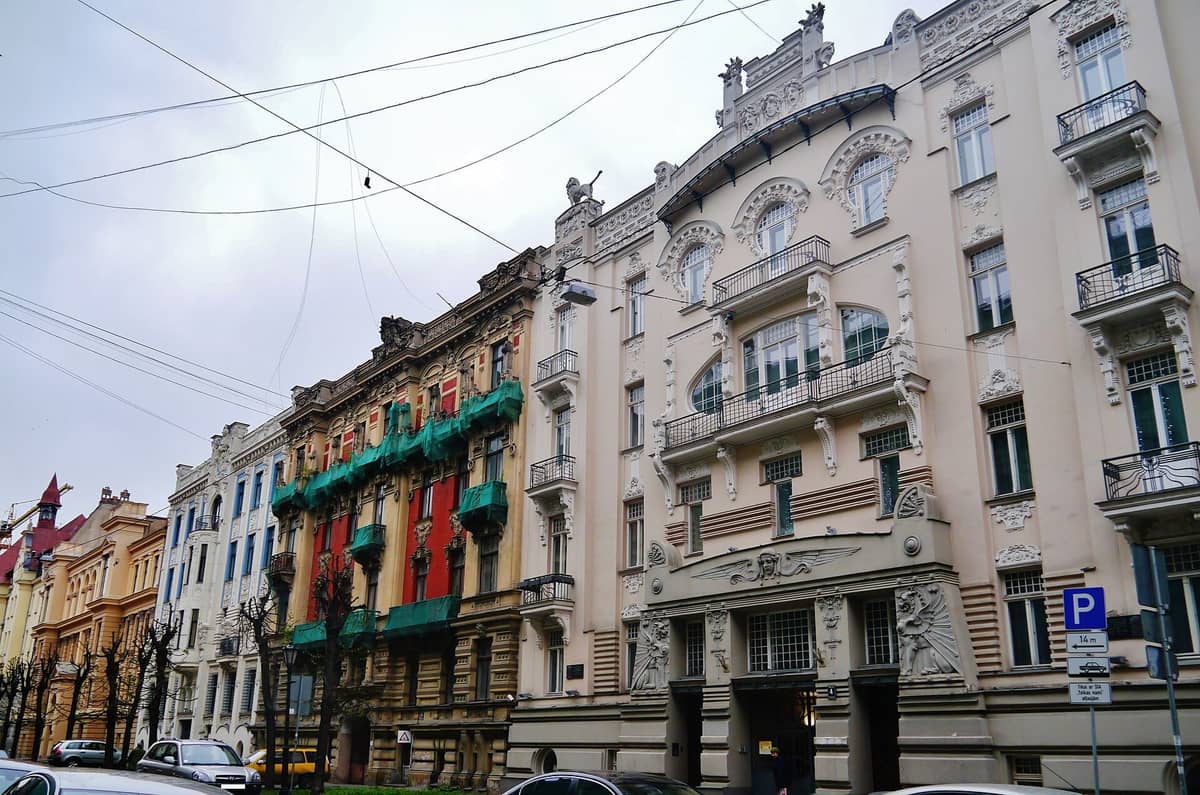
Alberta iela is a single short street in Riga's Quiet Centre, and it is not a museum, a park, or a ticketed attraction. It is a functioning residential address where people collect their post and walk their dogs. What makes it extraordinary is what lines both sides of the pavement: a nearly unbroken sequence of Art Nouveau apartment buildings constructed in the early 1900s, all from more or less the same period, many by the same architect.
The street is commonly described as having been created to mark the 700th anniversary of Riga’s founding and named after Bishop Albert of Buxhoeveden, the German cleric traditionally associated with the city’s establishment in 1201. That layered history, from medieval commemoration through imperial-era construction to Soviet-era use and post-Soviet recovery, is part of what gives the place its texture.
💡 Local tip
You do not need to book anything or carry a ticket. Alberta iela is a public street, accessible 24 hours a day, year-round, at no cost.
The Architecture: What You Are Looking At
The dominant presence on Alberta iela is Mikhail Eisenstein, a Russian-Baltic civil engineer who designed several of the street's most theatrical facades in the early 1900s. His buildings favour symmetrical compositions loaded with sculptural ornament: masks, female figures with flowing hair, plant tendrils, and faces that seem to stare back at you from the stonework. The style is Jugendstil, the German-language branch of Art Nouveau, and Eisenstein pushed it toward something more operatic than was typical of the movement elsewhere in Europe.
Not every building on the street follows the same formula. Some facades lean toward a more restrained National Romanticism, incorporating folk motifs and local stone textures rather than the dense ornamentation of the Eisenstein buildings. Standing at one end of the street and walking slowly toward the other, you move through subtle shifts in design philosophy from building to building. The variation is what makes the walk worth taking at a slow pace rather than a brisk one.
For deeper context on the broader district these buildings belong to, the Riga Art Nouveau Museum at nearby Alberta iela 12 presents original interiors and period furnishings. It is the one place on this street where you can step inside and understand what these apartments looked like when they were new.
Tickets & tours
Hand-picked options from our booking partner. Prices are indicative; availability and final rates are confirmed when you complete your booking.
Canal boat sightseeing tour in Riga
From 13 €Instant confirmationArt and culture walking tour of Riga with a local
From 66 €Instant confirmationFree cancellationSelf-guided discovery walk in Riga - the essential old town and its secrets
From 30 €Instant confirmationFree cancellationExclusive private guided tour of Riga's architecture with a local
From 175 €Instant confirmationFree cancellation
How the Street Changes Through the Day
Early morning, from around 7 to 9 am, Alberta iela is quiet in the way that residential streets are quiet: the occasional resident leaving for work, pigeons on the window ledges, light arriving at a low angle from the east that catches the relief work on the facades and throws shadows into every carved recess. This is the best light for photography, and it comes with almost no other visitors in the frame.
By mid-morning the tour groups begin to arrive, typically from around 11 am onward. These are rarely large crowds, but the street is narrow enough that a single group of fifteen people with a guide fills the pavement considerably. If you are interested in reading the architecture at your own pace rather than following commentary, arriving before 10 am or after 4 pm makes a noticeable difference.
In the late afternoon the light shifts to the west and the facade colours warm noticeably. The pale yellows, greens, and grey-whites of the render take on more depth. By evening the street lights come on and the carved faces above the upper-floor windows become shadowed and slightly unsettling in a way that photographers tend to find useful; the street remains safe to walk at night and is sometimes used for evening architecture walks.
💡 Local tip
For the best facade photographs, visit on a clear morning when sunlight hits from a low angle. Overcast days soften the shadows but make the ornamental detail harder to read from street level.
Practical Walkthrough: How to Do the Street Well
Alberta iela runs roughly east-west and is short enough to walk end-to-end in under five minutes if you are moving at a normal pace. The point is not to cover the distance but to stop, look up, and read each facade before moving on. Bring binoculars if you have them: much of the sculptural detail sits above the second and third floor lines and is genuinely difficult to appreciate at street level without optical help.
The street connects at its western end toward Strēlnieku iela and at its eastern end toward the broader Quiet Centre neighbourhood. A sensible approach is to walk Alberta iela as part of a larger loop that takes in the parallel streets of Elizabetes iela and Strēlnieku iela, both of which carry additional Art Nouveau buildings. The Riga Art Nouveau Museum at Alberta iela 12 is a practical stop before or after the street walk: the context it provides makes the exterior details easier to interpret.
Alberta iela sits within the broader Art Nouveau district, which is covered in detail in the Art Nouveau Riga guide. That resource maps the key streets and explains which buildings are worth prioritising if your time is limited.
The pavement on Alberta iela is paved and generally level, making it accessible for pushchairs and wheelchairs for the street walk itself. Entry to individual historic buildings is not covered here and many retain original staircase entrances from the 1900s that are not step-free.
Weather, Seasons, and What to Expect
Riga has a humid continental climate with cold winters and mild summers. Alberta iela can be visited in any season, but the experience changes considerably. In summer, roughly June through August, the long daylight hours mean you can walk the street in good light well into the evening. The trees along the pavement are in full leaf and soften the urban scale, though they also obscure some of the lower building details.
Winter visits come with bare trees that open up sightlines, and occasional snow on the carved ledges and cornices that adds a stark quality to the facades. The cold is real, often below freezing from December through February, and the street offers no shelter. Dress accordingly. The low winter sun angle, when it appears, can produce exceptional light for photography, but cloud cover is frequent and flat grey days are common.
For seasonal planning, the best time to visit Riga guide covers what each season brings to the city as a whole, including crowd levels and weather patterns.
⚠️ What to skip
Rain is possible in any season. The street has no covered walkways or shelter. If you are visiting primarily for photography, check the forecast before you go.
Practical Assessment: Is Alberta iela Worth Your Time?
If architecture is a reason you travel, Alberta iela belongs near the top of your Riga list. There is genuinely nothing quite like standing in front of an Eisenstein facade with time to read it properly. The density of high-quality Art Nouveau on a single street, with buildings in reasonable preservation, is exceptional by European standards.
If architecture is not a particular interest, the street may feel like a short walk past some ornate old buildings. It takes about thirty minutes to do well and there is nothing else to do on the street itself beyond looking. Travelers who prefer interactive experiences, indoor attractions, or natural settings may find it underwhelming as a standalone destination. The practical approach is to include it as one stop in a broader walking route rather than treating it as a half-day commitment.
Alberta iela works well as part of the Riga Old Town walking tour extended northward into the Quiet Centre, or as a starting point for a full morning in the Art Nouveau district.
Insider Tips
- Bring compact binoculars. The most interesting sculptural details on the Eisenstein facades sit above the second-floor line and are genuinely hard to read with the naked eye from street level.
- The Riga Art Nouveau Museum at Alberta iela 12 is on the same street. Visit it either before your walk to build context, or immediately after while the facade details are fresh in your mind. The combination takes a morning and is worth it.
- If you walk the parallel streets of Elizabetes iela and Strēlnieku iela on the same visit, you will see Art Nouveau buildings that are arguably as impressive as those on Alberta iela and typically with fewer other visitors around them.
- The carved faces and figures on the facades are easier to photograph in morning light from the east. Stand on the south side of the street and shoot north-facing facades in the early hours for the deepest shadow relief.
- If you encounter older maps or Soviet-era guidebooks in antique shops, the street will still appear as Alberta iela, referring to the same location.
Who Is Alberta iela (Art Nouveau Street) For?
- Architecture and design enthusiasts who want to see Jugendstil at its most concentrated
- Photographers working in natural light, especially early morning
- History travelers interested in the late imperial period and Riga's cultural development around 1900
- First-time visitors to Riga who want to understand why the city's Art Nouveau reputation is serious
- Travelers combining the street with a visit to the Riga Art Nouveau Museum for a focused half-day
Nearby Attractions
Other things to see while in Art Nouveau District (Quiet Centre):
- Riga Art Nouveau Museum
The Riga Art Nouveau Museum occupies the 1903 private house of architect Konstantīns Pēkšēns at Alberta iela 12, offering a rare look inside a fully restored Art Nouveau apartment. Unlike a gallery of objects under glass, this is a lived-in aesthetic world, with original furniture, ornamental ceilings, and decorative details intact across multiple rooms.