Riga Art Nouveau Museum: The Best-Preserved Interior on Alberta iela
The Riga Art Nouveau Museum occupies the 1903 private house of architect Konstantīns Pēkšēns at Alberta iela 12, offering a rare look inside a fully restored Art Nouveau apartment. Unlike a gallery of objects under glass, this is a lived-in aesthetic world, with original furniture, ornamental ceilings, and decorative details intact across multiple rooms.
Quick Facts
- Location
- Alberta iela 12 (entrance from Strēlnieku iela), Riga LV-1010
- Getting There
- Trolleybus 19 or buses 2, 20, 24 to nearby stops; tram 5 or 7 to nearby stops; 10–15 min walk from Old Town
- Time Needed
- 60–90 minutes
- Cost
- Adults €9, Students & Pensioners €5
- Best for
- Architecture enthusiasts, design lovers, history-minded travelers
- Official website
- jugendstils.riga.lv
What the Riga Art Nouveau Museum Actually Is
The Riga Art Nouveau Museum, officially known in Latvian as Rīgas Jūgendstila centrs, is not a conventional gallery. It is an authentic Art Nouveau apartment occupying the building at Alberta iela 12, designed in 1903 by the Latvian architect Konstantīns Pēkšēns in collaboration with Eižens Laube. Pēkšēns built the house as his own private residence, which gives the space an unusual intimacy. The rooms were not conceived as display cases; they were conceived as a home, and the museum works hard to communicate that distinction.
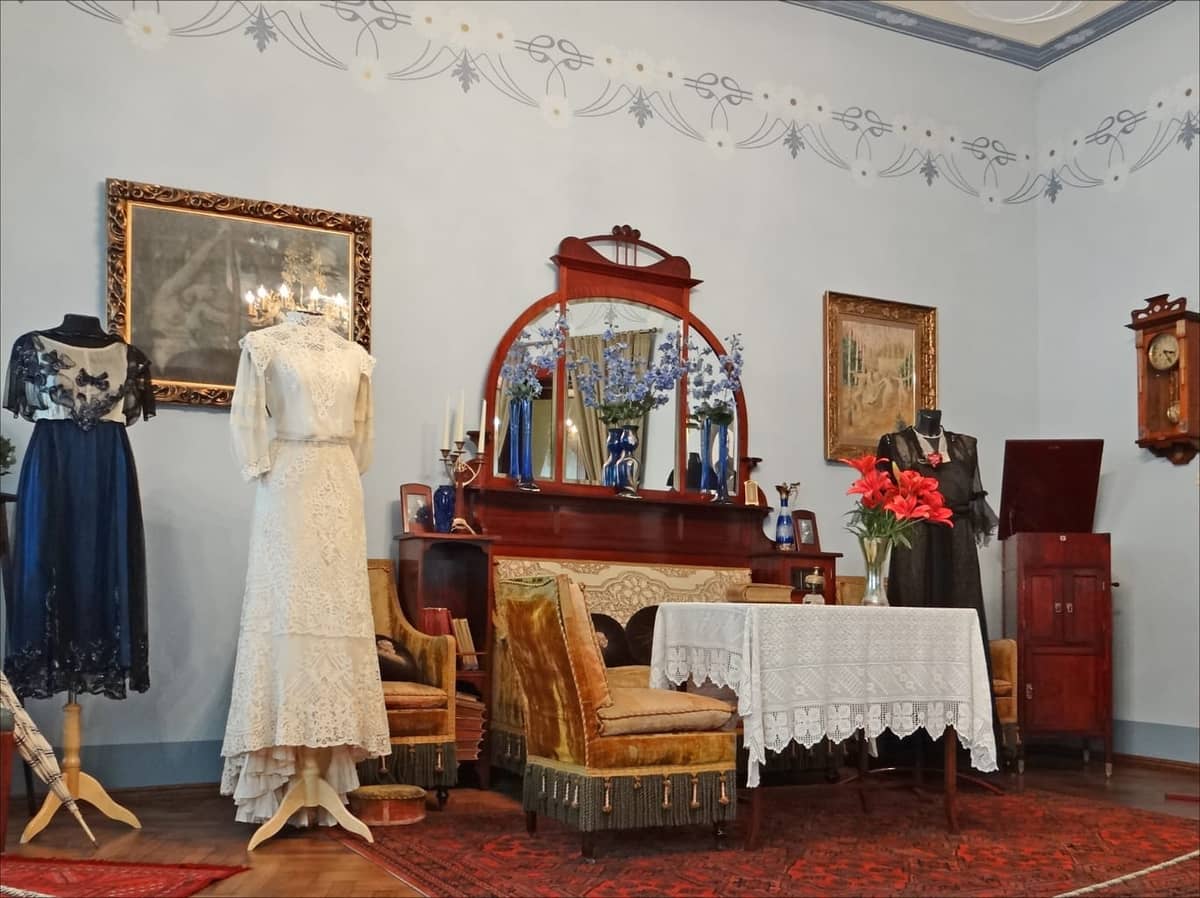
What you encounter inside is period furniture, original ornamental plasterwork, decorative door handles, tiled stoves, and wall treatments that demonstrate how thoroughly Art Nouveau penetrated the details of bourgeois Riga life at the turn of the twentieth century. The building itself is the exhibit, and the objects within it are arranged to reinforce that sense of continuity rather than to fragment it into individual artifacts.
💡 Local tip
The entrance is not on Alberta iela itself but around the corner on Strēlnieku iela. First-time visitors frequently walk past it. Look for the museum signage on the Strēlnieku iela side before assuming it is closed.
The Building and Its Architecture
Alberta iela is widely regarded as one of the most concentrated stretches of Art Nouveau architecture in Europe, and the building at number 12 sits within that context as one of the few addresses where you can go beyond the facade. Most visitors to the Alberta iela streetscape photograph the ornate exteriors and move on. The museum gives you access to the logic behind those facades by showing you what the interiors were designed to achieve.
The exterior of the building follows the expressive, asymmetrical language of Jugendstil, the German and Central European variant of Art Nouveau that dominated Riga's early twentieth-century building boom. Floral motifs, female figures, and abstract natural forms cover the stucco surfaces. Inside, the aesthetic continues into every fixture: the ceiling moldings in the main reception room use curved botanical lines, the floor parquet is laid in geometric patterns that echo the wall treatments, and the light fittings fit the period style.
Konstantīns Pēkšēns was one of the most prolific architects operating in Riga during the city's rapid Wilhelmine-era expansion. He is credited with designing hundreds of buildings in Riga, making the survival and restoration of his own house a document of both personal and professional significance. The building is not a reconstruction of a typical wealthy Riga apartment; it is a reconstruction of an architect's apartment, which means the design choices on display were deliberate and informed rather than simply fashionable.
Tickets & tours
Hand-picked options from our booking partner. Prices are indicative; availability and final rates are confirmed when you complete your booking.
Tour Riga's Art Nouveau scene in a city exploration game app
From 7 €Instant confirmationFree cancellationArt and culture walking tour of Riga with a local
From 66 €Instant confirmationFree cancellationRiga Rise observation wheel with digital art gallery
From 17 €Instant confirmationCanal boat sightseeing tour in Riga
From 13 €Instant confirmation
Moving Through the Rooms: What You See
The visit takes you through a sequence of rooms including the entrance hall, the drawing room, a study, a dining area, and bedroom spaces. Each room is furnished and styled to represent the period, with labels providing context on the objects and their function in early twentieth-century Latvian middle-class life.
The drawing room is the visual high point. The ceiling work here is dense and precise, with intertwined plant forms radiating from a central plaster medallion. The color palette, muted greens and ochres against off-white plasterwork, is deliberately period-authentic rather than freshly painted bright. This gives the room a weight that reproduction furniture alone cannot manufacture. Stand near the window and look back toward the interior: the light that enters through the original-style window dressing softens the space in a way that photographs rarely capture.
The study is smaller and more personal in feel, with books and writing implements arranged to suggest occupation rather than exhibition. The tiled stove in one of the rooms is a notable preserved example and it rewards close inspection., and it rewards close inspection. The tile work uses the same botanical motifs visible elsewhere in the apartment, demonstrating the integration of craft across every surface.
ℹ️ Good to know
Photography is generally permitted inside the museum. Tripods and flash equipment may have restrictions. Confirm with staff at the box office on arrival if you are planning serious interior photography.
When to Visit and How Crowds Behave
The museum is open Tuesday through Sunday, 10:00 to 18:00. It is a relatively small space, and on summer weekend afternoons it can feel congested in the narrow corridors between rooms. Groups with guides occasionally move through at pace and can fill the drawing room completely for ten minutes at a time. If you want unhurried access to the main rooms, arriving shortly after opening at 10:00 on a weekday is the most reliable strategy.
Winter visits have a different quality. The reduced natural light that enters through the windows in November through February makes the warm interior tones of the apartment feel more atmospheric rather than less. The tourist volume drops substantially outside summer, and you are more likely to have the drawing room to yourself for several minutes, which changes how you experience the scale and proportion of the space.
The museum is approximately 10 to 15 minutes on foot from Riga's Old Town. If you are combining it with a broader walk through the Art Nouveau district, consider pairing it with the Art Nouveau district guide to plan a logical route that includes both streetscape and interior experience without unnecessary backtracking.
Practical Access and Getting There
The museum address is Alberta iela 12, but the physical entrance is on Strēlnieku iela. By public transport, several tram and bus routes stop nearby. From either stop, the walk to the building is short and straightforward.
Admission is €9 for adults, €5 for students and pensioners. Tickets are purchased at the box office inside. The museum does not have a large café or shop, so plan accordingly if you are visiting as part of a longer half-day itinerary in the area.
For visitors with accessibility requirements, the museum asks that you inform staff at the box office on arrival or call ahead at +371 67181464. The building's staircase architecture is typical of its era, and the internal layout has not been fully adapted for universal access, so contacting them in advance is the practical route to getting useful information for your specific needs.
⚠️ What to skip
Ticket prices and opening hours can change. Verify the current schedule at jugendstils.riga.lv before your visit, particularly around Latvian public holidays when hours may differ.
Context: Why Riga Has So Much Art Nouveau
Riga's extraordinary concentration of Art Nouveau architecture is not accidental. In the late nineteenth and early twentieth centuries, Riga was one of the largest and fastest-growing cities in the Russian Empire, with an economy driven by trade, manufacturing, and a confident local bourgeoisie that had money to build. The architectural fashion of the moment was Jugendstil, imported from Central Europe and adapted by locally trained architects including Pēkšēns himself. Roughly a third of Riga’s central buildings date from this period, giving the city a coherence of streetscape that is unusual in a European capital. The museum at Alberta iela 12 provides the interpretive key to reading that streetscape rather than simply admiring it. If you are planning to spend significant time in the Art Nouveau district, visiting the museum first gives you a framework for everything you will see outside.
For travelers interested in Riga's broader architectural and cultural heritage, the best museums in Riga guide covers a wider range of institutions across the city, from Soviet-era history to natural science, which helps put the Art Nouveau Museum in proportion against other options competing for your time.
Who Will Not Enjoy This Museum
Travelers who primarily want hands-on, interactive, or multimedia-driven museum experiences will find the Riga Art Nouveau Museum quiet to the point of austere. There are no immersive audio-visual installations, no touchscreen reconstructions, and no theatrical lighting effects. The experience is essentially: walk through period rooms, read labels, and look carefully. That is its strength, but it is also its limitation for visitors who need more scaffolding to stay engaged.
Families with young children may find the confined spaces and the emphasis on fragile period objects stressful rather than enjoyable. The museum is better suited to adults and older teenagers with a specific interest in design, architecture, or early twentieth-century European history.
Insider Tips
- Arrive within the first 30 minutes of opening on weekdays to have the drawing room and study to yourself. Even a 20-minute window of uncrowded access transforms the experience of reading the space.
- Look down as well as up. The parquet floor patterns in the main rooms are as carefully designed as the ceiling moldings, and most visitors walk over them without noticing.
- The entrance on Strēlnieku iela is easy to miss. The Alberta iela facade has no door on the street level that leads to the museum. Walk around the corner before assuming you have the wrong address.
- After the museum, walk the full length of Alberta iela both directions. The museum gives you the vocabulary to read what you are looking at on the facades, and the street is at its best in morning light when shadows on the stucco reliefs are still defined.
- If you are visiting in winter, carry a layer. The building retains the thermal logic of its era, and some of the corridor spaces between rooms can feel noticeably cool even when heating is running.
Who Is Riga Art Nouveau Museum For?
- Architecture and design enthusiasts who want to understand Art Nouveau beyond facades
- Travelers combining a broader walking tour of the Art Nouveau district
- History-minded visitors interested in early twentieth-century bourgeois Latvian life
- Photographers looking for interior detail shots in period-authentic rooms
- Slow travelers who prefer depth of experience in one location over covering multiple sites quickly
Nearby Attractions
Other things to see while in Art Nouveau District (Quiet Centre):
- Alberta iela (Art Nouveau Street)
Alberta iela is a short residential street in Riga's central district that contains one of the most remarkable concentrations of Art Nouveau facades in Europe. The street is free to walk, open at all hours, and rewards visitors who slow down and look up. Here is what to know before you go.