Esplanade Park (Esplanāde): Riga's Central Breathing Room
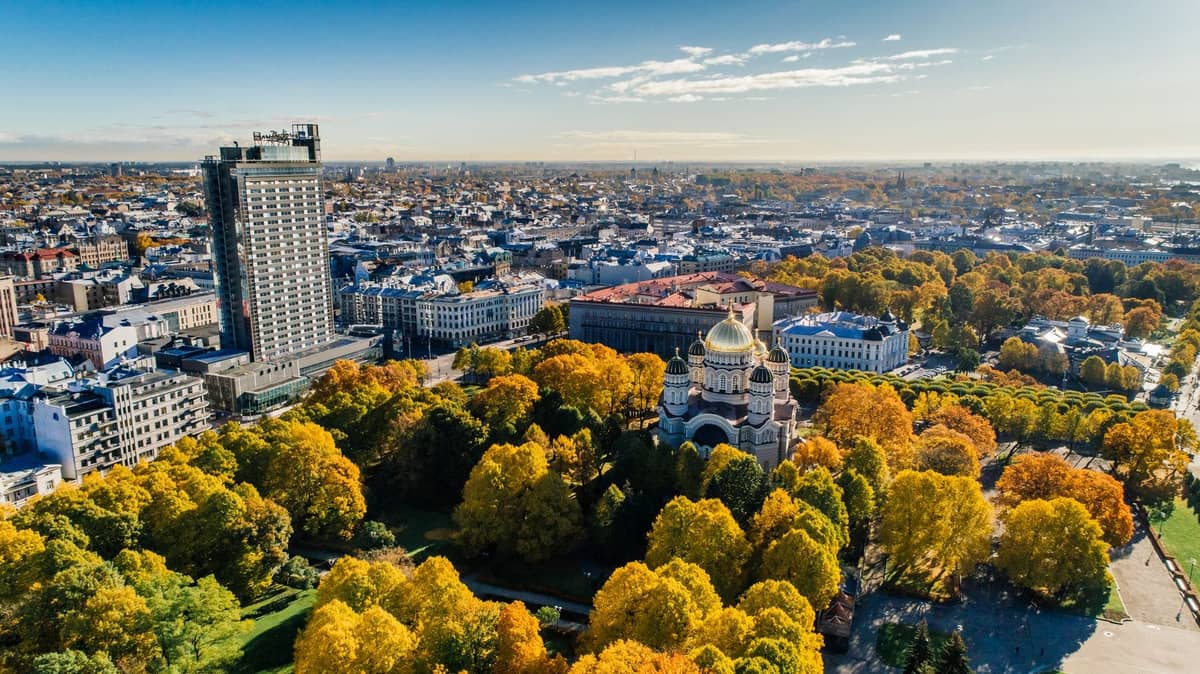
Stretching across 8.75 hectares in the heart of Riga, the Esplanāde is the city's most centrally located public park. Framed by grand streets and a cluster of significant landmarks, it offers a quiet, unhurried counterpoint to Old Town's crowds — and it's completely free.
Quick Facts
- Location
- Centre Riga, bounded by Elizabetes, Kalpaka, Krišjāņa Valdemāra, and Brīvības streets
- Getting There
- Multiple tram, trolleybus, and bus stops along Brīvības and Elizabetes streets
- Time Needed
- 30 minutes to 1.5 hours depending on pace and what you pair it with
- Cost
- Free — public park, no admission
- Best for
- Afternoon walks, casual picnics, architectural context, and pairing with nearby museums
- Official website
- www.liveriga.com/en/1636-esplanade
What the Esplanāde Actually Is
The Esplanade park in Riga is not a manicured showcase garden or a ticketed attraction. It is a wide, flat, tree-lined public park in the Centre district, used daily by students, office workers, elderly residents with dogs, and parents pushing prams. That ordinariness is precisely the point. It gives you an honest sense of city life beyond the amber-shop corridor of Old Town.
The park covers 8.75 hectares and sits at a genuinely central crossroads of Riga. Its four bordering streets — Elizabetes, Kalpaka, Krišjāņa Valdemāra, and Brīvības — connect it to several of the city's most significant institutions. The Latvian National Museum of Art stands directly adjacent on Krišjāņa Valdemāra, its neoclassical facade visible from the park's benches. The Nativity of Christ Cathedral anchors another corner. This is not coincidental: the park was historically conceived as an urban esplanade, a formal open space that gave these landmark buildings room to breathe and be seen.
💡 Local tip
If you are already planning to visit the Latvian National Museum of Art or the Nativity of Christ Cathedral, the Esplanāde makes a natural 20-minute pause between both — and the sightlines from the park give you a better sense of each building's scale than standing directly beneath them.
How the Park Changes Through the Day
Early morning is the park at its quietest and, in fair weather, its most atmospheric. The light filters through the old linden and chestnut trees at a low angle, casting long shadows across the gravel paths. Joggers make steady circuits. The air carries the faint sweetness of linden blossom in June and July, a smell distinctive enough that locals refer to it as a marker of summer's peak.
By midday on a weekday, the park fills with lunch crowds from nearby offices and the university precinct. Benches are occupied, and in summer the grass areas attract impromptu picnics. This is also when the park is noisiest — not unpleasantly so, but you will not find solitude between noon and 2pm on a warm weekday.
Late afternoon and early evening, particularly in summer, bring a mellower energy. The temperature drops slightly, the crowds thin, and the cathedral and museum facades catch warm directional light that makes them worth photographing. In winter, the park is near-empty after dark and the paths can be icy, but the snow-covered grounds have their own stark appeal, especially if the cathedral is lit.
⚠️ What to skip
In winter, the park's gravel and stone paths become slippery after snowfall or freeze-thaw cycles. Footwear with grip is strongly recommended from November through March.
Tickets & tours
Hand-picked options from our booking partner. Prices are indicative; availability and final rates are confirmed when you complete your booking.
Canal boat sightseeing tour in Riga
From 13 €Instant confirmationArt and culture walking tour of Riga with a local
From 66 €Instant confirmationFree cancellationSelf-guided discovery walk in Riga - the essential old town and its secrets
From 30 €Instant confirmationFree cancellationExclusive private guided tour of Riga's architecture with a local
From 175 €Instant confirmationFree cancellation
The Landmarks That Frame It
The park's surroundings are where most of the sightseeing value lies. The Latvian National Museum of Art — the country's largest and oldest art museum, housed in a building completed in 1905 — sits right on the park's western boundary. If you are visiting the museum, budget time before or after to see it from the park side, where the full proportioned facade is visible without obstruction.
On the park's eastern edge, the Riga Nativity of Christ Cathedral provides visual scale. This Russian Orthodox cathedral, with its five gilded domes, was completed in 1884 and is one of the largest Orthodox churches in the Baltic states. Its presence alongside a neoclassical Latvian art museum in the same park illustrates something specific about Riga's layered architectural identity — a city where imperial Russian, German Baltic, and Latvian national histories coexist in close physical proximity.
The Freedom Monument, Riga's defining national symbol, stands just a few minutes' walk from the park's northern edge. Many visitors move between the Esplanāde and the Monument naturally as part of a broader city-centre loop.
Walking the Park: What You Actually See
The Esplanāde has no formal entrance gates — you walk into it from any of its bordering streets. The interior is a mix of paved paths, gravel walkways, open grass areas, and clusters of mature trees. There are benches throughout. Fountains and sculptures are present in the park, though their exact placement and condition varies seasonally. In summer, flower beds add color near the main axis paths.
The park is flat, which makes it genuinely easy for visitors with mobility considerations. Paved paths are reasonably wide and connect all corners of the park without steps. That said, no official accessibility statement has been published, so visitors with specific requirements should verify current conditions directly.
Photography here rewards patience more than speed. The most interesting frames combine the park's foreground greenery with the architectural backdrops behind — the cathedral domes visible through tree canopy in summer, or the museum's classical columns reflected in a wet path after rain. Midday light is flat and unflattering for architecture; the hours around 7 to 9am or 5 to 7pm in summer give far better results.
ℹ️ Good to know
The park is free to enter at any hour. There are no locked gates, no closing time, and no ticketing of any kind. It functions as a public urban green space in the fullest sense.
The Park in Context: Centre Riga's Green Network
The Esplanāde is part of a broader band of parks and gardens that runs along the inner edge of the Centre district, roughly tracing the line of the old city fortifications demolished in the 19th century. Bastejkalns Park and the canal-side green areas nearby form a connected green corridor that stretches from the Old Town boundary up through the Centre. A slow walk linking these parks is one of the better ways to understand the spatial logic of how Riga's city centre was laid out.
If the Esplanāde gives you an appetite for more structured Riga walking, the Riga Old Town walking tour covers the medieval core to the south. For a broader orientation to the Centre district and its architecture, the Art Nouveau Riga guide is relevant — the park sits close to the concentration of Art Nouveau facades along Alberta iela and the surrounding streets.
Who Should Skip This
Travelers with very limited time in Riga and a packed itinerary of ticketed attractions may find the Esplanāde expendable on its own. It is not a destination in the way that the House of the Blackheads or the Occupation Museum are. If you are choosing between sitting in the park for 30 minutes or spending that time inside the National Museum of Art, the museum wins.
The park also offers relatively little for visitors during heavy rain — there is no shelter inside it, and the paths become muddy on the grass edges. It functions best as part of a broader walk rather than a standalone visit in bad weather.
Insider Tips
- The linden trees along the park's main paths bloom in late June to early July, producing a strong, honeyed scent that is surprisingly distinctive. If you visit then, the smell alone marks the season in a way that photographs cannot.
- The best exterior photography of the Latvian National Museum of Art is actually taken from inside the park, not from the pavement directly in front. The slight distance allows you to capture the full width of the facade with context.
- Riga's municipal tram network runs along Brīvības Street bordering the park, and trolleybuses and buses run along Elizabetes Street. If you are combining this area with a visit to the Art Nouveau district or the Old Town, trams are a faster option than walking the full distance.
- On summer weekends, the park occasionally hosts small outdoor events, markets, or public gatherings near its central areas. Check local listings if you want to time a visit around or specifically avoid these.
- The park is used as a shortcut by locals moving between the Centre district's northern and southern halves. If you are navigating on foot between the National Museum of Art area and the Freedom Monument, cutting through the Esplanāde is faster and far more pleasant than walking the perimeter streets.
Who Is Esplanade Park For?
- Travelers wanting a calm pause between visits to the Latvian National Museum of Art and the Nativity of Christ Cathedral
- Families with children who need open space and room to move in the middle of a city day
- Architecture and photography enthusiasts framing the park's landmark buildings with natural foreground
- Visitors building a self-guided Centre district walking route that connects the green corridor from Old Town northward
- Budget travelers looking for a quality outdoor experience with zero cost
Nearby Attractions
Other things to see while in City Centre (Centrs):
- Bastejkalns Park & City Canal
Bastejkalns Park, also known as Bastion Hill Park, wraps around the edge of Riga's Old Town along the historic City Canal. Formed on the site of demolished 19th-century fortifications, it offers terraced lawns, stone cascades, canal-side paths, and a rare pocket of calm within easy walking distance of the Freedom Monument and the Art Nouveau district.
- Freedom Monument
The Freedom Monument is the symbolic heart of Riga, a 42.7-metre granite and travertine column that has stood at the intersection of the Old Town and the main boulevard since 1935. Entry is free, access is around the clock, and the hourly changing of the guard adds a living ritual to what might otherwise be a static landmark.
- KGB Building (Corner House)
At the corner of Brīvības iela and Stabu iela stands a building that once made Riga's residents cross to the other side of the street. The Corner House served as the KGB's Latvian headquarters from 1940 to 1991, housing interrogation rooms, cells, and a bureaucracy of fear. Today it functions as a museum that documents Soviet occupation with unflinching honesty.
- Latvian Academy of Sciences Panorama Tower
The Panorama Riga observation deck crowns the Latvian Academy of Sciences, a Soviet-era Stalinist skyscraper completed in 1961. At roughly 65 metres above street level, the open-air circular terrace delivers unobstructed 360-degree views across Riga's rooftops, the Daugava River, and the Old Town spires. It is one of the most accessible and affordable high-level vantage points in central Riga.