Riga Nativity of Christ Cathedral: Latvia's Grandest Orthodox Church
The Cathedral of the Nativity of Christ is the largest Orthodox church in Latvia and the Baltic states, a Neo-Byzantine landmark rising from Esplanāde Park in central Riga. Built between 1876 and 1884, it survived Soviet conversion into a planetarium (and, according to some accounts, a café) before being restored as a working cathedral after independence. Entry is generally free, and the gilded interior rewards even a brief stop.
Quick Facts
- Location
- Brīvības bulvāris 23, Esplanāde Park, Central Riga (Centra rajons)
- Getting There
- 10-minute walk from Riga Central Station; trams and buses along Brīvības bulvāris stop nearby
- Time Needed
- 20–40 minutes inside; allow extra time to walk the park
- Cost
- Generally free (donations welcome)
- Best for
- Architecture lovers, history seekers, and anyone crossing central Riga on foot
- Official website
- www.orthodoxriga.lv
What You're Looking At and Why It Matters
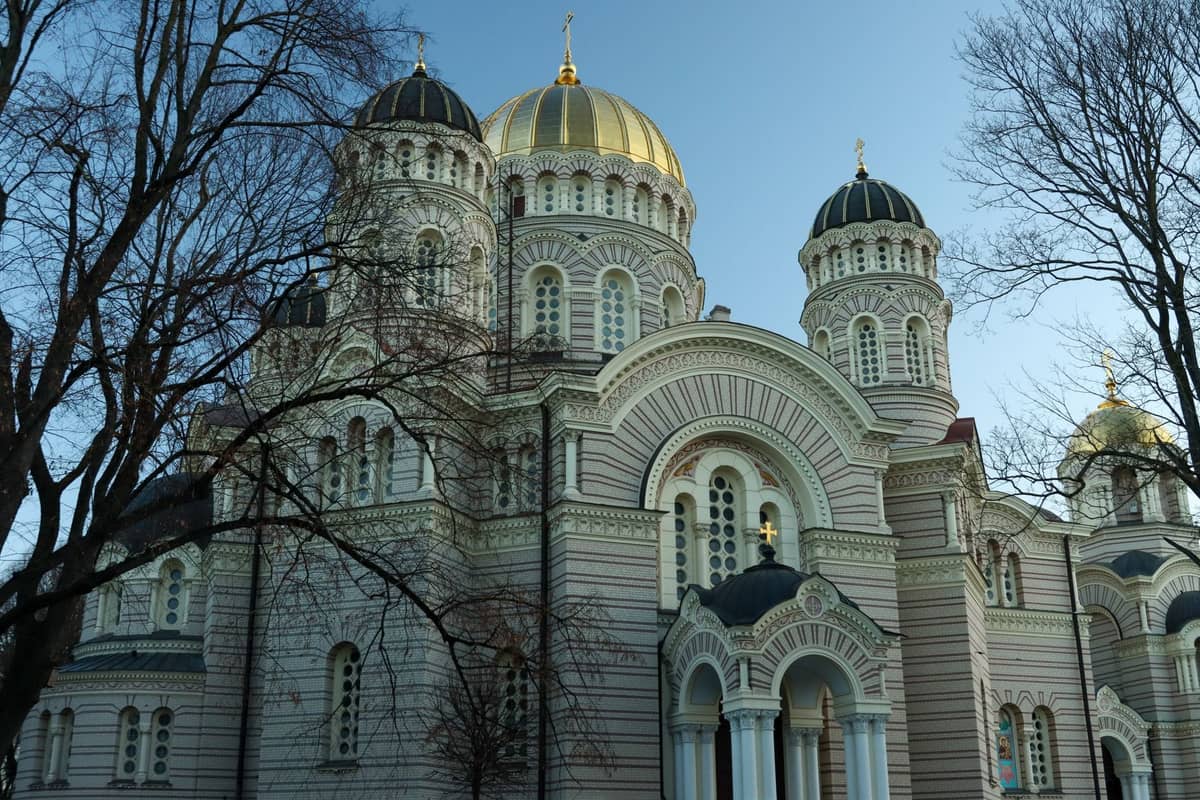
The Riga Nativity of Christ Cathedral (Latvian: Kristus Piedzimšanas pareizticīgo katedrāle) sits at the northern end of Esplanāde Park, its five gilded onion domes visible from several blocks away along Brīvības bulvāris. It is the largest Orthodox church in Latvia and, by most measures, the largest in the entire Baltic region. That scale is not immediately obvious in photographs — standing at the foot of the steps, looking up at the ribbed drum towers and the deep mosaic portal, the building resolves into something more imposing than any wide-angle lens captures.
The cathedral was designed in a Neo-Byzantine idiom at a moment when the Russian Empire was actively expressing its administrative presence in the Baltic provinces through civic architecture. Construction ran from 1876 to 1884. The style is deliberate: rounded arches, thick load-bearing walls, rich surface ornament, and a central dome that dominates the silhouette rather than a Gothic spire reaching skyward. For anyone already interested in the architectural variety of the city centre, this building completes a picture that includes Lutheran red-brick churches, Art Nouveau apartment blocks, and Baroque civic halls within a few hundred metres of each other.
ℹ️ Good to know
Opening hours are generally daily 07:00–18:30, with Saturday often extended to around 19:00 and early morning opening from about 06:00 on Sundays. Hours may shift on major Orthodox feast days. Check the official site at orthodoxriga.lv or ask at the door before planning your visit around specific service times.
The Interior: Gold, Candlelight, and Quiet
Inside, the cathedral follows the traditional Orthodox spatial arrangement: a narthex at the entrance, a main nave with no pews (Orthodox worshippers stand), and an ornate iconostasis screening the altar. The iconostasis here is multi-tiered, covered in gold-leafed frames, and filled with devotional icons. The light inside comes largely from candles purchased and lit by worshippers at low stands near the entrance — this warm, flickering glow against dark gilding gives the interior a quality that electric lighting can rarely replicate.
The smell is immediately distinctive: beeswax candles and incense accumulated over decades. The floor is cool stone, and voices echo in ways that make people instinctively lower their own. This is an active place of worship, not a museum, and the atmosphere reflects that. People come here to pray, light candles, and kiss icons. Visitors who maintain quiet and avoid photographing worshippers directly will find the space genuinely welcoming.
💡 Local tip
Photography inside the cathedral is generally tolerated for architecture and icons when services are not in progress, but flash photography and photographing worshippers without permission is disrespectful and often unwelcome. Women are expected to cover their heads inside; scarves are usually available at the entrance.
Tickets & tours
Hand-picked options from our booking partner. Prices are indicative; availability and final rates are confirmed when you complete your booking.
Canal boat sightseeing tour in Riga
From 13 €Instant confirmationArt and culture walking tour of Riga with a local
From 66 €Instant confirmationFree cancellationSelf-guided discovery walk in Riga - the essential old town and its secrets
From 30 €Instant confirmationFree cancellationExclusive private guided tour of Riga's architecture with a local
From 175 €Instant confirmationFree cancellation
The Soviet Chapter: Planetarium, Café, and Return
The cathedral's twentieth-century history is one of the more striking examples of Soviet-era repurposing of religious buildings. After Soviet occupation in 1940, the building was stripped of its religious function. At various points it was used as a planetarium and housed a café inside the nave — a transformation so jarring that photographs from the period are still circulated as a kind of shorthand for the cultural disruption of that era.
Following Latvian independence in 1991, the cathedral was returned to the Orthodox Church and underwent extensive restoration. The gilded domes were re-covered, the interior frescoes were repaired or repainted, and the iconostasis was gradually restored and consecrated in 2000. The building today shows limited visible evidence of its decades as a secular venue, which is itself a testament to the scale of work undertaken after 1991. For visitors interested in the broader arc of Soviet history in Latvia, the cathedral's story fits directly into the pattern of institutional dismantling and cultural recovery that shaped the country.
That context is explored in greater depth at the Museum of the Occupation of Latvia, about a ten-minute walk south through the Old Town, and at the KGB Building (Corner House), which addresses the Soviet security apparatus more directly.
Esplanāde Park: The Setting Matters
The cathedral does not stand in isolation. Esplanāde Park surrounds it on three sides, and the approach from Brīvības bulvāris along the central park path is one of the better short walks in central Riga. Tree-lined in summer, the park fills with people eating lunch on benches, students crossing between faculties, and elderly residents moving at a more deliberate pace. In autumn, the leaf cover turns the path between the cathedral and the boulevard into something genuinely photogenic, the gilded domes rising above the red and gold canopy.
The park itself, called Esplanāde Park, is worth a few minutes of deliberate attention rather than just a path to the entrance. The Latvian National Museum of Art occupies the southern edge of the same park, making this area one of the more concentrated clusters of significant architecture in the city centre.
How the Experience Changes by Time of Day
Early morning visits, particularly on weekdays before 09:00, tend to be quieter and more meditative. A small number of regular worshippers come for the morning liturgy, candles are freshly lit, and the interior smells more strongly of incense. The low morning light through the windows catches the gilded surfaces at a different angle than midday and is worth the earlier start for anyone who cares about photography or atmosphere.
Midday brings the largest tourist foot traffic, particularly in summer between June and August when Riga's tourist season peaks. Groups often arrive together, and the narrow narthex can feel cramped. The park outside is at its most active during lunch hours, which makes it a lively context but a noisier one.
Sunday mornings see the most significant Orthodox services, with full liturgy typically beginning around 09:00 or 10:00. If you arrive during a service, you are welcome to stand quietly and observe from the back of the nave, but this is not a suitable time for casual sightseeing or photography. Plan around it rather than through it.
⚠️ What to skip
Winter visits mean shorter daylight hours and colder temperatures, but the exterior looks particularly striking against snow. The interior is heated and genuinely warm compared to the street. Note that the park paths can be icy in January and February — appropriate footwear matters.
Getting There and Fitting It Into Your Riga Itinerary
The cathedral sits at Brīvības bulvāris 23, on the main boulevard running north from the Old Town, near Esplanāde Park. From Riga Central Station, it is a straightforward ten-minute walk north along Brīvības bulvāris. Multiple tram and bus lines run along this boulevard — stop names along this stretch are well-signed. From the Old Town, the walk takes about twelve to fifteen minutes through the park canal zone.
The cathedral fits naturally into a half-day loop of central Riga that also takes in the Freedom Monument a few hundred metres to the south, and the Art Nouveau apartment facades along Alberta iela to the north. If you are following a structured route, the Riga Old Town walking tour guide covers this corridor in detail.
Wheelchair users and those with limited mobility should be aware that the main entrance is reached via a short flight of steps. The ground-level approach through Esplanāde Park is flat, but entry into the building itself may present difficulty. Contact the cathedral in advance at orthodoxriga.lv if accessibility arrangements are needed.
Is This Worth Your Time? An Practical Assessment
The Riga Nativity of Christ Cathedral is not a secret, and it is not overlooked. It appears on most city maps and is photographed heavily. But it is also not overhyped in the way that some top-of-every-list attractions can be. The combination of genuine architectural scale, free admission, a compelling historical backstory, and an active devotional atmosphere makes it consistently worth a visit rather than a checkbox.
That said, visitors who are primarily interested in Latvian national culture and history will find the Lutheran churches of the Old Town, particularly the Dome Cathedral and St. Peter's Church, more central to that story. The Nativity Cathedral belongs to the Russian Orthodox tradition and reflects a different cultural and political thread running through Riga's history — one that is no less important, but distinct. Understanding both is part of understanding the city.
Travelers who want to understand Riga's layered architectural identity more fully should also read the Art Nouveau Riga guide, since the cathedral's immediate neighbourhood contains some of the finest Jugendstil facades in Europe, just a ten-minute walk north.
Insider Tips
- The best exterior photographs of the domes are taken from the park path approaching from Brīvības bulvāris, ideally in the morning when the sun catches the gilded surfaces from the east. The view from directly in front of the entrance looks upward at a compressed angle and rarely conveys the building's full scale.
- If you visit in late October or early November, the combination of autumn colour in Esplanāde Park and the gold of the domes is genuinely striking. This is also a lower-traffic period than summer, meaning the interior is quieter.
- Candles can be purchased inside the entrance for a small donation and lit at the stands near the icons. This is a normal part of Orthodox practice and visitors are welcome to participate if they wish, regardless of their own tradition.
- The Latvian National Museum of Art is in the same park and is typically free on the first Sunday of each month (check current conditions). Combining both into one Esplanāde Park visit is an efficient use of time on those days.
- Services in Russian are more common than in Latvian at this cathedral, which reflects its historical congregation. This is worth knowing for context but changes nothing about the visitor experience.
Who Is Riga Nativity of Christ Cathedral For?
- Architecture enthusiasts interested in Neo-Byzantine design and its political context in the Russian Empire period
- Travelers exploring Soviet-era history and the cultural repurposing of religious buildings
- Visitors building a walking route through central Riga who want a free, unhurried stop
- Photographers working in early morning light with an interest in religious architecture and park settings
- Anyone curious about the Orthodox Christian community and its long presence in Latvia
Nearby Attractions
Other things to see while in City Centre (Centrs):
- Bastejkalns Park & City Canal
Bastejkalns Park, also known as Bastion Hill Park, wraps around the edge of Riga's Old Town along the historic City Canal. Formed on the site of demolished 19th-century fortifications, it offers terraced lawns, stone cascades, canal-side paths, and a rare pocket of calm within easy walking distance of the Freedom Monument and the Art Nouveau district.
- Esplanade Park
Stretching across 8.75 hectares in the heart of Riga, the Esplanāde is the city's most centrally located public park. Framed by grand streets and a cluster of significant landmarks, it offers a quiet, unhurried counterpoint to Old Town's crowds — and it's completely free.
- Freedom Monument
The Freedom Monument is the symbolic heart of Riga, a 42.7-metre granite and travertine column that has stood at the intersection of the Old Town and the main boulevard since 1935. Entry is free, access is around the clock, and the hourly changing of the guard adds a living ritual to what might otherwise be a static landmark.
- KGB Building (Corner House)
At the corner of Brīvības iela and Stabu iela stands a building that once made Riga's residents cross to the other side of the street. The Corner House served as the KGB's Latvian headquarters from 1940 to 1991, housing interrogation rooms, cells, and a bureaucracy of fear. Today it functions as a museum that documents Soviet occupation with unflinching honesty.