The KGB Building (Corner House): Inside Riga's Most Chilling Address
At the corner of Brīvības iela and Stabu iela stands a building that once made Riga's residents cross to the other side of the street. The Corner House served as the KGB's Latvian headquarters from 1940 to 1991, housing interrogation rooms, cells, and a bureaucracy of fear. Today it functions as a museum that documents Soviet occupation with unflinching honesty.
Quick Facts
- Location
- Brīvības iela 61, Rīga, LV-1010 — corner of Brīvības iela and Stabu iela, approx. 1 km east of Old Town
- Getting There
- Walkable from Old Town in 15–20 min; nearest bus stops at Stabu iela on Brīvības iela
- Time Needed
- 1.5 to 2.5 hours for a thorough visit
- Cost
- Admission fee applies; verify current price on the official website before visiting
- Best for
- History, Cold War sites, Soviet-era context, reflective travel
- Official website
- okupacijasmuzejs.lv/en
What Is the Corner House?
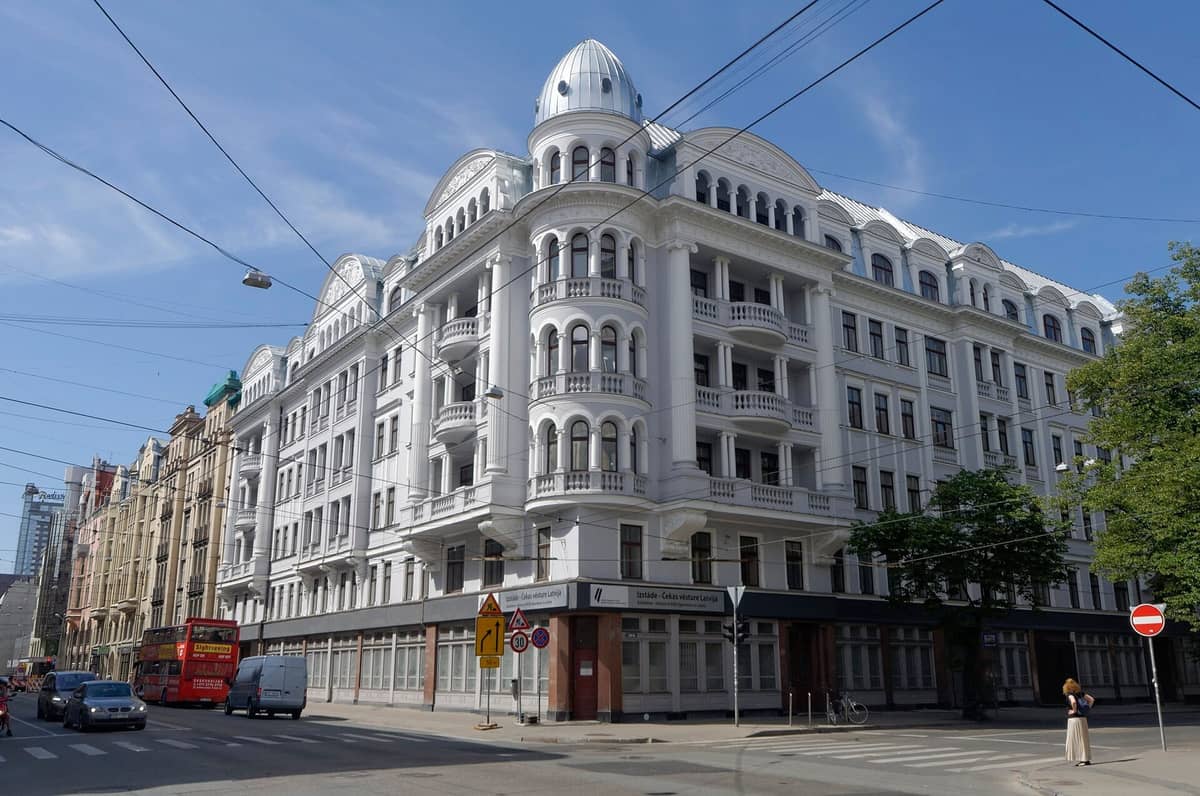
The KGB Building, known locally as Stūra māja or the Corner House, is one of the most significant sites of political repression in the Baltic states. Built in 1911, the imposing five-storey structure at Brīvības iela 61 was requisitioned by Soviet security services when the USSR first occupied Latvia in 1940. With a brief interruption during the Nazi occupation, it served as the Latvian headquarters of the KGB from 1940 to 1941 and from 1944 to 1991. For five decades, tens of thousands of Latvians passed through its doors under duress, many of them never to return home.
The building now operates as a museum branch under the Museum of the Occupation of Latvia. Unlike the main Occupation Museum near the Old Town, the Corner House takes you directly into the physical architecture of repression: the actual interrogation rooms, basement cells, and administrative corridors used by Soviet secret police. Very little has been sanitized. The peeling plaster, the narrow window slots, the graffiti scratched into cell walls by prisoners — it all remains.
ℹ️ Good to know
Opening hours: Daily 10:30–17:30. Closed on 1 January, 23–24 June, 18 November, 24–26 December, and 31 December. Verify current guided-tour prices directly at okupacijasmuzejs.lv/en before your visit.
The History Behind the Walls
The Corner House's history is inseparable from Latvia's 20th-century trauma. When Soviet forces occupied Latvia in June 1940, the NKVD (predecessor to the KGB) moved into the building almost immediately, establishing interrogation and detention infrastructure. The mass deportations of June 1941, in which over 15,000 Latvians were sent to Siberia in a single week, were coordinated in part from this building. After German forces withdrew and the Soviets returned in 1944, the NKVD resumed operations here, and the building remained central to Soviet state terror through the late Stalin period and beyond.
The KGB's presence continued well into the Khrushchev and Brezhnev eras, when outright executions gave way to psychiatric persecution, surveillance networks, and systematic intimidation of dissidents and intellectuals. Files maintained in buildings like this one tracked thousands of ordinary citizens. When Latvia declared independence in 1991, the KGB formally vacated the premises, but left behind a paper trail and a physical record that historians and curators have spent decades piecing together.
For broader context on how the Soviet period shaped modern Latvia, the Museum of the Occupation of Latvia near Town Hall Square covers the full arc of both Soviet and Nazi occupation through extensive exhibits and personal testimonies.
Tickets & tours
Hand-picked options from our booking partner. Prices are indicative; availability and final rates are confirmed when you complete your booking.
Exclusive private guided tour of Riga's architecture with a local
From 175 €Instant confirmationFree cancellation1-hour walking tour of Riga with a local
From 51 €Instant confirmationFree cancellationExclusive historical walking tour of Riga with a local
From 600 €Instant confirmationFree cancellationEntrance ticket to the House of the Black Heads in Riga
From 7 €Instant confirmationFree cancellation
What You'll Actually See Inside
The museum is structured around the building itself rather than a traditional display-case format. Guided tours (strongly recommended, especially for first-time visitors) walk you through the former administrative offices on upper floors, then descend to the basement, where the experience shifts in tone entirely. The basement housed the detention and interrogation facilities: isolation cells barely large enough to lie down in, a corridor where detainees were kept facing walls for hours, and rooms where interrogations stretched across sleepless days.
Exhibits combine archival documents, personal objects left behind by former prisoners, KGB operational equipment, and reconstructed furnishings. Some rooms have been deliberately left close to their original state. The sounds of the building are part of the experience too: the echo of footsteps on concrete floors, the silence of the cell block. It is not a comfortable visit, and it is not meant to be.
Photographs are generally permitted in public exhibit areas, though you should follow any specific guidance from your guide. The basement in particular benefits from a longer pause rather than rapid-fire photography. Take time to read the individual stories mounted alongside cell doors — these transform statistics into people.
💡 Local tip
Book a guided tour in advance through the official website. English-language tours are available, and a guide adds critical context that printed panels alone cannot provide. Walk-in visitors can still enter, but the experience is significantly richer with interpretation.
How the Visit Feels at Different Times of Day
Morning visits, shortly after the 10:30 opening, tend to be quieter. The light outside Brīvības iela casts long shadows across the building's corner facade in early hours, and the interior has a stillness that suits the subject matter. School groups often arrive mid-morning, and while their presence is entirely appropriate, it does shift the atmosphere. If you prefer a more solitary experience, aim to arrive at opening time or in the early afternoon on a weekday.
The building's exterior is worth observing before you enter. It reads as a perfectly ordinary early 20th-century apartment block: symmetrical, solid, unremarkable from a distance. That ordinariness was by design. The KGB did not want a fortress; it wanted a building that could absorb people quietly. Standing on the corner of Brīvības iela and Stabu iela and looking up at the windows, knowing what happened behind them, is its own form of confrontation before you've even bought your ticket.
Getting There and Practical Logistics
The Corner House sits on Brīvības iela, one of Riga's main arterial roads running northeast from the Old Town toward the city's quieter residential streets. On foot from the Old Town, it's a straightforward 15 to 20 minute walk along Brīvības iela. The route takes you past the Freedom Monument and through the central district, giving useful visual context for the city's layout. Several bus routes stop at or near Stabu iela on Brīvības iela.
If you're combining this with other sites in the area, Brīvības iela is also within reasonable walking distance of the Esplanade Park and the art nouveau streets to the northeast. A visit to the Corner House pairs logically with a walk through the Centre district, where the architectural legacy of the early 20th century stands alongside the more recent layers of Soviet-era urbanism.
There is no dedicated parking structure attached to the museum. Street parking exists in the surrounding blocks, but Brīvības iela itself is a busy main road. Walking or using public transit is the practical choice for most visitors.
⚠️ What to skip
The museum is closed on several Latvian national holidays including 18 November (Independence Day) and 23–24 June (Midsummer), which fall during high tourist season. Always check the official website for closures before making plans.
Who This Attraction Is For — and Who Might Struggle
The Corner House is not a general-interest tourist attraction. It is a place of historical reckoning, and visitors who come looking for a quick cultural tick may find it unexpectedly demanding. The content is emotionally heavy: stories of individuals who were tortured, imprisoned, or executed, presented in a space that has not been aesthetically softened. People who are sensitive to documentation of state violence, imprisonment, or trauma should approach with that awareness.
Children can visit — and in Latvia, many school curricula include this site — but parents should consider their child's age and readiness for material involving detention and persecution. The physical space includes narrow corridors and basement areas that may be challenging for visitors with mobility limitations; accessibility specifics should be confirmed directly with the museum before visiting.
For visitors building a fuller picture of Riga's Soviet history, this site connects naturally with the Salaspils Memorial outside the city and the Soviet history guide for Riga, which outlines the most significant sites across the city in context.
Travelers primarily focused on architecture, food markets, or outdoor activities will find little overlap here. That said, even visitors with a casual interest in 20th-century European history often describe the Corner House as the most affecting experience of their time in Riga — not because it is enjoyable, but because it is honest.
Insider Tips
- Arrive within the first 30 minutes of opening on a weekday for the quietest, most contemplative experience. Weekend mornings attract larger groups, especially in summer.
- The guided tour is not optional in spirit, even if it is in practice. The building's layout is confusing without orientation, and guides provide crucial biographical detail about individuals named in the exhibits.
- After your visit, the walk back along Brīvības iela toward the Freedom Monument has a particular resonance. The monument was banned under Soviet rule; standing at it after the Corner House gives the gesture of resistance a different weight.
- Bring something to write with. Several visitors find themselves wanting to note names or dates from the exhibits — the volume of information is substantial and not everything is available in printed form to take away.
- If you read Latvian or Russian, the archival documents on display offer a level of detail that English-language panels summarize but cannot fully convey. The originals are genuinely worth pausing over.
Who Is KGB Building (Corner House) For?
- History travelers with a focus on 20th-century European politics and Soviet repression
- Visitors who want to understand why Baltic identity and independence carry such emotional weight
- Journalists, researchers, and students studying Cold War-era security state methodology
- Travelers who have already visited the Museum of the Occupation and want deeper physical context
- Anyone spending more than two days in Riga and moving beyond the standard Old Town circuit
Nearby Attractions
Other things to see while in City Centre (Centrs):
- Bastejkalns Park & City Canal
Bastejkalns Park, also known as Bastion Hill Park, wraps around the edge of Riga's Old Town along the historic City Canal. Formed on the site of demolished 19th-century fortifications, it offers terraced lawns, stone cascades, canal-side paths, and a rare pocket of calm within easy walking distance of the Freedom Monument and the Art Nouveau district.
- Esplanade Park
Stretching across 8.75 hectares in the heart of Riga, the Esplanāde is the city's most centrally located public park. Framed by grand streets and a cluster of significant landmarks, it offers a quiet, unhurried counterpoint to Old Town's crowds — and it's completely free.
- Freedom Monument
The Freedom Monument is the symbolic heart of Riga, a 42.7-metre granite and travertine column that has stood at the intersection of the Old Town and the main boulevard since 1935. Entry is free, access is around the clock, and the hourly changing of the guard adds a living ritual to what might otherwise be a static landmark.
- Latvian Academy of Sciences Panorama Tower
The Panorama Riga observation deck crowns the Latvian Academy of Sciences, a Soviet-era Stalinist skyscraper completed in 1961. At roughly 65 metres above street level, the open-air circular terrace delivers unobstructed 360-degree views across Riga's rooftops, the Daugava River, and the Old Town spires. It is one of the most accessible and affordable high-level vantage points in central Riga.