Salaspils Memorial: The WWII Camp Site Outside Riga
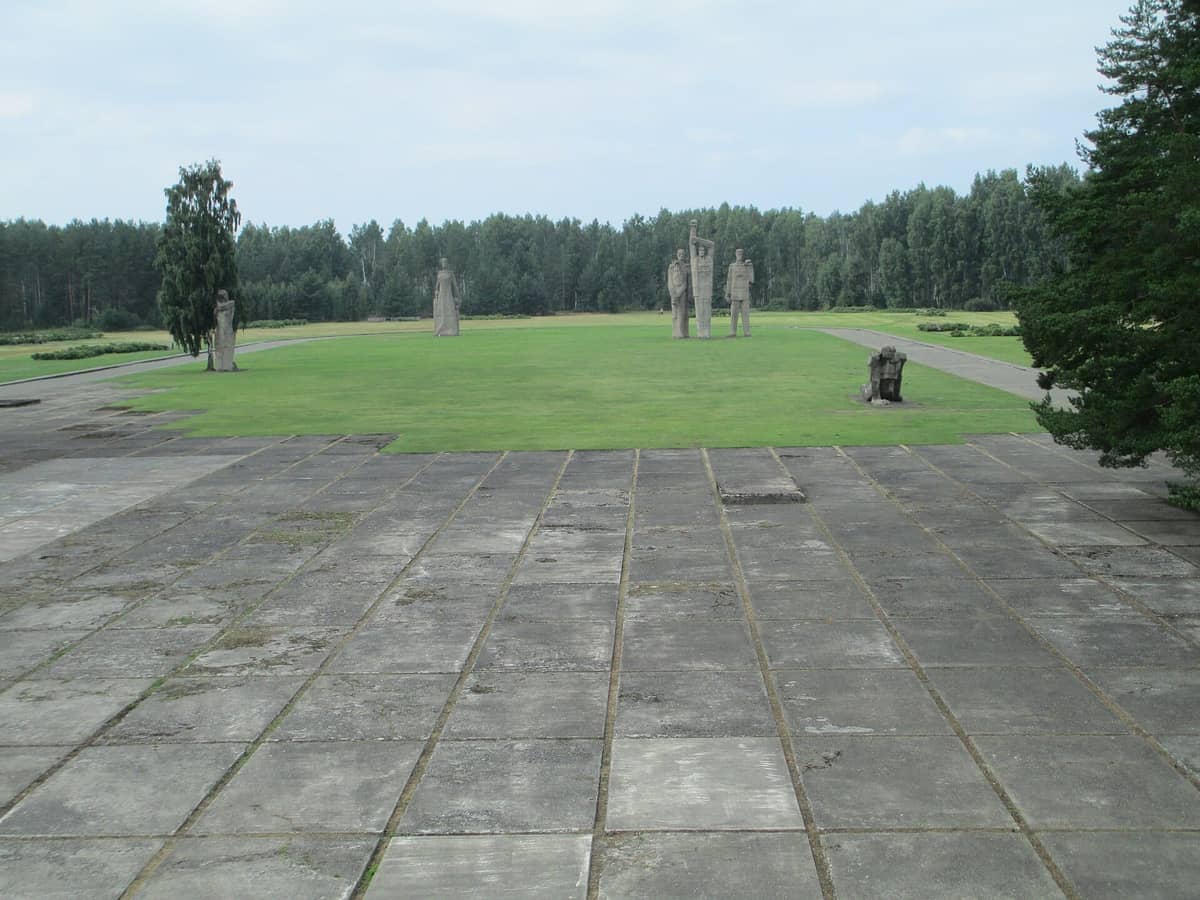
The Salaspils Memorial marks the site of a Nazi-era camp that operated from 1941 to 1944, southeast of Riga. A vast open-air ensemble of monumental concrete sculpture spreads across roughly 20 hectares of pine forest, with free admission and grounds open around the clock. It is one of the most historically significant and emotionally weighty sites in the entire Baltic region.
Quick Facts
- Location
- Salaspils Memorial, Salaspils county, LV-2118 — approx. 18 km southeast of central Riga
- Getting There
- Train from Riga Central Station to Dārzinži, then roughly 20-minute walk to the memorial
- Time Needed
- 1.5 to 3 hours depending on pace and whether you visit the indoor exposition
- Cost
- Free entry to the outdoor territory; indoor exposition admission — check official site for current details
- Best for
- History and WWII research, quiet contemplative visits, understanding Latvian wartime experience
- Official website
- salaspilsmemorials.lv/en/index
What the Salaspils Memorial Actually Is
The Salaspils Memorial is an open-air commemorative site built on the former grounds of the Salaspils concentration camp, which operated under Nazi German occupation from 1941 until 1944. The camp held political prisoners, Soviet POWs, Jewish detainees, and civilians from Latvia and across occupied Europe. After Soviet Latvia reclaimed the site, a major state memorial complex was constructed and officially opened in 1967, designed by architects Gunārs Asaris, Oļģerts Ostenbergs, Ivars Strautmanis, and sculptors including Ļevs Bukovskis.
The result is unlike any conventional war cemetery or museum. Instead of rows of headstones, the memorial uses colossal abstract concrete sculptures spread across a pine-forested landscape. Names like 'The Unbroken', 'The Humiliated', 'The Oath', and 'Mother' stand several meters tall and are positioned along a processional route that visitors walk in sequence. The scale and severity of the forms communicate something that plaques and photographs alone cannot.
ℹ️ Good to know
The outdoor territory of the Salaspils Memorial is open-air and available 24 hours a day, 7 days a week, all year. The indoor exposition is open daily 10:00–17:00 from April to October, and daily 10:00–15:00 from November to March.
Arriving at the Site: The Approach and First Impressions
The walk from Dārzinži station takes you through a quiet suburban and forested stretch. There are no ticket booths, no queues, no souvenir stalls. When you arrive at the entrance, the first thing you encounter is a long, low concrete threshold structure bearing the inscription 'Aiz šiem vārtiem vaid zeme' — Latvian for 'Beyond these gates the land groans'. That line, written by Latvian poet Eižens Vēveris, sets the register for everything that follows.
Beyond the threshold, the forest opens into a broad cleared landscape. The pine trees lining the edges muffle sound from the outside world, which amplifies the silence on the memorial grounds. On weekday mornings, particularly outside summer, it is not uncommon to be one of only a handful of visitors. That near-solitude makes the experience more intense, not less. The sculptures loom at unexpected distances, and the flat, expansive ground gives no sense of visual shelter.
On warmer weekends, especially around May 9 (Victory in Europe Day, still observed with particular feeling in Latvia's Russian-speaking community), the site draws larger crowds and sometimes organized commemorations with flowers. Visiting on those dates means a very different atmosphere — collective, sometimes politically charged, and more crowded.
Tickets & tours
Hand-picked options from our booking partner. Prices are indicative; availability and final rates are confirmed when you complete your booking.
Canal boat sightseeing tour in Riga
From 13 €Instant confirmationArt and culture walking tour of Riga with a local
From 66 €Instant confirmationFree cancellationSelf-guided discovery walk in Riga - the essential old town and its secrets
From 30 €Instant confirmationFree cancellationExclusive private guided tour of Riga's architecture with a local
From 175 €Instant confirmationFree cancellation
The Sculptures: Form, Scale, and Meaning
The memorial sculptures are the defining feature of the site, and they deserve more than a quick walk-past. Each figure was designed to represent a particular emotional or human state connected to the suffering of the camp. 'The Unbroken' is perhaps the most striking: a massive figure leaning backward at an impossible angle, resisting collapse. 'Mother' — also translated as 'Woman' in some materials — shows a figure bowed forward, the weight of grief rendered in raw concrete.
What distinguishes this Soviet-era memorial from many of its contemporaries is the absence of conventional heroic posturing. The figures are not triumphant soldiers. They depict endurance, dehumanization, and grief. The stylistic vocabulary is influenced by European modernism of the 1960s rather than the stricter Socialist Realist idiom, which gives the sculpture an expressiveness that holds up to repeated looking.
The memorial was built at a scale intended for large group visits, and it shows. Walking the full route from the entrance threshold to the far end of the sculpture field and back takes around 30 to 45 minutes at a moderate pace, more if you stop to read the informational markers. Bring footwear suited for uneven grass and gravel paths, particularly after rain, when the ground between sculptures can become soft.
💡 Local tip
Photography is permitted across the outdoor grounds. The late afternoon light in summer, when it comes in low through the pines and catches the textured concrete surfaces, produces the most visually striking conditions. Morning light in autumn and winter can also be atmospheric, with mist sometimes hanging between the tree lines.
Historical Context: The Camp and Its Place in Latvian Memory
Understanding why this memorial matters requires some context about the period it commemorates. Latvia was occupied first by the Soviet Union in 1940, then by Nazi Germany from 1941, and again by the Soviet Union from 1944 until independence was restored in 1991. The Salaspils camp existed during the German occupation and was one of multiple sites of organized violence and detention in what is now Latvian territory. Historians continue to research the precise number of victims and the camp's exact classification, and the site carries layers of contested memory from different communities.
The memorial itself was constructed under Soviet governance and reflects Soviet commemorative framing, which emphasized anti-fascist resistance and downplayed certain specific ethnic or national dimensions of the victims' identities. Since Latvian independence in 1991, the site's historical interpretation has been revisited by researchers and curators. Visitors interested in the broader context of wartime Latvia should pair a visit here with the Museum of the Occupation of Latvia in Riga's Old Town, which covers both Soviet and Nazi occupation periods in substantial depth.
The indoor exposition at the memorial provides additional interpretive material, including historical photographs, documents, and explanatory panels. It is modest in scale compared to major European Holocaust and WWII museums, but it adds essential specificity to the outdoor experience. Allow at least 30 to 40 minutes for the exposition if it is open during your visit.
Getting There and Practical Logistics
The most straightforward route from central Riga is by commuter train from Riga Central Station toward Ogre or Krustpils, alighting at Dārzinži station. The journey takes roughly 20 to 25 minutes. From the station, the memorial is reachable on foot in approximately 25 to 30 minutes through a quiet residential and forested area. Trains on this line run with reasonable frequency during daytime hours, but check the timetable in advance, particularly for return journeys, to avoid a long wait at a small rural station.
Driving is straightforward from Riga, with parking available near the site entrance. The memorial is in Salaspils county, LV-2118, and the coordinates 56.8731, 24.3028 work reliably in mapping applications. The drive from the city centre takes around 20 to 30 minutes depending on traffic.
If you are combining the memorial with other travel, Salaspils town is close to the route toward the Ethnographic Open-Air Museum, which lies to the north of Riga. The two sites are quite different in tone, but it is possible to visit both in a single day with a car. The memorial can also be included in a wider Soviet history itinerary around Riga.
⚠️ What to skip
In winter months, the grounds can be covered in snow and ice. Paths between sculptures are not always gritted. Wear boots with grip if visiting between November and March. The shorter exposition hours (closing at 15:00) also mean natural light begins to fade before closing time in December and January.
Tone, Atmosphere, and Who This Is Right For
The Salaspils Memorial is not a place that entertains. It is a place that asks something of you. The silence, the scale, the unflinching sculptural language — these work together to create an atmosphere that is genuinely affecting in a way that passively watching a documentary cannot replicate. That is the point of it, and by that measure it succeeds.
That said, visitors who come primarily for visual spectacle or who are not prepared to engage with the historical weight of the site may find the experience unrewarding. There are no interactive exhibits, no audio guides available at all hours, and no cafe on site. If you are traveling with young children, the subject matter is difficult and the site offers no interpretive resources aimed at that age group.
For travelers focused on Riga's wartime and Soviet history, this site belongs on any serious itinerary alongside the KGB Building (Corner House) in central Riga. For those spending more than a couple of days in the city, it provides a counterpoint to the architectural and cultural attractions of the Old Town and fills a gap that no in-city museum fully covers.
Guided Tours and Advance Booking
The official memorial website confirms that guided tours are available and should be booked in advance. A guided visit substantially deepens the experience, particularly for visitors without background knowledge of Latvian wartime history. The official site at salaspilsmemorials.lv provides booking information for group and individual tours. Without a guide, the outdoor space is still fully accessible, but some of the nuance of the individual sculptures and the historical sequence of the camp is harder to reconstruct from the on-site markers alone.
Insider Tips
- Visit on a weekday morning outside July and August for the most contemplative experience. Weekend afternoons in summer can bring tour groups that move through quickly and break the quiet the site depends on.
- The indoor exposition closes significantly earlier in winter (15:00). If you arrive at 14:30 in December expecting full access, you will have very little time inside. Plan to arrive by 13:30 at the latest in low season.
- The metronome sound installation inside the exposition building — a rhythmic beat representing the dead — is one of the most quietly powerful elements of the whole visit. Do not leave before spending a few minutes in that room.
- If you are arriving by train, download an offline timetable for return trains from Dārzinži before you leave Riga. Mobile coverage near the station can be inconsistent, and train frequency drops in the evening.
- Flowers are commonly left at the base of several sculptures, particularly 'Mother'. Bringing a small bunch is considered respectful and appropriate, especially on dates connected to wartime commemoration.
Who Is Salaspils Memorial For?
- Travelers with a serious interest in WWII and Holocaust history in the Baltic states
- Those researching Soviet-era commemorative architecture and public art
- Visitors who want to understand the full historical context of modern Latvia
- Photographers drawn to monumental concrete sculpture in natural settings
- Anyone spending three or more days in Riga who has covered the main in-city sites
Nearby Attractions
Combine your visit with:
- Āgenskalns Market
Āgenskalns Market (Āgenskalna tirgus) has anchored the left bank of the Daugava since 1898. Its architect-designed red-brick pavilion, restored in 2022, now blends a working food market with cafés, a bar, and a regular vintage and design market — all free to enter.
- Daugava River Promenade
The Daugava River Promenade stretches along the right bank of the Daugava from the edge of Old Town southward through the Ķengarags suburb. It is free, open around the clock, and offers some of the most unobstructed views of Riga's skyline, the wide river, and the left bank's quieter residential district. Whether you walk it at sunrise or cycle it on a summer evening, the promenade gives the city a different scale entirely.
- Ethnographic Open-Air Museum of Latvia
Spread across 87 hectares of pine forest on the shore of Lake Jugla, the Ethnographic Open-Air Museum of Latvia preserves rural Latvian building traditions in one walkable landscape. Founded in 1924 and open to the public since 1932, it is one of the oldest open-air museums in Europe. Allow at least half a day.
- Kalnciema Quarter
A restored complex of 18th and 19th-century wooden buildings on the left bank of the Daugava, Kalnciema Quarter hosts a popular Saturday market, summer concerts, and independent cafés. It offers a quieter, residential counterweight to Old Town's stone and crowds.