Kalnciema Quarter: Riga's Left-Bank Wooden Heritage Come to Life
A restored complex of 18th and 19th-century wooden buildings on the left bank of the Daugava, Kalnciema Quarter hosts a popular Saturday market, summer concerts, and independent cafés. It offers a quieter, residential counterweight to Old Town's stone and crowds.
Quick Facts
- Location
- Kalnciema iela 35, Rīga, LV-1046 — left bank of the Daugava
- Getting There
- Bus along Kalnciema iela; also reachable on foot or by taxi from the centre
- Time Needed
- 1.5 to 2.5 hours; longer if staying for a concert or the Saturday market
- Cost
- Free to enter the quarter and browse the market; some special events may be ticketed
- Best for
- Architecture lovers, local food shoppers, families, slow-travel visitors
- Official website
- www.kalnciemaiela.lv/en
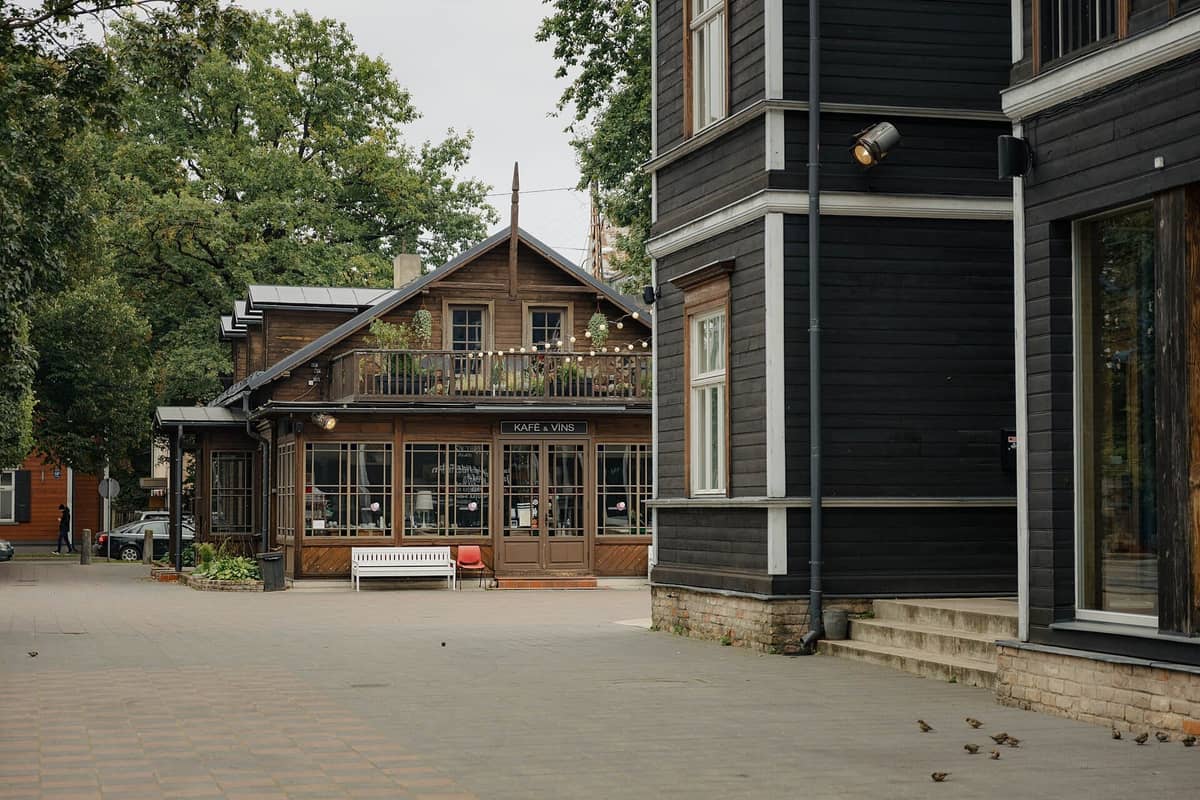
What Kalnciema Quarter Actually Is
Kalnciema Quarter (Latvian: Kalnciema kvartāls) is a privately restored complex of wooden buildings on Kalnciema iela, a broad street in Riga's Pārdaugava district on the left bank of the Daugava River. The buildings date to the turn of the 18th and 19th centuries and are among the best-preserved examples of Riga's historic wooden residential architecture outside of the Āgenskalns neighbourhood immediately to the north. Since 2001, when the restoration effort began, the quarter has evolved into a cultural and creative hub: part heritage site, part weekly market, part event venue.
This is not a museum or a ticketed attraction. While there are no fixed-schedule guided tours, the quarter does offer independent audio-guided tours and six renovated wooden buildings are publicly accessible to visitors. Instead, the quarter functions as a piece of living neighbourhood fabric: workshops, small shops, and cafés occupy the ground floors of the restored wooden houses, and the courtyard space at the centre hosts the Saturday market and outdoor summer concerts. The whole arrangement is loose and organic in a way that polished heritage sites rarely manage.
💡 Local tip
Saturday is the peak day. The weekly market runs from approximately 10:00 to 16:00.
The Architecture: Why These Buildings Matter
Riga's reputation for architecture tends to revolve around Art Nouveau stonework in the Quiet Centre, but the city's wooden districts are a parallel and equally serious tradition. In the 19th century, the left bank of the Daugava was largely working-class and mercantile, and its buildings reflected that: two-storey wooden houses with pitched roofs, decorated timber façades, and deep courtyards, built close to the street. Kalnciema iela 35 is a compact cluster of this typology, and the restoration work here has been careful rather than cosmetic.
The painted wooden façades still show wear in places, and that is intentional. Restoration teams preserved structural authenticity over a showroom finish. Walking along the street frontage, you notice the subtle colour palette: muted ochres, pale greens, and grey-blues that reference original 19th-century pigments rather than modern paint charts. For a broader understanding of Riga's architectural range, the Art Nouveau district guide covers the city's other major architectural tradition and makes a useful counterpoint to a visit here.
Tickets & tours
Hand-picked options from our booking partner. Prices are indicative; availability and final rates are confirmed when you complete your booking.
Canal boat sightseeing tour in Riga
From 13 €Instant confirmationArt and culture walking tour of Riga with a local
From 66 €Instant confirmationFree cancellationSelf-guided discovery walk in Riga - the essential old town and its secrets
From 30 €Instant confirmationFree cancellationExclusive private guided tour of Riga's architecture with a local
From 175 €Instant confirmationFree cancellation
The Saturday Market: What You'll Find
The Saturday market is the heartbeat of the quarter. It is smaller and more curated than Riga's sprawling Central Market, focusing on local producers: Latvian cheeses, smoked fish, honey, rye bread, and seasonal vegetables in summer and autumn. There are also craft and design vendors selling ceramics, textiles, and handmade goods, though the ratio shifts week to week depending on who has a pitch.
The food offer here skews towards quality and provenance in a way you won't find at the bigger markets. Producers often speak directly with buyers, which makes it genuinely useful for anyone curious about Latvian food culture rather than just browsing. If the Kalnciema market leaves you wanting more market depth, Riga Central Market — one of the largest in Europe — is a 20-minute bus ride away across the river and operates daily.
The courtyard fills up noticeably between 11:00 and 13:00. Families with young children, young couples, and older neighbourhood regulars all converge in that window. By 14:30 the stalls begin thinning out. If you are coming specifically to buy food, aim for 10:30 to 11:30.
ℹ️ Good to know
The market is primarily a Saturday affair (approx. 10:00–16:00). The quarter's shops and cafés are generally open Monday to Saturday, but hours vary by tenant. Confirm current hours via the official website before making a special trip on a weekday.
Concerts and Events: The Summer Programme
From late spring through early autumn, Kalnciema Quarter runs a programme of outdoor concerts and events. The courtyard is compact enough that even a modest crowd creates a real atmosphere: the wooden buildings act as a natural acoustic shell, and the scale keeps things intimate. Acts range from folk and jazz to contemporary Latvian musicians. Some events are free with market entry; others are ticketed.
Event programming is seasonal and changes annually. Check the official website at kalnciemaiela.lv for current listings before planning an evening visit. The Thursday concert format has been a fixture of the quarter's cultural calendar for years, but specific dates and lineups are only confirmed close to the season.
The Neighbourhood Context: Pārdaugava and the Left Bank
Most visitors to Riga never cross the Daugava at all. The Old Town and Art Nouveau district absorb the bulk of attention, and the left bank tends to be written off as residential. That is partly true and partly a missed opportunity. Pārdaugava — the broader left-bank territory — has a different grain: wider streets, more greenery, and a slower pace that reflects its history as a working and craftsman's quarter rather than a commercial or civic one.
Kalnciema Quarter sits roughly 2.4 km from the city centre, close enough for a comfortable walk across one of the Daugava bridges. The Daugava River promenade connects the two banks along the water and is a pleasant way to approach from the centre on foot. The Āgenskalns market — a covered neighbourhood market a short walk north on the left bank — is worth combining with a Kalnciema visit for a fuller picture of the area.
Travellers with more than a couple of days in Riga will find that a half-day on the left bank, combining Kalnciema Quarter with a walk through Āgenskalns and a stop at Āgenskalns Market, provides genuine neighbourhood texture that the Old Town cannot offer.
Practical Walkthrough: How to Spend Your Time Here
The quarter itself is compact. A slow walk through the courtyard, along the street frontage, and into the open wooden buildings takes 20 to 30 minutes without stopping. Add market browsing or a café stop and you are comfortably at an hour. Add a concert or a longer lunch and the afternoon disappears at its own pace.
On non-market weekdays, the atmosphere is quieter, almost residential. The courtyard is less animated but the wooden buildings are easier to photograph without crowds in the frame. Morning light from the east catches the front façades well until about 10:00. Overcast days actually suit the muted palette of the wooden buildings better than harsh midday sun.
- Getting there: Bus routes run along Kalnciema iela; confirm current route numbers with the Riga public transport site before visiting. A taxi or rideshare from the city centre takes around 10 minutes.
- What to bring: Cash is useful at the market, though some vendors accept cards. Wear comfortable flat shoes — the courtyard has cobbled and gravel surfaces.
- Photography: The wooden façades photograph best in soft morning or overcast light. On busy Saturday mornings, arrive early for cleaner shots of the buildings before stalls crowd the foreground.
- Accessibility: The general outdoor area is largely level, but detailed step-free access and accessible toilet information is not confirmed in official documentation. Contact the quarter directly for specific mobility needs.
- Rainy weather: The covered sections of the buildings provide some shelter, and the market still runs in light rain. Heavy rain significantly reduces the outdoor experience — check the forecast before making this your primary Saturday plan.
⚠️ What to skip
Kalnciema Quarter's Saturday market is closed on Sundays. If you are visiting Riga on a weekend with only one free morning, Saturday is your window for the market.
Practical Assessment: Who This Is For and Who Should Skip It
Kalnciema Quarter rewards travellers who find value in neighbourhood texture, architectural detail, and the rhythms of local life. If your interest is in history, craft, food provenance, or simply seeing a part of Riga that doesn't appear on every postcard, this is a rewarding half-day. The scale is human and unforced.
It is less suited to visitors on a tight two-day sprint through Riga's headline sights. If your itinerary is already full with the House of the Blackheads, the Freedom Monument, and the Old Town churches, adding a left-bank detour may stretch the day too thin. The quarter also lacks the drama of a single iconic view or a single unmissable object — its value is cumulative and atmospheric rather than concentrated.
Travellers who find farmers' markets generic, who are not interested in vernacular wooden architecture, or who are visiting in winter when the outdoor programme is dormant may find the experience underwhelming relative to the transit time from the centre. That is not a criticism of the quarter — it is an clear framing of what kind of traveller gets the most from it.
Insider Tips
- The best café seating in the courtyard fills up fast on Saturday mornings. If you want to eat at the quarter rather than grab food to go, arrive by 10:30 to claim a table before the market peaks.
- Thursday evening concerts in summer often draw a neighbourhood crowd rather than a tourist one. This makes them one of the more genuine social experiences available in Riga in that season — check the official event calendar in advance.
- Combining Kalnciema Quarter with Āgenskalns Market on the same morning (a 15-minute walk north) gives you a full picture of left-bank Riga without backtracking. The two venues have a complementary character: Kalnciema is curated and design-conscious, Āgenskalns is rougher and more workaday.
- The wooden façades on Kalnciema iela 35 are at their most photogenic in the hour after opening, before market stalls and signage clutter the foreground. Overcast mornings produce the most even light for architectural shots.
- If you are crossing on foot from the Old Town, the Vanšu Bridge pedestrian path offers a clear downstream view back toward the city skyline — worth pausing on rather than just using as transit.
Who Is Kalnciema Quarter For?
- Architecture and heritage travellers interested in Riga's wooden building tradition beyond the Art Nouveau district
- Food-focused visitors looking for Latvian producers and seasonal local goods in a smaller market format
- Families wanting outdoor space and low-key browsing without the intensity of the Old Town
- Slow travellers and repeat Riga visitors seeking neighbourhood life rather than landmark tourism
- Concert-goers looking for intimate outdoor summer music in an authentic setting
Nearby Attractions
Combine your visit with:
- Āgenskalns Market
Āgenskalns Market (Āgenskalna tirgus) has anchored the left bank of the Daugava since 1898. Its architect-designed red-brick pavilion, restored in 2022, now blends a working food market with cafés, a bar, and a regular vintage and design market — all free to enter.
- Daugava River Promenade
The Daugava River Promenade stretches along the right bank of the Daugava from the edge of Old Town southward through the Ķengarags suburb. It is free, open around the clock, and offers some of the most unobstructed views of Riga's skyline, the wide river, and the left bank's quieter residential district. Whether you walk it at sunrise or cycle it on a summer evening, the promenade gives the city a different scale entirely.
- Ethnographic Open-Air Museum of Latvia
Spread across 87 hectares of pine forest on the shore of Lake Jugla, the Ethnographic Open-Air Museum of Latvia preserves rural Latvian building traditions in one walkable landscape. Founded in 1924 and open to the public since 1932, it is one of the oldest open-air museums in Europe. Allow at least half a day.
- Mežaparks Forest Park
Mežaparks Forest Park is Riga's most expansive urban green space, stretching across a former garden city neighbourhood on the western shore of Lake Ķīšezers. Free to enter and open year-round, it combines dense pine forest, a landmark concert stage, and lakeside cycling paths within around 20–30 minutes of the city centre by tram.