Ethnographic Open-Air Museum of Latvia: A Living Archive of Rural Life
Spread across 87 hectares of pine forest on the shore of Lake Jugla, the Ethnographic Open-Air Museum of Latvia preserves rural Latvian building traditions in one walkable landscape. Founded in 1924 and open to the public since 1932, it is one of the oldest open-air museums in Europe. Allow at least half a day.
Quick Facts
- Location
- Brīvdabas iela 21, Rīga, LV-1024 — on the shore of Lake Jugla, approx. 30 min from the city centre
- Getting There
- City buses run from central Riga; confirm current route numbers via Rīgas Satiksme or the museum's official site before travelling
- Time Needed
- 3–5 hours for a thorough visit; 2 hours minimum for a highlights loop
- Cost
- Adults €8 | Seniors €6 | Students/schoolchildren €4 | Family (1–2 adults + 1–4 children) €14 | Groups (10+) €7 pp — verify current rates at lebm.gov.lv
- Best for
- Latvian cultural history, architecture enthusiasts, families with older children, slow-travel walkers
- Official website
- www.lebm.gov.lv/en
What the Ethnographic Open-Air Museum of Latvia Actually Is
The Ethnographic Open-Air Museum of Latvia (Latvian: Latvijas Etnogrāfiskais brīvdabas muzejs) is not a recreation or a themed park. It is a genuine preservation site: historic rural buildings, transported from across Latvia's four ethnographic regions, reassembled on 87 hectares of forest and lakeside terrain outside Riga. Founded in 1924 and first opened to the public in summer 1932, it ranks among the oldest open-air museums in Europe. The structures — farmsteads, windmills, granaries, fishermen's homesteads, village chapels — are authentic, not replicas.
Walking through it feels less like visiting a museum and more like stepping into a depopulated countryside. Paths wind through pine trees between wooden buildings that creak and smell of aged timber. On a quiet weekday morning, you may cover a full section without seeing another visitor. That silence is actually part of what makes the site so affecting.
💡 Local tip
Arrive by 10:00 on a weekday morning for the calmest experience. Summer weekends draw school groups and family outings, which changes the atmosphere considerably.
The Landscape and Layout
The museum sits on the shore of Lake Jugla, about 30 minutes from the centre of Riga, accessible through pine forest rather than urban sprawl. The transition from city to site feels abrupt and deliberate — you enter through a formal gate and immediately the asphalt ends. Paths are compacted earth and gravel, crossing small bridges over gullies, passing through clearings where farmsteads are arranged as they would have been in their original village contexts.
The 87-hectare territory is divided loosely by Latvia's four historical ethnographic regions: Vidzeme, Latgale, Kurzeme, and Zemgale. Each area has its own architectural character. Kurzeme farmsteads tend toward horizontal, low-profile structures with elaborately carved gateposts. Latgale buildings reflect stronger Polish and Russian cultural influences, with Orthodox crosses appearing on chapels. The differences are subtle but real, and the museum's layout makes them legible if you take the time to follow one section at a time.
The lake itself becomes visible at several points along the route, particularly near the fishermen's section. On clear days, the water through the pines provides a backdrop that no indoor museum could manufacture. In autumn, the combination of larch yellows and dark pine against wooden weathered structures is particularly strong from a photographic standpoint.
⚠️ What to skip
The terrain is uneven throughout: gravel paths, tree roots, wooden steps, and sloping ground. Visitors with limited mobility should contact the museum in advance to identify the most accessible sections and to arrange guided support if needed.
Tickets & tours
Hand-picked options from our booking partner. Prices are indicative; availability and final rates are confirmed when you complete your booking.
Canal boat sightseeing tour in Riga
From 13 €Instant confirmationArt and culture walking tour of Riga with a local
From 66 €Instant confirmationFree cancellationSelf-guided discovery walk in Riga - the essential old town and its secrets
From 30 €Instant confirmationFree cancellationExclusive private guided tour of Riga's architecture with a local
From 175 €Instant confirmationFree cancellation
The Buildings: What to Look For
The collection includes over 100 historic structures. A farmstead compound typically includes the main dwelling, a threshing barn (rija), a granary, and various storage buildings arranged around a yard. The rija, a combined threshing floor and living space heated by a large clay oven without a chimney, is the architectural centrepiece of many Latvian rural properties. The interior of a reconstructed rija, with its blackened ceiling beams and floor-level sleeping benches around the oven, conveys living conditions more viscerally than any caption could.
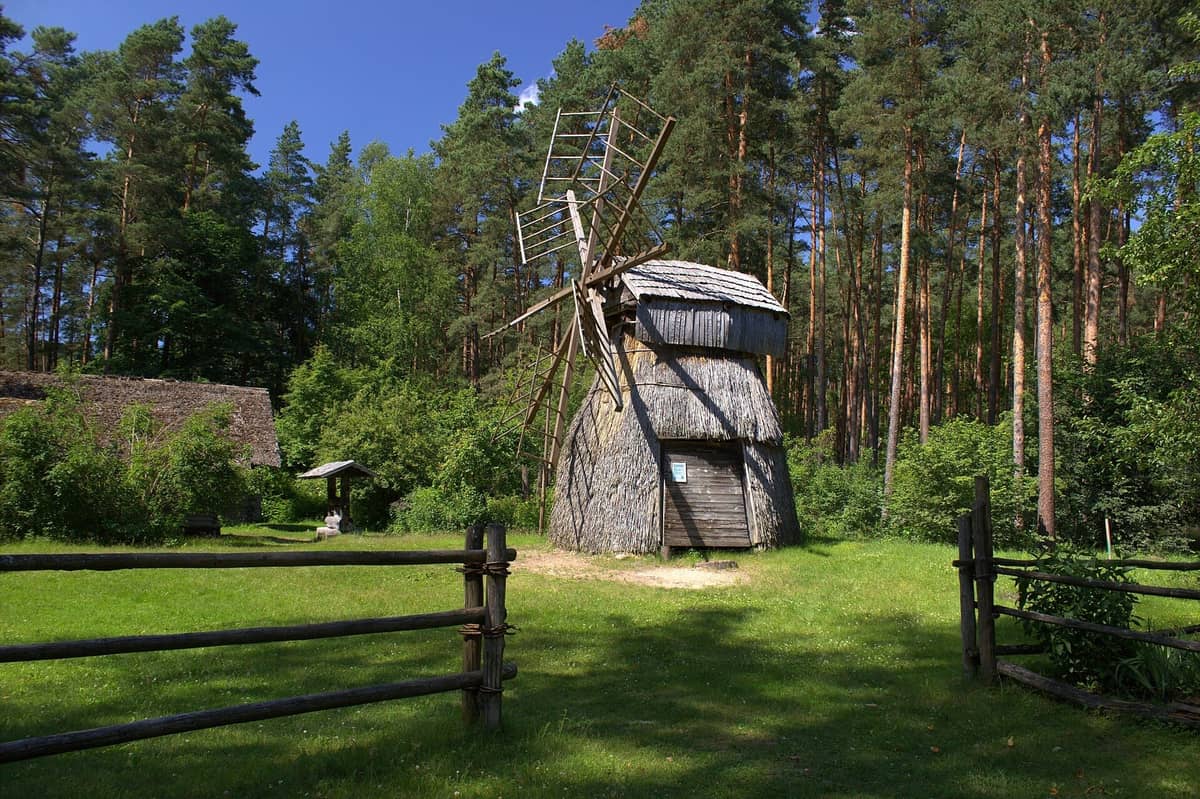
The windmills are among the most visually distinctive elements and easy to spot from a distance. Both post mills and Dutch-style smock mills appear in the collection, drawn from different regions. Some structures are left fully furnished, with period tools, textiles, and ceramic work in place. Others are presented as bare architecture, which can actually be more instructive for reading the spatial logic of the building.
The Kuldīga-region manor and the various Latgale Catholic and Lutheran chapels represent the social hierarchy of rural communities as much as the vernacular farmsteads. Walking between a labourer's one-room cottage and a prosperous farmer's compound 200 metres away communicates class difference more concretely than any written history.
If the architecture of the buildings sparks an interest in Riga's own built heritage, the city's Alberta iela Art Nouveau streetscape and the Art Nouveau Riga guide make a strong counterpart visit — urban versus rural, 20th century versus pre-industrial.
How the Experience Changes by Season
Summer (May through October) is when the museum operates at full capacity, with longer hours (10:00–18:00), craft demonstrations, and seasonal festivals. The Jāņi (Midsummer) celebrations held on-site around June 23 are among the most well-attended events in Latvia's cultural calendar. If you want the place to yourself, summer is actually the wrong time for a quiet visit — go in May before school trips begin, or on a weekday after 15:00.
Autumn brings a quieter, cooler version of the site. The deciduous trees around the lake turn, the visitor numbers drop significantly, and the buildings take on a more weathered, time-worn quality that suits their age. Shoulder season hours (daily 10:00–17:00 in April and October) still give plenty of time for a thorough visit.
Winter is underappreciated here. The museum is open from November through March, generally 10:00–16:00; from November through January it opens daily, while in February and March it is closed on Mondays. A thatched farmstead roof under snow, smoke rising from a chimney during a demonstration, the frozen lake visible through bare birches — it is a genuinely different experience, and crowds are minimal. Dress for prolonged outdoor exposure: a 3-hour winter walk on open paths in −10°C requires warm layers, waterproof boots, and gloves that allow camera operation.
ℹ️ Good to know
Opening hours are seasonal and subject to change. Always confirm current times at lebm.gov.lv before visiting, especially in shoulder months (April, October) or around public holidays.
Getting There and Practical Logistics
The museum is located at Brīvdabas iela 21, Rīga, LV-1024, roughly 30–40 minutes from the city centre by bus. City buses on routes serving the northeastern outskirts pass near the entrance; check Rīgas Satiksme's official journey planner (1188.lv) for current routes, as numbering and stops change periodically. A taxi or ride-hail from the centre costs more but saves navigation time, which may be worth it if you are combining the museum with other locations on the same day.
By car, follow Brīvības gatve northeast out of the city and follow signage toward the museum. Parking is available on site. Driving is practical if you are also planning to visit Jugla or areas further northeast along the same corridor.
For context on navigating Riga's public transport more broadly, the getting around Riga guide covers tram, trolleybus, and bus options with ticketing details.
Wear shoes suited for unpaved paths and occasional wooden steps. The site has a café or small food service during summer operation — confirm availability at the time of your visit, as hours and services vary. There is no large restaurant on site, so arriving well-fed or with snacks is sensible for a half-day visit. The entrance area has toilets; facilities within the museum grounds are limited.
Photography, Atmosphere, and Realistic Expectations
The Ethnographic Open-Air Museum of Latvia rewards patience more than any other attraction in the Riga region. The light through pine trees onto timber buildings is best in early morning and in the hour before closing, when the sun is low and shadows fall across carved woodwork. Midday light is flat and, on summer weekends, the paths can feel crowded around the most photogenic buildings.
Be honest with yourself about pace. Many visitors underestimate the site's scale and try to cover everything in 90 minutes, ending up rushing past the most interesting interiors. Two hours is a minimum for a genuine experience; four to five hours allows you to sit inside a farmstead, read the interpretive panels, and walk the lakeside section without feeling rushed.
The signage is available in Latvian and English throughout, with QR codes in some areas linking to additional information. Guided tours and educational programs can be booked in advance through the official site, and these are genuinely worth considering: a knowledgeable guide will unlock the logic of building arrangements and farming calendars in ways that the physical space alone cannot communicate.
If open-air historical sites appeal to you, the Riga region offers other meaningful stops: Salaspils Memorial and the Secret Soviet Bunker in Ligatne address very different chapters of Latvian history, but all three sites share that quality of history made spatial and physical rather than displayed behind glass.
💡 Local tip
The museum is not overhyped in the way that many city-centre attractions can be. It is, however, under-visited by international tourists who stick to the Old Town. If Latvian cultural history interests you at all, it justifies the journey.
Who Should Consider Skipping It
Visitors with very limited time in Riga (one full day or less) may find the 30-minute journey each way hard to justify against the density of attractions in the city centre and Old Town. The museum is most rewarding for people who are already interested in vernacular architecture, rural history, or Baltic culture. If you are in Riga primarily for the nightlife, the Art Nouveau streetscapes, or the food scene, there are higher-priority stops closer to the centre.
For a tighter Riga itinerary, the 2 days in Riga guide and the Riga Central Market offer a more condensed cross-section of Latvian life without leaving the urban core.
Visitors with significant mobility limitations should contact the museum before making the trip, since a large portion of the site involves uneven terrain that may not be fully navigable by wheelchair or for those who cannot manage gravel paths and wooden steps for extended periods.
Insider Tips
- The fishermen's homesteads near the lake are the least-visited section of the museum and often completely quiet even on busy summer days. Follow the path toward the water rather than staying on the main circuit.
- The museum hosts a major Jāņi (Midsummer) event around June 23 each year. The atmosphere is extraordinary, but it is not the day to visit if you want a contemplative experience — go the week before instead.
- If you are visiting in winter, call ahead or check the official site for special demonstration days when fires are lit in the rija ovens. The chance to experience a heated threshing barn in sub-zero temperatures is not something you can replicate anywhere else.
- Photography is best in the northeastern section of the site in the early afternoon, when the sun angles through the pines toward the lake. Bring a slightly longer lens if you want to compress the forest-and-farmstead compositions.
- A family ticket (1–2 adults with 1–4 children) at €14 makes this one of the better-value half-day options in Riga for families, especially compared to indoor museums of equivalent cultural depth.
Who Is Ethnographic Open-Air Museum of Latvia For?
- Travellers interested in Baltic and Latvian cultural history beyond the city centre
- Architecture enthusiasts drawn to vernacular and pre-industrial building traditions
- Families with children aged 8 and above who can manage a multi-hour outdoor walk
- Photographers seeking natural light, timber textures, and forest-framed rural compositions
- Visitors on longer stays (3+ days) who have already covered the Old Town highlights
Nearby Attractions
Combine your visit with:
- Āgenskalns Market
Āgenskalns Market (Āgenskalna tirgus) has anchored the left bank of the Daugava since 1898. Its architect-designed red-brick pavilion, restored in 2022, now blends a working food market with cafés, a bar, and a regular vintage and design market — all free to enter.
- Daugava River Promenade
The Daugava River Promenade stretches along the right bank of the Daugava from the edge of Old Town southward through the Ķengarags suburb. It is free, open around the clock, and offers some of the most unobstructed views of Riga's skyline, the wide river, and the left bank's quieter residential district. Whether you walk it at sunrise or cycle it on a summer evening, the promenade gives the city a different scale entirely.
- Kalnciema Quarter
A restored complex of 18th and 19th-century wooden buildings on the left bank of the Daugava, Kalnciema Quarter hosts a popular Saturday market, summer concerts, and independent cafés. It offers a quieter, residential counterweight to Old Town's stone and crowds.
- Mežaparks Forest Park
Mežaparks Forest Park is Riga's most expansive urban green space, stretching across a former garden city neighbourhood on the western shore of Lake Ķīšezers. Free to enter and open year-round, it combines dense pine forest, a landmark concert stage, and lakeside cycling paths within around 20–30 minutes of the city centre by tram.