Bastejkalns Park & the City Canal: Riga's Quiet Green Core
Bastejkalns Park, also known as Bastion Hill Park, wraps around the edge of Riga's Old Town along the historic City Canal. Formed on the site of demolished 19th-century fortifications, it offers terraced lawns, stone cascades, canal-side paths, and a rare pocket of calm within easy walking distance of the Freedom Monument and the Art Nouveau district.
Quick Facts
- Location
- Zigfrīda Annas Meierovica bulvāris, Centra rajons, Rīga, LV-1050 — adjacent to the City Canal on the northern edge of Old Town
- Getting There
- Stop 'Brīvības piemineklis' (buses 21, 3, 6, 9, 50, 316, 324) or 'Raiņa bulvāris' (buses 11, 2, 24)
- Time Needed
- 30–60 minutes for a leisurely loop; longer if you add a canal boat tour
- Cost
- Free, 24 hours daily, year-round
- Best for
- Morning walks, picnics, photography, a breathing space between Old Town sightseeing
- Official website
- www.liveriga.com/en/2989-bastion-hill
What Bastejkalns Park Actually Is
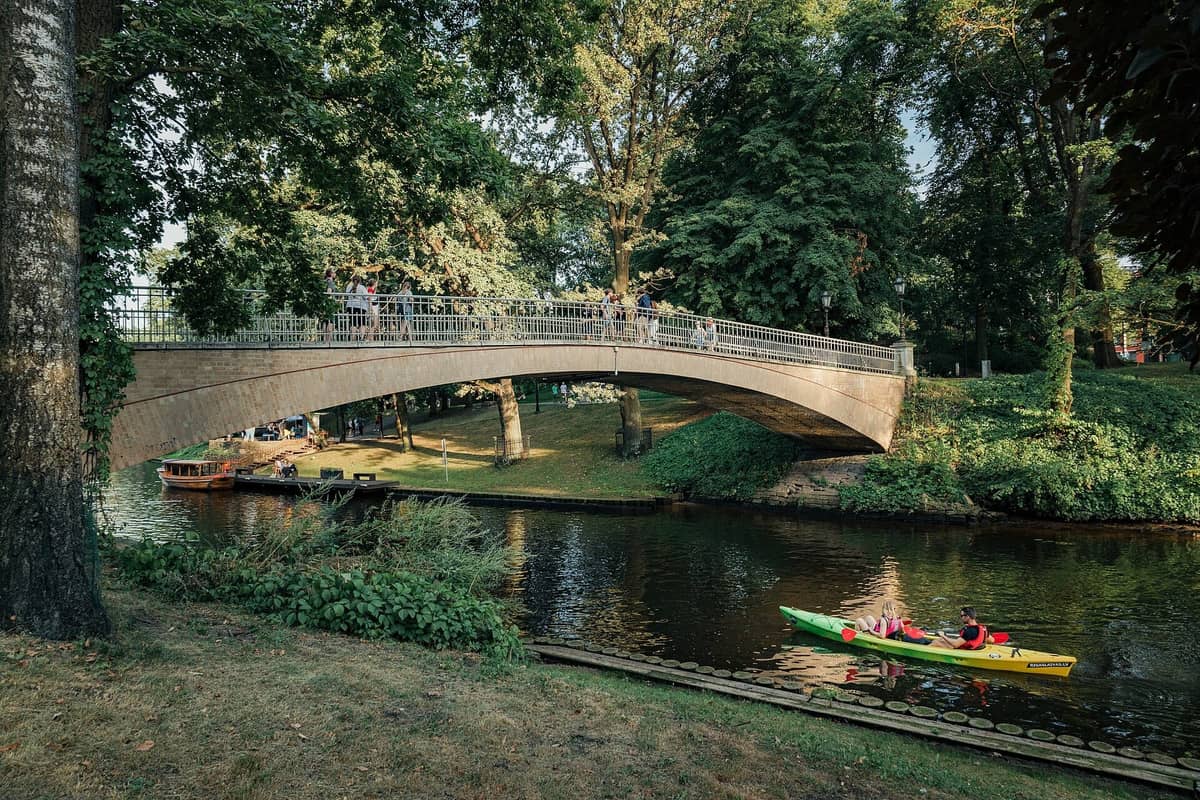
Bastejkalns Park, or Bastion Hill Park, is a long, narrow green corridor that curves along the outer edge of Riga's Old Town, following the Riga City Canal. It is not a grand botanical garden or a destination park in the theme-park sense. What it is, and what makes it genuinely useful for visitors, is a well-maintained urban greenway connecting some of Riga's most important landmarks by foot, free of traffic and tourist noise.
The park sits in Riga's central district, a short walk from the Freedom Monument, and forms part of a broader green belt that semi-encircles Vecrīga (Old Town) on its landward side. The Canal channels slow, dark water alongside lime tree alleys, stone bridges, and a series of small artificial cascades that murmur audibly on quiet mornings. It is exactly the kind of place a city needs: accessible, attractive enough to reward attention, and genuinely free.
💡 Local tip
The park is open 24 hours and free year-round. You need no ticket, no registration, and no advance planning. Simply enter from Basteja bulvāris, the boulevard running alongside it, or from the area near the Freedom Monument.
History: Fortifications, Demolition, and a Green Transformation
The park's unusual shape, a curving ridge with terraced slopes, is not natural. Historically, this ground was occupied by Riga's city bastions, earthwork fortifications built to protect the growing city. In the mid-19th century, when the military importance of these structures faded, the city authorities began demolishing the old ramparts and converting the land into a public park zone. The bastion mound, Bastejkalns, is a direct survivor of that landscape: the artificial hill is the former earthwork, reshaped and planted.
The City Canal itself follows the line of the former moat that ran along the outside of the fortification line. After the bastions came down, the moat was filled and the canal was constructed and integrated into the parkscape. The result is one of those rare urban transitions where the scars of old military infrastructure became something genuinely pleasant to walk through. The park's stone garden features, winding paths, and canal-side terraces were developed gradually through the 19th and 20th centuries, with the overall green belt concept maintained by the municipal parks authority, Rīgas Meži.
Bastejkalns sits just outside the boundary of Riga's UNESCO-listed historic centre, making it part of the natural approach to Riga's Old Town from the central boulevards. It connects the Freedom Monument end of the city to the National Opera and the broader park system extending toward Esplanade Park to the northeast.
Tickets & tours
Hand-picked options from our booking partner. Prices are indicative; availability and final rates are confirmed when you complete your booking.
Canal boat sightseeing tour in Riga
From 13 €Instant confirmationArt and culture walking tour of Riga with a local
From 66 €Instant confirmationFree cancellationSelf-guided discovery walk in Riga - the essential old town and its secrets
From 30 €Instant confirmationFree cancellationExclusive private guided tour of Riga's architecture with a local
From 175 €Instant confirmationFree cancellation
The Physical Experience: What You See and Hear
Entering from the Freedom Monument side, the park opens with a gentle slope down toward the Canal. The dominant sounds shift almost immediately: the traffic on Brīvības iela drops behind you, replaced by the soft run of water over the stone cascade steps and, depending on the season, birdsong from the mature lime and chestnut trees lining the paths. The canopy in summer is dense enough to cool the air noticeably.
The Canal path itself is flat and paved, suitable for walking at any pace. Small wooden and stone bridges cross the water at several points, giving views down the Canal that, in early morning light or in autumn, photograph exceptionally well. The water reflects the surrounding trees and, in certain conditions, the stone embankments give the scene something that might loosely be compared to a scaled-down version of city canal districts in other European capitals, though without the tourist-boat chaos.
The hill section of the park rises above the canal path and offers benches looking across the water toward the Old Town side. The terraces are mostly grass with stone retaining walls, and while the elevation is modest, the positioning above the water gives a layered sense of depth that makes it a useful photography spot. In winter, when the trees are bare, the stone architecture of the cathedral quarter on the far side of the canal becomes more visible from these terraces.
ℹ️ Good to know
The artificial cascade, a stepped stone water feature built into the park slope, is one of the distinctive elements. It feeds water from the hill level down to the Canal and can be heard before it is seen when approaching from the upper terraces. It is typically running except during maintenance periods or hard freezes.
Time of Day: How the Park Changes
Early mornings, from roughly 7am to 9am on weekdays, the park belongs almost entirely to locals: runners on the canal path, people walking dogs, the occasional office worker cutting through on a commute. The light on the water at this hour is worth setting an alarm for in summer, particularly in June and July when sunrise is early and the air has not yet warmed.
By mid-morning, visitors arriving from the Freedom Monument after checking it off their list start filtering through. The park becomes a natural transition corridor between the monument and the start of the Old Town walking circuit, and this function means it is rarely truly deserted but also rarely overwhelmed. There is a comfortable middle period between 10am and noon when both local and visitor density is moderate and the atmosphere is easy.
On warm summer evenings, the canal-side benches fill with couples and small groups, sometimes with cans from the convenience shops nearby. The park is legally accessible all night and the Canal path is lit well enough to feel safe, though it attracts a more mixed crowd after midnight. For families with children, late afternoon on a weekday is probably the most relaxed window.
⚠️ What to skip
In winter, the upper terraces and hill paths become slippery after frost or snowfall. The hill sections have uneven stone stairs. Wear shoes with grip if visiting between November and March.
Practical Walkthrough: How to Use the Park
The most efficient approach is to enter from the Freedom Monument end and follow the lower canal path northwest, crossing one of the small bridges and looping back via the upper terrace path. The full loop is under one kilometre but there are enough benches and viewpoints to extend the visit easily. Most visitors combine the park with a walk along Basteja bulvāris toward the Opera or toward the start of an Old Town route.
The park pairs naturally with a walk to the Freedom Monument immediately to the east, or with a route south toward the Latvian National Opera, which sits at the southwestern end of the canal green belt. It also connects on foot to Esplanade Park further north, making it part of a continuous green corridor that runs clear across the central city.
Canal boat tours operate from departure points near the park during warmer months. These short tours use the City Canal waterway and offer a different perspective on the green belt and the Old Town edges. Check locally for current operators and departure schedules, as these are seasonal and not managed by the park authority directly.
Accessibility is partial. The lower canal path is flat and paved, manageable for most mobility levels. The bastion hill section uses gravel paths and stone stairs with uneven surfaces, and the full terrace loop is not wheelchair-accessible. Visitors with limited mobility can still enjoy the lower canal path and the bridges without attempting the hill.
Photography and Seasonal Highlights
The park photographs differently in each season, and all four are worth experiencing if you are in Riga for more than a few days. Spring brings lime blossoms and the first greenery against the stone embankments; summer fills the canopy out and deepens the contrast between water and trees; autumn turns the lindens and chestnuts a clear yellow that reflects in the Canal; winter strips everything back and reveals the underlying geometry of the bridges and cascade stonework against snow or frost.
The Canal reflection shots from the bridges work best in low-angle morning light. For coverage of Riga's green spaces in the context of a broader trip, the complete things to do in Riga guide covers how Bastejkalns fits into a full itinerary. If you are planning a focused walk from the Freedom Monument through the Old Town, the Riga Old Town walking tour guide starts practically at the park's eastern edge.
The park is not overhyped in the way that some green spaces in European capitals become destination attractions in their own right. It is consistently well-reviewed by visitors not because it is spectacular, but because it delivers exactly what it promises: a clean, pleasant, free outdoor space with enough character to be memorable. Visitors hoping for botanical gardens, event spaces, or facilities beyond park benches and paths will need to look elsewhere.
Who Should Skip Bastejkalns
If your Riga visit is genuinely short, under 24 hours, and you are trying to reach the core architectural and historical landmarks quickly, the park can reasonably be appreciated as a route through rather than a destination. It rewards slower travel, and visitors on a tight itinerary who need to prioritise the Dome Cathedral, the House of the Blackheads, or the Art Nouveau streets on Alberta iela will find those experiences more immediately distinct to Riga.
Travellers specifically interested in Riga's urban parks system may prefer to also spend time at the larger Esplanade Park further along the same green corridor, which offers more open space and includes the Latvian National Museum of Art on its edge. Bastejkalns is the more intimate, historically layered option.
Insider Tips
- The stone cascade is on the eastern, Freedom Monument side of the hill. If you approach from the Opera side, you will walk the lower canal path first and miss it unless you climb the upper terrace. Head uphill early in your loop rather than at the end.
- The benches on the upper terrace face northeast across the Canal toward the Old Town edge. In late afternoon in summer, these are shaded and catch a breeze off the water, making them significantly cooler than the surrounding city streets.
- Canal boat tours are a genuinely different way to see the green belt. The departure point is typically near the Opera end of the canal system. Prices and operators change seasonally, so check locally rather than booking far in advance.
- The park's lime trees bloom in July and release a distinctly sweet smell that carries some distance. If you are in Riga in early-to-mid July, this is the atmospheric peak of the park in summer.
- At night, the lower canal path is lit and used by locals, but the upper hill paths are darker and less frequented after 10pm. Stick to the canal level after dark.
Who Is Bastejkalns Park & City Canal For?
- Travellers who want a calm, free outdoor break between Old Town sightseeing sessions
- Photographers looking for water reflections, autumn colour, or early morning light along a city canal
- Slow travellers and those spending three or more days in Riga who want to experience the city like a resident
- Families with children looking for a flat, safe outdoor walk without museum fatigue
- Anyone planning a walking route from the Freedom Monument toward the Opera or Esplanade Park
Nearby Attractions
Other things to see while in City Centre (Centrs):
- Esplanade Park
Stretching across 8.75 hectares in the heart of Riga, the Esplanāde is the city's most centrally located public park. Framed by grand streets and a cluster of significant landmarks, it offers a quiet, unhurried counterpoint to Old Town's crowds — and it's completely free.
- Freedom Monument
The Freedom Monument is the symbolic heart of Riga, a 42.7-metre granite and travertine column that has stood at the intersection of the Old Town and the main boulevard since 1935. Entry is free, access is around the clock, and the hourly changing of the guard adds a living ritual to what might otherwise be a static landmark.
- KGB Building (Corner House)
At the corner of Brīvības iela and Stabu iela stands a building that once made Riga's residents cross to the other side of the street. The Corner House served as the KGB's Latvian headquarters from 1940 to 1991, housing interrogation rooms, cells, and a bureaucracy of fear. Today it functions as a museum that documents Soviet occupation with unflinching honesty.
- Latvian Academy of Sciences Panorama Tower
The Panorama Riga observation deck crowns the Latvian Academy of Sciences, a Soviet-era Stalinist skyscraper completed in 1961. At roughly 65 metres above street level, the open-air circular terrace delivers unobstructed 360-degree views across Riga's rooftops, the Daugava River, and the Old Town spires. It is one of the most accessible and affordable high-level vantage points in central Riga.