Riga Castle (Rīgas pils): The 700-Year-Old Heart of Old Town
Riga Castle at Pils laukums 3 is one of the oldest continuously occupied buildings in the Baltic states. Serving simultaneously as the official residence of the President of Latvia and the home of the Latvian National Museum of History, it rewards visitors who understand what it is before they arrive.
Quick Facts
- Location
- Pils laukums 3, Old Town (Vecrīga), Riga
- Getting There
- 10-15 min walk from most of Old Town; multiple bus and tram routes serve the central district
- Time Needed
- 20–40 min for the exterior and riverfront; pre-arranged interior visits vary
- Cost
- Free (visits by prior arrangement through the President's Chancery; no admission fee charged)
- Best for
- History enthusiasts, architecture walkers, Daugava riverfront strollers
- Official website
- www.president.lv/en/riga-castle
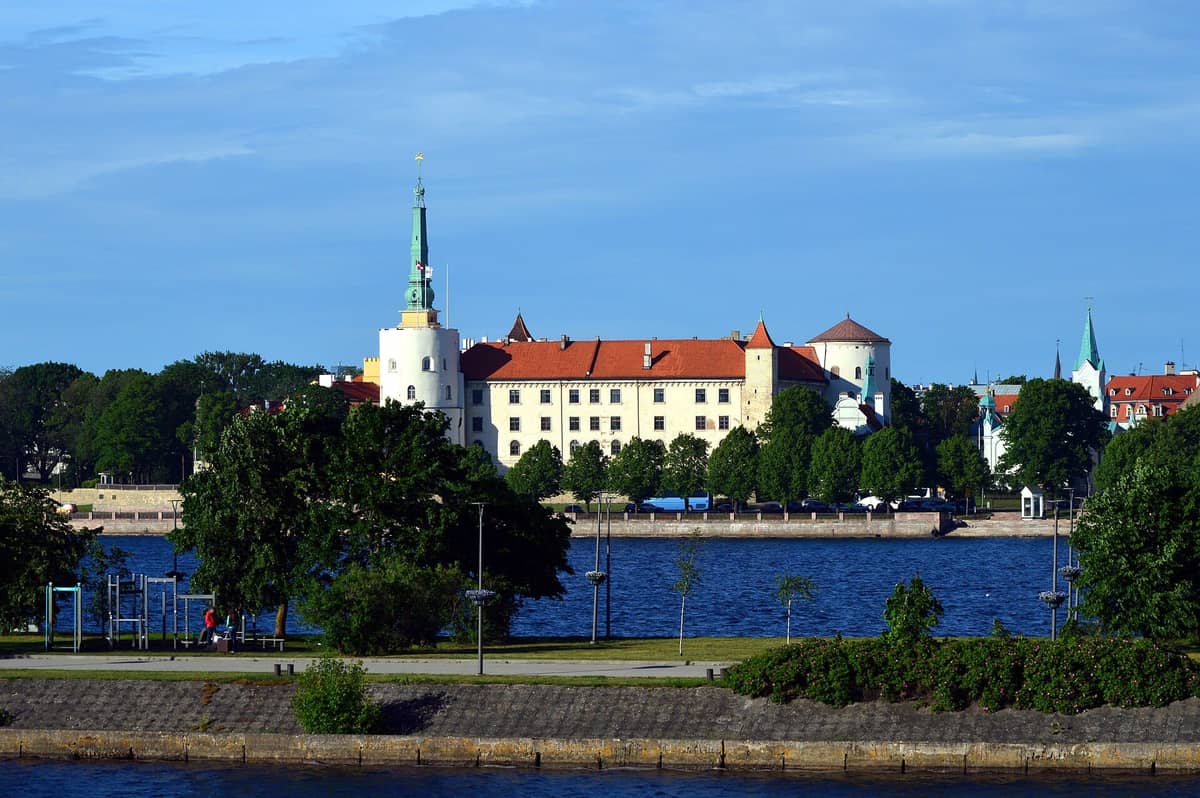
What Riga Castle Actually Is (And Why That Matters Before You Go)
Riga Castle, known in Latvian as Rīgas pils, is not a castle in the open-doors, audio-guide, gift-shop sense. It is a working seat of state. Since 1922, when the institution of the President of Latvia was founded, the building has served as the official residence of the President of Latvia. That means the interior is not available for spontaneous visits. If you arrive expecting to walk the halls, you will find a graceful white facade, a formal courtyard glimpsed through gates, and Presidential Guards in ceremonial uniform. And that is worth seeing on its own terms.
Individual visits and group tours must be arranged in advance through the President's Chancery. The Chancery also confirms that Riga Castle is closed for visits on weekends and public holidays. Interior access is free of charge when arranged, but the logistics require planning. The Latvian National Museum of History also has exhibitions at Riga Castle, though these are currently being set up and only exceptional open days are announced separately on the museum's own site.
⚠️ What to skip
Do not plan a drop-in interior visit. Riga Castle operates as an active presidential residence. Visits require advance coordination with the President's Chancery (president.lv/en/visit-riga-castle). Weekend and public holiday visits are not available.
Seven Centuries on the Daugava: The History Behind the Walls
The foundation stone of Riga Castle was laid on 15 June 1330, making this structure over 700 years old. It was originally built by the Livonian Order, the German crusading military order that controlled much of present-day Latvia and Estonia during the medieval period. The castle's location on the right bank of the River Daugava was deliberate: this was a strategic and commercial chokepoint, and the Order needed a fortress that could dominate both the river and the city they had come to rule.
The relationship between the Order and the city of Riga was contentious. Riga's citizens repeatedly resisted the Order's authority, and the castle itself was destroyed and rebuilt more than once as a result of these conflicts. The version standing today reflects centuries of reconstruction and modification, with the building taking on Renaissance and later additions over its medieval core. It is not a pristine example of any single architectural period, which makes it historically richer than a restored showpiece would be.
Since 1920, the castle has also housed the National History Museum collections, making it one of the few buildings in Europe that serves simultaneously as a presidential palace and a major historical institution. That dual role reflects the compressed, layered quality of Latvian national identity itself, where state symbols and historical memory occupy the same physical space.
Tickets & tours
Hand-picked options from our booking partner. Prices are indicative; availability and final rates are confirmed when you complete your booking.
Canal boat sightseeing tour in Riga
From 13 €Instant confirmationArt and culture walking tour of Riga with a local
From 66 €Instant confirmationFree cancellationSelf-guided discovery walk in Riga - the essential old town and its secrets
From 30 €Instant confirmationFree cancellationExclusive private guided tour of Riga's architecture with a local
From 175 €Instant confirmationFree cancellation
The Exterior Experience: What You See When You Arrive
The castle faces Pils laukums, a square that opens onto the Daugava riverfront. The white-rendered facade is formal and restrained, more administrative palace than romantic medieval fortress. There are no towers bristling with battlements visible from the square. What you get instead is a sense of quiet institutional authority, which is historically appropriate.
The changing of the Presidential Guard, when it occurs, draws a small crowd and provides a few minutes of ceremony worth watching. The ceremonial guards in formal uniform stand at the main entrance, and their presence makes clear this is no abandoned ruin or converted hotel. This is a live building, used daily by the Latvian state.
Walk around to the riverside and the atmosphere shifts. The Daugava is wide here, and the castle's position on its bank makes more sense in person than on a map. The river is genuinely large, roughly 300 to 400 metres across at this point, and the scale gives the castle's strategic logic an immediate clarity. On a clear day, the light off the water in the late afternoon is particularly good for photography, with the castle's pale walls picking up warm tones.
💡 Local tip
For the best photographs of the castle exterior, position yourself along the Daugava promenade in the late afternoon when the sun is low. The facade catches evening light well.
The Surrounding Area: Riga Castle Within Old Town
Riga Castle sits at the northern edge of Old Town (Vecrīga), just a few minutes on foot from the main cluster of medieval streets and landmarks. The Three Brothers, the oldest surviving residential complex in the city, is less than five minutes' walk to the southeast. The Swedish Gate, Riga's only remaining city gate from the 17th century, is also close by. This northwestern corner of Old Town is noticeably quieter than the area around Town Hall Square, and the streets around the castle see fewer tourist groups.
If you are doing a broader architectural circuit, the Old Town walking tour route logically includes the castle as a northern anchor point before looping back through the medieval core. The walk from the castle down along the riverfront toward the House of the Blackheads and Riga Town Hall Square is one of the more satisfying linear walks in the city, about 15 minutes at a relaxed pace.
How the Experience Changes by Time of Day
Riga Castle's immediate surroundings behave quite differently at different hours. Early morning, before 8am in summer, the square in front of the castle is almost empty. The light is soft and low, the Guards have not yet taken up their post in the same configuration as midday, and the walk along the riverbank has a calm that disappears later. This is the time for photography without crowds in the frame.
By mid-morning on weekdays, the area picks up with commuters and officials entering the Chancery. Small tour groups begin to arrive around 10am. By midday in summer, the square and riverfront promenade are lively with tourists, particularly those who have combined the castle visit with a walk from the Dome Cathedral area. The afternoon can feel crowded in July and August.
Evenings, especially in summer when it stays light until past 10pm, bring a different crowd: locals walking along the Daugava, cyclists on the riverfront path, and a more relaxed atmosphere overall. The castle itself goes quiet as an institution, but the setting is arguably at its most pleasant.
ℹ️ Good to know
In winter, the castle square and riverfront are far less busy, and the low Baltic sun creates sharp, atmospheric light in the early afternoon. If you are visiting Riga in colder months, the castle exterior can be appreciated almost in solitude.
Practical Information: Getting There and Planning Your Visit
The castle is at Pils laukums 3, in the northwestern corner of Old Town. From most points in central Riga, it is reachable on foot in 15 to 20 minutes. Multiple tram and bus routes serve the central district. No specific car parking is available at the castle, and driving into Old Town is restricted, so walking or public transport are the practical options.
For an interior visit, contact the President's Chancery directly through the official website at president.lv/en/visit-riga-castle. Visits are free, arranged in advance, and not available on weekends or public holidays. For the National History Museum exhibitions, check lnvm.gov.lv/en/riga-castle/ for any announced open days, as those exhibitions are currently in a setup phase.
The exterior can be visited at any time. There are no fences blocking the square or the riverside view. Accessibility details for any arranged interior visit should be confirmed directly with the Chancery when booking, as the official pages do not currently publish detailed step-free access information.
💡 Local tip
Wear comfortable walking shoes. The cobblestones around Pils laukums and the surrounding Old Town streets are uneven and can be slippery after rain. This applies to nearly all of Old Town, not just the castle area.
Insider Tips
- The Presidential Guard change at the main entrance is a small but photogenic ceremony. Ask locally or check with your accommodation about the current schedule, as it is not published on the official site.
- The Daugava riverfront path immediately beside the castle connects north toward the National Library and south toward the AB dam and the rest of the promenade. If you have time, follow it for 10 minutes in either direction to see how the city relates to its river.
- Weekday mornings between 9am and 10am are the calmest period for visiting the square and exterior, before tour groups arrive and while the light is still good from the east.
- If you are interested in the National History Museum collections, check lnvm.gov.lv for any announced exceptional open days at the castle, as the exhibitions are being reinstalled and access is irregular.
- The castle exterior is often quieter than the main Old Town cluster a few streets south. If you find Town Hall Square too busy, walking up to Pils laukums provides a noticeably calmer atmosphere while still being historically significant.
Who Is Riga Castle For?
- Architecture and history enthusiasts who want to understand how medieval, Renaissance, and modern state architecture layers onto a single building
- Photographers looking for good riverside compositions with strong historical context
- Walkers doing a full Old Town circuit who want to cover the northern end of Vecrīga
- Travelers interested in Baltic political history and how Latvia's post-independence institutions occupy its oldest spaces
- Those who prefer their sightseeing without crowds, since this corner of Old Town is consistently quieter than the central tourist core
Nearby Attractions
Other things to see while in Old Town (Vecrīga):
- Bremen Town Musicians Sculpture
Standing on Skārņu iela in Riga's medieval Old Town, this bronze sculpture of four stacked animals tells a Brothers Grimm story while carrying a quietly powerful political message about the end of the Iron Curtain. Cast in 1990 and gifted by the city of Bremen, it's free to visit, open around the clock, and one of the most photographed corners of Vecrīga.
- House of the Blackheads
Standing on Town Hall Square in Riga's Old Town, the House of the Blackheads is a reconstructed 14th-century guild hall with an ornate Dutch Renaissance facade that stops pedestrians cold. Behind the stone and gilded detail lies a layered story of medieval merchant culture, wartime destruction, and Latvian national pride.
- Museum of the Occupation of Latvia
Housed in the heart of Riga Old Town, the Museum of the Occupation of Latvia documents 51 years of Soviet and Nazi rule from 1940 to 1991. It is one of the most carefully assembled historical museums in the Baltic states, and a visit here fundamentally changes how you understand the country around you.
- Powder Tower & Latvian War Museum
The Powder Tower (Pulvertornis) is the sole surviving tower from Riga's medieval city walls, first recorded in 1330. Today it houses the Latvian War Museum, a free, well-curated institution spanning centuries of Baltic military history. It stands at the northern edge of Old Town, easy to find and easier to underestimate.