The Swedish Gate: Riga's Last Surviving City Gate
Built in 1698 and the sole remaining gate from Riga's original eight, the Swedish Gate (Zviedru vārti) is a narrow cobblestone arch through the Old Town city wall. Free to enter at any hour, it's one of the most historically loaded two seconds of walking you'll do in Latvia.
Quick Facts
- Location
- Torņa iela 11, Vecrīga (Old Town), Riga
- Getting There
- Bus or tram to 'Nacionālais teātris' stop, then a short walk into Old Town
- Time Needed
- 10–20 minutes at the gate; longer if combining with Powder Tower or Jacob's Barracks
- Cost
- Free, open 24 hours year-round
- Best for
- History lovers, architecture walkers, Old Town itineraries
- Official website
- www.liveriga.com/en/1595-swedish-gate
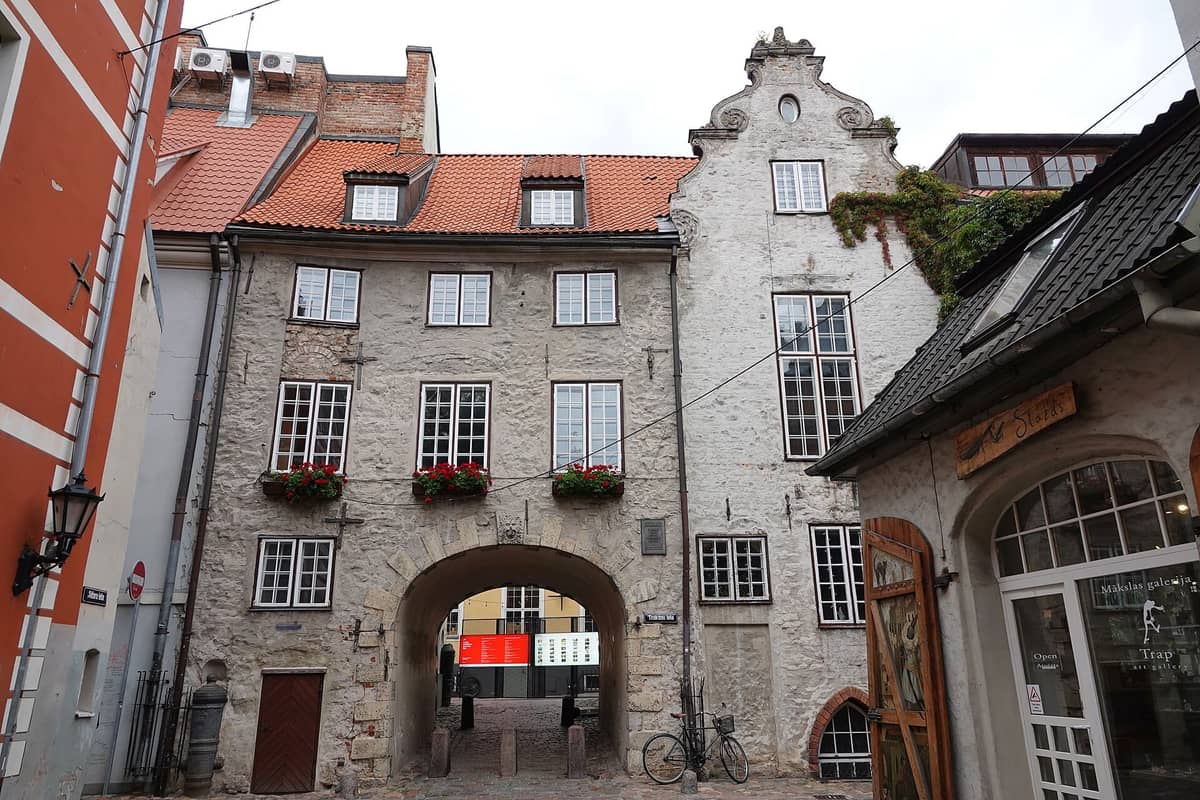
What the Swedish Gate Actually Is
The Swedish Gate, known in Latvian as Zviedru vārti, is a stone arch cut directly through Riga's medieval city wall on Torņa iela. Built in 1698, it was originally constructed to provide convenient passage from the inner city to barracks and residential buildings located just outside the fortifications. What makes it remarkable today is not grandeur but survival: it is the only gate remaining from the eight that once punctuated Riga's old defensive walls. The other seven were demolished over the centuries as the city expanded and the walls became inconvenient rather than protective.
The arch is not imposing in the way that gothic city gates elsewhere in Europe tend to be. It is modest in scale, a single barrel-vaulted opening barely wide enough for a car, framed by worn red brick and topped by a residential building that was incorporated into the wall's structure. The effect is quietly strange: you are walking through a living piece of 17th-century infrastructure that people still pass through daily, often without looking up.
💡 Local tip
The gate faces onto Torņa iela. To get the full architectural context, approach from the Old Town side first, then step through and immediately turn around for the best view of the arch against the wall.
Historical Context: Swedish Rule and the Riga City Wall
The gate's name reflects a crucial chapter in Riga's history. By 1698, when the gate was built, Riga was under Swedish rule, part of the Swedish Empire's Baltic territories. The city had been a significant military and commercial centre for decades, and the fortification walls were an active part of urban defence planning rather than a relic.
The wall itself predates the Swedish period, with medieval origins going back centuries, but the Swedes maintained and extended sections of it throughout their rule. Riga was captured by Russian forces under Peter the Great in 1710, ending the Swedish era, but the gate they built remained. That it survived subsequent Russian imperial redesign, two world wars, and Soviet urban planning is a minor miracle of architectural continuity.
The Swedish Gate sits at the northern edge of Old Town, close to two other remnants of Riga's fortification history: the Powder Tower, a 14th-century gunpowder store that now houses a war museum, and Jacob's Barracks, a long, low Swedish-era military building now converted into shops and restaurants. Together, these three structures give a concentrated picture of the city's defensive past in a single short stretch of street.
Tickets & tours
Hand-picked options from our booking partner. Prices are indicative; availability and final rates are confirmed when you complete your booking.
Canal boat sightseeing tour in Riga
From 13 €Instant confirmationArt and culture walking tour of Riga with a local
From 66 €Instant confirmationFree cancellationSelf-guided discovery walk in Riga - the essential old town and its secrets
From 30 €Instant confirmationFree cancellationExclusive private guided tour of Riga's architecture with a local
From 175 €Instant confirmationFree cancellation
The Experience: Walking Through the Gate
The physical act of passing through the Swedish Gate takes only a few seconds, but the sensory shift is noticeable. The cobblestones underfoot are original and uneven, worn smooth in the centre by centuries of foot traffic. The walls of the arch are close enough that you could touch both sides simultaneously. There is a slight drop in temperature as you pass through, the stone holding cool air even on warm afternoons, and sound changes too: the ambient noise of Torņa iela muffles briefly before opening again on the other side.
The gate is incorporated into a residential building that spans the top of the arch. Locals live above it. On mornings when windows are open, you might hear a radio or smell coffee from the apartments overhead, which creates an odd domestic intimacy for a medieval structure. This is not a preserved monument behind glass. It is a working part of the neighbourhood.
ℹ️ Good to know
According to local legend, any unmarried woman who passes through the gate on the night of Jāņi (Midsummer, June 23–24) will find a husband within the year. Whether or not you believe it, it makes for a good story to tell while you're standing there.
When to Visit and How the Gate Changes Through the Day
The Swedish Gate is now open and accessible at every hour of every day, with no ticket, no queue, and no closing time. That means your choice of when to visit is entirely about atmosphere and photography rather than logistics.
Early morning, between around 7 and 9 am, is the calmest window. The tour groups that fill Old Town by mid-morning have not yet arrived, and the light from the east angles along Torņa iela in a way that picks out the texture of the stonework. In summer, this gives you genuinely beautiful conditions for photography without other visitors stepping into frame. Midday in peak season brings steady foot traffic and occasional tour group clusters, which can make lingering feel awkward in such a narrow space.
Evening visits have their own quality. The gate is not dramatically lit at night, but the surrounding streetlights cast a warm tone on the brick, and the quiet of a weeknight in Old Town lets you actually hear the gate rather than just see it. Rain changes things again: the cobblestones darken, the stonework shows more colour variation, and the whole stretch of Torņa iela takes on a reflective quality that rewards a slow walk.
💡 Local tip
For photography, a slightly overcast day diffuses shadows inside the arch and gives even exposure across the stonework. Bright midday sun creates strong contrast that can blow out detail in the brighter stone sections.
Practical Walkthrough: Getting There and Getting the Most Out of It
The gate is located at Torņa iela 11 in Vecrīga, Riga's Old Town. The closest public transit stop is 'Nacionālais teātris', served by several bus and tram lines. From there, the walk into Old Town takes around 10 minutes on foot. If you are already exploring Old Town, the gate is near the northern edge and fits naturally into a circuit that includes the Powder Tower to the west and the broader network of medieval streets to the south.
The Swedish Gate works well as one stop on a longer Old Town walk rather than a standalone destination. A practical route pairs it with the Powder Tower, Jacob's Barracks, and then continues south toward Riga Town Hall Square and the House of the Blackheads. Budget around two to three hours for that full circuit at a relaxed pace.
Footwear matters more here than at most city attractions. The cobblestones on Torņa iela and through the gate itself are genuinely uneven and can be slippery when wet. Flat, rubber-soled shoes are strongly preferable over heels or smooth leather soles. Wheelchair users and visitors with mobility limitations should be aware that the cobbled surface through and around the gate is not smoothed or ramped, which may make passage difficult.
Practical Assessment: Is It Worth Your Time?
The Swedish Gate is not a destination in itself. It does not take an hour to experience, and there is no interior to explore, no exhibit to read, and no guided tour required. Visitors expecting a grand monumental gateway in the style of, say, Brandenburg Gate will be underwhelmed. What it offers instead is specificity: a precise, dated, authenticated fragment of a city's fortification history that you can stand inside.
For travellers who find meaning in that kind of physical continuity with the past, the gate delivers well above its footprint. For those primarily interested in Old Town's major sights and not drawn to architectural fragments, it is easily passed through without stopping and still appreciated as part of the street texture of Vecrīga.
If you are building an itinerary, the gate pairs naturally with a broader exploration of Riga's Old Town. It also fits into the Old Town walking tour without adding meaningful time to your route, since you are likely to walk past it anyway.
Those doing a free day in the city will find this fits naturally into a no-cost morning: the gate, the exterior of the Powder Tower, and a walk through the medieval street grid cost nothing. See our guide to free things to do in Riga for a broader itinerary built around this approach.
Insider Tips
- Stand still inside the arch for a moment and look up: the keystone and barrel vault are original 17th-century masonry, and the wear patterns on the stone tell the story of three centuries of daily use better than any information board.
- The building directly above the gate arch is residential. Do not ring doorbells or attempt to access the stairwell. The gate itself is public; the building is not.
- Jacob's Barracks, the long yellow building running alongside Torņa iela just past the gate, is worth a slow walk along its length. It is one of the best-preserved Swedish military structures in the Baltic and is often overlooked in favour of the gate itself.
- If you visit during Jāņi (Latvian Midsummer, June 23–24), the area around the gate sees local celebration and the legendary significance of the gate gets retold widely. It is a good time to hear Old Town residents talk about the city's folklore.
- Combine the gate with the Powder Tower immediately to the west, which houses the Latvian War Museum. Entry to the museum's permanent collection is free, making it an excellent companion stop for history-focused visitors.
Who Is The Swedish Gate For?
- History and architecture travellers building a medieval Riga itinerary
- Photographers looking for textured, atmospheric urban details in morning light
- Budget travellers and those doing a free Old Town walking day
- Visitors interested in Baltic and Northern European history under Swedish rule
- Travellers with limited time who want to cover Old Town's key historic markers efficiently
Nearby Attractions
Other things to see while in Old Town (Vecrīga):
- Bremen Town Musicians Sculpture
Standing on Skārņu iela in Riga's medieval Old Town, this bronze sculpture of four stacked animals tells a Brothers Grimm story while carrying a quietly powerful political message about the end of the Iron Curtain. Cast in 1990 and gifted by the city of Bremen, it's free to visit, open around the clock, and one of the most photographed corners of Vecrīga.
- House of the Blackheads
Standing on Town Hall Square in Riga's Old Town, the House of the Blackheads is a reconstructed 14th-century guild hall with an ornate Dutch Renaissance facade that stops pedestrians cold. Behind the stone and gilded detail lies a layered story of medieval merchant culture, wartime destruction, and Latvian national pride.
- Museum of the Occupation of Latvia
Housed in the heart of Riga Old Town, the Museum of the Occupation of Latvia documents 51 years of Soviet and Nazi rule from 1940 to 1991. It is one of the most carefully assembled historical museums in the Baltic states, and a visit here fundamentally changes how you understand the country around you.
- Powder Tower & Latvian War Museum
The Powder Tower (Pulvertornis) is the sole surviving tower from Riga's medieval city walls, first recorded in 1330. Today it houses the Latvian War Museum, a free, well-curated institution spanning centuries of Baltic military history. It stands at the northern edge of Old Town, easy to find and easier to underestimate.