Bremen Town Musicians Sculpture: Riga's Iron Curtain-Era Gift from Bremen
Standing on Skārņu iela in Riga's medieval Old Town, this bronze sculpture of four stacked animals tells a Brothers Grimm story while carrying a quietly powerful political message about the end of the Iron Curtain. Cast in 1990 and gifted by the city of Bremen, it's free to visit, open around the clock, and one of the most photographed corners of Vecrīga.
Quick Facts
- Location
- Skārņu iela, Old Town (Vecrīga), Riga
- Getting There
- Old Town / Pēterbaznīcas iela bus stops; easily walkable from central Riga
- Time Needed
- 10–20 minutes
- Cost
- Free, no ticket required
- Best for
- History lovers, families, photography, casual Old Town walks
What You're Looking At
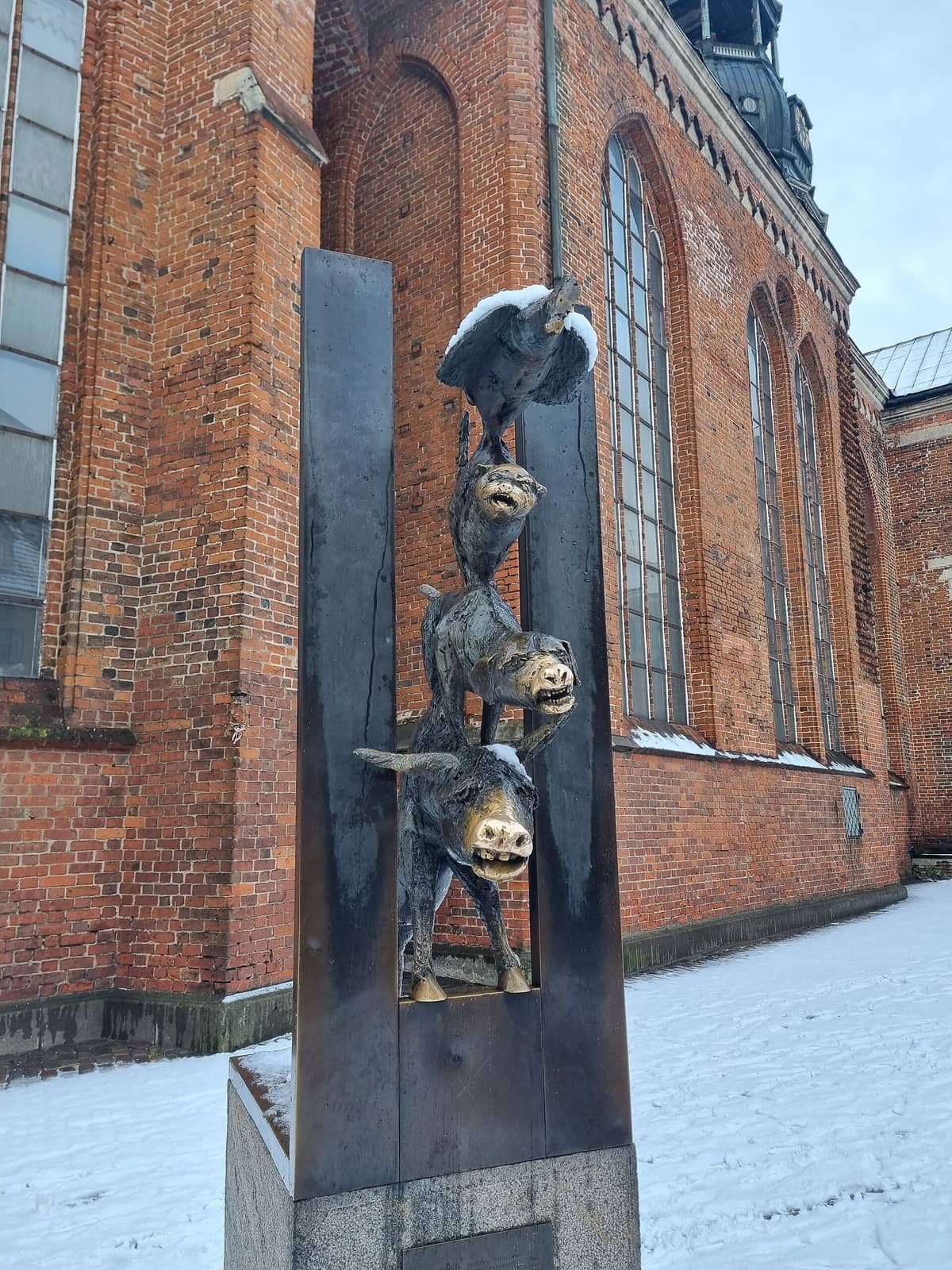
The Bremen Town Musicians sculpture on Skārņu iela is a bronze casting of four animals arranged in a precarious tower: a donkey carries a dog on its back, a cat perches above the dog, and a rooster crowns the whole composition. Each animal faces slightly outward, alert, mid-motion. The group stands roughly life-size, dark with age and polished bright at the spots where thousands of hands have touched it. The worn patches at the donkey's front hooves and the cat's paws are the first thing you notice up close.
Created in 1990 by Bremen sculptor Christa Baumgärtel, the piece was presented to Riga by the city of Bremen as a gesture of partnership between the two cities. On the surface it illustrates the Brothers Grimm fairy tale 'Town Musicians of Bremen', in which four aging animals abandoned by their owners set off to make a new life as street musicians. But the timing of this particular version is not coincidental. Unveiled in the transformative period at the end of Soviet rule in Latvia, the sculpture incorporates a symbolic gap in what is clearly meant to represent the Iron Curtain, through which the animals appear to peer. That detail transforms what might otherwise be a charming decorative piece into a small monument to the end of an era.
ℹ️ Good to know
The sculpture is accessible 24 hours a day, every day of the year. There is no entrance fee, no gate, and no queue. It sits directly on the pedestrian street, about 30 seconds' walk north of the main entrance to St. Peter's Church.
How It Fits Into the Surrounding Old Town
Skārņu iela is one of the quieter pedestrian lanes threading through Riga's Old Town, and the sculpture sits against a backdrop of low stone walls and the rounded apse of St. Peter's Church rising behind it. The placement is deliberate. The wall behind the animals references the medieval convent complex that once occupied this corner of the city, and the narrow lane keeps the scale intimate rather than grand.
The sculpture is a short walk from several of Old Town's heaviest-traffic landmarks. The House of the Blackheads is roughly five minutes on foot to the northwest. Riga Town Hall Square is even closer. This means Skārņu iela sees steady tourist foot traffic throughout the day, but the lane itself rarely feels crowded in the way the main squares do.
Tickets & tours
Hand-picked options from our booking partner. Prices are indicative; availability and final rates are confirmed when you complete your booking.
Art and culture walking tour of Riga with a local
From 66 €Instant confirmationFree cancellationSelf-guided discovery walk in Riga - the essential old town and its secrets
From 30 €Instant confirmationFree cancellationRiga 24 or 48-hour hop-on hop-off sightseeing bus tour
From 0 €Instant confirmationFree cancellationRiga 24 or 48-hour hop-on hop-off sightseeing bus tour
From 0 €Instant confirmationFree cancellation
Morning, Afternoon, and Evening: How the Experience Changes
Early morning, from roughly 7am to 9am, is the least visited window. The cobblestones on Skārņu iela are often still damp from overnight rain or morning dew, and the light at that hour falls sideways across the bronze surface, catching every texture in the casting. At this time you can examine the sculpture without competition from other visitors, and the lane smells faintly of the stone and old timber that defines this part of Riga's medieval core.
Midday brings the largest crowds, particularly in summer between June and August when tour groups move through Old Town in steady rotation. The sculpture becomes a congregation point: people take turns standing beside the donkey, and there is usually a short informal queue for photos from roughly 11am to 3pm. If you are visiting primarily to photograph the piece without people in the frame, this is not your window.
Evening visits, especially after 7pm in summer, offer a useful compromise: fewer tour groups, warmer ambient light, and the Old Town streetlamps beginning to illuminate the bronze from below. In winter the days are short, so evening visits after 4pm occur in near-darkness, which creates a different and more atmospheric experience but makes detail photography difficult without additional light.
💡 Local tip
For unobstructed photos, arrive before 9am in summer or on a weekday morning in shoulder season (May or September). The best angle is from slightly northeast of the sculpture, which frames it against the apse of St. Peter's Church.
The Story Behind the Gift: Bremen and Riga as Twin Cities
Bremen and Riga established a formal twin-city relationship that made the gift of this sculpture a deliberate diplomatic and cultural act. Bremen itself is historically associated with the Brothers Grimm tale, which is set in and around that city, and Bremen has placed versions of this same sculpture in several of its twin cities around the world. The Riga version is not a direct copy of the famous original in Bremen's city centre, however. Christa Baumgärtel's design for Riga introduced the Iron Curtain motif specifically for this location, giving the piece its own identity rooted in Baltic context.
The year 1990 matters. Latvia declared the restoration of its independence on May 4, 1990. The sculpture arrived as that process was underway, making it simultaneously a fairy tale illustration and an artifact of one of the most significant political moments in modern European history. For visitors with an interest in how the late Soviet period and the end of the Iron Curtain shaped Latvia's cultural landscape, this small sculpture is more layered than it first appears.
If that context interests you, the Museum of the Occupation of Latvia is a ten-minute walk away and provides the broader historical framework in considerable depth. The Soviet history trail through Riga is a useful companion itinerary if the Cold War dimension of the sculpture is what draws you here.
Practical Walkthrough: Getting There and Getting the Most Out of It
The sculpture is easiest to reach on foot from anywhere in the Old Town. From the central market area or from Rātslaukums (Town Hall Square), head toward St. Peter's Church and follow Skārņu iela east along the church's south flank. The sculpture appears on your left, set against the wall.
If arriving by public transport, the nearest bus stops serving the Old Town perimeter are around Pēterbaznīcas iela. From there it is a three to four minute walk into the pedestrian zone. Much of the Old Town is reserved for pedestrians, with restricted vehicle access, so driving directly to the sculpture is not an option for most visitors. Tram lines on the outer ring of the Old Town bring you to within a five-minute walk.
Wear comfortable flat shoes. The cobblestone surface on Skārņu iela is uneven in places, particularly the older sections near the convent wall. Wheelchair access is possible along the route, though the cobbles require care. There are no steps or barriers at the sculpture itself.
⚠️ What to skip
In winter, cobblestones in Old Town can become icy and slippery. Take this seriously: wear grippy footwear and walk slowly on the narrower lanes around Skārņu iela between November and March.
Is This Worth Your Time?
Honestly: if you are already walking between St. Peter's Church and the medieval convent area, the sculpture costs you nothing extra and takes only a few minutes. The Iron Curtain detail is genuinely interesting if you pause to look for it rather than just photographing the animals and moving on. At that level, yes, it earns its place on an Old Town walk.
If you are making a dedicated trip specifically for this sculpture, scale your expectations. It is a single statue on a pedestrian lane, not an expansive site. Visitors looking for immersive cultural experiences will want to pair it with St. Peter's Church directly behind it, or continue east toward the Swedish Gate and the medieval street network that surrounds it.
Travelers who find public sculpture generally unremarkable, or who are short on time and need to prioritize, might reasonably skip it. But if you are following an Old Town walking itinerary, it fits naturally into any route that passes St. Peter's Church, adding context without demanding significant time.
Photography Notes
The sculpture is roughly life-size, which means a standard smartphone held at arm's length captures the full composition comfortably. The best full-length shot requires stepping back about four to five meters, which is possible on the lane when it is not crowded. The bronze oxidization creates a dark, matte surface that responds well to soft overcast light: the common grey Riga sky is actually useful here, reducing harsh shadows between the stacked animals.
For detail shots of the Iron Curtain motif, look at the base and middle section of the composition where the symbolic gap is incorporated into the design. This is the most easily overlooked element and also the most photographically interesting for anyone who knows what it represents.
Insider Tips
- Look specifically for the Iron Curtain gap worked into the base of the composition. Most visitors photograph the animals and leave without noticing it, but it is the detail that gives the sculpture its political weight.
- The best morning light hits the sculpture from the east, so arrive early on a clear day and position yourself slightly northeast of the piece with St. Peter's Church apse in the background.
- Combine this stop with the interior of St. Peter's Church immediately behind it. The church tower offers one of the best elevated views over Old Town rooftops, and the two visits together take under an hour.
- If you touch the donkey's front hooves, you are joining a local tradition said to bring good luck. The hooves are visibly polished compared to the rest of the bronze, which tells you how many people have done this before you.
- Visit on a weekday rather than a Saturday or Sunday in summer. Weekend tour group density in this corner of Old Town is notably higher, and the lane is narrow enough that a single group can block the entire sight line.
Who Is Bremen Town Musicians Sculpture For?
- Travelers with an interest in Cold War history and Baltic independence who want context beyond museums
- Families with children who know the Brothers Grimm story and will enjoy the tactile, interactive nature of the sculpture
- Photographers looking for an architecturally interesting backdrop combining medieval stonework and public art
- Anyone following a self-guided Old Town walking route who wants to understand the symbolic layers of Riga's public spaces
- Budget travelers: this is entirely free and requires no advance planning
Nearby Attractions
Other things to see while in Old Town (Vecrīga):
- House of the Blackheads
Standing on Town Hall Square in Riga's Old Town, the House of the Blackheads is a reconstructed 14th-century guild hall with an ornate Dutch Renaissance facade that stops pedestrians cold. Behind the stone and gilded detail lies a layered story of medieval merchant culture, wartime destruction, and Latvian national pride.
- Museum of the Occupation of Latvia
Housed in the heart of Riga Old Town, the Museum of the Occupation of Latvia documents 51 years of Soviet and Nazi rule from 1940 to 1991. It is one of the most carefully assembled historical museums in the Baltic states, and a visit here fundamentally changes how you understand the country around you.
- Powder Tower & Latvian War Museum
The Powder Tower (Pulvertornis) is the sole surviving tower from Riga's medieval city walls, first recorded in 1330. Today it houses the Latvian War Museum, a free, well-curated institution spanning centuries of Baltic military history. It stands at the northern edge of Old Town, easy to find and easier to underestimate.
- Riga Castle
Riga Castle at Pils laukums 3 is one of the oldest continuously occupied buildings in the Baltic states. Serving simultaneously as the official residence of the President of Latvia and the home of the Latvian National Museum of History, it rewards visitors who understand what it is before they arrive.