The Panthéon, Paris: Inside France's Temple of Immortals
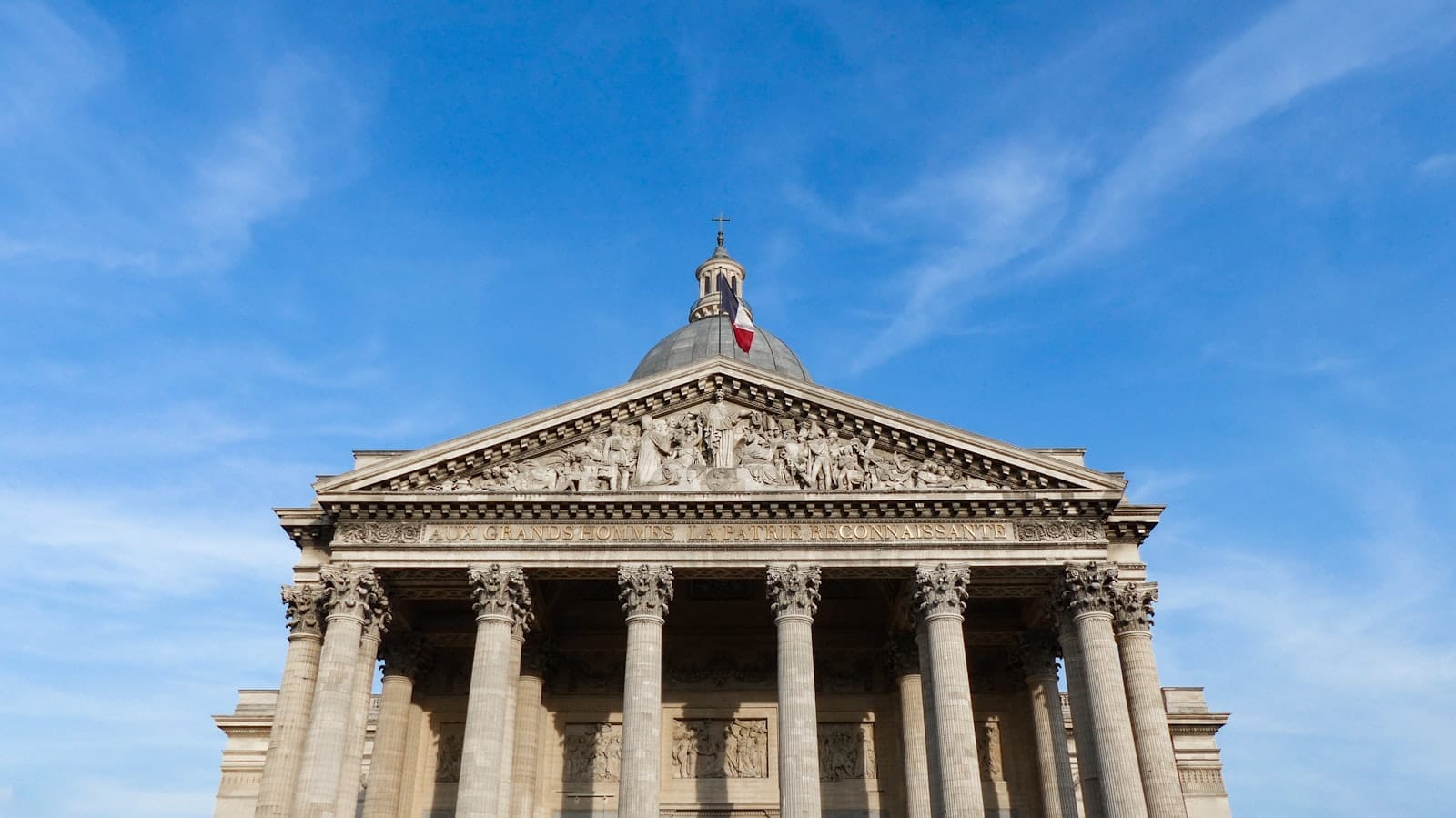
Rising above the Latin Quarter on the Sainte-Geneviève hill, the Panthéon is France's secular mausoleum for its greatest thinkers, writers, and scientists. Beneath its vast neoclassical dome, the crypt holds figures from Voltaire and Rousseau to Marie Curie and Joséphine Baker. It is a working monument where the past is present, and where the architecture alone earns the entrance fee.
Quick Facts
- Location
- Place du Panthéon, 75005 Paris (Latin Quarter, 5th arrondissement)
- Getting There
- Métro Place Monge (Line 7) or Cardinal Lemoine (Line 10) or RER B Luxembourg; Bus 21, 27, 38, 84, 85, 89 (Panthéon stop)
- Time Needed
- 1.5 to 2 hours (add 45 min for colonnade panorama, April–October)
- Cost
- €13 (adult, 2026); free for under-18s; free for EU residents under 26; dome supplement extra (April–October, weather permitting)
- Best for
- History lovers, architecture enthusiasts, literature and science fans
- Official website
- www.paris-pantheon.fr/en
What the Panthéon Actually Is
The Panthéon stands on the highest point of the Left Bank, its Greek-columned facade and 83-metre dome visible from much of central Paris. It is not a church, not a museum, and not quite a memorial park. It occupies a category of its own: a secular temple commissioned under the monarchy, repurposed by the Revolution as a mausoleum, briefly returned to the Church, and finally committed to the Republic in 1885. Today it is the official resting place of more than 80 individuals whom France has judged essential to its identity, including some of the sharpest minds the Western world has produced. If you are exploring the Saint-Germain-des-Prés and Latin Quarter area, it is the most intellectually serious stop on any itinerary.
Construction began in 1757 under architect Jacques-Germain Soufflot, who was commissioned by Louis XV to build a grand church dedicated to Sainte-Geneviève, the patron saint of Paris. The building was completed in 1790, just in time for the Revolution to transform its purpose entirely. The windows were bricked up to create a suitably sombre atmosphere, the steeple was removed, and in 1791 the crypt received its first resident: Honoré Mirabeau, the revolutionary orator. Voltaire followed days later. The inscription above the entrance, carved into the stone pediment, says it plainly: 'Aux grands hommes, la Patrie reconnaissante' — To great men, the grateful homeland.
ℹ️ Good to know
The Panthéon is closed on 1 January, 1 May, and 25 December. On the first working Monday of each month, it opens at noon instead of 10 AM. Last admission is 45 minutes before closing.
The Architecture: Soufflot's Neoclassical Masterpiece
Soufflot drew directly from the Pantheon in Rome and from St Paul's Cathedral in London, but what he built was something distinctly French in its rational clarity. The Greek-cross plan, the shallow coffered dome, and the enormous colonnaded portico were radical departures from the heavier Baroque style still dominant at the time. Walking through the entrance and into the nave, the scale hits immediately: the space runs 110 metres long, 84 metres wide, and the interior dome rises more than 80 metres overhead. The stone is pale limestone, the light diffuse, and on quiet mornings in particular the silence absorbs every sound.
The walls and pendentives are covered in large-scale murals commissioned during the 19th century, including Puvis de Chavannes's celebrated series depicting the life of Sainte-Geneviève. These occupy the nave with considerable presence — their muted tones and archaic figures give the interior something of an early Renaissance quality, even though they date from the 1870s and 1880s. Look up into the dome itself and you will see a smaller, gilded composition that rewards the neck strain.
💡 Local tip
Photography tip: The nave photographs best in the late morning when natural light from the high windows reaches the floor. Avoid wide-angle lenses on the murals — the distortion is unflattering.
Tickets & tours
Hand-picked options from our booking partner. Prices are indicative; availability and final rates are confirmed when you complete your booking.
Entrance tickets to Paris' Pantheon
From 14 €Instant confirmationParis Essential dinner cruise at 6.15pm
From 99 €Instant confirmationFree cancellationBest of Paris city tour with Eiffel Tower lunch and Seine cruise
From 144 €Instant confirmationFree cancellationBest of Paris guided bike tour
From 45 €Instant confirmationFree cancellation
Foucault's Pendulum: The Centre of Attention
Suspended from the apex of the dome by a 67-metre wire, the copy of Léon Foucault's pendulum swings steadily in the middle of the nave. The original experiment was conducted here in 1851, when Foucault used the building's enormous height to demonstrate, for the first time in a public setting, that the Earth rotates on its own axis. A 28-kilogram brass bob traces its arc across a sand-filled circle on the floor, and the plane of its swing appears to rotate slowly over the course of the day — though it is the Earth that moves, not the pendulum.
Visitors cluster around it at any hour, reading the explanation panels and watching the bob push through the sand. It is one of the few scientific demonstrations in Paris that requires no digital screen or interactive exhibit. The effect is quiet and profound: a piece of equipment proving the rotation of the planet, hanging in a building that once tried to be a church. Children often find it hypnotic. So do adults who allow themselves to watch long enough.
The Crypt: Who Is Down There and Why It Matters
Descend the stairs to the crypt and the atmosphere changes. The vaulted corridors are cool and dim, the stone underfoot worn smooth, and the sarcophagi are arranged in side chambers off the main passageway. The scale is unexpectedly intimate. You are walking through a grid of rooms that hold, among others: Voltaire and Rousseau, enemies in life, neighbours in death; Victor Hugo and Émile Zola, brought here within two years of each other; Pierre and Marie Curie, the latter being the first woman interred in the Panthéon on her own merits, in 1995; and Joséphine Baker, the American-born dancer and French Resistance spy, symbolically inducted in 2021 (her remains stayed in Monaco at her family's request).
The criteria for entry have shifted over time. During the Napoleonic era, the Panthéon housed the remains of French and allied foreign figures alike. Today, French citizenship is required, and the decision requires a presidential decree. This makes each new interment a national event, typically preceded by months of public debate. The most recent additions include Simone Veil, the Holocaust survivor and author of France's abortion rights law, who entered in 2018 alongside her husband.
If the density of literary history here intrigues you, the Musée Carnavalet nearby covers the full sweep of Parisian history and puts many of these figures into biographical context.
The Colonnade Panorama: A View Worth the Extra Ticket
Between April and October, visitors can pay a supplement of €3 to access the exterior colonnade that wraps around the base of the dome. The climb involves a winding staircase of several hundred steps through the building's internal structure — tight in places, with low clearance on some landings. The reward is a 360-degree view from one of the highest vantage points on the Left Bank: the Luxembourg Gardens directly to the south, the Eiffel Tower to the west, Notre-Dame and the Île de la Cité to the north, and the Sacré-Cœur dome crowning Montmartre on the horizon.
The colonnade is not the tallest view in Paris (that distinction belongs to the Montparnasse Tower and the Eiffel Tower itself), but it is arguably the most architecturally satisfying, because you are standing on the monument rather than looking at it from afar. On a clear day the view extends well beyond the périphérique. Bring a layer in any season — wind exposure at the colonnade is significant even in summer.
⚠️ What to skip
The colonnade climb is not suitable for visitors with limited mobility or claustrophobia. The staircase is narrow, steep in sections, and involves passing through tight internal spaces. The panorama is only available April through October.
When to Visit and How to Make the Most of It
The Panthéon draws substantial crowds from late morning onward, particularly on weekends and during the summer months of July and August. Arriving at or just after 10 AM on a weekday gives you the best chance of a quiet first hour in the nave — genuinely quiet, the kind that is hard to find at most major Parisian monuments. By 1 PM, school groups and guided tour cohorts fill the space with noise and structured movement. Late afternoon, around 4 to 5 PM, sees another relative lull before closing.
Spring and early autumn are the most comfortable seasons for a visit. Parisian summers push the interior temperature up and the entrance queue longer. Winter visits offer the shortest queues and the most atmospheric crypt experience — the cold follows you down the stairs and the low winter light from the bricked-up-era windows gives the nave a gravitas that brighter conditions soften. If you are planning a broader Latin Quarter walk, the Jardin du Luxembourg is five minutes on foot to the southwest and makes an ideal decompression stop before or after.
The Paris Museum Pass covers entry to the Panthéon, which makes it worth factoring into a multi-day itinerary. If you are on a tight budget, EU residents under 26 enter free, as do children under 18 regardless of nationality — one of the more generous admission policies among Paris's major monuments.
For a fuller picture of how the Panthéon fits into a multi-day schedule, see the Paris Museum Pass guide and the 3-day Paris itinerary for suggested sequencing.
Honest Assessment: Who Should Reconsider
The Panthéon demands a degree of prior engagement to be fully rewarding. Visitors who arrive without any awareness of French history, literature, or science will find it beautiful but somewhat abstract — a grand stone room with a swinging pendulum and some named coffins. The information panels are reasonably detailed in French and English, but the monument assumes a baseline of cultural literacy that not every visitor will have. If you are in Paris for the first time and your priority is immediate visual impact, the Eiffel Tower, Notre-Dame, or the Louvre will compete more effectively for your limited time.
The crypt can also feel anticlimactic to visitors expecting something elaborate. The sarcophagi are plain and uniform, the rooms modest. There are no effigies, no dramatic sculpture, no personal objects on display. This restraint is intentional and is very French in its seriousness, but it does mean the experience relies heavily on what you bring to it intellectually.
For comparison, the Sainte-Chapelle — a few kilometres north on the Île de la Cité — delivers an immediate, overwhelming sensory experience through its stained glass that requires no historical preparation at all. The two monuments could not be more different in approach.
Insider Tips
- Book tickets online in advance. The queue outside can stretch 30–45 minutes on summer weekends, and pre-purchased tickets let you walk directly to the entrance.
- The colonnade panorama sells out for time slots on busy days. If you want the rooftop view, reserve it as an add-on when booking your main ticket online.
- Visit on a weekday morning in autumn or winter for near-solitude in the nave. The pendulum is far more affecting when you can watch it without shoulder-to-shoulder crowds.
- The crypt is cool year-round (roughly 12–14°C / 54–57°F). Bring a light layer even in summer if you plan to spend time exploring all its corridors.
- Combine with a walk through the Latin Quarter: Rue Mouffetard, one of the oldest market streets in Paris, is a 10-minute walk east and makes a vivid contrast with the Panthéon's solemn interior.
Who Is Panthéon For?
- Lovers of French literature, philosophy, and intellectual history who want to pay their respects to the figures they have read
- Architecture enthusiasts interested in neoclassical design and the technical ambition of 18th-century French building
- Science-minded visitors, particularly those curious about Foucault's pendulum and the history of physics demonstrations
- Families with children aged 10 and above who are studying French history or European history at school
- Travellers on a second or third Paris visit who have already covered the headline attractions and want more depth
Nearby Attractions
Other things to see while in Saint-Germain-des-Prés & the Latin Quarter:
- Catacombs of Paris
Twenty metres underground, the Catacombs of Paris hold the remains of more than six million people in a network of former limestone quarries beneath the 14th arrondissement. It is one of the most unusual historical sites in Europe, and one of the most crowded. Here is what visiting actually looks like.
- Jardin des Plantes
Founded in 1626 as a royal medicinal herb garden, the Jardin des Plantes is France's principal botanical garden and one of Paris's most underrated green spaces. Free to enter and open every day of the year, it combines formal flowerbeds, towering greenhouse pavilions, a zoo, and four natural history museums inside a single 28-hectare site on the left bank of the Seine.
- Jardin du Luxembourg
Spread across 25.72 hectares in the heart of the 6th arrondissement, Jardin du Luxembourg is Paris's most refined public garden. Created in 1612 by Marie de Médicis, it blends French formal geometry with wilder English-style landscaping, 102 statues, a working orchard, and the grand Luxembourg Palace. Entry is free and the atmosphere shifts completely depending on the hour.
- Latin Quarter (Saint-Michel)
The Latin Quarter is Paris's most historically layered neighborhood, stretching across the 5th and 6th arrondissements on the Left Bank. From the monumental Saint-Michel Fountain to streets that follow paths worn by Roman Lutetia, this is a district where two thousand years of intellectual and political life are woven into the stone. Entry is free, and it rewards exploration at any hour.