Palazzo Grassi: Where 18th-Century Venice Meets the World's Most Ambitious Contemporary Art
Palazzo Grassi is the Pinault Collection's flagship Venice venue, a neoclassical Grand Canal palace transformed by architect Tadao Ando into one of Europe's most serious contemporary art spaces. Expect monumental installations, rigorous curation, and a building that competes with what hangs on its walls.
Quick Facts
- Location
- Campo San Samuele 3231, San Marco, Venice
- Getting There
- San Samuele (Line 2) or Sant'Angelo (Line 1) vaporetto stops
- Time Needed
- 1.5 to 3 hours depending on exhibition
- Cost
- Around €20 full / Around €15 reduced / Ages 20–26: around €7 / Under 20: free (verify before visiting)
- Best for
- Contemporary art enthusiasts, architecture lovers, Grand Canal views
- Official website
- www.pinaultcollection.com/palazzograssi
What Palazzo Grassi Actually Is
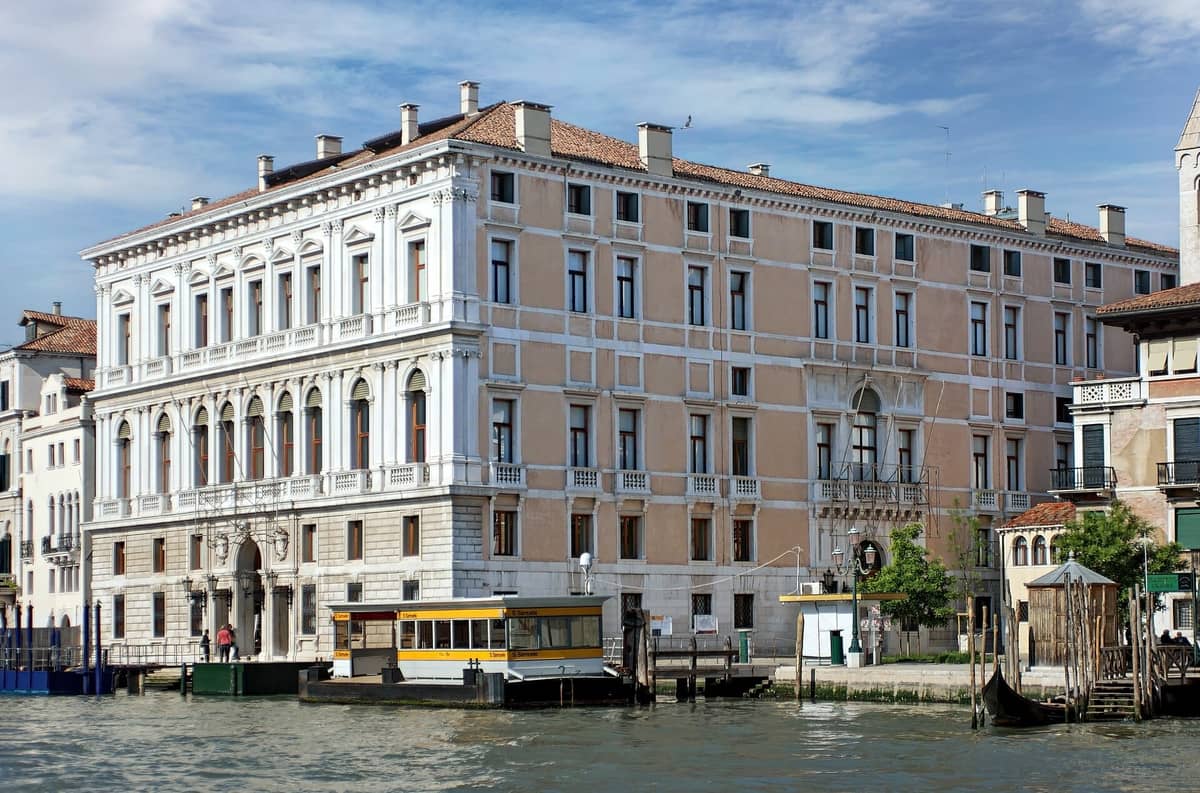
Palazzo Grassi is a neoclassical palace completed in 1772 on the Grand Canal, widely regarded as the last great palace built in Venice before the fall of the Venetian Republic. Today it operates as part of the Pinault Collection, the private contemporary art holdings of French billionaire François Pinault, who acquired the building in 2005 and commissioned Japanese architect Tadao Ando to oversee its renovation. It reopened to the public in 2006 and has since become one of Italy's most significant venues for large-scale contemporary art exhibitions.
Unlike the Peggy Guggenheim Collection a short walk away along the canal, Palazzo Grassi does not maintain a permanent hang. Every exhibition is a temporary show, often organized around a single artist or theme drawn from the Pinault Collection's vast holdings. This means the experience changes entirely from one visit to the next, and whether a show is worth your time depends on who is exhibiting. Check the current program before booking.
⚠️ What to skip
Palazzo Grassi is only open during active exhibition periods. It closes between shows and on Tuesdays throughout the year. Always verify dates on the official site before planning your visit, as there can be gaps of several weeks between exhibitions.
The Building: Giorgio Massari Meets Tadao Ando
The palace was designed by Giorgio Massari, one of the leading Venetian architects of the 18th century, and its facade reads as restrained and orderly against the theatrical excess of older Grand Canal palaces. The main entrance opens from the canal side onto a large internal courtyard, which Tadao Ando converted into the visual heart of the museum experience. Ando left the proportions intact while introducing bare concrete planes, clean white walls, and industrial-grade lighting systems that create a severe, focused atmosphere suited to serious art viewing.
The tension between Massari's ornate plasterwork and Ando's minimalism is felt throughout. In some rooms the original frescoed ceilings survive above contemporary canvases of stark abstraction or large video installations. This collision is not accidental. It is precisely the point, and it gives Palazzo Grassi a character that no purpose-built contemporary museum can replicate. The building itself becomes part of the curatorial argument.
The internal courtyard, flanked by a colonnade on the ground level, is where visitors tend to slow down regardless of what is installed there. The proportions are grand without being oppressive. Light enters from above, changes through the day, and by late afternoon creates a warmth that softens Ando's harder materials. If you can, plan to reach the courtyard in the hour before closing when crowds thin and the quality of light is at its best.
Tickets & tours
Hand-picked options from our booking partner. Prices are indicative; availability and final rates are confirmed when you complete your booking.
Doge's Palace skip-the-line tour
From 67 €Instant confirmationFree cancellationVenice Legends, Anecdotes and Ghost Stories Tour
From 35 €Instant confirmationFree cancellationGhosts and legends tour of Venice
From 29 €Instant confirmationFree cancellationSkip-the-line guided tour of Doge's Palace and Saint Mark's Basilica
From 106 €Instant confirmationFree cancellation
What to Expect During a Visit
Entry is from the canal-facing facade at Campo San Samuele, through a narrow campiello that does not announce itself loudly. First-time visitors sometimes walk past it. Once inside, the sequence of rooms on the ground floor typically introduces the exhibition's premise, with larger installations and heavier works occupying the upper floors. The layout encourages a slow, non-linear exploration, and signage is usually bilingual in Italian and English.
The upper floors offer canal-facing windows that frame views of the Grand Canal between Palazzo Moro Lin and the bend toward the Accademia. These are not advertised as a feature of the visit but are among the more quietly rewarding moments, particularly if you are visiting on a weekday morning when boat traffic is lighter and the water reflects the early light cleanly.
💡 Local tip
Arrive within 30 minutes of opening (10:00) on weekday mornings for the quietest experience. Weekend afternoons, particularly Saturdays, see the heaviest foot traffic. Midweek mornings in autumn or winter often feel close to having the building to yourself.
The bookshop near the entrance stocks exhibition catalogues and critical texts that are often unavailable elsewhere in Venice. If you are serious about the show you are seeing, the catalogue is usually worth the price. There is a cafe on site, though it is functional rather than exceptional.
The Pinault Collection and Its Place in Venice's Art World
Palazzo Grassi operates in conjunction with Punta della Dogana, the former customs house at the tip of Dorsoduro that Pinault also renovated with Tadao Ando and opened in 2009. The two venues function as a single institutional entity, and a combined ticket is available. A free vaporetto shuttle service connects the two locations on Mondays, Wednesdays, Saturdays, and Sundays between 11:00 and 13:00 and again between 15:00 and 17:00, requiring a valid exhibition ticket. The journey across the Grand Canal takes only a few minutes but saves considerable walking time.
Together, the two venues represent the single most significant private investment in contemporary art infrastructure in Venice. Pinault's collection encompasses works by artists including Cy Twombly, Jeff Koons, Cindy Sherman, Marlene Dumas, and Damien Hirst, among many others. Not all works are on view at any given time; the collection rotates, and each exhibition is typically conceived around a specific thematic or monographic focus.
This concentration of contemporary art in Venice is worth understanding in context. The city already hosts the Venice Biennale, the world's oldest and most prestigious international art exhibition, which takes place in odd-numbered years and draws the global art world to the Giardini della Biennale and the Arsenale. Palazzo Grassi operates independently of the Biennale but its programming often intersects with the city's broader cultural calendar, and during Biennale years the concentration of significant art in Venice becomes unusually dense.
How the Experience Changes Through the Day and Year
Morning visits offer the clearest thinking space. The galleries are quieter, the cafe has fresh coffee, and the light in the courtyard has a cooler, more neutral quality that suits careful looking. By noon, group tours and individual visitors fill the main rooms, and conversation levels rise enough to affect how you engage with more contemplative or sound-based works.
In summer, Venice's broader tourist pressure is felt here too. The lines outside are rarely as long as at St. Mark's Basilica or the Doge's Palace, but the galleries can feel crowded on peak-season afternoons. Autumn and winter visits carry a different atmosphere entirely. The light outside is lower and more diffuse, the city quieter, and the walk along the Grand Canal to reach the palazzo feels more like an event in itself. For those willing to accept cooler temperatures and the occasional acqua alta warning, an off-season visit to Palazzo Grassi is a noticeably calmer experience.
ℹ️ Good to know
Venice residents and students receive free admission on Wednesdays and on the first and last day of each exhibition. If you qualify, these are the best days to visit both for the cost saving and because these days tend to draw a more locally engaged, less tourist-heavy crowd.
Getting There and Practical Logistics
The most direct route from central Venice is by ACTV vaporetto to the San Samuele stop, which deposits you almost directly in front of the entrance on the Grand Canal. Line 2 serves this stop. The walk from Rialto Bridge on foot takes roughly 15 minutes through the San Marco sestiere, passing through smaller campi and calli that are worth navigating at a slow pace.
From Piazza San Marco, the walk is around 10 to 12 minutes along the canal-side path toward Campo San Stefano and then Campo San Samuele. This route passes through one of the quieter stretches of the San Marco sestiere and gives a good sense of how residential life operates a few blocks from the city's main tourist axis.
Opening hours during exhibition periods are daily except Tuesday, 10:00 to 18:00, with last entry at 17:00. The museum is closed on 25 December. For visitors with mobility needs or specific accessibility requirements, the museum advises contacting the general information line at +39 041 2401 308 directly. The free shuttle between Palazzo Grassi and Punta della Dogana is particularly useful for visitors who find extended walking difficult.
Is It Worth Your Time?
The honest answer is: it depends on the show. When Palazzo Grassi mounts a major monographic exhibition, the combination of the collection's depth and the building's quality makes it one of the strongest contemporary art experiences available anywhere in Europe. When a show is thematically diffuse or relies on works that do not translate well to the space, it can feel underwhelming relative to the admission price.
Travelers who visit Venice primarily for its historic fabric and are indifferent to contemporary art will find little to hold them here. The building's exterior is handsome but not the most spectacular on the Grand Canal, and without engagement with the art inside, the visit does not justify the time or cost. Conversely, for anyone with a genuine interest in contemporary art or in Tadao Ando's work, Palazzo Grassi is one of the most architecturally and intellectually coherent museum experiences the city offers.
If your itinerary includes the Peggy Guggenheim Collection as well, consider spacing the two visits across different days. Both demand attentive looking, and combining them in a single afternoon tends to produce fatigue rather than depth. The Guggenheim's permanent collection of modern art and Palazzo Grassi's rotating contemporary program complement each other without overlapping, and visiting both over the course of a longer Venice stay is one of the stronger ways to understand the city's art geography.
Insider Tips
- Check the exhibition calendar at least two weeks before your trip. Palazzo Grassi closes entirely between shows and gives no advance notice of exact closure dates on third-party sites. The official website is the only reliable source.
- The free vaporetto shuttle between Palazzo Grassi and Punta della Dogana runs on a fixed schedule and fills up quickly on busy days. Arrive at the dock 10 minutes before the departure time listed on your ticket documentation.
- If you are visiting during the Venice Biennale (odd-numbered years, typically May to November), buy your Palazzo Grassi ticket in advance online. The Biennale brings an influx of art professionals and collectors who also visit the Pinault venues, and walk-up queues can be longer than usual.
- The ground-floor courtyard is the best place to linger. Find a spot near the colonnade in the late afternoon when the light drops from the overhead opening and gives the space a quality no photograph fully captures.
- Photography is generally permitted without flash in most areas of the exhibition, but rules vary by show. Confirm on-site at the entrance rather than assuming.
Who Is Palazzo Grassi For?
- Contemporary art enthusiasts looking for serious, well-resourced exhibitions outside the Biennale calendar
- Architecture followers interested in Tadao Ando's approach to historic adaptive reuse
- Travelers on a multi-day Venice itinerary who want contrast with the city's Renaissance and Baroque heritage
- Visitors combining Palazzo Grassi with Punta della Dogana for a full immersion in the Pinault Collection
- Off-season visitors who want a substantive indoor cultural experience away from the city's most crowded sites
Nearby Attractions
Other things to see while in San Marco:
- Bridge of Sighs (Ponte dei Sospiri)
The Ponte dei Sospiri is one of Venice's most photographed structures, an enclosed white limestone bridge linking the Doge's Palace to the New Prisons over the narrow Rio di Palazzo canal. You can see it for free from the Ponte della Paglia, or cross it from the inside as part of a Doge's Palace ticket. Here is everything you need to visit it well.
- Doge's Palace (Palazzo Ducale)
Doge's Palace is the Gothic heart of Venice's political history, rising at the edge of Piazza San Marco with a facade unlike anything else in Italy. This guide covers what you'll actually experience inside, when to visit for smaller crowds, and how to make the most of one of Europe's most significant civic buildings.
- Grand Canal (Canal Grande)
The Canal Grande is the main artery of Venice, a reverse-S shaped waterway stretching 3.8 km through the heart of the city and lined with more than 170 palaces spanning six centuries of Venetian architecture. Free to view at any hour, it rewards visitors who know when and how to travel it.
- Museo Correr
Occupying the grand Napoleonic Wing and part of the Procuratie Nuove above Piazza San Marco, the Museo Correr holds centuries of Venetian civic history, Renaissance painting, and lavishly decorated royal apartments. It rewards visitors who take their time, and it's consistently overlooked by crowds fixated on the Doge's Palace next door.