Palau Nacional: Barcelona's Grand Palace of Art Above the City
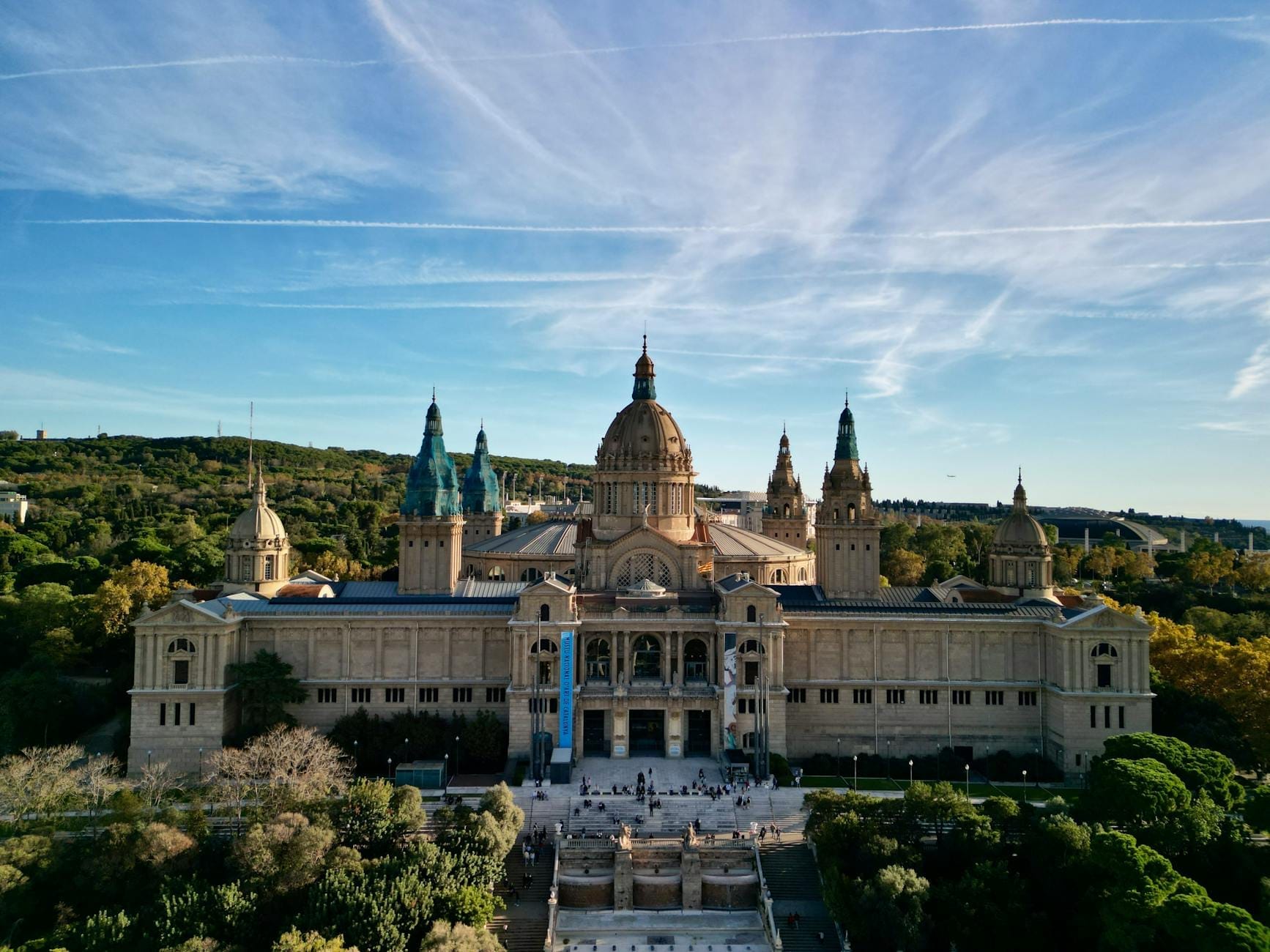
The Palau Nacional is one of Barcelona's most commanding landmarks, a Spanish Renaissance palace built for the 1929 International Exposition that today houses the Museu Nacional d'Art de Catalunya (MNAC). From its hilltop position on Montjuïc, it offers sweeping views down the Avinguda de la Reina Maria Cristina toward the sea, making it as much an architectural experience as a cultural one.
Quick Facts
- Location
- Parc de Montjuïc, 08038 Barcelona (Montjuïc hill)
- Getting There
- Metro L1/L3 to Espanya, then walk up Avinguda de la Reina Maria Cristina or take the escalators from Plaça d'Espanya
- Time Needed
- 2–4 hours for the museum; 30 minutes if visiting for the exterior and views only
- Cost
- Verify current MNAC ticket prices directly; the exterior terrace and views are free
- Best for
- Art lovers, architecture enthusiasts, photographers, and anyone wanting panoramic city views
What the Palau Nacional Actually Is
The Palau Nacional is a Spanish Renaissance palace completed in 1929 as the centerpiece of Barcelona's International Exposition. It sits at the top of a grand ceremonial axis on Montjuïc hill, framed by fountains, manicured terraces, and a cascade of steps that draws the eye upward from Plaça d'Espanya. Since 1934, it has served as the home of the Museu Nacional d'Art de Catalunya, known universally as MNAC, which holds one of the most significant collections of Romanesque art in the world.
Most visitors arriving from the city see the palace from below first, a white neoclassical mass crowned by an elliptical central dome flanked by two smaller towers. The scale only becomes fully apparent when you reach the terrace at its base and turn around to see the city laid out below you, the Eixample grid stretching to the sea, the Sagrada Família visible in the middle distance, and on clear days, the water glinting at the horizon.
ℹ️ Good to know
The exterior terrace and views are completely free to access. If you're short on time or not interested in the museum, the walk up from Plaça d'Espanya to the palace terrace is still one of the best city panoramas in Barcelona.
The Building Itself: Architecture Worth Slowing Down For
Architects Eugenio Cendoya and Enric Catà, supervised by Pere Domènech i Roura, designed the Palau Nacional in a style that blends Spanish Renaissance and Baroque influences. The first stone was laid on 30 June 1926, and the entire structure was completed in under three years, an extraordinary construction timeline given the building's scale of 32,000 square metres in its original form.
The central dome is the defining element. Elliptical rather than circular, it rises above a rectangular plan with projecting wings at each end, giving the facade a sense of lateral spread that keeps it grounded despite its imposing height. Up close, the stonework reveals detailed cornices, arched windows, and ornamental sculpture that reward a slow circuit around the building. The fountains flanking the main staircase were designed by Carles Buïgas, the same engineer behind the nearby Magic Fountain of Montjuïc.
Between 1996 and 2004, the palace underwent a major renovation to properly house MNAC's growing collection, expanding the total floor area to 51,600 square metres. A dedicated temporary exhibitions space opened in 2003. The renovation carefully preserved the ceremonial character of the original interiors while adding modern infrastructure. For more on the surrounding hill's attractions, see our guide to Montjuïc hill.
Tickets & tours
Live prices and dates from our booking partner. If you book, we may earn a commission at no extra cost to you.
Barcelona small group walking tour with boat ride
From 55 €Instant confirmationFree cancellationGuided tour of Palau de la Musica Catalana in Barcelona
From 22 €Instant confirmationFree cancellationGoCar Barcelona discovering Gaudi
From 50 €Instant confirmationVermouth time and sailing experience in Barcelona
From 36 €Instant confirmationFree cancellation
Inside MNAC: What to Expect from the Collection
The Museu Nacional d'Art de Catalunya holds over 5,000 works spanning roughly a thousand years of Catalan and Spanish art. The collection is strongest in two areas: the Romanesque art galleries on the ground floor and the Modernisme collection on the upper level.
The Romanesque galleries are the main reason serious art historians make the journey. The collection was assembled in the early 20th century when fragments of medieval frescoes were being sold off from isolated Pyrenean churches. Rather than allow them to scatter internationally, Catalan cultural institutions acquired them and had the paintings carefully removed from the church walls and reinstalled in purpose-built apse-shaped rooms that replicate the original settings. The result is disorienting in the best way: you move through rooms that feel architecturally consistent with 12th-century churches, looking at paintings that have not left Catalonia.
The Modernisme galleries cover the decorative arts of the late 19th and early 20th century, including furniture, graphic design, and applied crafts alongside painting. For visitors already familiar with the architecture of the Eixample, this section provides cultural context for what they've seen on the streets. It connects directly to the world of Ramon Casas, Santiago Rusiñol, and the broader movement that produced the city's most celebrated buildings.
💡 Local tip
Start with the Romanesque galleries if you have limited time. They are the most unique part of the collection and the hardest to find elsewhere in the world. The upper floors can be explored on a second visit or revisited after a coffee break at the museum's cafe.
The View from the Terrace: Better Than You Expect
The terrace directly in front of the Palau Nacional is one of the best elevated viewpoints in the city, though it receives less attention than the rooftop of Casa Milà or the outlook from Bunkers del Carmel. Standing here, the formal axis of Avinguda de la Reina Maria Cristina runs directly away from you toward the twin towers of the Fira de Barcelona trade halls, with Plaça d'Espanya below and the city grid beyond. The geometry is precise and intentional: it was designed as a processional approach to the palace during the 1929 Exposition.
Morning light falls on the facade from the east, making it photogenic early in the day. By midday the terrace is exposed and warm, better suited to a brief stop than a long stay. Late afternoon, especially in summer, brings softer light across the city and is the most rewarding time for photography. On Thursday and Saturday evenings, the Magic Fountain below activates, and the view from the palace terrace looking down at the light-and-water show is considerably better than the view from within the crowd at the fountain itself.
For a broader look at the best panoramas across the city, the best views in Barcelona guide covers how the Palau Nacional terrace compares to other high-points around the city.
Getting There and Moving Through the Site
The most scenic approach is on foot from Plaça d'Espanya, taking the escalator-assisted path up through the Exposition grounds. Metro lines L1 and L3 both stop at Espanya station, making this one of the easier Montjuïc sites to reach without a car or cable car. The walk from the metro to the palace takes roughly 10 to 15 minutes at a moderate pace, depending on how long you pause at the fountain level.
Alternatively, the Montjuïc cable car reaches the upper section of the hill and is useful if you're combining the Palau Nacional with other sites further up, such as Montjuïc Castle. Bus routes also serve Montjuïc from various points in the city.
The museum is open Wednesday through Sunday, 10:00 to 20:00, and is closed on Mondays and Tuesdays. Verify current ticket prices directly with MNAC before your visit, as pricing and discount structures change. EU citizens under 16 have generally had free entry, and there are often reduced rates for students, seniors, and Barcelona residents, but these should be confirmed in advance.
⚠️ What to skip
The museum is closed on Mondays and Tuesdays. This is easy to overlook when planning a Montjuïc day, so check before combining it with other hill visits.
Honest Assessment: Worth the Effort?
For first-time visitors to Barcelona, the Palau Nacional offers genuine value at two different levels. The exterior approach and terrace view require no ticket and relatively little time. The walk up from Plaça d'Espanya is pleasant and the view is reward enough on its own. That part of the experience consistently delivers.
The museum inside is more selective in appeal. If Romanesque art, Catalan Modernisme, or Gothic panel painting mean something to you, MNAC is a serious institution with a serious collection and you'll likely want more time than you planned for. If your interest in art is casual and your Barcelona itinerary already includes the Picasso Museum or CaixaForum, the overlap in general appeal means you may leave MNAC feeling overstuffed with museum time.
Travelers with limited time who prioritize Gaudí's buildings, the Gothic Quarter, or the beaches of Barceloneta may find MNAC better suited to a return trip. Those following a structured Barcelona itinerary that already includes a Montjuïc half-day will find the Palau Nacional a natural anchor for that section of the trip.
One practical note: the building is large and can feel tiring to navigate in full. Wear comfortable shoes, take the escalators between floors, and use the cafe on the middle level as a break point rather than trying to power through the entire collection in one pass.
Insider Tips
- The view of the Magic Fountain show from the palace terrace, looking downhill, gives you the full spectacle without the crowds. Shows typically run Friday and Saturday evenings in summer, but verify the current schedule before planning around it.
- The Oval Room beneath the central dome is one of the most striking interior spaces in any public building in Barcelona. Even if you skip most of the museum, it is worth walking through for the architecture alone.
- Entry to the permanent collection is free on Saturdays after 15:00, the first Sunday of each month, and on certain public holidays. Check the MNAC website before your visit to see if your dates qualify.
- The terraces on the south side of the building, less used than the main frontal terrace, offer a quieter spot to sit and look out over the lower slopes of Montjuïc toward the port and sea.
- Combine the Palau Nacional with the Fundació Joan Miró, a short walk away on the same hill, to make a full Montjuïc art day. Both institutions are serious but manageable, and the contrast between medieval Romanesque and 20th-century abstraction is more interesting than it sounds.
Who Is Palau Nacional For?
- Art history enthusiasts, especially those with interest in medieval Romanesque or early 20th-century Catalan art
- Architecture-focused travelers wanting to see the 1929 Exposition legacy firsthand
- Photographers looking for the best wide-angle view of Barcelona's Eixample grid
- Visitors combining a full Montjuïc day with the cable car, castle, and Fundació Joan Miró
- Travelers on return visits to Barcelona who have already covered the main Gaudí sites
Nearby Attractions
Other things to see while in Montjuïc:
- CaixaForum Barcelona
CaixaForum Barcelona occupies a meticulously restored 1911 textile factory near Plaça d'Espanya, pairing Catalan Modernista architecture with rotating international exhibitions, film cycles, and cultural programming. It is one of the most architecturally distinctive cultural spaces in the city, and admission is remarkably affordable.
- Fundació Joan Miró
Perched on the slopes of Montjuïc, Fundació Joan Miró is Barcelona's first contemporary art museum and one of the most cohesive artist foundations in Europe. The building, the collection, and the outdoor spaces combine into an experience unlike any other major art institution in the city.
- Jardí Botànic de Barcelona
Perched on the slopes of Montjuïc, the Jardí Botànic de Barcelona spreads across 14 hectares of carefully arranged Mediterranean flora from five continents. It offers a rare combination of botanical depth, architectural landscape design, and sweeping views over Barcelona, all without the crowds that dominate the city's headline attractions.
- Magic Fountain (Font Màgica)
The Font Màgica de Montjuïc is a monumental choreographed fountain at the foot of Montjuïc hill, combining jets of water reaching up to 50 metres with coloured lights and music. It's free to attend, open on select evenings year-round, and consistently draws one of Barcelona's largest spontaneous crowds.
Planning a trip? Discover personalized activities with the Nomado app.