Olympiastadion Berlin: History, Access, and What to Expect on Your Visit
Built for the 1936 Summer Olympics and thoroughly renovated in 2004, the Olympiastadion Berlin is one of Europe's most architecturally significant sports venues. With a capacity of about 74,500, it hosts Hertha BSC matches, major concerts, and regular sightseeing visits that take you from pitch level to the roof walkway.
Quick Facts
- Location
- Olympischer Platz 3, 14053 Berlin (Westend, Charlottenburg-Wilmersdorf)
- Getting There
- U2 to Olympia-Stadion; S5/S75 to Olympiastadion station
- Time Needed
- 1.5–2.5 hours for self-guided sightseeing
- Cost
- Adults €11 / Reduced €8 / Children (6–14) €6 / Family card €25 (sightseeing, non-event days)
- Best for
- History enthusiasts, architecture fans, football supporters, families
- Official website
- olympiastadion.berlin/en/home
What Is the Olympiastadion Berlin?
The Olympiastadion Berlin is a large multi-purpose stadium in the Westend district of Charlottenburg-Wilmersdorf, roughly ten kilometres west of the city centre. It was constructed between 1934 and 1936 under architect Werner March and opened for the 1936 Summer Olympics, the games that Adolf Hitler intended to showcase National Socialist Germany to the world. That political context is impossible to separate from the structure itself, and the stadium is candid about it: information panels throughout the complex address the history directly rather than glossing over it.
After a comprehensive modernisation, the stadium reopened on 1 August 2004 with its capacity raised to approximately 74,500 seats. Today it serves as the home ground of Bundesliga club Hertha BSC and hosts major international events including UEFA finals and large-scale concerts. On non-event days, the venue opens its doors for guided and self-guided sightseeing visits, making it accessible to any curious visitor regardless of whether football is on.
⚠️ What to skip
The Visitor Centre is closed on Hertha BSC home match days and other major event days. Check the official website before you go, as hours and access can change at short notice: https://olympiastadion.berlin/en/sightseeing/
The Architecture: What You're Actually Looking At
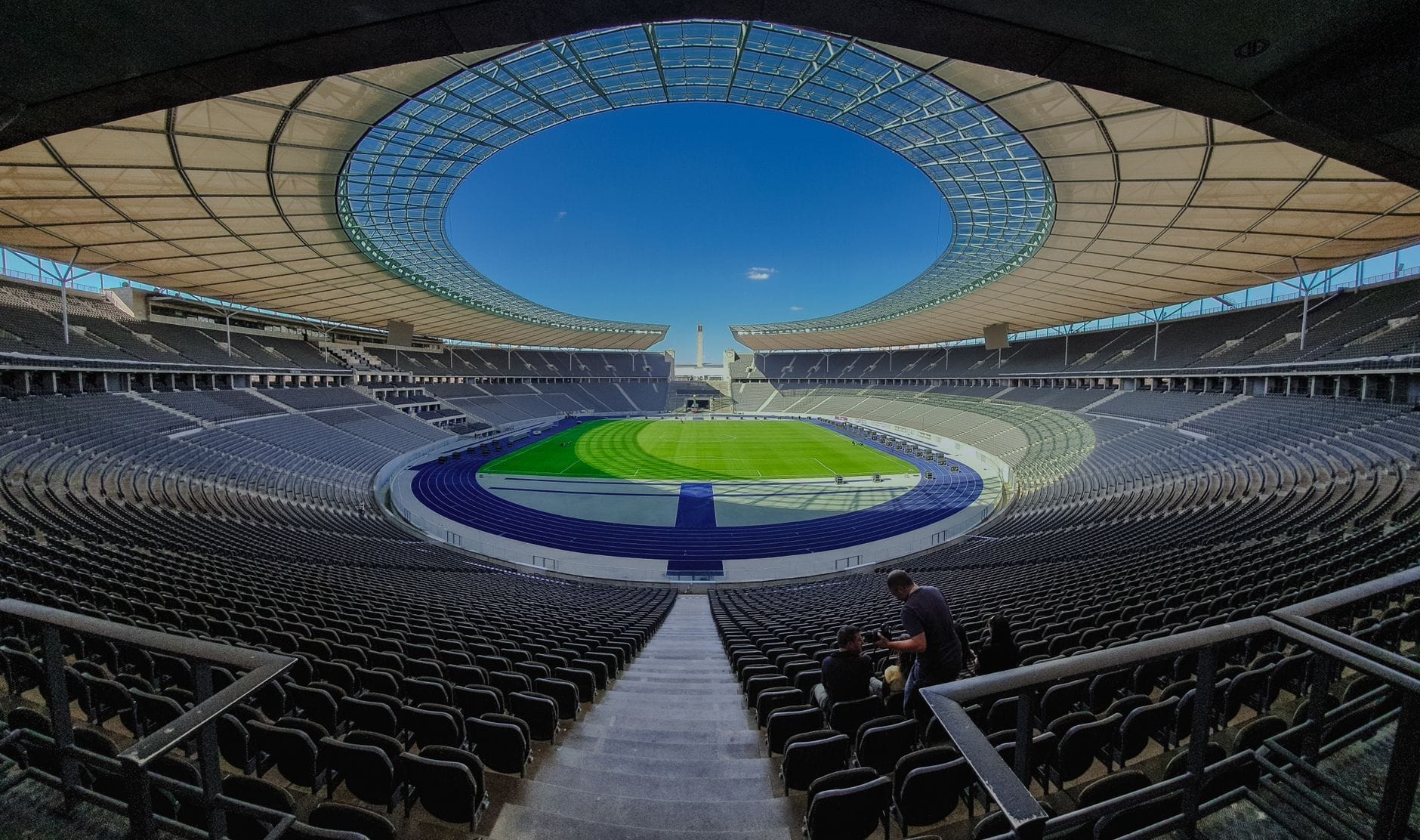
Werner March's design drew on neoclassical forms: massive limestone cladding, colonnaded walkways, and a deliberately sunken pitch that means the playing field sits below street level. From outside, the stadium reads as imposing but not colossal. Step through the main gate, though, and the sheer scale becomes apparent: the bowl drops away beneath you, the pitch stretching to 105 metres by 68 metres, and the stands rising in a continuous curve on all sides.
The 2004 renovation added a sweeping partial roof that covers most spectator areas while leaving the characteristic open strip along the top edge. This keeps the historic silhouette intact from the outside while dramatically improving the experience inside. The structural contrast between the pre-war limestone and the modern tensile canopy is worth studying up close, particularly from the upper tiers where both layers are visible simultaneously.
Visitors interested in the wider architectural and urban planning legacy of the Nazi era in Berlin may also want to visit Karl Marx Allee in the east and the Olympic Park grounds surrounding the stadium, which include the bell tower, the Maifeld parade ground, and the Waldbühne open-air amphitheatre.
Tickets & tours
Hand-picked options from our booking partner. Prices are indicative; availability and final rates are confirmed when you complete your booking.
Olympiastadion Berlin entrance ticket
From 11 €Instant confirmationFree cancellationSkip-the-line ticket for Gemaldegalerie Berlin
From 14 €Instant confirmationPanoramapunkt Berlin ticket with skip-the-line option
From 9 €Instant confirmation1-Hour Berlin Spree River Cruise with On-Board Guide
From 21 €Instant confirmationFree cancellation
The Sightseeing Visit: What to Expect
Entry for sightseeing visits is via the Visitor Centre at Olympischer Platz 3. Adults pay €11, with reduced rates of €8 for students, trainees, those with disabilities, and groups of ten or more. Children between 6 and 14 pay €6, and a family card covering two adults and up to three children costs €27. Valid ID is required for reduced-rate tickets.
Standard sightseeing hours typically start at 09:00, with closing times varying seasonally between late afternoon and 20:00 on open days, though these vary seasonally and around events. The experience is largely self-guided: you move through the concourse levels, descend to pitch-side access points, and can walk sections of the upper walkway. Audio guides are available in multiple languages. Plan for around 90 minutes at a relaxed pace; two and a half hours if you read everything and walk the full circuit.
Pitch level is the highlight for most visitors. Standing at the edge of the grass, the scale of the bowl becomes visceral. The lower seating tiers press close to the playing surface, and the acoustics give even a quiet Tuesday morning an unusual resonance. Morning light coming in low over the east stand casts long shadows across the pitch, which makes early visits worth considering for photographers.
💡 Local tip
Arrive before 10:00 on weekday mornings for the fewest visitors. The stadium is popular with school groups from late morning onward, particularly in spring and early summer. Weekends see more general tourists after 11:00.
Historical Context: 1936 and Its Weight
The 1936 Berlin Olympics were the first Games to be televised and the first to use the torch relay as a ceremonial opening. They were also a carefully staged propaganda event. Jesse Owens' four gold medals at this stadium became one of sport's most resonant moments precisely because they challenged the racial ideology the host government was promoting. The stadium's exhibition materials acknowledge this layered history with a seriousness that distinguishes it from a straightforward sports venue tour.
The stadium survived World War II largely intact, then served the British Army of the Rhine as a military base from 1945 until the 1990s. This extended postwar life means the structure carries multiple eras of use rather than functioning as a simple monument to its original moment. That accumulated history makes a visit here considerably more thought-provoking than the average stadium tour.
For visitors who want to situate the Olympiastadion within a broader exploration of how Berlin has confronted its National Socialist past, the Topography of Terror documentation centre and the Holocaust Memorial provide essential complementary context. The Berlin memorials guide covers these and other sites across the city.
Getting There and Getting Around the Site
Public transport is straightforward. The U2 line stops at Olympia-Stadion station, a short walk from the main entrance. S-Bahn lines S3 and S9 serve Olympiastadion station on the southern side of the complex. On non-event days, either option works well with no crowding. On match days or concert evenings, expect S-Bahn platforms to be extremely busy after the event; the U2 often moves faster in those circumstances.
On-site parking is available, and on non-event weekdays spaces are generally easy to find. Approaching by bicycle is feasible given the park-like setting of the surrounding Olympiapark, and bike stands are located near the entrance area.
Wheelchair users can access the stadium through the Visitor Centre entrance. Designated wheelchair spaces are located in row 41, with barrier-free access to the lower concourse at the level of blocks C/D, G/H, J/K, N, Q/R, and S/T, and accessible toilets are available throughout the venue. The concourse surfaces are largely level, though some viewing positions involve steps that have no ramped alternative.
Photography, Timing, and Practical Details
The Olympiastadion is photogenic across the day, but the light conditions shift significantly. Morning visits under clear skies produce strong directional light from the east that models the limestone facade beautifully. Midday light is flat and best for wide interior shots. Late afternoon, when the sun moves to the west, illuminates the upper canopy and creates silhouette opportunities against the open strip.
Bring a wide-angle lens if you want to capture the full bowl from pitch level. Telephoto shots work well from the upper tier looking down toward the goal mouths. Photography is permitted for personal use throughout the sightseeing areas; commercial or drone photography requires advance permission from the stadium management.
Wear comfortable, flat shoes. The concourse is smooth but extensive, and the steps between tiers are steeper than in many modern venues. There is no requirement to dress for weather, as much of the route is sheltered under the canopy, but the pitch-side area and upper walkway are exposed, so a layer is advisable in cooler months.
ℹ️ Good to know
The surrounding Olympiapark includes the Waldbühne open-air amphitheatre and the 77.2-metre bell tower, which offers a panoramic view over the city. Both are worth combining with your stadium visit if time allows.
Who Will Enjoy This, and Who Might Not
The Olympiastadion rewards visitors who come with some historical curiosity. If you approach it purely as a football venue without interest in the 1936 context, the self-guided tour can feel like a long walk around an empty stadium. The interpretive content is what elevates the experience beyond novelty.
Families with children generally get good value from the visit: the scale impresses younger visitors, the pitch-side access is genuinely exciting, and the family card pricing is reasonable. Older children who have covered World War II history at school tend to find the exhibition panels engaging rather than dry.
Visitors with very limited time in Berlin who must prioritise should know that the Olympiastadion sits at the western end of the city, away from the cluster of central landmarks. If your itinerary is already full, consider whether the Reichstag, Museum Island, or other central sites should take priority. The stadium is better suited to a second day or a Berlin visit of three days or more. Our 3-day Berlin itinerary shows how to combine it with western Berlin attractions efficiently.
Those who dislike large, open spaces or have difficulty with extended walking will find the venue physically demanding. The full self-guided route covers substantial ground, and there are few places to sit along the concourse circuit outside the seating areas themselves.
Insider Tips
- Check the official website's event calendar before booking: on Hertha BSC home match days and major concert days, the Visitor Centre is entirely closed and the surrounding streets fill with crowds hours before kickoff.
- The bell tower in the adjacent Olympiapark offers one of Berlin's less-visited panoramic viewpoints. A combined walk through the Olympiapark and stadium tour makes for a full half-day without needing to use public transport between stops.
- If you plan to attend a Hertha BSC match rather than a sightseeing visit, buy tickets directly through the club's official channels well in advance. Popular fixtures sell out weeks ahead, and the stadium atmosphere at near-capacity is markedly different from the quiet of a touring visit.
- The Waldbühne amphitheatre, a five-minute walk from the stadium's western side, hosts summer concerts in a woodland setting. If your Berlin visit coincides with an event there, the combination of venue and atmosphere is worth seeking out.
- Early September is a reliable time to visit: summer crowds have eased, the stadium's surrounding greenery is still in good shape, and natural light is at a workable angle through most of the morning hours.
Who Is Olympiastadion Berlin For?
- Architecture and design enthusiasts interested in 1930s monumental building and its postwar transformation
- History visitors who want to engage with the 1936 Olympics in a physical, spatial way rather than through a conventional museum
- Football supporters, particularly those following Hertha BSC or attending international fixtures
- Families with children aged 8 and older who can engage with the historical material
- Photographers working on projects about German urban or sporting heritage
Nearby Attractions
Combine your visit with:
- Grunewald Forest
Grunewald Forest is Berlin's largest forested area, stretching across 3,000 hectares in the city's west. Free to enter and open at all hours, it offers lakes, woodland trails, a Renaissance hunting lodge, and genuine quiet within one of Europe's great capital cities.
- House of the Wannsee Conference (Gedenk- und Bildungsstätte)
On 20 January 1942, fifteen Nazi officials met in a lakeside villa southwest of Berlin and coordinated the systematic murder of European Jews. The House of the Wannsee Conference is now a permanent memorial and educational site. Admission is free. The experience is unforgettable.
- Sanssouci Palace and Park (Potsdam)
Built for Frederick the Great between 1745 and 1747, Sanssouci Palace is Germany's most celebrated royal summer retreat. Set within a UNESCO-listed park of terraced vineyards, fountains, and baroque pavilions just outside Potsdam, it rewards visitors who arrive early and stay long.
- Sachsenhausen Memorial and Museum
Located around 30 km north of Berlin in Oranienburg, the Sachsenhausen Memorial and Museum stands on the site of a Nazi concentration camp where more than 200,000 people were imprisoned between 1936 and 1945. Admission is free. The visit takes a minimum of three hours and leaves a lasting impression.