Sanssouci Palace and Park: The Prussian Versailles Worth the Day Trip
Built for Frederick the Great between 1745 and 1747, Sanssouci Palace is Germany's most celebrated royal summer retreat. Set within a UNESCO-listed park of terraced vineyards, fountains, and baroque pavilions just outside Potsdam, it rewards visitors who arrive early and stay long.
Quick Facts
- Location
- Maulbeerallee / Weinbergterrassen, 14469 Potsdam, Germany (approx. 30 km southwest of central Berlin)
- Getting There
- Regional train (RE1, RB21, or S7) from Berlin to Potsdam Hauptbahnhof, then bus 695 to Schloss Sanssouci stop; total journey approx. 40–50 min
- Time Needed
- 3–5 hours for palace plus park; a full day if visiting multiple SPSG palaces
- Cost
- Palace entry approx. €14 adult / €11 reduced; park entry free; Sanssouci+ day ticket covers all open SPSG palaces (check SPSG for current rates)
- Best for
- History lovers, architecture enthusiasts, garden walkers, and anyone doing the Berlin-to-Potsdam day trip
- Official website
- www.spsg.de/en/palaces-gardens/object/sanssouci-palace
What Sanssouci Actually Is (and Why It Matters)
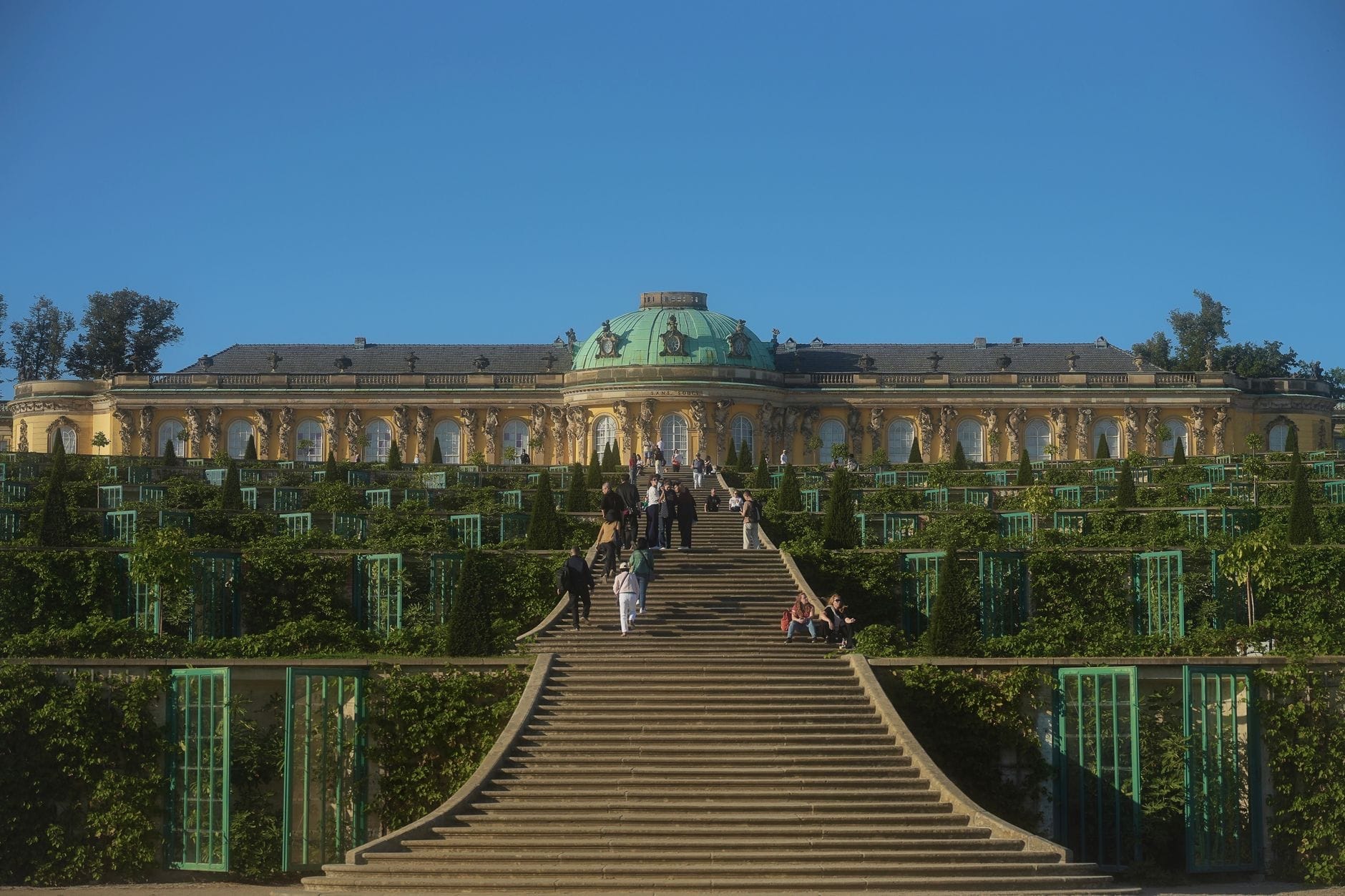
Sanssouci Palace, or Schloss Sanssouci, is the single-story rococo summer residence that Frederick II of Prussia had built on a south-facing hillside between 1745 and 1747. The name translates from French as 'without care', a deliberate statement of intention: this was Frederick's retreat from the formalities of the Berlin court, a place where he could read philosophy, play the flute, correspond with Voltaire, and tend his terraced vineyards in private. It is not a grand power palace in the way Versailles is. It is compact, personal, and surprisingly human in scale, which is precisely what makes it interesting.
The palace and its surrounding park were inscribed as a UNESCO World Heritage Site in 1990, within the ensemble of palaces and parks in Potsdam and Berlin. Emperor Wilhelm I opened the complex to the public as a museum in 1873, and the Prussian Palaces and Gardens Foundation (SPSG) now administers it alongside more than 30 other palaces and gardens in the region. The park itself, at roughly 290 hectares, contains multiple other royal structures including the Neue Palais, the Chinese House, and the Dragon House. On a busy summer weekend, all of it fills with visitors, so understanding how to move through the site matters.
💡 Local tip
Palace entry uses timed tickets and numbers are limited. Book your time slot in advance through the SPSG website, especially for visits between late April and September. Walk-up tickets often sell out by mid-morning on weekends.
The Palace Interior: What You Actually See
The interior of Sanssouci Palace is small compared to what the park might lead you to expect. There are around twelve principal rooms open to visitors, including Frederick's study, his library, and the intimate concert room where he performed chamber music. The aesthetic is Frederician Rococo: gilded stucco, silk wall coverings, curved door frames, and an almost obsessive decorative energy in every corner. Light enters through full-height windows looking out over the terraced vineyard below, and the relationship between the interior and the landscape was deliberate. Frederick wanted to feel the garden from inside the palace.
The guided tour format means you move through the rooms as part of a group, which keeps the pace brisk. The rooms themselves are modest in size, and the density of ornament can feel overwhelming if you move too quickly. Budget extra attention for the Marble Hall at the center of the building: an oval room with white Carrara marble and a ceiling that rises above the roofline. It is the architectural heart of the palace and the only space that reads as formally grand.
Frederick the Great is buried on the terrace just outside the palace, beside his greyhounds. He requested this burial site himself; it was eventually honored after German reunification in 1991. The grave is modest, usually marked by a small bunch of flowers left by visitors, and it adds a quiet, unexpectedly personal note to an otherwise theatrical complex.
ℹ️ Good to know
Opening hours: April–October, Tuesday–Sunday 10:00–17:30; November–March, Tuesday–Sunday 10:00–16:30. Closed on Mondays. Always verify current hours on the SPSG website before your visit.
Tickets & tours
Hand-picked options from our booking partner. Prices are indicative; availability and final rates are confirmed when you complete your booking.
Potsdam tour with optional admission to Sanssouci Palace
From 0 €Instant confirmationPotsdam tour with optional admission to Sanssouci Palace
From 0 €Instant confirmationPanoramapunkt Berlin ticket with skip-the-line option
From 9 €Instant confirmationPanoramapunkt Berlin ticket with skip-the-line option
From 14 €Instant confirmation
The Terraced Vineyards and Park: More Than a Walk-Through
The six terraced levels of vineyard below the palace facade are the defining image of Sanssouci, and they look best from the bottom of the stairs looking up, not from the top looking down. The terraces are planted with grapevines sheltered by glass frames, a southern European fantasy transplanted to the sandy Brandenburg plain. In late morning, with the sun high and the stone warm underfoot, the effect is genuinely striking.
The park extends roughly two kilometers from east to west, and walking the full length takes about 45 minutes at a relaxed pace. The main axis runs from the Obelisk Portal on the southeastern edge past the palace, through the Great Fountain, and west toward the Neue Palais. Along the way, side paths branch off to the Chinese House, the Sicilian Garden, the Orangery Palace, the Ruinenberg, and the Dragon House. These detours are where the park rewards careful exploration: most visitors follow the main axis and miss the quieter corners entirely.
The park is open daily and free to enter year-round. In summer, it fills by mid-morning. By 09:00 on a weekday, the paths near the palace are nearly empty, and the morning light on the vineyard terraces is the best photographic condition of the day. By 11:30, tour groups arrive in steady rotation. If you are visiting for the park rather than the palace interior, arriving early or staying until late afternoon (when light is warm and crowds have thinned) is the practical choice.
Getting There from Berlin: The Practical Route
Sanssouci is in Potsdam, not Berlin, which is a detail worth stating clearly. The journey from central Berlin takes approximately 40 to 50 minutes by public transport. Regional trains (RE1, RE7, or RB21) run frequently from Berlin Hauptbahnhof or Friedrichstraße to Potsdam Hauptbahnhof. From there, bus 695 runs directly to the Schloss Sanssouci stop, or bus 606 to Luisenplatz, from where the park's western entrance is a short walk. Berlin's ABC zone tickets (including the Berlin Welcome Card if you hold one with the Potsdam extension) cover this journey, so check what you already have before buying a separate ticket.
The Berlin–Potsdam connection makes Sanssouci the most accessible major palace day trip from the German capital. For broader context on what else to combine in a day out of Berlin, the day trips from Berlin guide covers Potsdam alongside other regional options. Potsdam's old town, Dutch Quarter, and the Cecilienhof palace (site of the 1945 Potsdam Conference) are all reachable on foot or by bus from Sanssouci, making a full-day itinerary straightforward.
⚠️ What to skip
Do not rely on driving to the palace itself: parking near the main entrance is limited and the park's internal roads are restricted. Arriving by public transport and walking the park is the standard approach, and it works well.
When to Visit: Seasons Make a Significant Difference
Summer (June through August) delivers the best park conditions: fountains running, gardens in full color, and long daylight hours. It also delivers the largest crowds. If you visit in July or August, book palace tickets weeks in advance and arrive before 10:00. Spring (April and May) and early autumn (September) offer a reasonable balance: fewer visitors, pleasant temperatures, and the vineyard terraces looking their most photogenic. The best time to visit Berlin guide addresses seasonal trade-offs across the region in more detail.
Winter visits are underrated, not because the experience rivals summer, but because the palace interiors are unchanged and the park has a stripped-down quality that suits the Frederician aesthetic. Note that opening hours shorten significantly (last entry at 16:30 from November through March), and the reduced daylight window means the park walk should come first, before the palace ticket time slot.
Rain affects the park walk significantly. The gravel paths become slippery, the vineyard terraces are uncomfortable to climb, and several small pavilions close or restrict access in wet conditions. Waterproof shoes and a layer are worth bringing in any shoulder season. The palace interiors are unaffected by weather, so a rainy visit is still viable if the interior is your primary interest.
Beyond the Palace: Other Structures Worth Your Time
The Chinese House, located in the southern section of the park, is a gilded pavilion in the chinoiserie style popular in 18th-century European courts. It is small, eccentric, and far less visited than the main palace. The exterior, with its gilded figures seated under a mushroom-shaped roof, is more interesting than the interior, and it can be seen from outside without purchasing an additional ticket.
The Neue Palais at the western end of the park is the opposite of Sanssouci in character: large, theatrical, and built by Frederick after the Seven Years' War as a statement of Prussian power. Its Grottensaal (grotto hall), lined with shells, minerals, and semi-precious stones, is one of the stranger interiors in European royal architecture. If you have the Sanssouci+ day ticket, the Neue Palais is included and worth the walk. For visitors building a broader picture of Berlin and Potsdam's Prussian heritage, the context provided by the Cold War Berlin guide helps explain why so much of this landscape fell within the restricted zone of East Germany for decades after 1945.
Charlottenburg Palace in Berlin itself is the other major Hohenzollern residence accessible to visitors and makes for a useful comparison. It is larger and more conventionally grand, better suited to visitors who want the full baroque experience without traveling to Potsdam.
Accessibility, Photography, and Practical Notes
The palace and park are partially accessible. The flat main axis through the park is manageable for wheelchair users, but the vineyard terraces involve a long flight of stone steps with no lift alternative. Several interior rooms in the palace also have thresholds and restrictions. The SPSG publishes detailed, route-specific accessibility information on its website, and contacting them in advance is advisable for visitors with mobility impairments.
Photography inside the palace is restricted: tripods are prohibited, and flash photography is not permitted near the historic textiles. The park is fully open to photography. The best exterior shots of the palace require climbing to the top of the terraces, then looking back down from the level of the palace facade with the vineyard rows in the foreground. This is a more interesting composition than the standard shot from below, and it is almost always clear of other visitors at the sides.
💡 Local tip
Bring water and a snack. The park is large and the on-site café options near the palace fill quickly on busy days. A picnic on the lawn near the Great Fountain is a completely normal and practical choice.
Insider Tips
- Book your palace time slot the moment you decide to visit: the online SPSG ticket shop often shows availability gaps weeks in advance during summer, and walk-up availability on popular days runs out well before noon.
- The Ruinenberg, a short walk north of the palace, is an artificial hill topped with decorative ruins and a reservoir. Most visitors ignore it entirely, but the view back toward Sanssouci Palace from the hill is one of the cleaner long-distance perspectives available in the park.
- The park's eastern entrance near the Obelisk Portal puts you closest to the palace with a direct walk up the main axis. The western entrance near the Neue Palais is better if you want to visit that building first and work eastward with the light behind you in the morning.
- If you are visiting on a weekday in late September or October, the vineyard terraces take on a warm amber tone as the leaves turn. This is genuinely the most photogenic the palace facade ever looks, and crowds are noticeably thinner than in summer.
- The SPSG's combined Sanssouci+ ticket covers all open palaces in Potsdam for one day. If you are spending a full day in Potsdam, it almost always works out cheaper than buying individual entries, but it requires disciplined time management to use fully.
Who Is Sanssouci Palace and Park (Potsdam) For?
- Architecture and history enthusiasts who want to understand Prussian court culture beyond Berlin's city limits
- Walkers and garden lovers who want a full half-day in a well-maintained historic landscape
- Photographers looking for a European palace setting that is less photographed than Versailles or Schönbrunn
- Travelers on a 3-day Berlin itinerary who want to tick the major regional highlight with a half-day excursion
- Couples and families comfortable with a structured outing that mixes a ticketed interior with free outdoor exploration
Nearby Attractions
Combine your visit with:
- Grunewald Forest
Grunewald Forest is Berlin's largest forested area, stretching across 3,000 hectares in the city's west. Free to enter and open at all hours, it offers lakes, woodland trails, a Renaissance hunting lodge, and genuine quiet within one of Europe's great capital cities.
- House of the Wannsee Conference (Gedenk- und Bildungsstätte)
On 20 January 1942, fifteen Nazi officials met in a lakeside villa southwest of Berlin and coordinated the systematic murder of European Jews. The House of the Wannsee Conference is now a permanent memorial and educational site. Admission is free. The experience is unforgettable.
- Olympiastadion Berlin
Built for the 1936 Summer Olympics and thoroughly renovated in 2004, the Olympiastadion Berlin is one of Europe's most architecturally significant sports venues. With a capacity of about 74,500, it hosts Hertha BSC matches, major concerts, and regular sightseeing visits that take you from pitch level to the roof walkway.
- Sachsenhausen Memorial and Museum
Located around 30 km north of Berlin in Oranienburg, the Sachsenhausen Memorial and Museum stands on the site of a Nazi concentration camp where more than 200,000 people were imprisoned between 1936 and 1945. Admission is free. The visit takes a minimum of three hours and leaves a lasting impression.