House of the Wannsee Conference: Where the Holocaust Was Coordinated
On 20 January 1942, fifteen Nazi officials met in a lakeside villa southwest of Berlin and coordinated the systematic murder of European Jews. The House of the Wannsee Conference is now a permanent memorial and educational site. Admission is free. The experience is unforgettable.
Quick Facts
- Location
- Am Großen Wannsee 56–58, 14109 Berlin
- Getting There
- S-Bahn S1 or S7 to Wannsee, then bus 114
- Time Needed
- 1.5–2.5 hours
- Cost
- Free (seminars may carry extra charges)
- Best for
- History, Holocaust education, serious reflection
- Official website
- www.ghwk.de/en
What This Place Is — and Why It Matters
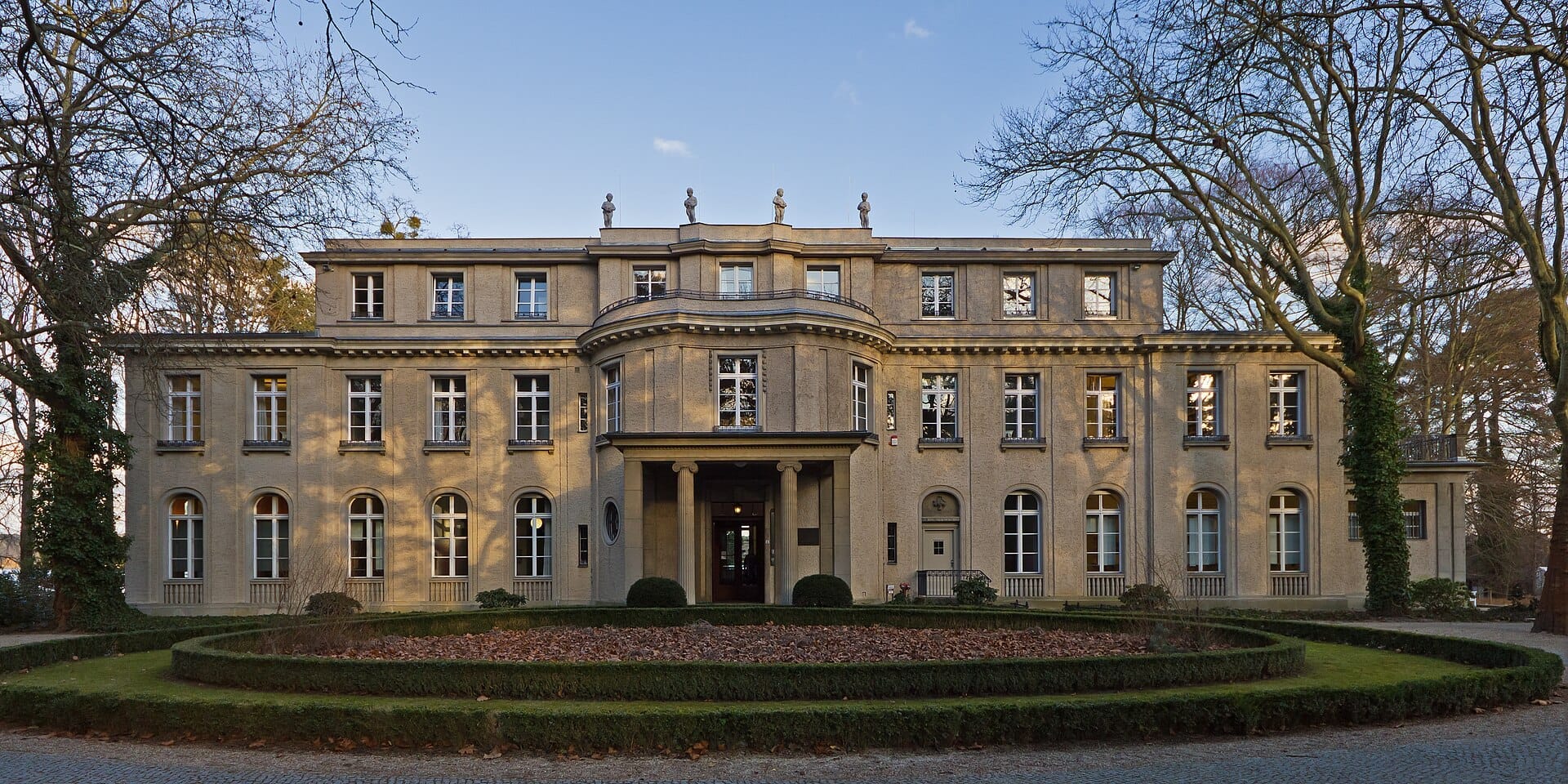
The House of the Wannsee Conference (Gedenk- und Bildungsstätte Haus der Wannsee-Konferenz) sits at the edge of Großer Wannsee lake, inside a handsome white Jugendstil villa built in 1915. From the outside, it could pass for a prosperous Berlin weekend retreat. That contrast is precisely the point.
On 20 January 1942, fifteen senior Nazi officials gathered here for a meeting that lasted roughly ninety minutes. They did not debate whether to exterminate Europe's Jewish population — that decision had already been taken at the highest levels. What they coordinated was the bureaucratic machinery: which agencies were responsible, how deportations would proceed across occupied Europe, what would happen to people of partial Jewish heritage. The document that emerged, known as the Wannsee Protocol, became a key piece of evidence at the Nuremberg trials.
The memorial and educational centre opened here in 1992, fifty years after the conference. It is one of the most carefully conceived Holocaust sites in Germany: less about spectacle, more about making the administrative logic of genocide legible to anyone willing to engage with it.
ℹ️ Good to know
Opening hours: Daily 10:00–18:00. Closed 1–4 Jan, 8 Mar, Good Friday, 1 May, Ascension Day, 3 Oct, and 24–31 Dec. Admission is free.
The Permanent Exhibition: Room by Room
The exhibition is arranged across fifteen rooms on the ground and upper floors of the villa. It follows a roughly chronological structure, beginning with the legal and social persecution of Jews in Germany from 1933 and tracing the escalating radicalization of Nazi policy through the invasion of the Soviet Union in 1941, when systematic mass shootings began. The conference itself occupies the middle of the exhibition, with a full reproduction of the Wannsee Protocol displayed and annotated.
What distinguishes this exhibition from similar sites is its deliberate focus on perpetrators: their careers, their institutional roles, their post-war fates. Many of the fifteen participants returned to civilian life after 1945. Several were never convicted. The exhibition traces these outcomes without editorializing heavily, which makes the information land harder than any polemical framing would.
Audio guides are available in multiple languages, and the level of English translation throughout the exhibition is thorough. Plan at least ninety minutes if you intend to read seriously. Two to two and a half hours is more realistic for visitors who engage with the supplementary materials.
💡 Local tip
Pick up the printed exhibition guide at the entrance — it provides fuller context for sections where wall text is dense and benefits from slower reading at home afterward.
Tickets & tours
Live prices and dates from our booking partner. If you book, we may earn a commission at no extra cost to you.
3-hour Berlin World Heritage boat tour from Wannsee
From 24 €Instant confirmationFree cancellationWild plant foraging guided walk in Berlin Wannsee
From 39 €Instant confirmation2 hour-cruise around seven lakes in Wannsee and Havel
From 19 €Instant confirmationFree cancellationGuided bike tour from Berlin Wannsee to Potsdam
From 30 €Instant confirmationFree cancellation
The Villa Itself: Architecture and Setting
The building was constructed in 1915 and served various private and corporate owners before the SS acquired it in 1941 as a guest house. The architecture is upper-bourgeois Wilhelmine: broad terraces facing the lake, tall windows, ornate plaster ceilings in several rooms. The conference room where the 1942 meeting took place has been preserved as an exhibition space with historical references to its former furnishings. Sitting in it is a genuinely arresting experience.
The garden terrace runs along the lakeshore. On a clear morning, the view across Großer Wannsee is quiet and beautiful, with water visible between mature trees. That juxtaposition, an almost pastoral setting wrapped around one of history's most calculated acts of bureaucratic evil, is something the memorial does not try to resolve. It simply places you inside it.
The Wannsee area itself is one of Berlin's most affluent lakeside districts. If you arrive by public transit and walk from the S-Bahn station, you pass through streets lined with large private houses and small marinas. The contrast with the sombre purpose of the visit is jarring in a way that some visitors find useful for understanding how ordinary institutional settings hosted extraordinary crimes. For broader context on Berlin's lake district, the Berlin lakes guide covers the wider geography of the area.
Getting There and Practical Logistics
The memorial is in the far southwest of Berlin, roughly 30–40 minutes from the city centre by public transit. Take S-Bahn line S1 or S7 to Wannsee station, then board bus 114 toward Wannsee Kronprinzenweg. The memorial stop is well signed. Allow around ten minutes for the bus leg. Driving and cycling are both practical; the area has parking and a cycling path runs along the lakeside road.
The site is not inside any of Berlin's central neighbourhoods, which means most visitors make a dedicated trip rather than combining it casually with other sightseeing. That is appropriate. Pairing it with the nearby Wannsee lake itself, or continuing to Potsdam, makes for a coherent day if you are managing your time. Potsdam is one stop further on the S1 and connects easily.
If you are building a broader itinerary around Berlin's memorial culture, consider also visiting the Topography of Terror in Mitte, which documents the SS and Gestapo headquarters, and the Holocaust Memorial near the Brandenburg Gate. Together these three sites give a more complete picture than any one alone. The Berlin memorials guide maps out the full landscape of commemorative sites across the city.
When to Visit and What to Expect
Weekday mornings are the quietest. School groups arrive in the mid-morning, primarily on weekdays, and can fill the smaller rooms. If you prefer to move through the exhibition at your own pace, arriving at opening time (10:00) on a Tuesday or Wednesday tends to give you the most space. Weekends attract more individual visitors and fewer groups.
The entire exhibition is indoors, so weather is not a major factor for the visit itself. The garden terrace is worth a few minutes if conditions allow, but the core experience is inside. Winter visits, when daylight is short and the garden bare, feel appropriately stark. Summer visits, when the lake outside shimmers with daytrippers, add an additional layer of dissonance that many visitors find unexpectedly affecting.
⚠️ What to skip
This is an emotionally demanding site. The exhibition does not shield visitors from graphic documentation of mass murder. Children under 12 are generally not suited to the content; parents should assess carefully based on their child's maturity.
Photography is permitted in most of the exhibition. The staff are knowledgeable and available for questions, particularly in the education wing. The centre also runs seminars and workshops for groups, which may carry additional fees — check the official website for current programming.
Is It Worth the Journey?
The Wannsee villa is farther from the centre than most of Berlin's major memorial sites. Some visitors, especially those on short trips, choose the more centrally located Holocaust Memorial or the Jewish Museum instead. That is a reasonable calculation. But the House of the Wannsee Conference offers something those sites do not: a specific, documentable moment, in a preserved room, with the actual paperwork on the wall.
If you want to understand not just that the Holocaust happened but how it was administered, how ordinary bureaucrats participated, and how such decisions were made around a conference table rather than in the abstract, this is the most precise answer Berlin has to give. The journey out to Wannsee is part of what makes the experience stick.
Visitors serious about the Cold War and post-war divisions in Berlin might also consider the Cold War Berlin guide for context on how the city processed — and in some cases failed to process — this history in the decades after 1945.
Who Should Skip It
Travelers looking for a quick historical overview of Berlin should start elsewhere — the German Historical Museum in Mitte covers a much broader sweep and is easier to reach. Those with very limited time (a single day in Berlin) may find the forty-five-minute round trip to Wannsee difficult to justify unless this specific history is a primary reason for the trip. The site is not suited to young children. Visitors who find documentary exhibitions of atrocity psychologically harmful should approach with caution or choose a different commemorative format.
Insider Tips
- Arrive at 10:00 on a weekday to avoid school groups, which typically arrive from mid-morning onward and can make the smaller exhibition rooms feel crowded.
- The conference room on the ground floor, where the 1942 meeting took place, is one of the few spaces in any Berlin memorial where you can stand in the actual room. Take your time there.
- The memorial's library holds an extensive specialist collection on the Holocaust and Nazi bureaucracy. It is open to researchers and serious visitors who want to go deeper than the permanent exhibition.
- Combine the visit with a walk along the Wannsee lakeshore afterward. The contrast is jarring but many visitors find it helps them decompress and process what they have just seen.
- The official website (ghwk.de/en) publishes the full Wannsee Protocol in translation. Reading it before your visit makes the exhibition considerably more impactful.
Who Is House of the Wannsee Conference (Gedenk- und Bildungsstätte) For?
- History students and researchers with a specific interest in the Holocaust and Nazi administrative history
- Travelers building a serious memorial itinerary across Berlin
- Teachers and educators — the centre runs structured educational programs for groups
- Visitors who have already seen the central Berlin memorials and want to go deeper
- Anyone trying to understand how institutions and bureaucracies enable atrocity
Nearby Attractions
Combine your visit with:
- Grunewald Forest
Grunewald Forest is Berlin's largest forested area, stretching across 3,000 hectares in the city's west. Free to enter and open at all hours, it offers lakes, woodland trails, a Renaissance hunting lodge, and genuine quiet within one of Europe's great capital cities.
- Olympiastadion Berlin
Built for the 1936 Summer Olympics and thoroughly renovated in 2004, the Olympiastadion Berlin is one of Europe's most architecturally significant sports venues. With a capacity of about 74,500, it hosts Hertha BSC matches, major concerts, and regular sightseeing visits that take you from pitch level to the roof walkway.
- Sanssouci Palace and Park (Potsdam)
Built for Frederick the Great between 1745 and 1747, Sanssouci Palace is Germany's most celebrated royal summer retreat. Set within a UNESCO-listed park of terraced vineyards, fountains, and baroque pavilions just outside Potsdam, it rewards visitors who arrive early and stay long.
- Sachsenhausen Memorial and Museum
Located around 30 km north of Berlin in Oranienburg, the Sachsenhausen Memorial and Museum stands on the site of a Nazi concentration camp where more than 200,000 people were imprisoned between 1936 and 1945. Admission is free. The visit takes a minimum of three hours and leaves a lasting impression.
Planning a trip? Discover personalized activities with the Nomado app.